Most buyers think quality problems start on the production floor. They don’t. In my experience, the decision that causes a failed shipment was made weeks before production began.
Most quality problems in Chinese safety shoes are decided before production starts — wrong supplier, no material spec, no lab-tested sample. Locking in a detailed spec sheet, running in-line inspections, and verifying certifications independently are the three steps that prevent the majority of sourcing failures.
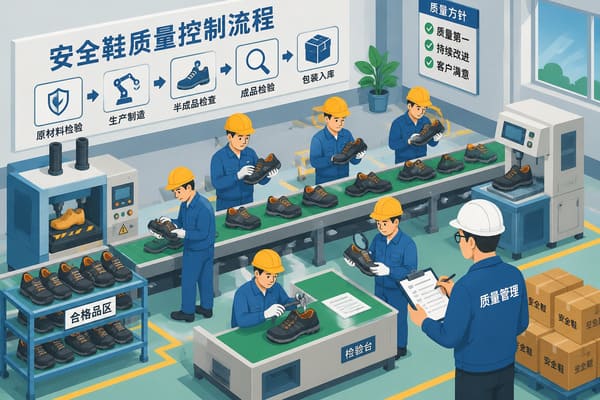
I’ve been making safety shoes for over 15 years. In that time, I’d say 70% of the quality problems I’ve seen were decided at the sourcing stage — not on the floor. One buyer came to us after receiving 2,000 pairs from another factory. The steel toe caps failed impact testing. The shoes had a certificate printed on the box, but nobody had checked whether that certificate matched the actual product. They lost the entire shipment. The factory blamed the buyer for "not specifying clearly." That’s the game some factories play. If you want to understand how to protect yourself, the place to start is the sourcing process itself.
How Do You Check the Quality of Safety Shoes?
Most buyers only check quality at the end — when the goods are already packed and ready to ship. By that point, if something is wrong, you have very few options and very little time.
Quality checks for safety shoes should happen in three stages: before production (material spec confirmation), during production (in-line inspection), and after production (lab testing of finished goods). Skipping any one of these stages leaves a gap that factories can — and sometimes do — exploit.
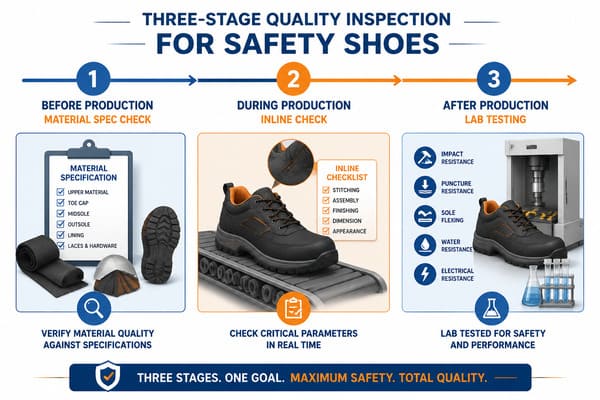
Stage 1 — Before Production: Lock In the Material Spec
Before a single pair is cut, you need a signed material spec sheet. This means the exact upper material with leather grade and thickness in millimeters, lining type, insole density, outsole rubber compound, and toe cap grade. If it’s not written down and signed off by both sides, the factory can substitute any material they want — and you have no ground to stand on when you raise a complaint.
Stage 2 — During Production: In-Line Inspection
An in-line inspection means sending someone to the factory floor when roughly 20% of the order is complete. At that point, check stitching tension, bonding pressure between the upper and sole, and toe cap placement. If something is wrong at 200 pairs, it can be fixed. At 2,000 pairs, it cannot.
Stage 3 — After Production: Lab Testing of Finished Goods
Pull 3 to 5 pairs from the finished batch and send them to an accredited lab. A standard EN ISO 20345 test costs around $250 to $4001. That is a very small number compared to the cost of a rejected shipment or a workplace accident caused by a shoe that doesn’t perform as labeled.
I had a client who approved samples visually and skipped lab testing entirely. The finished batch had outsoles that looked identical to the approved sample but used a different rubber compound. Slip resistance dropped by 40%2. He only found out when his end customer reported accidents on site. That is not a story I want any of my buyers to repeat.
| Inspection Stage | What to Check | Who Does It |
|---|---|---|
| Before production | Material spec sheet, signed by both parties | Buyer + factory |
| During production (at 20%) | Stitching, bonding, toe cap placement | QC inspector on-site |
| After production | Impact, compression, slip resistance, sole adhesion | Accredited lab (SGS, Intertek, TÜV) |
What Are the Most Common Quality Problems with Chinese Safety Shoes?
Not all quality problems look the same. Some show up in the first week. Others take a month. And some never get traced back to the factory at all — the end user just thinks the shoes are bad.
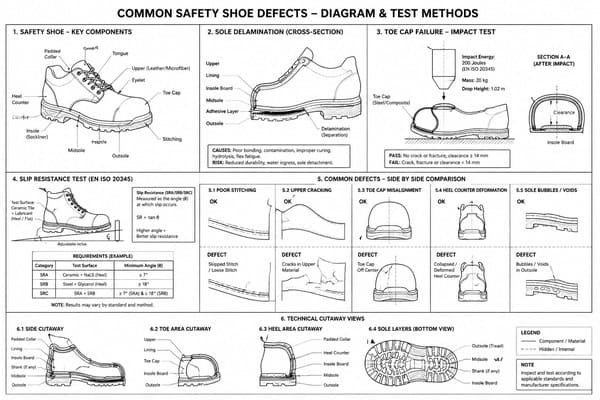
The five most common quality problems in Chinese safety shoes are: sole delamination, toe cap failure, slip resistance underperformance, odor and breathability failure, and inconsistent sizing across production batches. Each one has a specific root cause that can be identified and prevented before production begins.
Sole Delamination
The outsole separates from the upper within 4 to 8 weeks of use. This is almost always caused by rushing the bonding process. The adhesive used in PU-to-rubber bonds needs a full 24 hours to cure3. Some factories cut that to 6 hours to hit a shipment deadline. The shoe looks fine when it leaves the factory. It falls apart on the job site.
Toe Cap Failure
The cap doesn’t meet the 200-joule impact rating4 printed on the label. I have personally tested competitor samples where the cap was a cheaper grade, substituted after the certified sample was approved. The certificate on the box was real. The product inside was not the one that was certified.
Slip Resistance Underperformance
The outsole pattern looks correct, but the rubber hardness is wrong. A proper anti-slip outsole should be Shore A 55 to 655. Some factories push the hardness up to Shore A 75 to reduce material cost. The shoe lasts longer in terms of wear, but it grips like plastic on a wet floor.
Odor and Breathability Failure
This is the number one end-user complaint we hear. A cheap non-woven lining absorbs sweat but traps it. After 30 days of daily wear, the shoe becomes unwearable. We switched to moisture-wicking mesh lining across all our standard models three years ago specifically because of this feedback from buyers in the Middle East and Southeast Asia.
Inconsistent Sizing Across Batches
The sample fits perfectly. But in a 1,000-pair order, 15 to 20% of pairs are 3 to 5mm off the approved last6. This happens when factories use multiple lasts during peak season without rechecking calibration between runs.
| Problem | Root Cause | Prevention |
|---|---|---|
| Sole delamination | Shortened adhesive cure time | Spec minimum cure time in contract |
| Toe cap failure | Material substitution after sample approval | Lab test finished goods, not just samples |
| Slip resistance failure | Wrong rubber hardness (Shore A too high) | Specify Shore A range in material spec |
| Odor/breathability | Cheap non-woven lining | Specify lining type and moisture performance |
| Sizing inconsistency | Uncalibrated lasts during peak production | Request last calibration records |
The root cause behind almost all of these problems is the same. A factory accepted a price that didn’t support the right materials or the right process time, and then quietly cut corners to protect their margin. The buyer never knew what they agreed to — because nothing was written down in enough detail.
How Do You Verify a Chinese Safety Shoe Manufacturer Before Placing an Order?
Most buyers ask for a product catalog and a price list. That tells you almost nothing about whether a factory can actually deliver what they’re promising.
To verify a Chinese safety shoe manufacturer, you need to complete four steps: a factory audit, lab testing of their sample, a direct reference check with existing clients, and a review of their recent production records. Most buyers skip three of these four steps — and that’s where the risk comes in.
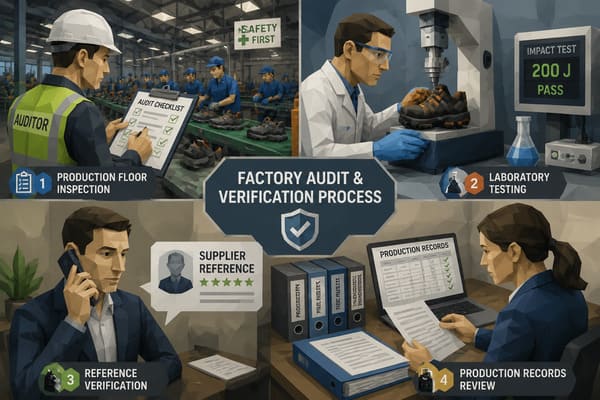
Step 1 — Factory Audit
This can be done in person or through a third-party agency like SGS or Bureau Veritas7. When you audit a factory, you are looking for four things. First, production capacity — how many pairs per day can they actually produce, not what they tell you on paper. Second, QC staffing — a serious factory has at least 2 to 3 dedicated quality control people on the floor, not one person checking finished boxes at the end of the line. Third, machinery age and maintenance records. Fourth, whether they actually manufacture safety shoes or just assemble bought-in components. A factory with 20 workers and 3 sewing machines cannot complete a 3,000-pair order in 30 days. I have seen buyers get promised exactly that, then wait 90 days for half the order.
Step 2 — Lab-Tested Sample
Do not approve samples visually. Take the sample they send you and submit it to an accredited lab — SGS, Intertek, or TÜV. Run the key tests from EN ISO 20345 or ASTM F2413: impact resistance, compression, slip resistance, and sole adhesion. Budget around $300. It is the cheapest insurance you will ever buy in this business.
Step 3 — Client Reference Check
Ask for two or three existing export clients and contact them directly. Not logos on a website — actual buyers with names and contact information you can reach. Ask them three things: Did the first production order match the approved sample? Were there any quality claims? How did the factory respond when there was a problem? One honest conversation with an existing client tells you more than ten factory visits.
Step 4 — Production Trail Review
Ask the factory for their last three production orders: what product, what quantity, what delivery date, and did they ship on time. A factory that is proud of their track record will show you this in 10 minutes. A factory that hesitates has something to hide.
I went through all four of these steps myself when I was building Shoegan’s raw material supplier base. The suppliers that passed all four steps are still working with us today. The ones that failed at step 2 or step 3 — we never worked with again.
What Certifications Should a Reliable Safety Shoe Supplier Have?
Certifications are one of the most important trust signals in this industry. They are also one of the most commonly faked or misrepresented documents you will encounter.
A reliable safety shoe supplier should hold EN ISO 20345 for European markets8, ASTM F2413 for North America9, AS/NZS 2210.3 for Australia and New Zealand10, GSO 2233 for the Gulf region11, and ISO 9001 for overall quality management12. Each certificate must be independently verified — not just accepted at face value.
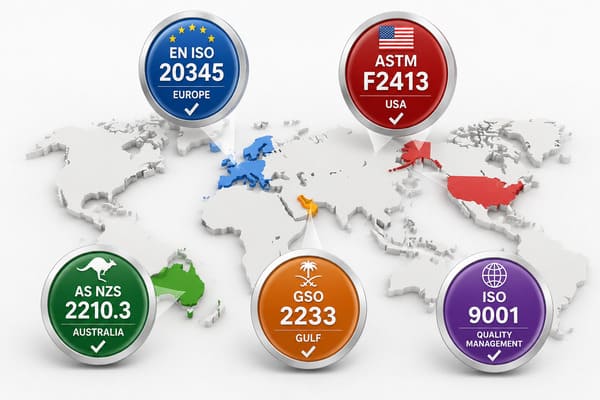
Why Verification Matters More Than the Certificate Itself
I have personally seen a factory present an EN ISO 20345 certificate that was issued four years ago for a specific model — and then apply it to a completely different product made with different materials. The certificate number was real. The product it covered was not the one being sold. A buyer importing into Germany nearly had their entire stock seized at customs because of this.
The Five Certifications That Matter
| Certification | Market | What It Covers |
|---|---|---|
| EN ISO 20345 | Europe (CE marking required) | Full safety performance standard for protective footwear |
| ASTM F2413 | USA and Canada | Impact, compression, and optional electrical protection |
| AS/NZS 2210.3 | Australia and New Zealand | Local performance requirements for safety footwear |
| GSO 2233 | Gulf Cooperation Council | Regional standard for PPE including safety shoes |
| ISO 9001 | Global | Factory-level quality management system |
How to Verify a Certificate in 5 Minutes
Every legitimate certification body — SGS, Intertek, TÜV, Bureau Veritas — has an online portal where you can enter a certificate number and confirm that it is valid, current, and covers the exact product you are ordering. This takes five minutes. If a supplier refuses to give you the certificate number for independent verification, stop the conversation there. That is not a supplier you want to work with.
At Shoegan, we hold all five of the certifications listed above. I send them proactively with every serious inquiry — including the certificate numbers — because if I were the buyer, that is exactly what I would want to see before I trusted anyone with my order.
Conclusion
Quality problems in safety shoe sourcing are almost always preventable. The right spec, the right checks, and the right supplier make all the difference. At Shoegan, we build every pair to protect the people wearing them — and every partnership to protect the buyers who trust us.
-
"EN ISO 20345:2021 – Safety Footwear", https://pacificcert.com/iso-20345-safety-footwear-standard/. Accredited testing bodies such as SGS, Intertek, and TÜV publish indicative fee schedules for PPE footwear testing; costs vary by test scope and laboratory location, with basic EN ISO 20345 assessments typically falling within a few hundred USD. Evidence role: general_support; source type: institution. Supports: Approximate cost range for third-party laboratory testing of safety footwear against EN ISO 20345. Scope note: Published fee schedules may not reflect negotiated or regional pricing and should be treated as indicative rather than definitive figures. ↩
-
"Development of a High Slip-resistant Footwear Outsole Using …", https://pmc.ncbi.nlm.nih.gov/articles/PMC4246531/. Studies on footwear tribology demonstrate that outsole compound composition is a primary determinant of measured coefficient of friction; substitution of rubber formulations with differing hardness or surface energy characteristics can produce substantial changes in slip resistance test results under EN ISO 13287 or equivalent protocols. Evidence role: mechanism; source type: paper. Supports: The sensitivity of footwear slip resistance measurements to outsole rubber compound composition. Scope note: The 40% reduction cited is a specific anecdotal case; actual variation depends on the compounds compared, test surface, and contamination conditions. ↩
-
"Single side adhesives-PUR in footwear manufacturing industry", https://next.henkel-adhesives.com/us/en/articles/3-reasons-to-use-single-side-adhesives.html. Adhesive chemistry literature documents that polyurethane-based bonding systems used in footwear assembly require adequate cure time to achieve full bond strength; premature mechanical stress before full cure is a recognised cause of delamination failure. Evidence role: mechanism; source type: research. Supports: Required cure time for polyurethane adhesives used in footwear sole bonding and consequences of premature loading. Scope note: Exact cure times depend on adhesive formulation, ambient temperature, and humidity; the 24-hour figure cited is a general guideline and may differ by product. ↩
-
"[PDF] ASTM F2413-11 Performance Requirements for Protective Footwear", https://facilities.uw.edu/partner-resources/files/media/performance-requirements-for-protective-footwear.pdf. EN ISO 20345:2011 specifies that safety footwear toe caps must withstand an impact energy of 200 joules without the clearance falling below defined limits, establishing the benchmark referenced in product labelling and certification. Evidence role: definition; source type: institution. Supports: The 200-joule impact energy requirement for protective toe caps in safety footwear standards. Scope note: ASTM F2413 uses different units and test methodology; the 200-joule figure applies specifically to the EN ISO framework and should not be assumed equivalent across all markets. ↩
-
"Development of a High Slip-resistant Footwear Outsole Using …", https://pmc.ncbi.nlm.nih.gov/articles/PMC4246531/. Research on footwear tribology indicates that outsole rubber hardness significantly influences coefficient of friction on wet surfaces, with softer compounds generally providing superior grip; the specific Shore A 55–65 range cited reflects common industry practice rather than a single codified standard. Evidence role: mechanism; source type: paper. Supports: Relationship between rubber Shore A hardness and slip-resistance performance in footwear outsoles. Scope note: The precise hardness range may vary across manufacturers and test conditions; no single international standard mandates this exact range. ↩
-
"6 Common Quality Control Problems in Shoes and How to …", https://www.tradeaiders.com/6-common-quality-control-problems-in-shoes-and-how-to-fix-them.html. Footwear manufacturing literature identifies last calibration as a critical process control variable; dimensional variation between lasts used across production runs is a documented source of sizing inconsistency in batch footwear production. Evidence role: general_support; source type: research. Supports: Sizing inconsistency as a recognised quality defect in footwear manufacturing linked to last calibration practices. Scope note: The specific figures of 15–20% deviation rate and 3–5mm tolerance cited in the article are the author’s experiential estimates and are not drawn from a published study. ↩
-
"Bureau Veritas", https://en.wikipedia.org/wiki/Bureau_Veritas. SGS and Bureau Veritas are among the largest internationally operating testing, inspection, and certification companies; both hold accreditations under ISO/IEC 17020 for inspection body activities and conduct supplier audits across manufacturing sectors including PPE and footwear. Evidence role: general_support; source type: institution. Supports: SGS and Bureau Veritas as internationally accredited inspection and certification bodies conducting factory audits. Scope note: Accreditation scope varies by national accreditation body and service line; buyers should confirm that the specific audit programme offered is accredited for the relevant standard or market. ↩
-
"CE marking for PPE footwear", https://www.ctcgroupe.com/en/expertise-and-services/ppe/certification/ce-marking/footwear-657-1.html. Under EU Regulation 2016/425 on personal protective equipment, safety footwear classified as Category II or III PPE must bear CE marking, with EN ISO 20345 serving as the principal harmonised standard defining performance requirements for protective footwear. Evidence role: definition; source type: government. Supports: EN ISO 20345 as the harmonised standard underpinning CE marking requirements for safety footwear sold in the European Economic Area. Scope note: Harmonised standard status is subject to periodic review and publication in the Official Journal of the EU; buyers should confirm current harmonisation status at time of import. ↩
-
"1910.136 – Foot protection. | Occupational Safety and …", http://www.osha.gov/laws-regs/regulations/standardnumber/1910/1910.136. ASTM F2413, published by ASTM International, establishes minimum performance requirements for protective footwear in the United States; OSHA’s PPE regulations reference consensus standards including ASTM F2413 as the basis for employer footwear selection obligations. Evidence role: definition; source type: government. Supports: ASTM F2413 as the standard governing protective footwear performance requirements referenced by OSHA in the United States. Scope note: Canada has its own CSA Z195 standard for protective footwear; ASTM F2413 is not universally mandated across all Canadian jurisdictions. ↩
-
"Safety Standards for our Footwear – Hard Yakka Australia", https://www.hardyakka.com/au/Safety-Standards.html?srsltid=AfmBOorMZrwVHa1VGu0TYbVXWFw1C2Rsves16LWj4bAfmgORkCSehPmc. AS/NZS 2210.3 is published jointly by Standards Australia and Standards New Zealand and specifies performance requirements for occupational protective footwear; it is referenced in workplace health and safety regulations across both countries as the basis for footwear selection in hazardous environments. Evidence role: definition; source type: institution. Supports: AS/NZS 2210.3 as the joint Australian and New Zealand standard for safety footwear performance requirements. Scope note: Regulatory enforcement is administered separately by Safe Work Australia and WorkSafe New Zealand; mandatory compliance requirements may differ by industry sector and jurisdiction. ↩
-
"1910.136 – Foot protection. | Occupational Safety and …", http://www.osha.gov/laws-regs/regulations/standardnumber/1910/1910.136. GSO 2233 is published by the Gulf Standards Organization (GSO), the standardisation body of the Gulf Cooperation Council, and establishes performance requirements for personal protective footwear sold in GCC member states; it is broadly aligned with international PPE footwear standards. Evidence role: definition; source type: institution. Supports: GSO 2233 as the Gulf Cooperation Council regional standard for safety footwear. Scope note: Enforcement and market surveillance of GSO standards varies by GCC member state; buyers should confirm current import requirements with the relevant national authority. ↩
-
"ISO 9001:2015(en), Quality management systems — Requirements", https://www.iso.org/obp/ui/#iso:std:iso:9001:ed-5:v1:en. ISO 9001, published by the International Organization for Standardization, specifies requirements for a quality management system that organisations can use to demonstrate consistent ability to provide products meeting customer and regulatory requirements; certification is awarded by accredited third-party bodies following audit. Evidence role: definition; source type: institution. Supports: What ISO 9001 certification covers and its role as a quality management system standard for manufacturing organisations. Scope note: ISO 9001 certifies the management system, not the product itself; a certified factory may still produce non-conforming goods if process controls are inadequate. ↩