
Buyers often focus on the shoe itself and treat packaging as an afterthought. That is a mistake that costs real money — in damaged goods, failed brand impressions, and lost repeat orders.
Customizing safety shoe packaging means choosing the right box material for shipping durability, printing your logo with accurate color reproduction, and understanding how MOQ and SKU count affect your cost per pair. Done right, packaging protects your product and sells your brand1.
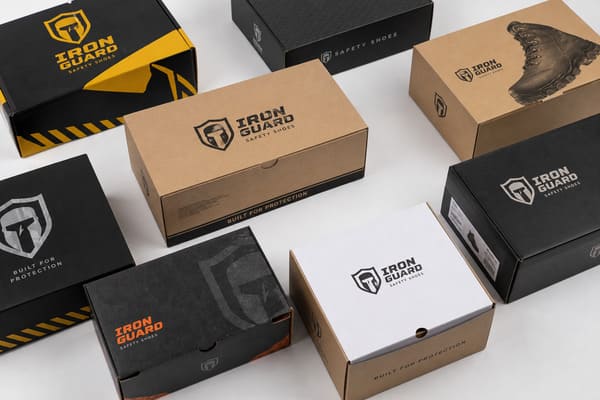
I have been working in safety shoe manufacturing for over 20 years. In that time, I have seen packaging decisions save orders and destroy them. The sections below break down every part of the customization process — material, print, MOQ, and cost — so you can make the right call before you place your order.
What Packaging Materials Are Available for Safety Shoe Boxes?
Most buyers pick a box style without knowing what the box will go through. A safety shoe pair weighs between 1.2 and 1.8 kilograms2. Six pairs per carton puts you over 10 kilograms per box3 before you even add the carton weight itself.
For safety shoes, the outer carton should use five-layer B/C corrugated board with an edge crush strength of at least 12 kgf4. The inner box can be kraft paper for industrial distribution or rigid paperboard for retail and e-commerce channels5. Material choice directly controls your cargo damage rate.
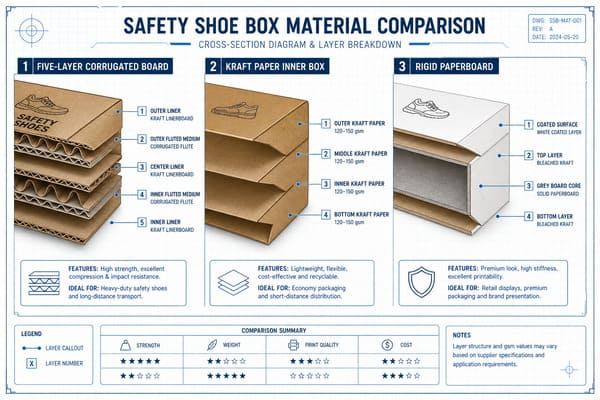
I once saw a buyer ship an order to Rotterdam using standard double-wall cartons to save cost. The bottom layer of every pallet collapsed under the weight. The uppers deformed. The buyer demanded compensation. That buyer saved $0.40 per pair on packaging. The final loss from compensation and reshipping was nearly 20 times that difference. That experience set our standard for all ocean freight orders: five-layer B/C corrugated outer carton, no exceptions.
The inner box is a separate decision and depends on where your shoe is sold. Here is how I break it down for every new client:
Inner Box Material by Sales Channel
| Sales Channel | Recommended Inner Box | Reason |
|---|---|---|
| Industrial distributor / B2B | Kraft paper inner box | Functional, low cost, buyers do not care about unboxing |
| Retail shelf | Rigid paperboard inner box | Shelf presence, brand visibility, cleaner look |
| E-commerce | Rigid paperboard inner box | Unboxing experience matters, reduces return rate6 |
| Gift or premium retail | Rigid gift box with insert | First impression is the product, packaging must match |
The outer carton protects your cargo. The inner box communicates your brand. These are two different jobs, and they need two different decisions. Choosing the wrong material for either one creates a problem — either at the port or at the point of sale. I always ask clients to confirm their sales channel before we finalize any packaging spec, because the same shoe going to a construction site wholesaler and a retail chain needs completely different inner packaging, even if the product inside is identical.
Can You Print Your Logo and Brand Colors on Safety Shoe Packaging?
Many factories say yes to custom printing without telling you the real limitation. The limitation is not whether they can print your logo. It is whether they can reproduce your brand color accurately.
Yes, logos and brand colors can be printed on safety shoe packaging using offset printing with Pantone color matching7. Digital printing is available but has a narrower color gamut. For brand-critical colors, always request a physical sample proof before approving production.
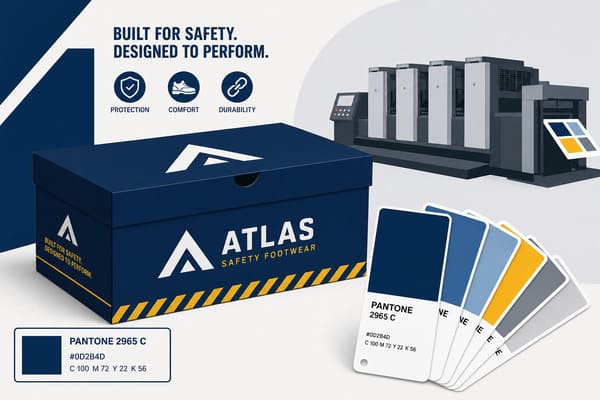
I had a client in Germany whose brand color was Pantone 281C — a cold, deep navy blue. The first sample came back visibly green. Their brand manager emailed immediately: "This is not our color. We cannot accept this." We had used digital printing. The color gamut was not wide enough to hit that specific Pantone value. We switched to offset printing, matched against the physical Pantone swatch, and the second sample was approved. That experience changed how I handle every custom packaging inquiry.
Now the first question I ask any client is: do you have a Pantone number? If a client sends only an image file and no Pantone reference, color deviation is not a risk — it is a certainty.
Printing Method Comparison for Safety Shoe Packaging
| Printing Method | Color Accuracy | Best For | Cost Level |
|---|---|---|---|
| Offset printing | High, Pantone-matchable | Brand-critical colors, large runs | Medium |
| Digital printing | Medium, screen-dependent | Simple logos, small runs | Low |
| Screen printing | Medium-high | Single or two-color designs | Low-medium |
| Hot stamping (foil)8 | Not color-based | Gold/silver accent details | Medium-high |
The rule I follow is simple. If your brand has a specific Pantone color that your customers recognize, use offset printing and demand a physical sample before you approve anything. If your logo is a simple one-color mark and color precision is not critical, digital printing is fine and cheaper. Color management is where you separate suppliers who can really do custom work from suppliers who just say they can.
What Is the Minimum Order Quantity for Custom Branded Packaging?
The MOQ question sounds simple. It is not. The number matters less than how many SKUs you are splitting it across.
Our minimum order quantity for custom branded packaging is 500 pairs, tied to the shoe order. Packaging is not sold separately. If you are ordering multiple styles, each style requires its own print setup fee, which typically ranges from 800 to 1,500 RMB per design set9 and adds to your per-pair cost.
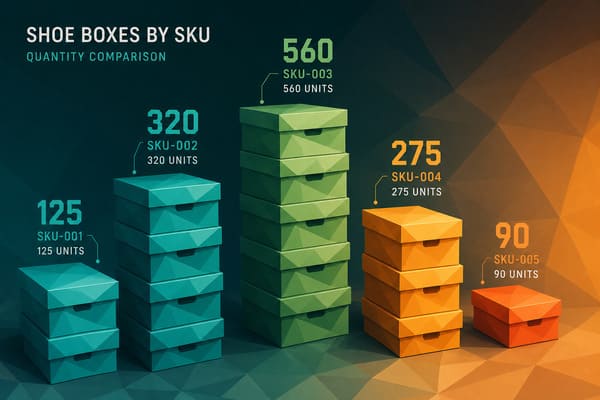
Here is where most new buyers make a calculation error. They think 500 pairs is the threshold, and once they hit it, the cost is fixed. But if you have five styles at 100 pairs each, you pay five separate setup fees. At 800 to 1,500 RMB per setup, five styles cost you 4,000 to 7,500 RMB in fixed print costs before a single box is made. Spread across 500 pairs, that alone adds 15% to 30% to your per-pair packaging cost compared to running one style at 500 pairs.
I had a client from the Middle East who wanted to launch six styles in his first order. I told him to start with two. His strongest two styles, the ones he was most confident about. Get those to market, see what sells, then expand. He followed that advice. His first shipment sold through. When he came back for a repeat order, he added three new styles with confidence — and by then his volume per style was higher, so the setup cost per pair was lower.
How SKU Count Affects Packaging Cost Per Pair
| Number of Styles | Total Pairs | Setup Fee (est.) | Setup Cost Per Pair |
|---|---|---|---|
| 1 style | 500 pairs | 800–1,500 RMB | 1.6–3.0 RMB |
| 3 styles | 500 pairs | 2,400–4,500 RMB | 4.8–9.0 RMB |
| 5 styles | 500 pairs | 4,000–7,500 RMB | 8.0–15.0 RMB |
| 5 styles | 2,500 pairs | 4,000–7,500 RMB | 1.6–3.0 RMB |
The MOQ is a quantity floor. SKU concentration is a cost management decision. If you are launching a new brand, fewer styles at higher volume per style is almost always the smarter move for your first order.
Does Custom Packaging Add a Lot to the Cost Per Pair?
The honest answer is: it depends on which tier you choose. Custom packaging is not one price. It is a range, and the range is wide.
Custom safety shoe packaging typically adds between $0.20 and $3.00 per pair depending on the box type, print complexity, and finish. A single-color kraft box adds almost nothing. A full-color rigid box with foil stamping adds $2 to $3. Most brand clients choose the mid-tier option at $0.80 to $1.20 per pair.
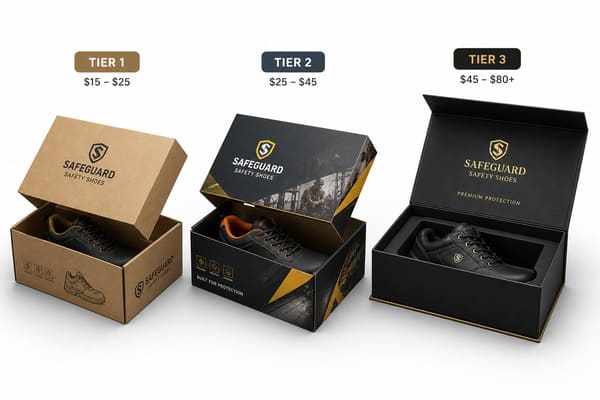
I break the cost structure into three tiers for every client who asks. This makes the decision concrete instead of abstract.
Custom Packaging Cost Tiers
| Tier | Spec | Added Cost Per Pair | Best For |
|---|---|---|---|
| Tier 1 | Kraft inner box + single-color logo print | $0.20–$0.40 | Industrial distributors, B2B wholesale |
| Tier 2 | Full-color print + matte lamination10 | $0.80–$1.20 | Brand owners, retail channel |
| Tier 3 | Rigid gift box + foil stamping + inner insert | $2.00–$3.00 | Premium retail, gift channel |
I had a client in Australia who came to me wanting Tier 3 — the full rigid gift box with foil. I sent them the cost breakdown. They switched to Tier 2 and used the savings to upgrade the outsole material on the shoe itself. That was the right call for their market. Their shoes were sold through industrial safety distributors, not gift shops. The packaging did not need to be the hero.
My general rule is this: if your shoe is sold on a job site or through a wholesale catalog, keep packaging simple and put your budget into the product. If your shoe is sold on a retail shelf or through e-commerce, the box is the first thing the buyer sees. It is your first salesperson. That investment is worth making.
Conclusion
Custom packaging is a real business decision — material, print quality, SKU count, and cost tier all affect your margin and your brand. Choose based on your sales channel, not just your budget. At Shoegan, we help brand owners build packaging that protects the product and represents the brand — from the first sample to the final shipment.
-
"Package design as a branding tool in the cosmetic industry – PMC – NIH", https://pmc.ncbi.nlm.nih.gov/articles/PMC9123395/. Marketing and packaging science literature consistently identifies two primary functions of product packaging: a utilitarian function encompassing physical protection and logistics efficiency, and a communicative function encompassing brand identity, consumer information, and purchase influence at point of sale. Evidence role: expert_consensus; source type: research. Supports: The established dual function of product packaging as both a physical protective system and a brand communication vehicle. Scope note: The relative weight of each function varies by product category and sales channel; the claim is well-supported as a general principle but the specific commercial impact depends on context. ↩
-
"Steel-toe boot", https://en.wikipedia.org/wiki/Steel-toe_boot. Industry standards bodies and footwear testing organizations document typical safety shoe weight ranges, which inform carton load calculations for shipping compliance. Evidence role: statistic; source type: institution. Supports: Typical weight range of safety footwear per pair in kilograms. Scope note: Weight varies significantly by construction type (steel toe vs. composite toe) and upper material; a single range may not represent all safety shoe categories. ↩
-
"Section 6 – Carton Packing, Packaging, Labeling, Shipping …", https://www.footlocker-inc.com/content/dam/flincfoundation/footlockerinc_documents/vms/europe/2022/2024-Section-06.pdf. Freight and logistics guidelines for footwear exports document common master carton configurations, with gross weights for safety footwear cartons frequently exceeding 10 kg when packed at six pairs per carton, a factor relevant to carton compression strength requirements. Evidence role: general_support; source type: institution. Supports: Standard packing configurations and resulting gross weights for safety footwear export cartons. Scope note: Actual carton weight depends on shoe weight, inner packaging materials, and carton board weight; the 10 kg figure is an approximation based on the weight range cited in the article. ↩
-
"Mullen Test vs. Edge Crush Test Boxes", https://crownpack.com/wp-content/uploads/2023/11/Crown-Packaging-Mullen-vs-ECT-Whitepaper.pdf. Standards such as ISO 3037 and TAPPI T 811 define edge crush resistance testing for corrugated fibreboard, providing the technical basis for specifying minimum ECT values in shipping carton design. Evidence role: definition; source type: institution. Supports: Edge crush test (ECT) methodology and performance thresholds for corrugated board used in shipping cartons. Scope note: The 12 kgf threshold cited in the article is a supplier-specific recommendation; applicable standards define test methods rather than prescribing minimum values for specific cargo types. ↩
-
"Shoe Box Dimensions: Everything You Need to Know About Sizing", https://custompackaginghouse.com/shoe-box-dimensions/?srsltid=AfmBOoqKbhF7PWe2Z0zE6-rfv6XBPbqyqkKyDv13ts-tVj-MZqBShiSk. Packaging industry associations and retail supply chain guidelines recognize rigid paperboard construction as a standard for consumer-facing footwear packaging, citing its structural integrity for shelf display and its role in communicating brand quality at point of sale. Evidence role: general_support; source type: institution. Supports: Use of rigid paperboard packaging in retail and e-commerce footwear channels as an industry norm. Scope note: This reflects general industry practice rather than a mandatory standard; channel requirements vary by retailer and market. ↩
-
"The Effects of Return Policies in E-commerce", https://www.colorado.edu/economics/sites/default/files/attached-files/newberry.pdf. Research on e-commerce logistics has found that inadequate protective packaging is a contributing factor to product damage during transit, which is among the leading causes of customer-initiated returns in online retail. Evidence role: general_support; source type: research. Supports: The relationship between packaging quality and e-commerce product return rates. Scope note: The article conflates two distinct mechanisms—damage prevention and unboxing experience—as joint drivers of return reduction; evidence is stronger for the damage-prevention pathway than for unboxing experience alone. ↩
-
"[PDF] Accurately Reproducing Pantone Colors on Digital Presses", https://digitalcommons.calpoly.edu/cgi/viewcontent.cgi?article=1084&context=grcsp. Pantone LLC’s color matching system documentation describes how spot color inks used in offset lithography reproduce specific Pantone values more reliably than process-color digital printing, which is constrained by CMYK gamut limitations. Evidence role: mechanism; source type: institution. Supports: How offset printing achieves Pantone spot color accuracy compared to digital printing processes. Scope note: Color accuracy in offset printing also depends on substrate, ink density, and press calibration; the comparison is directionally supported but not absolute. ↩
-
"Hot stamping", https://en.wikipedia.org/wiki/Hot_stamping. Printing and packaging industry references define hot foil stamping as a dry printing process in which a heated die presses metallic or pigmented foil onto a substrate, transferring a decorative layer without ink; it is commonly used for premium accent details on folding cartons and rigid boxes. Evidence role: definition; source type: other. Supports: The hot stamping process as applied to paperboard packaging for metallic accent decoration. Scope note: The article’s characterization of hot stamping as ‘not color-based’ is a simplification; pigmented (non-metallic) foils are available in a range of colors, though metallic gold and silver are the most common commercial applications. ↩
-
"Custom Packaging from China: Why It Still Works Post …", https://baysourceglobal.com/custom-packaging-china-tariffs-2025/. Trade sourcing platforms and packaging industry cost guides document setup or plate fees charged by Chinese manufacturers for custom offset printing, which vary based on number of colors, plate type, and supplier tier. Evidence role: statistic; source type: other. Supports: Typical print plate or setup fee ranges charged by Chinese packaging manufacturers for custom box printing. Scope note: The 800–1,500 RMB range reflects one supplier’s pricing and may not represent the broader market; fees vary with print complexity, number of colors, and supplier scale. ↩
-
"Comparing Matte vs Gloss Lamination for Packaging", https://pakfactory.com/blog/matte-vs-gloss-lamination?srsltid=AfmBOopbjdEmNJf5T0yCPnwcrlJ7rNlOVfOGx-wwDK0lHleUfMbFqPmX. Packaging industry references describe matte lamination as a thin polymer film applied to printed paperboard surfaces, providing scuff resistance, moisture barrier properties, and a non-reflective finish that is widely used in mid-range consumer product packaging for its perceived premium aesthetic. Evidence role: definition; source type: other. Supports: Properties and common applications of matte lamination as a packaging surface finish. Scope note: Performance characteristics vary by laminate thickness and adhesive type; the description reflects general industry use rather than a specific tested standard. ↩