Most buyers focus on price. But the real risk is not overpaying — it is receiving 3,000 pairs of shoes that fail your country’s certification test.
Choosing a safety shoe manufacturer in China means finding a supplier who holds the right certifications for your market, can produce consistent quality at scale, and will not substitute materials to cut costs. Price matters, but compliance and production integrity matter more.
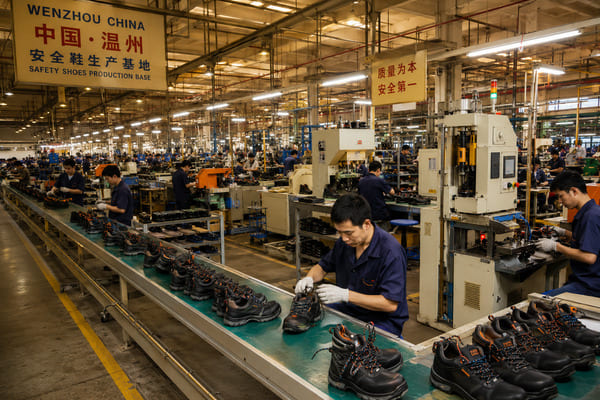
One of my clients came to me after a very expensive mistake. They had ordered from a cheaper supplier. The shoes arrived, failed the EN ISO 20345 impact test, and they could not sell a single pair. The certification papers looked real. The test reports were not. That mistake cost them over $18,000 and a four-month delay. I have been in this industry for over 20 years. I started on a factory floor in Wenzhou in my early 20s. What I have learned is that choosing a manufacturer is really about choosing someone who can protect you from that kind of loss.
How Do You Find Shoe Manufacturers in China?
Everyone says go to Alibaba or the Canton Fair. Those are not wrong places to start — but most buyers do not know what they are actually looking at.
China’s safety shoe industry is heavily concentrated in Wenzhou, Zhejiang Province. Over 60% of China’s safety footwear exports come from this region1. If a supplier claims to be a Wenzhou manufacturer but lists a Guangzhou or Yiwu address, the shoes are probably not made where you think they are.
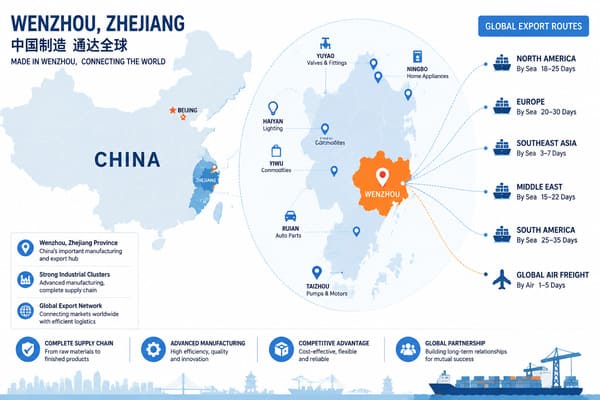
I grew up in this industry in Wenzhou. I know the production clusters, the real material suppliers, and which factories actually control their own production lines. When a buyer tells me they found a "Wenzhou manufacturer" but the address is somewhere else entirely, that is the first question I ask: where are the shoes actually made?
Here is what to check when you are evaluating a supplier’s location and production claims:
How to Verify a Manufacturer’s Production Capability
| What to Check | What a Real Manufacturer Can Show You |
|---|---|
| Factory address | Matches the business license and export records |
| Production photos | Show actual machinery, not stock images |
| Business license | Lists manufacturing as the registered business type |
| Export records | Verifiable shipment history to your target market |
| Third-party audit | Welcomes SGS, Bureau Veritas, or buyer-sent inspectors |
Trading companies are not always a problem — but they should not be presented as manufacturers. A trading company does not control material sourcing, production scheduling, or quality checks on the line2. When something goes wrong, they cannot fix it. They can only pass your complaint to someone else. At Shoegan, we own our production. When a client has a question about midsole material or outsole compound, I can answer it directly, because I built the specifications myself.
Which Company Is Best for Safety Shoes?
There is no single best company for safety shoes. There is only the right match for your specific market — and that starts with certifications.
The right safety shoe manufacturer holds the certifications required for your target market: EN ISO 20345 for Europe3, ASTM F2413 for the US4, AS/NZS 2210 for Australia and New Zealand5, and GSO for the Gulf region6. These standards are not interchangeable, and one certificate does not cover all markets.
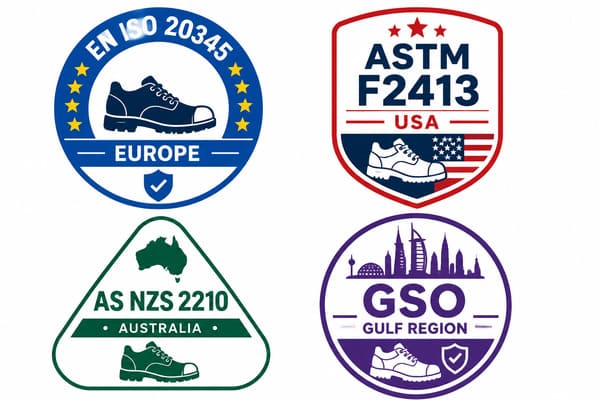
I had a client in Australia who came to me after buying from a supplier that held EN ISO 20345 certification. The shoes looked fine. But Australia requires AS/NZS 2210, and those are different standards with different test requirements. The entire order was non-compliant. When I speak with a new buyer, the first thing I ask is: what country are you selling into?
Certification Requirements by Market
| Target Market | Required Standard | Key Test Body Examples |
|---|---|---|
| Europe | EN ISO 20345 | SGS, Intertek, TÜV, Bureau Veritas |
| United States | ASTM F2413 | SATRA, SGS, Intertek |
| Australia / New Zealand | AS/NZS 2210 | SATRA, SAI Global |
| Gulf / Middle East | GSO | Accredited Gulf-recognized labs |
| China (domestic) | GB 12011 | CNAS-accredited labs |
A manufacturer who understands your market will ask you these questions before you have to ask them. At Shoegan, we hold EN ISO 20345, ASTM F2413, AS/NZS 2210, GSO, and GB 12011. When a buyer comes to us, we already know which documents their shipment will need before it leaves Wenzhou.
What Should You Look for in a Chinese Safety Shoe Manufacturer?
Most buyers evaluate price and delivery time. But there are three things that actually predict whether a supplier will cause you problems — and most buyers never check them.
Look for verifiable test reports from internationally recognized labs, production consistency across a full bulk order run, and a supplier who can answer specific technical questions about every product they make. These three things separate real manufacturers from companies that just look like manufacturers.
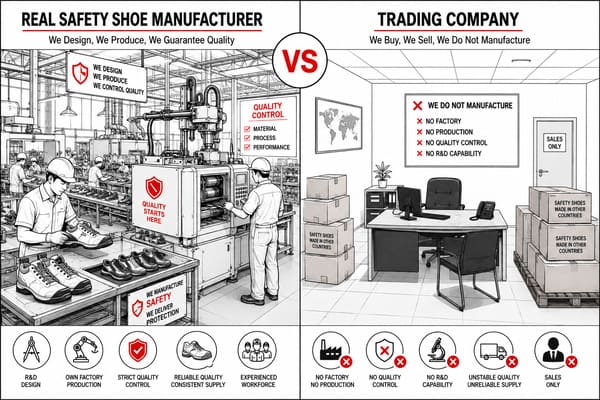
I have seen each of these three issues cause a real problem for a buyer. Here is what each one means in practice.
Three Things That Separate Real Manufacturers from the Rest
Test reports, not just certificate photos. A client once sent me a photo of a certificate they received from their previous supplier. It looked legitimate. But the issuing body was a domestic Chinese testing organization with no international recognition. For EN ISO 20345, you need test reports from accredited labs — SGS, Intertek, Bureau Veritas, TÜV. Ask for the actual report, not just the certificate image. The report will show the test date, the exact shoe model, and the specific test results. If a supplier cannot produce that document, stop there.
Sample quality versus production consistency. Almost every factory can make a good sample. The real question is whether pair number 2,800 looks and performs the same as pair number one. Ask for a production sample pulled from an actual bulk order run — not a handmade showroom sample. One of my long-term clients, a distributor in Germany, told me the reason they have stayed with us for six years is because our 500th pair is the same as our first. That consistency comes from controlling the production line directly.
Technical answers to technical questions. This filters out most bad suppliers immediately. Ask them: what is the midsole material, and what is its puncture resistance rating? What is the outsole compound, and what slip resistance standard does it meet? If the answer is vague — "good quality," "standard material" — that tells you they do not control their own production. I can answer those questions for every SKU we make.
| Question to Ask | What a Weak Answer Sounds Like | What a Strong Answer Sounds Like |
|---|---|---|
| Midsole material? | "Good quality, standard" | "Anti-puncture steel plate, meets EN ISO 20345 Level 1 (1100N)" |
| Outsole compound? | "Rubber, slip resistant" | "Nitrile rubber, meets SRC rating under EN ISO 203457" |
| Toe cap spec? | "Steel toe, 200J" | "Steel toe cap, 200J impact / 15kN compression, tested by SGS" |
| Certification lab? | "We have certificate" | "Test report from Intertek, report number available on request" |
What Are the Red Flags When Sourcing Safety Shoes from China?
Some red flags are easy to spot. Others look completely normal until your goods arrive and fail inspection. I have seen all of these happen — some to clients before they found me, some I caught before they became real problems.
The most common red flags when sourcing safety shoes from China include unverifiable certifications, prices that cannot support compliant materials, refusal to allow factory audits, vague answers on OEM customization, and no experience with your import market’s documentation requirements.
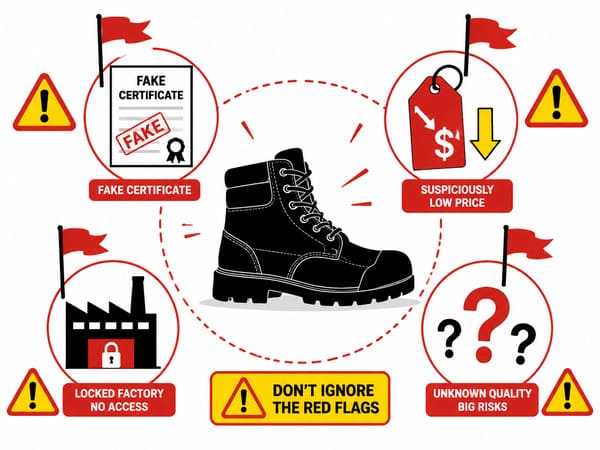
Here is what each of these looks like in practice, and why each one matters.
Red Flags and What They Actually Mean
"We have all certifications." Real certifications cost between $5,000 and $15,000 per standard to obtain8, plus ongoing renewal fees. If a supplier claims to hold EN, ASTM, AS/NZS, and GSO with no hesitation and no documentation delay, ask for all four sets of test reports at once. You will find out very quickly what is real and what is a scanned copy from another product.
The price is 20–30% below market. Safety shoe materials have a floor cost. A steel toe cap that meets EN ISO 20345 impact requirements costs a specific amount. A puncture-resistant midsole plate has a minimum material specification. If the price does not support those materials, something was substituted9. I once saw a competitor’s shoe with a toe cap stamped "steel" that was actually a low-grade alloy. It deformed under the standard 200-joule impact test. The shoes were $4 cheaper per pair. They were also dangerous.
They will not allow a third-party factory audit. Every legitimate manufacturer welcomes audits. We have had clients send SGS auditors, Bureau Veritas inspectors, and their own sourcing teams to our facility. I personally walk them through the production floor. If a supplier delays, redirects, or makes excuses when you request an audit, the factory you are looking at in photos is probably not the factory making your shoes.
Vague answers on OEM customization. Real OEM capability means the supplier has a design team, a material sourcing network, and packaging options. When a buyer asks me whether we can make a shoe in their brand colors with their logo on the tongue and a custom box, my next message is a list of specific questions: Pantone number? Logo file format? Box dimensions? If a supplier just says "yes no problem" and asks for your deposit, they are going to figure it out later — at your expense.
No experience with your import market. DDP shipping to Europe or the Middle East involves customs classification, import duties, compliance documentation, and sometimes country-specific labeling requirements10. A factory that has never done this will create problems that cost you two to three weeks and unexpected fees. We have shipped DDP to Germany, the UAE, and Australia. I know what documents each market needs before the goods leave Wenzhou.
| Red Flag | Why It Matters | What to Do |
|---|---|---|
| Claims all certifications, no delay | Real certs take time and money to obtain | Request all test reports immediately |
| Price 20–30% below market | Materials were likely substituted | Ask for material specs and lab reports |
| Refuses factory audit | Factory in photos may not be real | Walk away or insist on third-party audit |
| Vague OEM answers | No real design or sourcing capability | Ask specific technical questions upfront |
| No DDP experience | Will cause customs and compliance delays | Ask for DDP shipment references |
Conclusion
Choosing a safety shoe manufacturer in China is about protecting your business from compliance failures, material substitution, and suppliers who cannot deliver what they promise. At Shoegan, we are a mid-to-high end safety shoe manufacturer based in Wenzhou, with 15+ years of production experience, full certification coverage across major global markets, and complete OEM/ODM capability — built to protect your business, and your customers. Contact us at [email protected] or WhatsApp +8613008988018.
-
"China Footwear Exports, Imports, Tariffs by country & region 2022", https://wits.worldbank.org/CountryProfile/en/Country/CHN/Year/2022/TradeFlow/EXPIMP/Partner/All/Product/64-67_Footwear. Industry trade data and export statistics from bodies such as the China Leather Industry Association or China Customs should be cited to substantiate the claim that Wenzhou accounts for over 60% of China’s safety footwear exports. Evidence role: statistic; source type: institution. Supports: The proportion of China’s safety footwear exports attributable to Wenzhou, Zhejiang Province. Scope note: Aggregate export figures may not disaggregate safety footwear from general footwear; the statistic should be verified against a source that specifically addresses the safety footwear sub-category. ↩
-
"China – Market Challenges – International Trade Administration", https://www.trade.gov/country-commercial-guides/china-market-challenges. Research on China’s export supply chain structure documents that trading companies typically act as intermediaries without direct authority over production inputs or in-process quality controls, in contrast to vertically integrated manufacturers who manage these functions internally. Evidence role: mechanism; source type: paper. Supports: The structural distinction between Chinese trading companies and manufacturers with respect to supply chain control, material sourcing authority, and quality management. Scope note: The degree of supply chain control exercised by trading companies varies considerably; some large trading companies maintain dedicated quality assurance teams, and the claim represents a general tendency rather than a universal rule. ↩
-
"ISO 20345:2021 – Personal protective equipment — Safety footwear", https://www.iso.org/standard/73222.html. EN ISO 20345, published jointly by the International Organization for Standardization and the European Committee for Standardization, specifies requirements for safety footwear used in conjunction with the EU Personal Protective Equipment Regulation (EU) 2016/425. Evidence role: definition; source type: institution. Supports: EN ISO 20345 as the applicable standard for safety footwear sold in European markets, including its scope and test requirements. ↩
-
"1910.136 – Foot protection. | Occupational Safety and Health … – OSHA", http://www.osha.gov/laws-regs/regulations/standardnumber/1910/1910.136. ASTM F2413, Standard Specification for Performance Requirements for Protective (Safety) Toe Cap Footwear, is referenced by the U.S. Occupational Safety and Health Administration as the applicable standard for protective footwear in general industry and construction settings. Evidence role: definition; source type: government. Supports: ASTM F2413 as the applicable performance standard for safety footwear in the United States, including its relationship to OSHA personal protective equipment requirements. Scope note: OSHA references ASTM F2413 as an acceptable standard but does not mandate it exclusively; buyers should verify current OSHA 29 CFR 1910.136 and 1926.96 requirements. ↩
-
"[PDF] as-nzs-2210.1-pc-draft.pdf – Standards New Zealand", https://consultations.standards.govt.nz/draft-standards/safety-protective-and-occupational-footwear/user_uploads/as-nzs-2210.1-pc-draft.pdf. AS/NZS 2210, Occupational Protective Footwear, is published jointly by Standards Australia and Standards New Zealand and specifies performance requirements distinct from European and North American standards. Evidence role: definition; source type: institution. Supports: AS/NZS 2210 as the applicable occupational protective footwear standard for Australia and New Zealand. Scope note: The AS/NZS 2210 series comprises multiple parts; the article does not specify which part applies, and buyers should confirm the relevant part number for their product category. ↩
-
"Footwear | U.S. Customs and Border Protection", https://www.cbp.gov/document/guidance/footwear. The Gulf Standards Organization (GSO), established by the GCC member states, issues technical regulations and conformity assessment requirements for personal protective equipment including safety footwear; compliance is required for market access in participating countries. Evidence role: definition; source type: institution. Supports: The GSO (Gulf Standards Organization) certification framework as it applies to safety footwear imported into Gulf Cooperation Council member states. Scope note: GSO requirements and their enforcement vary by individual GCC member state; buyers should verify current national-level implementation with the relevant authority in their target country. ↩
-
"Understanding Slip Ratings – V12 Footwear Blog", https://blog.v12footwear.com/understanding-slip-ratings. Under EN ISO 20345, the SRC marking denotes that footwear has passed slip resistance tests on both a ceramic tile wetted with a dilute soap solution (SRA) and a steel floor wetted with glycerol (SRB), as tested in accordance with EN ISO 13287. Evidence role: definition; source type: institution. Supports: The SRC slip resistance classification as defined within EN ISO 20345, including the test surfaces and conditions it encompasses. ↩
-
"[PDF] ASTM F2413-11 Performance Requirements for Protective Footwear", https://facilities.uw.edu/partner-resources/files/media/performance-requirements-for-protective-footwear.pdf. Published fee schedules from internationally accredited testing bodies such as SGS, Intertek, or Bureau Veritas would substantiate the claimed cost range of $5,000–$15,000 per standard for safety footwear certification. Evidence role: statistic; source type: institution. Supports: The approximate cost range for obtaining third-party safety footwear certification from internationally accredited laboratories. Scope note: Testing costs vary significantly by laboratory, standard, number of models tested, and geographic location of the test facility; the stated range is an approximation and may not reflect current market rates. ↩
-
"The dangers of fake PPE – PMC – NIH", https://pmc.ncbi.nlm.nih.gov/articles/PMC7499936/. Market surveillance reports from bodies such as the European Commission’s RAPEX system and national product safety authorities have documented instances of safety footwear failing mandatory performance tests due to substitution of non-compliant materials, particularly in toe cap and midsole components. Evidence role: general_support; source type: institution. Supports: The risk of material substitution in low-cost safety footwear and its relationship to non-compliance with certified performance standards. Scope note: Publicly available surveillance reports document failure rates but do not typically establish a direct causal link between price point and probability of material substitution; the price-floor argument is plausible but not directly proven by surveillance data alone. ↩
-
"EU – Import Requirements and Documentation", https://www.trade.gov/country-commercial-guides/eu-import-requirements-and-documentation. Under Incoterms® 2020, published by the International Chamber of Commerce, the Delivered Duty Paid (DDP) rule places maximum obligation on the seller, who is responsible for all costs and risks including export and import clearance, duties, taxes, and delivery to the named destination. Evidence role: definition; source type: institution. Supports: The obligations associated with DDP (Delivered Duty Paid) Incoterms, including responsibility for customs clearance, import duties, and compliance documentation. Scope note: Incoterms define contractual risk and cost allocation between buyer and seller but do not specify the content of compliance documentation, which is governed separately by the import regulations of each destination country. ↩