
Most buyers focus on the toe cap and the outsole. The midsole gets ignored — until a nail goes through the foot.
A steel midsole is a thin metal plate inside the shoe that blocks sharp objects from below. A composite midsole does the same job but uses non-metal materials like Kevlar or fiberglass. Both can pass EN ISO 20345’s 1100N puncture resistance standard1. The real difference is weight, conductivity, and how each one fails under extreme force.
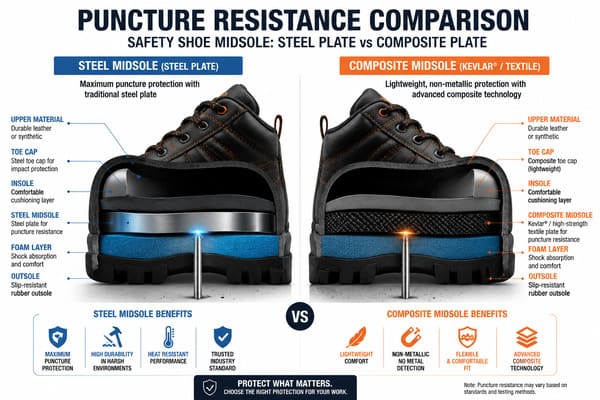
I once had a client who distributed construction materials. He came to me saying his workers’ safety shoes had "terrible quality." Three months in, a nail had gone straight through the sole. He shipped the shoes to me. The toe cap was steel. The outsole was decent. But the midsole — there was none. The supplier had left it out entirely. The buyer had no idea. That was 500 pairs, all scrapped. The midsole sits inside the shoe. You cannot see it from the outside. That makes it the easiest component to cut and the easiest one to miss.
What Is Stronger, Steel Toe or Composite Toe?
"Stronger" sounds like a simple question. But when I run the actual numbers, the answer is not what most buyers expect.
Steel toe caps generally handle higher impact loads and resist deformation better under direct compression. Composite toe caps, made from carbon fiber, Kevlar, or fiberglass, meet the same EN ISO 20345 200-joule impact standard. The difference shows up not in normal use, but in how each material behaves when it reaches its limit.
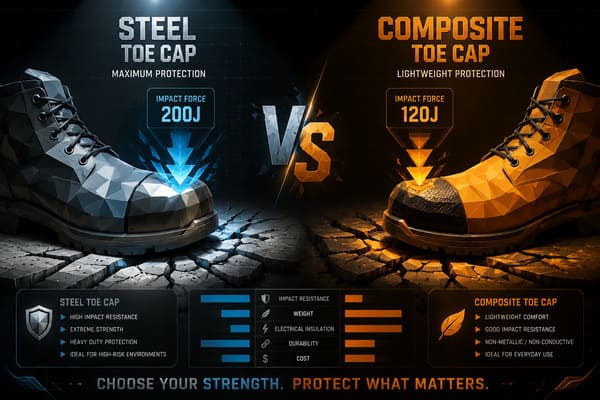
We have done internal tests comparing steel and composite midsoles at equal spec levels. Both pass the 1100N puncture test. But when we pushed the force beyond that threshold, the steel midsole bent. You could see the deformation happening gradually. The composite midsole held — and then cracked, all at once, with no warning2. In a lab, this is just data. On a real worksite, that sudden failure with no warning sign is how accidents happen. Steel fails slowly. Composite fails fast.
Steel Toe vs Composite Toe: A Direct Comparison
| Feature | Steel Toe | Composite Toe |
|---|---|---|
| Impact resistance | Higher ceiling | Meets standard, lower ceiling |
| Failure mode | Gradual deformation | Sudden fracture |
| Weight | Heavier | 30–40% lighter3 |
| Metal detector safe | No | Yes |
| Electrical conductivity | Conducts | Non-conductive |
| Cold weather performance | Conducts cold | Better insulation |
| Cost | Lower | Higher |
The question is not which material is stronger in absolute terms. The question is which failure mode is acceptable in your work environment. A steel toe that bends gives the worker a warning. A composite toe that cracks gives none. For high-load, high-impact environments like heavy manufacturing or construction, steel toe remains the safer choice. For environments with electrical hazards, airport security, or cold storage, composite is the right call.
Why Is Composite Better Than Steel?
Composite is not better than steel in every situation. But there are specific conditions where composite is clearly the right choice, and ignoring those conditions creates real risk.
Composite midsoles and toe caps are non-conductive, lighter by 30–40%, and do not transfer cold or heat. In electrical environments, ESD-sensitive areas, cold storage, or jobs requiring long hours on foot, composite outperforms steel in ways that directly affect worker safety and daily comfort.
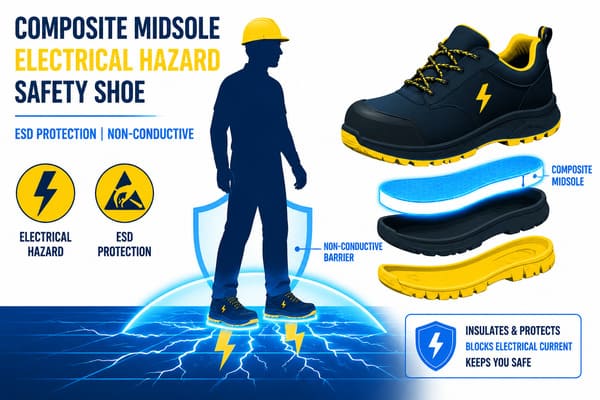
I have a client who manages maintenance for electrical equipment. His team was using steel midsole safety shoes. During one job, a worker’s sole made accidental contact with a low-voltage exposed wire. No serious injury, but it was close. After that, he came to me. We replaced the entire fleet with composite midsole shoes paired with insulating outsoles. The new shoes passed EN ISO 20345 electrical insulation testing4. A steel midsole in an electrical environment is not just a poor fit — it is a conductive path running directly under the worker’s foot.
Where Composite Wins Over Steel
| Condition | Why Composite Is Better |
|---|---|
| Electrical / live wire environments | Steel conducts electricity; composite does not |
| ESD-sensitive workplaces | Composite supports controlled static discharge |
| Cold storage / freezer environments | Steel transfers cold; composite insulates5 |
| Long shifts on foot (8+ hours) | Lower weight reduces fatigue6 |
| Airport security checkpoints | Composite does not trigger metal detectors7 |
| Food processing (hygiene-sensitive) | No metal contamination risk8 |
The most underrated advantage of composite is not the weight. It is the conductivity — or rather, the lack of it. Every client I have placed in an electrical or ESD environment has stayed on composite after the first order. The weight benefit gets them to try it. The safety benefit keeps them there.
Which Industries Need Steel Midsoles and Which Need Composite?
I get this question from procurement teams who manage multiple sites. The honest answer is that some companies need both — at the same time.
Steel midsoles suit heavy industries where sharp debris, heavy loads, and unpredictable ground conditions are constant. Composite midsoles suit industries where electrical hazards, static sensitivity, long wear time, or metal-free requirements apply. Many companies need both, depending on the specific work area.
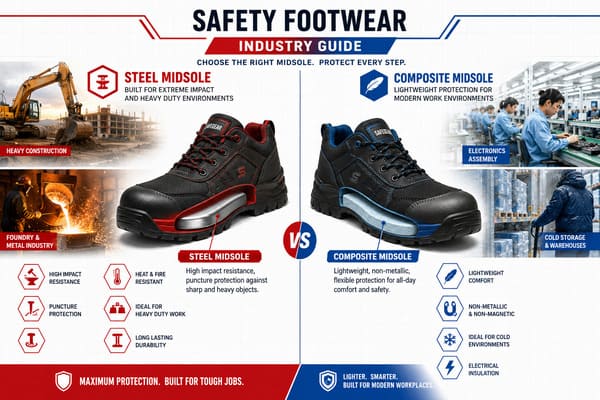
I had a client — one company, two workshops. One was a heavy stamping floor. The other was an electronics assembly area. I gave them two separate shoe specifications. Same brand, same outsole platform, different midsoles. The stamping floor got steel midsoles for maximum puncture resistance under unpredictable metal debris. The assembly floor got composite midsoles for ESD compliance9 and comfort during long stationary shifts. That is a real purchasing scenario. One factory, two midsole types, both correct.
Industry-by-Industry Midsole Guide
| Industry | Recommended Midsole | Key Reason |
|---|---|---|
| Construction | Steel | Nail and rebar puncture risk |
| Heavy manufacturing / stamping | Steel | High-load metal debris on floor |
| Foundry / casting | Steel | Irregular sharp metal fragments |
| Oil & gas (field work) | Steel | Rough terrain, sharp debris |
| Electrical / power maintenance | Composite | Non-conductive, insulation required |
| Electronics assembly | Composite | ESD compliance, light fatigue |
| Cold storage / logistics | Composite | Thermal insulation, less weight |
| Food processing | Composite | No metal contamination risk |
| Airport / security-sensitive sites | Composite | Metal detector clearance |
If you are buying for multiple sites or multiple job roles, do not default to one midsole type across the board. The right answer is to map the work environment first, then choose the midsole. A steel midsole on an electrical maintenance worker is a liability. A composite midsole on a foundry floor may not give you the puncture performance you need when a sharp casting fragment hits at a bad angle.
What Is the Best Material for a Shoe Midsole?
Every few months, a buyer asks me this directly: steel or composite, which is better? I always answer with a question back.
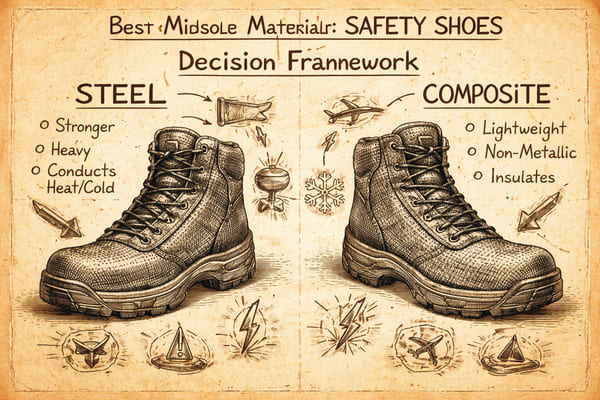
There is no single best midsole material. Steel offers higher puncture resistance and gradual failure behavior. Composite offers lower weight, non-conductivity, and better thermal insulation. The best material depends on the specific hazards, work duration, and compliance requirements of the job.
I had a client in the foundry procurement space. His first message to me was: "I want the lightest safety shoes you have." I asked him to describe the work floor. Metal shavings on the ground. Irregular steel offcuts. Temperatures above 40°C. Workers standing for over eight hours a day. I did not recommend composite midsoles. I recommended steel midsoles paired with a lightweight outsole compound and a breathable upper. Weight reduction should come from the outsole and the upper — not from reducing the protective coverage or rigidity of the midsole. Composite is lighter, but lighter is not always safer.
Midsole Material Decision Framework
| Factor | Choose Steel | Choose Composite |
|---|---|---|
| Floor hazard type | Sharp metal debris, nails, rebar | Light debris, smooth industrial floors |
| Electrical risk | None | Present — live wires, ESD zones |
| Shift length | Shorter or mixed | Long stationary or walking shifts |
| Temperature environment | Warm or hot | Cold storage or freezer |
| Certification needed | EN ISO 20345 puncture | EI (electrical insulation), ESD |
| Metal detector requirement | Not required | Required |
| Budget sensitivity | Lower cost priority | Performance priority |
The best midsole material is the one that matches the actual hazard. If you are not sure what hazards your workers face, that is the first thing to find out — before you choose a midsole, before you choose a shoe.
Conclusion
The midsole is invisible, but it is not optional. Steel and composite each solve different problems. Match the material to the hazard, not to the price. At Shoegan, we help B2B buyers specify the right midsole for each work environment — from heavy manufacturing to electrical maintenance — with full OEM customization and certifications including EN ISO 20345, ASTM F241310, and more. Contact us at [email protected] or WhatsApp +8613008988018.
-
"Understanding EN ISO 20345 – Safety Footwear (formerly EN345)", https://www.wiseworksafe.com/blog/view/understanding-en-iso-20345-safety-footwear-formerly-en345-. EN ISO 20345:2011 (Safety Footwear) specifies that midsoles must withstand a minimum puncture resistance force of 1100 N when tested with a standardized nail, establishing the baseline performance requirement for both steel and non-metallic midsole materials. Evidence role: definition; source type: institution. Supports: The EN ISO 20345 standard specifies a 1100N force threshold for midsole puncture resistance testing in safety footwear.. Scope note: Access to the full standard text requires purchase from ISO or a national standards body; summaries from certification laboratories may not capture all test conditions. ↩
-
"[PDF] 1 CHAPTER 11 FRACTURE OF MATERIALS 11.1 Brittle vs. Ductile …", https://www.usna.edu/NAOE/_files/documents/Courses/EN380/Course_Notes/Ch11_Fracture.pdf. Materials science literature characterizes fiber-reinforced composites (including Kevlar and fiberglass laminates) as exhibiting brittle failure modes with minimal plastic deformation prior to fracture, in contrast to the ductile deformation behavior of steel under compressive overload. Evidence role: mechanism; source type: paper. Supports: Composite materials typically exhibit brittle fracture with little plastic deformation prior to failure, while steel exhibits ductile deformation, providing visible warning before catastrophic failure.. Scope note: General materials science findings on brittle versus ductile failure may not directly replicate the specific geometry and loading conditions of a safety shoe midsole. ↩
-
"What’s the Impact of Safety Footwear on Workers Concerning Foot …", https://pmc.ncbi.nlm.nih.gov/articles/PMC11311279/. Comparative assessments of safety footwear components report that composite toe caps and midsoles made from materials such as Kevlar or fiberglass are typically 30–40% lighter than steel equivalents of equivalent protective rating. Evidence role: statistic; source type: research. Supports: Composite safety footwear components are approximately 30–40% lighter than equivalent steel components.. Scope note: The precise weight differential varies by manufacturer, component geometry, and material grade; the 30–40% figure represents a commonly cited range rather than a single standardized measurement. ↩
-
"EN ISO 20345 Safety Footwear Standard — Requirements and Test …", https://www.ejendals.com/jalas-safety-shoes/safety-standards-jalas-footwear/en-iso-20345-safety-footwear-standard/. EN ISO 20345 defines an electrical insulation (EI) additional marking for safety footwear, specifying test conditions under which the complete shoe must resist electrical current flow, a requirement relevant to the selection of non-conductive midsole materials in live-wire environments. Evidence role: definition; source type: institution. Supports: EN ISO 20345 includes an electrical insulation (EI) classification with defined test voltage and leakage current thresholds for safety footwear.. Scope note: Electrical insulation performance of the complete shoe depends on the combination of midsole, outsole, and upper materials; the midsole alone does not determine EI classification. ↩
-
"Thermal Study of Carbon-Fiber-Reinforced Polymer Composites …", https://pmc.ncbi.nlm.nih.gov/articles/PMC10673121/. Steel has a thermal conductivity of approximately 50 W/m·K, whereas fiber-reinforced composites such as fiberglass and Kevlar laminates typically exhibit thermal conductivity values below 1 W/m·K, supporting the claim that composite midsoles provide substantially better thermal insulation in cold environments. Evidence role: mechanism; source type: encyclopedia. Supports: Steel has significantly higher thermal conductivity than composite materials such as Kevlar or fiberglass, meaning steel midsoles transfer cold more readily to the foot.. Scope note: Actual heat transfer in a worn shoe depends on midsole thickness, contact area, and the presence of insulating layers; bulk thermal conductivity values are indicative rather than directly predictive of in-shoe performance. ↩
-
"The Impact of Footwear on Occupational Task Performance and …", https://pmc.ncbi.nlm.nih.gov/articles/PMC9518076/. Ergonomics research has demonstrated that footwear mass is positively associated with metabolic energy cost during walking and prolonged standing, with heavier footwear contributing to increased lower-limb muscle fatigue over extended work shifts. Evidence role: mechanism; source type: paper. Supports: Heavier footwear increases metabolic energy expenditure and contributes to lower-limb fatigue during prolonged standing or walking.. Scope note: The magnitude of fatigue reduction attributable specifically to midsole weight savings (as opposed to total shoe weight) has not been isolated in most published studies. ↩
-
"Steel Toe Boots | Transportation Security Administration – TSA", https://www.tsa.gov/travel/security-screening/whatcanibring/items/steel-toe-boots. Walk-through metal detectors used in security screening operate by detecting conductive or ferromagnetic materials; composite safety footwear components constructed from fiber-reinforced polymers such as Kevlar or fiberglass lack these properties and are therefore transparent to standard metal detection systems. Evidence role: general_support; source type: research. Supports: Composite safety footwear components made from non-metallic materials such as Kevlar or fiberglass do not contain ferromagnetic or highly conductive materials and therefore do not trigger standard walk-through metal detectors.. Scope note: Metal detector sensitivity settings vary by installation; some high-sensitivity security checkpoints may detect trace metallic elements in adhesives or hardware elsewhere in the shoe even when the midsole and toe cap are composite. ↩
-
"Protective Footwear | Environmental Health & Safety – Mizzou", https://ehs.missouri.edu/program-areas/personal-protection/protective-footwear. Food safety management frameworks such as HACCP (Hazard Analysis and Critical Control Points), as referenced in Codex Alimentarius guidelines and national food safety regulations, identify physical metal contamination as a critical hazard; the use of non-metallic footwear components in food processing environments reduces the risk of metal fragment introduction into the food production area. Evidence role: general_support; source type: government. Supports: Food processing facilities operating under HACCP or equivalent food safety management systems identify metal contamination as a critical hazard, making non-metallic footwear components preferable.. Scope note: Regulatory requirements for footwear material in food processing vary by jurisdiction and facility type; composite midsoles reduce but do not eliminate all sources of physical contamination risk. ↩
-
"ESD safety shoes – ElectroStatic Discharge – read our guide", https://www.solidgearfootwear.com/guides/esd. Standards such as EN 61340-5-1 and the ESD (electrostatic dissipative) classification within EN ISO 20345 specify resistance ranges for footwear used in electrostatic-sensitive environments; composite midsoles are compatible with these requirements because they do not introduce uncontrolled conductive paths. Evidence role: definition; source type: institution. Supports: ESD-compliant safety footwear must meet defined electrical resistance ranges, and composite midsoles are compatible with ESD footwear construction requirements.. Scope note: ESD compliance is a system-level property of the complete shoe and flooring combination, not solely determined by midsole material choice. ↩
-
"Employer Personal Protective Equipment Workplace Hazard … – OSHA", http://www.osha.gov/laws-regs/standardinterpretations/2013-12-09. ASTM F2413, published by ASTM International, is the standard specification for performance requirements for protective (safety) toe cap footwear in the United States, covering impact resistance, compression resistance, puncture resistance, and electrical hazard protection, among other classifications. Evidence role: definition; source type: institution. Supports: ASTM F2413 is the primary American standard for safety footwear, covering impact resistance, compression resistance, and metatarsal protection among other hazards.. Scope note: ASTM F2413 and EN ISO 20345 use different test methodologies and classification systems; compliance with one does not automatically imply compliance with the other. ↩