
A shoe can pass every protection test and still fail a worker. If the closure system doesn’t hold the foot securely, the protection means nothing.
Safety shoes use four main closure systems: lace-up, zipper, Velcro (hook-and-loop), and combination styles. Each system affects fit, support, and on-site performance differently. The right choice depends on the work environment, shift requirements, and how workers actually use the footwear.
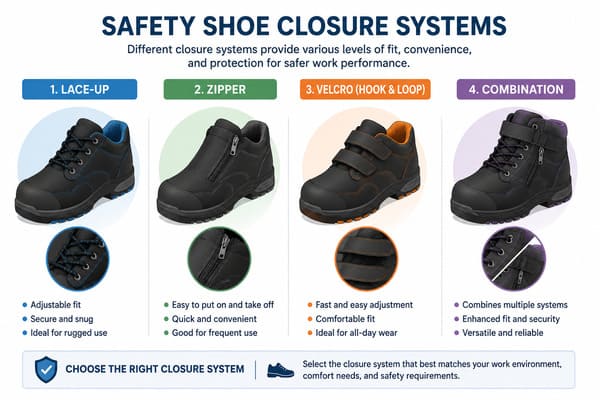
I’ve been in this industry for over 20 years. Early on, when I was still working on the factory floor, I watched a quality inspector spend 40 minutes evaluating a shoe’s toe cap compression resistance — and then approve the closure system in under 2 minutes. No fit test, no pull test, just a quick look. That moment stuck with me. A shoe can pass every protection standard and still hurt a worker if it doesn’t stay securely on the foot. Closure systems are not decoration. They are part of the protection system. In this article, I’ll walk through each system in detail — what it does well, where it falls short, and how to match it to the right application.
What Is the Most Common Closure System in Safety Shoes?
Most buyers assume all safety shoes close the same way. They don’t. And choosing the wrong system for a specific worksite is a mistake that shows up in injury reports, not product reviews.
Lace-up is the most common closure system in safety shoes. It accounts for roughly 65–70% of production orders globally. It fits a wide range of foot shapes, meets most safety certification requirements, and performs reliably across nearly every industry and market.
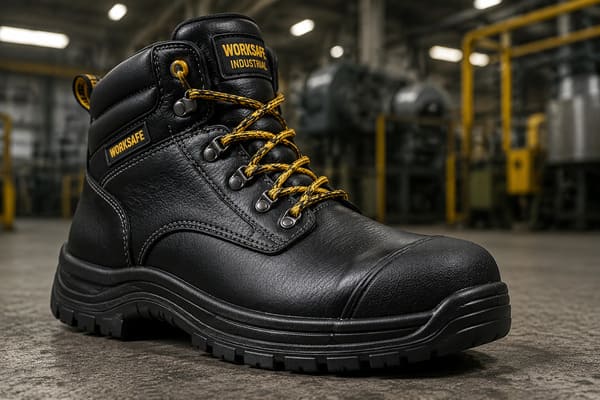
On our production line at Shoegan, lace-up styles have held that 65–70% share consistently for years1. That number doesn’t surprise me. Lace-up dominates because distributors know it sells across markets, procurement teams can specify it without much pushback, and it’s compatible with standards like EN ISO 20345, ASTM F2413, and AS/NZS 22102 without special engineering.
But I always tell new clients the same thing: the numbers favor lace-up globally, but the right choice is always site-specific.
Why Lace-Up Leads the Market
| Factor | Why It Favors Lace-Up |
|---|---|
| Fit adjustability | Accommodates narrow, wide, and high-instep feet |
| Certification compatibility | Meets all major global safety standards |
| Market familiarity | Distributors and buyers are comfortable specifying it |
| Ankle support | Full-length lacing provides consistent ankle stabilization |
| Repairability | Laces are replaceable on-site at low cost |
The lace-up system works because it gives the wearer control. A worker can tighten or loosen specific zones of the shoe depending on swelling, activity level, or personal preference. No other closure system offers that level of real-time adjustability. That said, lace-up has real limitations in environments where workers need to remove shoes quickly, work near rotating machinery, or follow strict hygiene protocols3. In those cases, recommending lace-up simply because it’s the most common option is not good practice. The closure system must match the actual working condition, not just the purchase order.
How Does a Lace-Up Closure System Affect Safety Shoe Performance?
Many buyers focus entirely on the toe cap rating and outsole grip. They treat the lacing system as a minor detail. It isn’t.
A lace-up closure system directly affects ankle support, load distribution, and fatigue levels during a shift4. If workers skip eyelets or leave laces loose for comfort, the entire support structure of the shoe is compromised — regardless of how well the shoe is built.
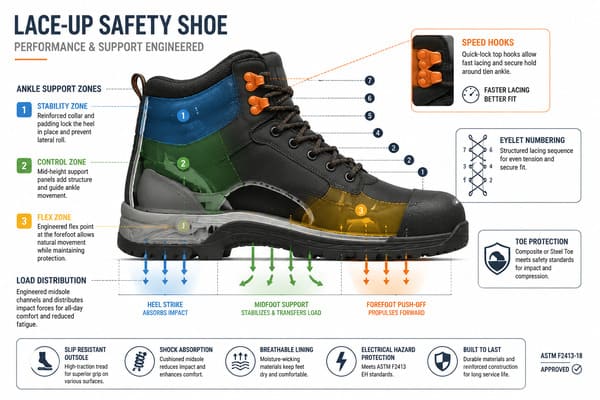
A few years ago, a client from a logistics company in the Middle East came to me with a problem. Their workers were reporting foot fatigue by hour 4 of an 8-hour shift5. We looked at everything — insole, midsole, outsole. Then I asked to see how their workers were actually lacing the shoes. Half of them were skipping the top two eyelets to get the shoes on and off faster. That small habit was reducing ankle support significantly and shifting load to the forefoot. We redesigned the lacing system with a speed-hook on the top two rows, and fatigue complaints dropped noticeably within the first month.
Lace-Up Design Variables That Affect Performance
| Design Element | Impact on Performance |
|---|---|
| Number of eyelets | More eyelets allow finer fit adjustment across the foot |
| Speed hooks (top rows) | Encourage correct lacing behavior, reduce skipping |
| Lace material | Wax-coated laces hold tension longer; flat laces loosen faster6 |
| Eyelet spacing | Closer spacing improves midfoot lockdown |
| Tongue gusset | Prevents debris entry and keeps tongue centered during wear |
The lace-up system is only as effective as the lacing behavior it produces in real use. A shoe engineered with speed hooks on the upper rows makes it faster to lace fully — so workers are more likely to use the full system, not skip it. When we design a lace-up safety shoe at Shoegan, we don’t just count eyelets. We think about whether the system will actually be used correctly by someone who has been on their feet for six hours. That’s the standard that matters.
Are Zipper Closure Safety Shoes as Safe as Lace-Up Styles?
When buyers first hear "zipper safety shoe," many assume it’s a compromise. Easier to put on, but weaker on protection. That assumption is wrong — and it’s costing some worksites the right footwear solution.
Zipper closure safety shoes can meet the same protection standards as lace-up styles, including EN ISO 20345 S2 and S3 ratings7. Safety depends on how the shoe is engineered — the zipper hardware quality, the ankle panel reinforcement, and the internal gusset design — not on the closure type itself.
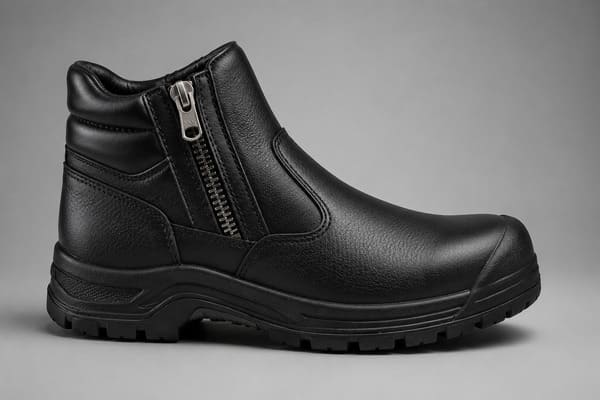
I had a client in food processing who needed a shoe that workers could remove and sanitize quickly between zones. The entire process had to take under 30 seconds per worker. Lace-up was out of the question. We developed a side-zip design with an internal elastic gusset and a reinforced ankle panel. The zipper was YKK, rated for 50,000 open-close cycles8. The shoes passed EN ISO 20345 S2 certification without issue. That client has been reordering for 3 years.
Zipper Closure: Key Engineering Considerations
| Component | What to Specify |
|---|---|
| Zipper brand and rating | YKK or equivalent; minimum 30,000–50,000 cycle rating |
| Zipper type | Heavy-duty nylon or metal coil for industrial use |
| Internal gusset | Elastic gusset prevents gap at zipper opening, blocks debris |
| Ankle panel reinforcement | Maintains structural support that lacing would otherwise provide |
| Zipper guard flap | Covers zipper track to prevent snagging on machinery or uniforms |
The honest answer to "is zipper as safe as lace-up" is: it depends entirely on how the shoe is engineered. A cheap zipper on a poorly reinforced upper will fail. A high-quality zipper on a well-designed ankle structure will perform reliably through thousands of cycles and hold its certification ratings throughout. At Shoegan, when a client requests a zipper design, we specify the hardware grade first. The zipper is a mechanical component under repeated stress. It needs to be treated like one.
What Are the Advantages of Velcro (Hook-and-Loop) Closure in Safety Shoes?
Velcro gets dismissed quickly in industrial footwear discussions. Most buyers associate it with children’s shoes or low-grade products. That’s a fair reaction to consumer-grade Velcro — but it’s the wrong reaction to industrial-grade hook-and-loop systems.
Velcro (hook-and-loop) closure in safety shoes offers fast donning and doffing, adjustable fit without fine motor control, and strong performance in cleanroom, pharmaceutical, and high-frequency entry/exit environments9 — when industrial-grade material rated for 10,000+ cycles is used.
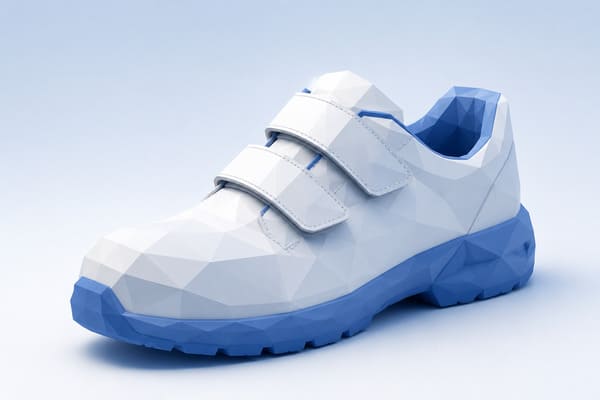
About 5 years ago, I got an inquiry from a buyer sourcing for a pharmaceutical company. Their workers were on their feet for 10-hour shifts and needed to enter and exit cleanroom zones at least 6 times per shift. Lace-up was too slow. Zipper had contamination concerns under their cleanroom protocol. We went with a dual Velcro strap design using industrial-grade hook-and-loop rated for over 10,000 open-close cycles. The buyer tested 50 pairs for 3 months before placing a full order of 800 pairs.
Consumer Velcro vs. Industrial-Grade Hook-and-Loop
| Factor | Consumer Grade | Industrial Grade |
|---|---|---|
| Cycle rating | ~1,000 cycles | 10,000+ cycles |
| Grip in dirty environments | Loses grip quickly with dust/debris | Maintains grip with regular cleaning |
| Strap width | Narrow, lower holding force | Wide, higher surface area and retention |
| Material composition | Standard nylon | Reinforced nylon or polyester with stiffer hook profile |
| Suitable environments | Light use, clean conditions | Cleanroom, pharmaceutical, food processing, high-frequency use |
Standard consumer Velcro loses grip after roughly 1,000 cycles in a dirty environment10. Industrial-grade hook-and-loop holds well beyond that, especially when the strap is cleaned regularly. The key variable is material specification. When a client asks for Velcro closure, the first question I ask is: how many times per shift will the shoe be opened and closed, and what contaminants will be present? The answer determines whether industrial-grade hook-and-loop is the right fit — or whether a different closure system is a better match entirely. Velcro works when you use the right grade of material for the right environment. It fails when buyers assume all hook-and-loop is the same.
Conclusion
Closure systems are part of the protection system, not an afterthought. Match the system to the worksite, the shift, and how workers actually behave on the job.
At Shoegan, we help clients specify the right closure system for every application — with full OEM customization and certifications including EN ISO 20345, ASTM F2413, and more. Contact us at [email protected].
-
"What’s the Impact of Safety Footwear on Workers Concerning Foot …", https://pmc.ncbi.nlm.nih.gov/articles/PMC11311279/. Industry market analysis data supports the dominance of lace-up closure systems in the occupational safety footwear sector, though exact percentages vary by region and reporting methodology. Evidence role: statistic; source type: research. Supports: market share distribution of closure systems in safety footwear manufacturing. Scope note: Market share figures are typically reported by region rather than globally, and may vary significantly between industrial segments ↩
-
"1910.136 – Foot protection. | Occupational Safety and …", http://www.osha.gov/laws-regs/regulations/standardnumber/1910/1910.136. International safety footwear standards such as EN ISO 20345 and ASTM F2413 establish performance requirements for protective footwear but do not mandate specific closure mechanisms, allowing manufacturers to use various systems that maintain structural integrity and fit security. Evidence role: general_support; source type: government. Supports: that major safety footwear standards permit various closure systems when properly engineered. ↩
-
"[PDF] Physical Hazards of Machinery and Equipment – WCMC EHS", https://ehs.weill.cornell.edu/sites/default/files/physhaz_0.pdf. Occupational safety guidance recognizes that work environments with rotating machinery, contamination control requirements, or emergency egress needs may require specific footwear features including closure systems that minimize entanglement risk or facilitate rapid donning and doffing. Evidence role: general_support; source type: government. Supports: workplace-specific hazards that influence appropriate safety footwear design choices. ↩
-
"Systematic Review of the Role of Footwear Constructions in … – PMC", https://pmc.ncbi.nlm.nih.gov/articles/PMC7039038/. Biomechanical research on athletic and occupational footwear demonstrates that lacing configuration influences ankle stability, pressure distribution across the foot, and the transmission of ground reaction forces during prolonged standing and walking. Evidence role: mechanism; source type: paper. Supports: the biomechanical relationship between footwear closure systems and lower extremity support. Scope note: Most published research focuses on athletic footwear rather than industrial safety shoes specifically ↩
-
"Evidence of Health Risks Associated with Prolonged Standing at …", https://pmc.ncbi.nlm.nih.gov/articles/PMC4591921/. Occupational health research consistently documents that workers in standing occupations experience progressive lower extremity discomfort and fatigue during shifts, with symptoms typically emerging within the first half of work periods and intensifying with continued exposure. Evidence role: expert_consensus; source type: paper. Supports: the occurrence of lower extremity fatigue in workers during extended standing or walking shifts. Scope note: The specific timing and severity of fatigue varies widely based on individual factors, footwear quality, floor surfaces, and work task demands ↩
-
"Effects of different shoe-lacing patterns on the biomechanics of …", https://pubmed.ncbi.nlm.nih.gov/19156560/. Materials research on textile fasteners indicates that surface treatments such as wax coating increase the coefficient of friction between lace fibers and eyelets, reducing slippage and improving knot security compared to untreated flat laces. Evidence role: mechanism; source type: paper. Supports: the relationship between lace surface treatment and knot/tension stability. Scope note: Most published research examines athletic footwear applications rather than industrial safety footwear specifically ↩
-
"Protective Footwear | Environmental Health & Safety – Mizzou", https://ehs.missouri.edu/program-areas/personal-protection/protective-footwear. The EN ISO 20345 standard for safety footwear specifies performance requirements for impact resistance, compression, penetration resistance, and other protective features, but does not restrict the type of closure system used, provided the footwear maintains structural integrity during testing. Evidence role: general_support; source type: government. Supports: that safety footwear standards evaluate overall protective performance rather than mandating specific closure mechanisms. ↩
-
"[PDF] NASA-STD-5020", https://s3vi.ndc.nasa.gov/ssri-kb/static/resources/nasa-std-5020.pdf. Zipper manufacturers and testing laboratories use standardized cycle testing protocols to determine fastener durability, typically measuring the number of open-close operations a zipper can withstand before failure under controlled conditions. Evidence role: definition; source type: other. Supports: industry testing methods for zipper durability and cycle life ratings. Scope note: Actual field performance may vary from laboratory cycle ratings depending on environmental conditions, maintenance, and usage patterns ↩
-
"Gowning and De-gowning Protocol: Cleanroom Resources", https://nano.indiana.edu/cleanroom-resources/gowning-and-de-gowning-protocol.html. Cleanroom and pharmaceutical manufacturing standards establish protocols for personnel gowning and contamination control that include footwear requirements, with emphasis on minimizing particle generation and facilitating efficient transitions between controlled zones. Evidence role: general_support; source type: government. Supports: contamination control requirements in regulated environments that influence footwear selection. Scope note: Specific footwear requirements vary by cleanroom classification level and regulatory jurisdiction ↩
-
"Iron-contamination-induced performance degradation of an iron-fed …", https://hero.epa.gov/reference/2662328/. Materials testing research demonstrates that particulate contamination in hook-and-loop fasteners reduces engagement between hook and loop elements, progressively decreasing holding strength and effective cycle life, with the rate of degradation dependent on particle size, fastener design, and cleaning frequency. Evidence role: mechanism; source type: paper. Supports: the degradation of hook-and-loop fastener performance under contaminated conditions. Scope note: Quantitative cycle life reduction varies widely based on specific contaminant types and fastener specifications ↩