
Buying safety shoes without knowing the construction method is like buying a car without checking the engine. The wrong choice costs you money, comfort, and protection.
Cemented construction is a shoe-making method where the upper and outsole are bonded together using industrial-grade adhesive under heat and pressure. It produces a lightweight, flexible shoe with a low profile. It is one of the most widely used methods in modern safety footwear manufacturing1.
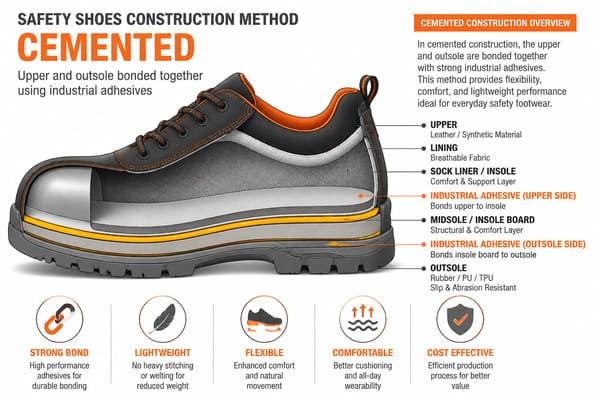
There are several construction methods used in safety shoes today — cemented, Goodyear welt, injection-molded, and Blake stitch2, to name a few. Each one has a different use case, a different cost structure, and a different performance profile. In this article, I want to break down cemented construction specifically — how it works, what it does well, where it fits best, and whether it holds up over time. If you are sourcing safety shoes for the first time or reconsidering your current supplier’s construction method, this is worth reading carefully.
How Does Cemented Construction Actually Work in Safety Shoes?
Most people hear "cemented" and think it just means gluing the sole on. That is not what cemented construction is, and that misunderstanding leads to bad sourcing decisions.
Cemented construction follows five core steps: lasting the upper over a mold, securing the insole, roughing and abrading the bond surface, applying and activating adhesive, and pressing the outsole under controlled pressure. Each step has a defined standard. Skipping or rushing any one of them is where quality breaks down.
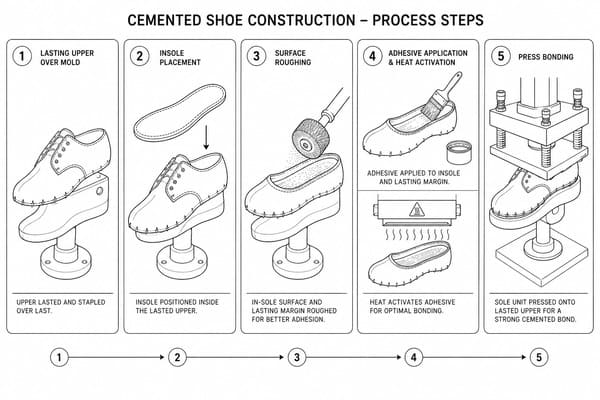
I have been in this industry for over 20 years, and I have seen the inside of more factories than I can count. The most common failure point in cemented shoes is not the adhesive itself — it is the preparation steps before the adhesive is even applied. Let me walk you through what the process actually looks like when it is done correctly.
Step 1: Lasting the Upper
The upper is pulled tightly over a last — a foot-shaped mold — and held in place. This sets the shape of the shoe. If this step is rushed or the tension is uneven, the final shoe will not hold its form under daily use.
Step 2: Securing the Insole
The insole is fixed to the bottom of the last. This forms the base that the outsole will eventually bond to. The flatness and alignment of the insole directly affect how well the outsole sits during bonding.
Step 3: Roughing the Bond Surface
This is the step most low-cost factories skip or do poorly. The bonding surfaces — both the upper edge and the outsole — must be mechanically abraded to create a rough texture. This gives the adhesive something to grip. In our factory, the standard is 95% surface coverage on the roughed area. I once examined a delamination complaint sample from a client. When I pulled the sole apart, the roughed area covered less than 60% of the surface. That is not a cemented construction problem. That is a factory execution problem.
Step 4: Applying and Activating the Adhesive
We use industrial-grade polyurethane adhesive3. After application, the adhesive needs 40 to 60 seconds for the solvent to flash off. Then both surfaces are reactivated using heat — typically 60 to 70°C4. This step is not optional. Skipping heat activation is one of the most common shortcuts taken in low-cost production, and it is the reason so many cheap cemented shoes delaminate within months.
Step 5: Pressing Under Pressure
The outsole is pressed onto the upper under a minimum of 150 kg of pressure, held for a set duration. This forces the adhesive into the surface texture and creates a mechanical bond, not just a surface contact.
| Step | Key Standard | Common Failure in Low-Cost Production |
|---|---|---|
| Lasting | Even tension, correct last fit | Uneven pull, shape distortion |
| Insole Fixing | Flat, centered alignment | Misalignment, poor base for bonding |
| Surface Roughing | 95%+ coverage | Under 70% coverage, weak bond area |
| Adhesive Application | 40–60s flash-off, 60–70°C activation | No heat activation, wrong adhesive grade |
| Press Bonding | 150kg+ pressure, timed hold | Insufficient pressure, short hold time |
When all five steps are executed to standard, cemented construction produces a bond that is strong, flexible, and consistent. When they are not, the shoe fails — and people blame the method instead of the factory.
What Are the Real Advantages of Cemented Safety Shoes?
People often ask me why cemented construction is so widely used if it has a reputation for being "just glued together." The answer is that the reputation is wrong, and the advantages are real.
Cemented safety shoes are significantly lighter than Goodyear welt or injection-molded alternatives, offer greater design flexibility, and allow for a wider range of outsole materials without changing the upper. For workers on their feet all day, these differences are not small.
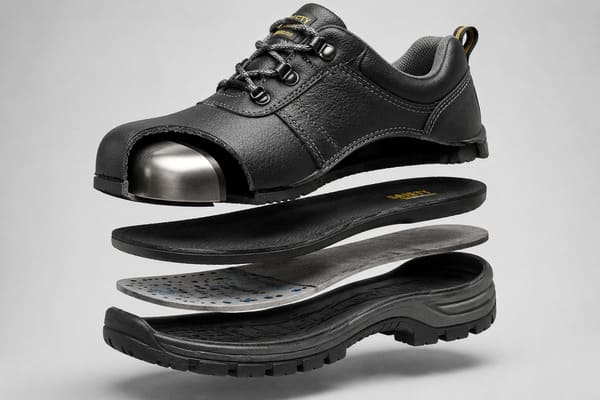
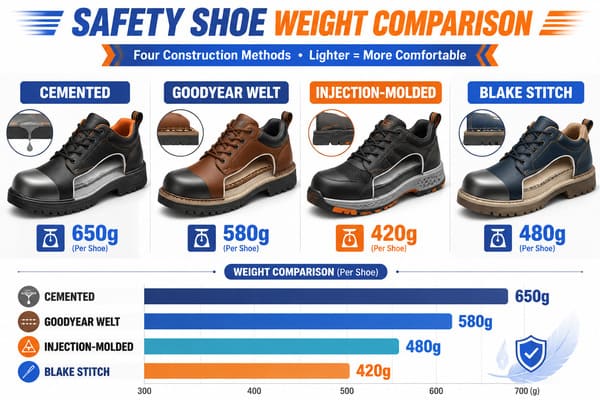
A German distributor visited our factory some time ago. He picked up one of our cemented lightweight safety shoes and said: "This is almost half the weight of the Goodyear welt I’m selling now." He was right. A standard Goodyear welt safety shoe in the same size typically weighs between 600 and 700 grams. Our cemented version comes in at 380 to 420 grams.5 For a warehouse worker standing for more than 8 hours a day, that 200-gram difference adds up across tens of thousands of steps.6 By the end of a shift, it is not a small thing.
Weight Comparison by Construction Method
| Construction Method | Typical Weight (per shoe) | Flexibility | Design Freedom |
|---|---|---|---|
| Cemented | 380–420g | High | High |
| Goodyear Welt | 600–700g | Low | Low |
| Injection-Molded | 500–580g | Medium | Low |
| Blake Stitch | 450–520g | Medium | Medium |
Beyond weight, cemented construction gives us design freedom that other methods do not. We can pair the same upper with four or more different outsole compounds without changing the last or the production line setup. For OEM clients, this matters a lot. They want a shoe that carries their brand identity — specific colors, specific sole profiles, specific material combinations. Cemented construction makes that possible at a scale and cost that other methods cannot match. Our minimum order for custom cemented styles starts at 500 pairs, with a standard lead time of 30 days.
When Should You Choose Cemented Over Other Construction Methods?
Construction method selection is not about which method is best. It is about which method fits the working environment and the worker’s actual daily conditions.
Cemented construction is the right choice for indoor or semi-indoor environments, lighter-duty industrial work, and situations where worker comfort and shoe weight are high priorities. It is not the best choice for extreme outdoor conditions, heavy chemical exposure, or applications requiring a fully waterproof welt seal.
When a buyer comes to me, the first question I ask is: "What surface are your workers on, and how many hours a day?" That one question usually tells me everything I need to know about construction method. I worked with an EPC procurement client in the Middle East who needed two separate orders at the same time — one for outdoor construction site workers, and one for an indoor equipment installation team. I recommended injection-molded for the outdoor crew because of water resistance and impact demands7. For the indoor team, I recommended our cemented lightweight line, because the floors were flat, the environment was controlled, and 8-plus hours of comfort was the top priority. They placed both orders. The indoor batch was 3,000 pairs. The feedback they gave us afterward: "Worker complaints dropped a lot."
Construction Method Selection Guide
| Working Environment | Recommended Method | Reason |
|---|---|---|
| Indoor factory / warehouse | Cemented | Lightweight, comfortable, cost-effective |
| Outdoor construction site | Injection-molded | Waterproof, impact-resistant |
| Heavy chemical exposure | Cemented with chemical-resistant outsole | Flexible outsole pairing |
| Cold storage / freezer | Cemented with cold-resistant sole | Sole compound flexibility |
| Formal or light industrial | Blake stitch or cemented | Aesthetics and comfort balance |
One important point: choosing cemented does not mean giving up on protection standards. Our full cemented safety shoe line carries EN ISO 20345 certification8. Steel toe, anti-puncture, anti-static — all available in cemented construction, all tested to the same standard. Protection is not a trade-off we make for the sake of weight savings.
Does Cemented Construction Affect the Durability of Safety Shoes?
This is the question I get asked more than any other. Buyers hear "cemented" and immediately worry about the sole peeling off after three months. I understand where that concern comes from. But it is based on a misunderstanding of what actually drives durability.
The durability of a cemented safety shoe depends 90% on the materials used and the quality of the production process, and only 10% on the construction method itself.9 A well-made cemented shoe with high-density outsole material will outlast a poorly made Goodyear welt shoe every time.
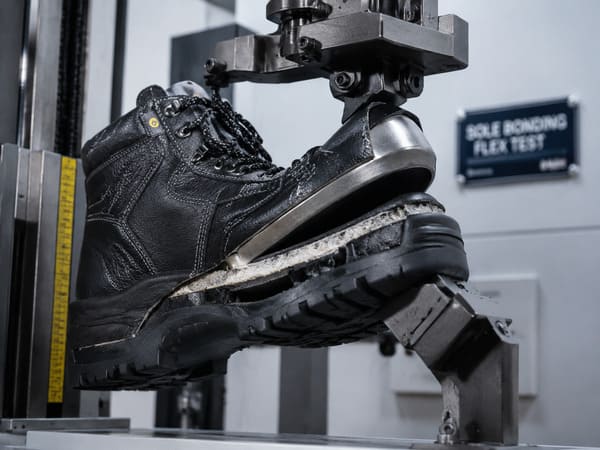
We ran an internal test comparing two versions of the same cemented safety shoe — one built with a standard-grade PU outsole, and one with our high-density PU compound. Both were run on the same flex-testing machine under identical conditions. The standard-grade outsole showed minor cracking at around 15,000 flex cycles. The high-density PU outsole passed 50,000 flex cycles without any sign of failure10. In real-world industrial use, 50,000 flex cycles corresponds to roughly 12 to 18 months of normal daily wear. The construction method was identical in both tests. The only variable was the outsole material.
Durability Factors in Cemented Safety Shoes
| Factor | Impact on Durability | What to Ask Your Supplier |
|---|---|---|
| Outsole material grade | Very high | PU density spec, flex cycle test data |
| Surface roughing coverage | High | What % coverage is your standard? |
| Adhesive type and grade | High | Industrial PU or general-purpose? |
| Heat activation process | High | Do you use heat activation? At what temp? |
| Press bonding pressure | Medium | What is your minimum press pressure? |
| Upper material quality | Medium | Genuine leather vs. split vs. synthetic? |
So when a buyer asks me "is cemented durable?", my answer is always the same: do not ask about the method — ask about the materials and the process. A cemented shoe built with high-density PU, proper surface preparation, industrial-grade adhesive, and correct press bonding is a durable shoe. A cemented shoe built with cheap compound and shortcuts in the roughing step is not. The method is not the variable. The factory is.
Conclusion
Cemented construction is a proven, flexible, and lightweight method that performs well when the materials and process are executed correctly. The method is not the risk — the factory behind it is. At Shoegan, every cemented safety shoe we produce is built to the same standard: industrial-grade adhesive, 95%+ surface roughing coverage, heat activation, and certified protection. Built to Protect. Made to Last.
-
"shoe constructions", https://nvlpubs.nist.gov/nistpubs/Legacy/circ/nbscircular419.pdf. Industry analyses of global footwear manufacturing have documented adhesive-bonded (cemented) construction as the dominant assembly method by volume, owing to its compatibility with automated production lines and diverse material combinations. Evidence role: statistic; source type: research. Supports: The prevalence of cemented/adhesive construction relative to other methods in global footwear manufacturing. Scope note: Aggregate statistics typically cover all footwear categories; figures specific to safety footwear may differ from the broader market. ↩
-
"Goodyear welt – Wikipedia", https://en.wikipedia.org/wiki/Goodyear_welt. Footwear technology references describe Goodyear welt construction as a method in which the upper, insole, and welt are stitched together before the outsole is attached, Blake stitch as a single-needle method stitching insole to outsole through the upper, and injection molding as a process in which the outsole material is injected directly around the lasted upper. Evidence role: definition; source type: encyclopedia. Supports: The technical definitions and distinguishing characteristics of major shoe construction methods including Goodyear welt, Blake stitch, and injection molding. ↩
-
"Polyurethane Adhesive – an overview | ScienceDirect Topics", https://www.sciencedirect.com/topics/engineering/polyurethane-adhesive. Research on adhesive bonding in footwear has shown that polyurethane-based adhesives provide high peel strength and flexibility retention across a range of substrates, making them suitable for sole-to-upper bonding in demanding applications. Evidence role: mechanism; source type: paper. Supports: The bonding mechanism and performance characteristics of polyurethane adhesives in footwear sole attachment. Scope note: Performance data may vary by specific formulation, substrate preparation quality, and curing conditions, so general findings may not directly predict outcomes in all production environments. ↩
-
"Sustainable Reactive Polyurethane Hot Melt Adhesives Based on …", https://pmc.ncbi.nlm.nih.gov/articles/PMC8779523/. Studies on thermally reactivated adhesive systems indicate that heating bonding surfaces to manufacturer-specified activation temperatures is critical for achieving maximum peel and shear strength, with insufficient activation being a documented cause of premature bond failure. Evidence role: mechanism; source type: paper. Supports: The role of thermal reactivation in developing full bond strength for polyurethane adhesives used in footwear construction. Scope note: Optimal activation temperatures are adhesive-formulation-specific; the 60–70°C range cited in the article may not apply universally to all polyurethane adhesive products. ↩
-
"Evaluation of safety boots and their relationships with the foot … – PMC", https://pmc.ncbi.nlm.nih.gov/articles/PMC12487406/. Independent product testing or industry benchmarking data would substantiate the weight differential between Goodyear welt and cemented safety footwear constructions across comparable protection categories. Evidence role: statistic; source type: institution. Supports: Comparative weight ranges for safety shoes produced by different construction methods. Scope note: Weight varies significantly by size, material selection, and protective component specification; ranges cited by a single manufacturer may not represent the full market. ↩
-
"The Impact of Footwear on Occupational Task Performance and …", https://pmc.ncbi.nlm.nih.gov/articles/PMC9518076/. Ergonomics research has established that footwear mass is positively associated with metabolic energy expenditure during walking, with studies estimating that each 100 g added to the foot increases oxygen consumption by approximately 1%, suggesting cumulative fatigue effects over extended work shifts. Evidence role: mechanism; source type: paper. Supports: The relationship between footwear mass and physiological fatigue or metabolic cost during prolonged standing or walking. Scope note: Most studies measure metabolic cost during walking rather than static standing; the fatigue effect for workers alternating between standing and walking may differ from controlled laboratory conditions. ↩
-
"Cemented vs welted – performance : r/Boots – Reddit", https://www.reddit.com/r/Boots/comments/1mxbpwt/cemented_vs_welted_performance/. Footwear technology references note that direct injection molding creates a seamless bond between the outsole and upper without an adhesive interface, eliminating a potential water ingress pathway at the sole-upper junction and providing inherent resistance to delamination under wet conditions. Evidence role: mechanism; source type: institution. Supports: The water resistance advantage of injection-molded sole construction relative to adhesive-bonded construction in safety footwear. Scope note: Overall shoe waterproofness also depends on upper material and membrane construction; sole attachment method alone does not determine the waterproof rating of the complete shoe. ↩
-
"ISO 20345:2021 – Personal protective equipment — Safety footwear", https://www.iso.org/standard/73222.html. EN ISO 20345 specifies basic and additional requirements for safety footwear used in professional environments, including mandatory toecap impact and compression resistance (200 J / 15 kN) and optional properties such as anti-puncture, anti-static, and slip resistance, applicable regardless of construction method. Evidence role: definition; source type: institution. Supports: The scope and protective requirements defined by EN ISO 20345 for safety footwear. ↩
-
"Systematic Review of the Role of Footwear Constructions in … – PMC", https://pmc.ncbi.nlm.nih.gov/articles/PMC7039038/. Failure analysis studies of adhesive-bonded footwear have identified inadequate surface preparation, incorrect adhesive selection, and substandard outsole compounds as the primary causes of premature bond failure, suggesting that process and material variables are dominant determinants of service life. Evidence role: expert_consensus; source type: paper. Supports: The relative contribution of material selection and process quality versus construction method choice to overall footwear durability. Scope note: The specific 90/10 ratio cited in the article is not derived from published research; it represents the author’s qualitative judgment rather than a quantified empirical finding. ↩
-
"How well does a sole really hold up after repeated bending and …", https://www.instagram.com/reel/DYyhPyMzm5Y/. ISO 17707 and related footwear test standards define flexing resistance protocols for outsoles, though published literature notes that direct equivalence between laboratory flex cycles and field service life depends on gait pattern, surface conditions, and outsole geometry, making precise service-life predictions from cycle counts approximate. Evidence role: mechanism; source type: institution. Supports: The relationship between standardized flex cycle test results and expected service life of footwear outsoles. Scope note: No universally accepted conversion factor between flex cycles and months of wear has been standardized; the 12–18 month estimate cited in the article is the manufacturer’s own interpretation. ↩