
Most buyers ask about the toe cap first. They forget the outsole is the part that actually touches the ground — every step, every shift, for up to 12 hours a day.
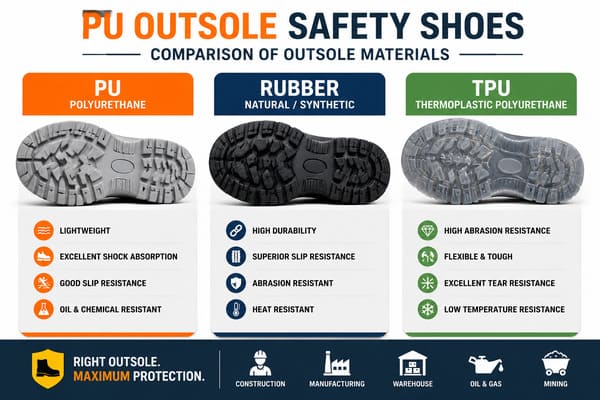
A PU (polyurethane) outsole is a type of shoe sole made by injection-molding polyurethane foam directly onto the upper. It is lighter than rubber by 30–40%1, offers real shock absorption, and bonds tightly to the upper to reduce delamination risk — making it one of the most widely used materials in mid-to-high end safety footwear.
I remember a client from a German distribution company visiting our factory about six years ago. He picked up one of our PU outsole samples and said, "This feels too light to be safe." I handed him a rubber sole of the same size. He held both, looked at me, and said, "Okay, I get it now." That weight difference is exactly why PU became the standard material for mid-range and premium safety shoes. The real question is not just what PU is — it is when to use it, and when not to.
What Makes PU Outsole Different from Rubber and TPU?
I have been asked this question at trade shows, over WeChat, and in factory audits — more times than I can count. People treat rubber, TPU, and PU as the same thing with different names. They are not.
PU outsoles typically weigh 200–350g per pair2 and offer real cushioning through injection-molded density control. Rubber outsoles weigh 400–600g and excel at heat resistance and grip3. TPU outsoles are the most abrasion-resistant of the three but provide almost no shock absorption4. Each material serves a different purpose.
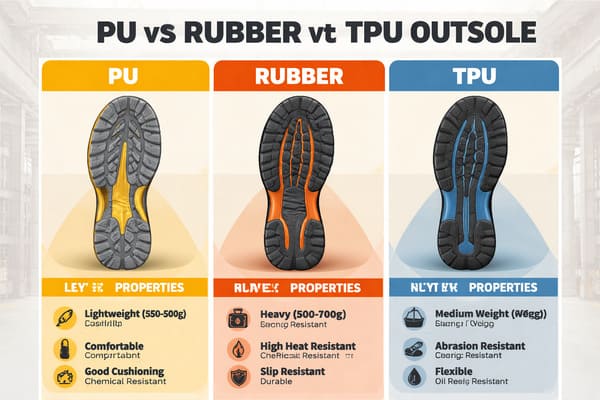
Rubber outsoles are great for grip and heat resistance, but hard on the legs after eight hours. TPU handles abrasion better than both, but it is stiff and does almost nothing for cushioning. PU lands in the middle — lighter, more comfortable, and well-suited for long shifts on hard floors. Here is a direct comparison of all three materials across the factors that matter most to buyers:
PU vs. Rubber vs. TPU: A Direct Comparison
| Property | PU | Rubber | TPU |
|---|---|---|---|
| Weight (per pair) | 200–350g | 400–600g | 300–450g |
| Shock absorption | High | Low–Medium | Low |
| Abrasion resistance | Medium | Medium–High | High |
| Heat resistance | Up to ~60°C | Up to ~300°C | Up to ~80°C |
| Cold resistance | Down to ~-10°C | Down to ~-40°C | Down to ~-20°C |
| Chemical resistance | Low–Medium | High | Medium |
| Bonding method | Direct injection | Cementing / vulcanizing | Cementing |
| Delamination risk | Low | Medium–High | Medium |
| Typical application | Indoor industrial, logistics | Outdoor, high-heat, oil fields | Heavy abrasion, light chemical |
In our factory, we often produce dual-density PU outsoles — a firmer outer layer for durability, a softer inner layer for comfort. The other thing buyers rarely ask about but should: because PU is direct-injection molded onto the upper, the sole and upper become one unit. That bonding process dramatically reduces the risk of delamination5 after six to twelve months of heavy use. A cemented rubber sole does not give you that same structural integrity. For buyers sourcing shoes that need to last a full year in daily industrial use, that bonding difference matters more than most people realize.
What Are the Pros and Cons of PU Outsoles in Safety Footwear?
I will be straight with you — I have seen PU outsoles fail, and I have seen them outlast expectations. Understanding both sides is the only way to make the right sourcing decision.
PU outsoles offer excellent cushioning, low weight, and strong upper bonding. Their main weakness is hydrolysis — a chemical breakdown caused by prolonged exposure to moisture and heat during storage or use6. For dry, temperature-controlled environments, PU performs very well. For humid storage or extreme outdoor conditions, it carries real risk.
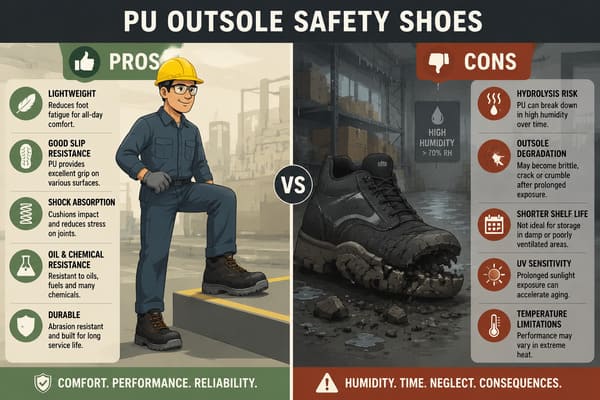
The failure I remember most clearly happened with a batch a distributor stored in a humid warehouse in Southeast Asia for about fourteen months. When they finally pulled the shoes out, the soles were crumbling — not from use, but from hydrolysis. On the flip side, I have had clients in European logistics companies report that their workers specifically requested PU-soled shoes because of the reduced leg fatigue after a full shift. One buyer told me his warehouse team’s sick leave dropped noticeably in the three months after switching to lighter footwear. Here is a clear breakdown of what PU does well and where it falls short:
PU Outsole: Strengths and Weaknesses
| Factor | PU Performance | Notes |
|---|---|---|
| Weight reduction | ✅ Strong | 30–40% lighter than rubber |
| Shock absorption | ✅ Strong | Returns energy with each step |
| Upper bonding | ✅ Strong | Direct injection reduces delamination |
| Comfort over long shifts | ✅ Strong | Reduces leg fatigue significantly |
| Abrasion resistance | ⚠️ Medium | Adequate for most indoor floors |
| Heat resistance | ⚠️ Limited | Softens above 60°C |
| Hydrolysis resistance | ❌ Weak | Breaks down in humid storage over time |
| Chemical resistance | ❌ Weak | Not suitable for direct chemical contact |
| Cold brittleness | ⚠️ Limited | Becomes brittle below -10°C |
The hydrolysis risk is manageable. We recommend that distributors store PU-soled shoes in cool, dry conditions and rotate stock within twelve months of production. We also use hydrolysis-resistant PU compounds in our production — this adds a small cost but significantly extends shelf life and working life. For buyers in humid climates or with slower inventory turnover, this is a specification worth asking about before placing an order.
Which Work Environments Are Best Suited for PU Outsole Safety Shoes?
A few years back, I had a client sourcing shoes for two completely different sites — a refrigerated food processing plant and an outdoor oil field in the Middle East. He wanted to use the same shoe for both. I told him that was a mistake.
PU outsoles perform best in dry, temperature-controlled indoor environments such as warehouses, logistics centers, light manufacturing, and food processing plants. They are not recommended for high-heat outdoor sites, direct chemical exposure, or extended cold storage environments below -10°C.

PU outsoles perform best between -10°C and 60°C. Below that, the material gets brittle. Above that, it starts to soften and lose grip. For the food processing plant — controlled temperature, concrete floors, light moisture — PU was the right call. For the oil field, with surface temperatures hitting 70°C or higher on summer days and direct contact with petroleum residue, we went with a rubber-based outsole instead. Here is a practical guide to matching outsole material with work environment:
Outsole Material Selection by Work Environment
| Work Environment | Recommended Outsole | Reason |
|---|---|---|
| Warehouse / logistics | PU | Light weight, cushioning for long shifts |
| Food processing (dry/cold) | PU | Temperature-controlled, hard floors |
| Construction (outdoor) | Rubber or PU+Rubber hybrid | Grip, heat, and terrain variability |
| Oil and gas (outdoor) | Rubber | High heat, petroleum chemical contact |
| Cold storage (below -10°C) | Rubber | PU becomes brittle at low temperatures |
| Light manufacturing | PU | Comfort, anti-fatigue for daily indoor use |
| ESD / anti-static environments | PU | Easily compounded for static-dissipative specs |
| Heavy abrasion environments | TPU or hybrid | Higher wear resistance needed |
PU also works extremely well for ESD (anti-static) safety shoes because the material can be compounded to meet static-dissipative requirements without adding extra layers. About 70% of our ESD orders use a PU outsole7 for exactly that reason. If you are sourcing for electronics manufacturing, semiconductor facilities, or any environment with static-sensitive equipment, PU is the natural starting point for outsole material selection.
Which Type of Sole Is Best for Safety Shoes?
A buyer once asked me point-blank: "Egan, just tell me — rubber or PU?" I told him I needed three more questions answered before I could say. What industry? What floor surface? How many hours a day?
There is no single best outsole for all safety shoes. The right material depends on the work environment, temperature range, shift length, and exposure risks. PU suits indoor comfort-focused applications. Rubber suits high-heat and outdoor grip. TPU suits heavy abrasion. A PU+rubber hybrid offers the best balance for demanding mixed-use environments.
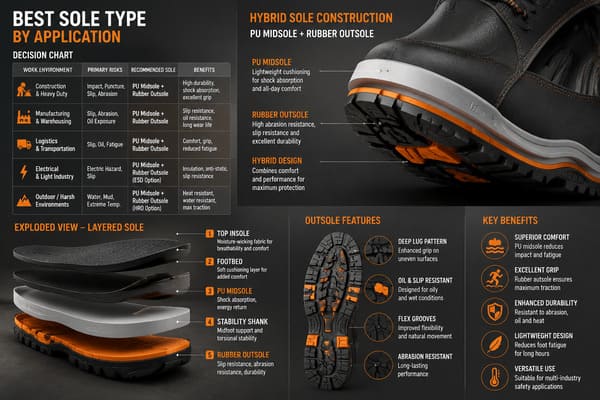
In our current product line, we use PU for standard indoor industrial shoes, rubber for high-heat or outdoor grip applications, and TPU for styles that face heavy abrasion or light chemical splash. For our premium line, we use a PU midsole plus rubber outsole combination — the PU layer handles cushioning and weight reduction, the rubber layer handles grip and ground contact durability. Here is how the decision framework looks in practice:
How to Choose the Right Outsole Material
| Priority | Best Outsole Choice | Why |
|---|---|---|
| Comfort and fatigue reduction | PU | Lightest, best shock absorption |
| Maximum grip on wet/oily surfaces | Rubber | Higher friction coefficient |
| Long-term abrasion resistance | TPU | Hardest wearing surface |
| Balanced performance (premium) | PU midsole + Rubber outsole | Best of both materials |
| Static-dissipative (ESD) | PU | Easy to compound for ESD specs |
| High-heat environments | Rubber | Stable above 60°C |
| Cold environments below -10°C | Rubber | Stays flexible at low temperatures |
That hybrid structure adds about two to four dollars to the unit cost, but it extends the shoe’s working life by an estimated 30–40% based on wear tests we have done internally8. Budget shoes pick one material and move on. Well-engineered safety shoes are built in layers, for a specific purpose. When a buyer asks me which sole is best, my answer is always the same: tell me where the shoe is going, and I will tell you what it needs.
Conclusion
Outsole material directly affects protection, comfort, and how long a safety shoe actually lasts. Matching the right material to the right environment is the decision that matters most.
At Shoegan, we build every outsole choice around the job it needs to do — because protection should never come at the cost of comfort. Contact us at [email protected] or WhatsApp +8613008988018.
-
"Differences & Similarities Between Foam Density, Weight & Firmness", https://foamonline.com/blog/differences-similarities-between-foam-density-weight-firmness/?srsltid=AfmBOoproZ8XuvrZkGpTvmqd1zdij7FNOfjwkp1eivmjXvsss_fPcyD8. Polyurethane foams typically exhibit densities of 0.3–0.7 g/cm³ depending on formulation, compared to vulcanized rubber at approximately 1.1–1.2 g/cm³, consistent with reported weight reductions of 30–40% in comparable sole geometries. Evidence role: statistic; source type: encyclopedia. Supports: The density of polyurethane foam relative to vulcanized rubber, supporting a 30–40% weight reduction figure. Scope note: Exact weight reduction depends on foam density grade and sole geometry; a general density comparison provides contextual rather than direct proof of the stated percentage. ↩
-
"The Impact of Footwear on Occupational Task Performance and …", https://pmc.ncbi.nlm.nih.gov/articles/PMC9518076/. The weight of polyurethane outsoles varies with foam density, sole geometry, and size; expanded PU foams used in footwear typically have densities of 0.35–0.55 g/cm³, yielding outsole weights consistent with the 200–350g per pair range reported for mid-range safety footwear. Evidence role: statistic; source type: research. Supports: The typical weight range of polyurethane outsoles used in safety footwear, approximately 200–350g per pair. Scope note: Actual outsole weight depends on shoe size, sole thickness, and specific PU formulation; the stated range is a general estimate applicable to standard adult safety shoe sizes. ↩
-
"Slip resistance of winter footwear on snow and ice measured using …", https://pmc.ncbi.nlm.nih.gov/articles/PMC4917907/. Vulcanized rubber outsoles used in safety footwear typically exhibit higher mass than polyurethane equivalents due to rubber’s greater density, and are recognized for thermal stability and frictional performance on wet and oily surfaces. Evidence role: statistic; source type: research. Supports: Typical weight range and heat/grip performance characteristics of vulcanized rubber outsoles in safety footwear. Scope note: Weight figures depend on sole thickness and geometry; the 400–600g range is a general estimate that may not apply uniformly across all rubber sole designs. ↩
-
"Physical Property of 3D-Printed N-Pointed Star-Shaped Outsole …", https://pmc.ncbi.nlm.nih.gov/articles/PMC9371032/. Thermoplastic polyurethane (TPU) exhibits high hardness and abrasion resistance, as measured by standardized tests such as DIN 53516, but its stiffness results in low energy absorption, making it less effective than expanded PU foams for impact attenuation in footwear. Evidence role: expert_consensus; source type: paper. Supports: TPU’s relatively high abrasion resistance and low energy-return/cushioning properties compared to softer PU foams and rubber compounds. Scope note: Abrasion resistance and cushioning performance vary with TPU grade and hardness specification; direct comparisons require controlled testing under identical conditions. ↩
-
"Preventing delamination of a dual density shoe sole |PU", https://de.chemtrend.com/problem/delamination-of-a-dual-density-shoe-sole/?lang=en. Direct injection molding of polyurethane onto footwear uppers creates a mechanical and chemical bond at the interface, eliminating the adhesive layer present in cemented constructions and thereby reducing the primary failure mode of sole delamination under cyclic loading. Evidence role: mechanism; source type: research. Supports: The superior bond integrity of direct-injection molded soles compared to adhesive-cemented soles in footwear construction. Scope note: Bond strength depends on upper material preparation and PU formulation; the claim of reduced delamination risk is mechanistically plausible but would require controlled durability testing for quantitative confirmation. ↩
-
"Hydrolysis of poly(ester urethane): In-depth mechanistic pathway …", https://www.osti.gov/biblio/2477458. Ester-based polyurethanes are susceptible to hydrolytic degradation, wherein water molecules cleave ester linkages in the polymer backbone, leading to loss of mechanical integrity; this process is accelerated by elevated temperature and humidity. Evidence role: mechanism; source type: paper. Supports: The chemical mechanism by which moisture and heat cause hydrolytic degradation in polyurethane polymers, particularly ester-based PU. Scope note: The rate and severity of hydrolysis vary significantly between ether-based and ester-based PU formulations; the article does not specify which type is used in the described outsoles. ↩
-
"What Footwear Materials Provide Static Dissipation in ESD Shoes?", https://www.leenol.com/What-Footwear-Materials-Provide-Static-Dissipation-in-ESD-Shoes-id42594775.html. ESD footwear standards such as EN ISO 20345 define electrical resistance requirements for static-dissipative footwear; polyurethane outsoles can be formulated with conductive carbon black or other additives to achieve the required resistance range, making PU a common base material for ESD-rated safety shoes. Evidence role: mechanism; source type: institution. Supports: The ability to compound polyurethane with conductive or static-dissipative additives to meet ESD footwear specifications. Scope note: ESD performance depends on the specific additive loading and formulation; not all PU outsoles are inherently static-dissipative without deliberate compounding. ↩
-
"PU Sole Footwear Polyurethane Market Report, Industry …", https://www.strategicmarketresearch.com/market-report/pu-sole-footwear-polyurethane-market. Hybrid sole constructions that separate cushioning and wear-resistance functions across distinct layers are documented in footwear engineering literature as a strategy for optimizing both comfort and durability, though specific life-extension percentages depend on use conditions and material specifications. Evidence role: general_support; source type: research. Supports: That hybrid sole constructions combining cushioning midsole materials with durable outsole materials can improve overall footwear longevity. Scope note: The 30–40% figure cited is derived from the manufacturer’s internal testing; independent third-party validation under standardized conditions would be required to confirm this estimate. ↩
[…] Direct injection lets us engineer a dual-density PU sole in a single production step. We set a softer density at the midsole and a harder density at the outsole6. […]
[…] in cold conditions. Key properties include oil and fuel resistance, abrasion resistance (under 150mm³ loss per DIN 535164), heat resistance up to 120°C5, and no swelling in petroleum-based […]