
Asking the wrong questions wastes time. Asking no questions costs money. Most sourcing mistakes I’ve seen were not about bad luck — they were about the questions nobody asked.
To vet a safety shoe supplier properly, ask about their manufacturing control, certification match to your target market, and how they handle mid-order changes. These four areas expose the risks most buyers never see until it’s too late.
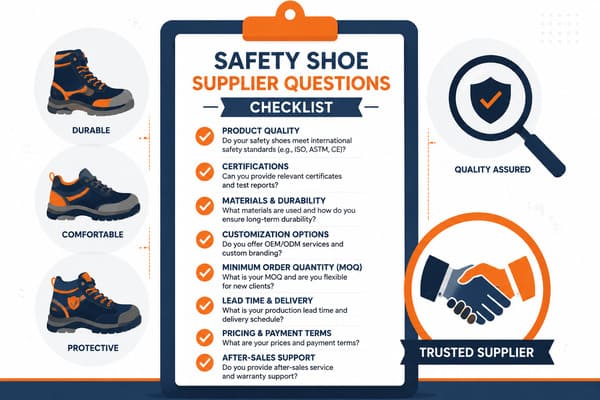
I’ve been in the safety shoe industry for over 20 years. I started on the factory floor, and today I run my own export business at Shoegan. I’ve seen buyers lose tens of thousands of dollars not because they were cheated, but because they never asked the right questions. This article breaks down exactly what to ask, and why each question matters more than you think.
Why Does Asking the Right Questions Actually Matter?
Most buyers think asking questions is about checking whether a supplier is trustworthy. It’s not. It’s about finding your own blind spots before they cost you.
The right questions don’t just filter bad suppliers — they force you to define what you actually need. A buyer who asks specific, technical questions gets specific, useful answers. A buyer who asks vague questions gets a polished sales pitch.
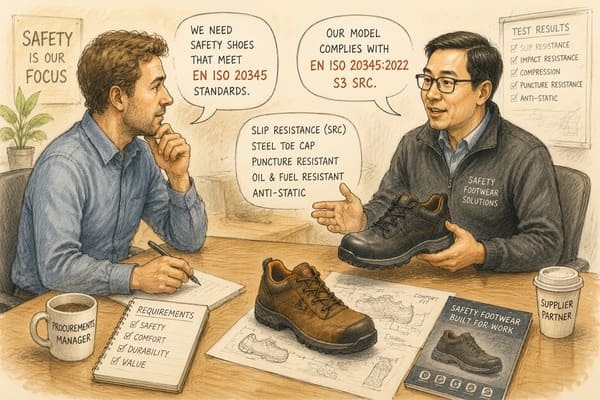
I once spoke with a procurement manager from the Middle East after a bad order. He had bought 3,000 pairs of safety shoes. When the shipment arrived, the slip resistance rating didn’t meet local job site requirements1. He lost close to $18,000 in goods and faced two months of project delays. I asked him: did you ever ask about the slip resistance test standard? He said, "I assumed all safety shoes were the same."
That’s the real problem. He wasn’t deceived. He just never asked the one question that would have protected him.
What Happens When You Ask Vague vs. Specific Questions?
There is a clear difference between a buyer who asks "do you have certifications?" and one who asks "does this model carry EN ISO 20345 S3 certification2, and can you send me the test report?" The information gap between those two questions is enormous.
| Question Type | What You Get |
|---|---|
| "Do you have certifications?" | A yes/no answer, maybe a logo |
| "Does this model have EN ISO 20345 S3? Can I see the test report?" | A specific document tied to a specific product |
| "What is your slip resistance test standard?" | A measurable answer you can verify |
| "What is your defect rate per batch?" | A number that tells you about their quality control |
The more specific your question, the more a serious supplier will take you seriously. Vague questions attract vague answers. Specific questions attract real data. And real data is the only thing that protects your order.
Here is another thing most buyers don’t realize: the quality of your questions signals your experience level to the supplier. When you ask precise, technical questions, suppliers treat you differently. They know you will notice problems. That alone changes how carefully they handle your order.
Are They a Real Manufacturer or Just a Trading Company?
The question "are you a factory?" sounds useful. It isn’t. The real question is: who controls the quality of production on your order?
Many suppliers who call themselves factories outsource 60–80% of production to smaller workshops3. This isn’t always visible from the outside. The risk isn’t whether they own machines — it’s whether anyone is actually watching the quality of your specific order.
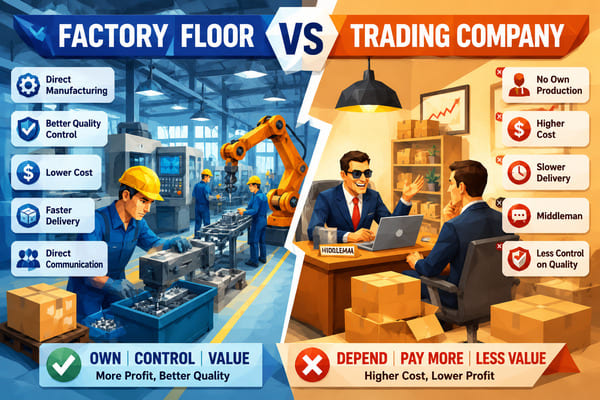
I came up through factory production myself, so I know how this works from the inside. I’ve seen companies show buyers a real workshop, hand over real certifications, and still quietly move production to a subcontractor once the relationship was established. One European buyer came to me after two years with another supplier. The first two batches were fine. By the third batch, steel toe caps were misaligned and sole delamination rates had climbed to nearly 8%4. When we traced the problem, the goods had not been made in the original factory at all.
Questions That Reveal Real Manufacturing Control
Asking to see a factory photo tells you almost nothing. Anyone can send a photo. Instead, ask questions that only someone with direct production knowledge can answer quickly and specifically.
| Question to Ask | What a Real Manufacturer Can Answer |
|---|---|
| Where is your production facility? | Full address, not just a city |
| Who supplies the upper leather for this model? | Specific supplier name |
| What is your in-house QC process? | Step-by-step, with inspection ratios |
| What percentage of your orders are subcontracted? | A direct number or a clear policy |
| Can I visit the factory or arrange a third-party audit5? | Yes, with a specific process |
A real manufacturer can answer these questions in five minutes. Not because they prepared for them, but because they live with this information every day. If a supplier responds to these questions with only a factory panorama photo and a brochure, the risk level is the same whether they call themselves a factory or a trading company.
The goal isn’t to catch anyone lying. The goal is to confirm that someone with real authority over your production is accountable for the result.
Do Their Certifications Actually Match Your Market?
A certification is not a general quality badge. It is a market entry pass — and each pass only opens one specific door, for one specific product.
Before accepting any certification, confirm three things: the standard matches your destination market, the test report covers the exact model and material configuration you are ordering, and the certification has not expired. One mismatch in any of these three areas can stop your shipment at customs.
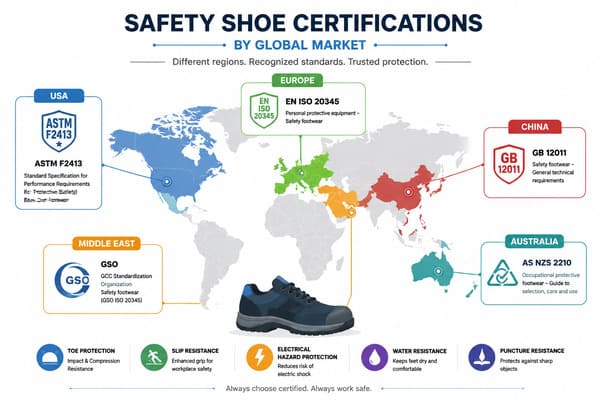
I’ve seen this go wrong more times than I can count. A supplier sends over an EN ISO 20345 certificate. The buyer feels confident. The goods arrive in Australia, and customs requires AS/NZS 22106. The shipment is held. Clearance fees, storage fees, and re-testing costs add up to over $12,000. The certificate was real. It just wasn’t the right certificate for that market.
The Hidden Risk: Certifications That Don’t Cover Your Exact Product
There is a less obvious version of this problem that catches even experienced buyers. The supplier holds a valid certification — but it was issued for a different model. They tested Model A. You ordered Model B, which uses a different outsole compound and a different lining material. No re-testing was done.
Certifications are issued for specific products, not for factories. A factory-level ISO 9001 certificate tells you about their quality management system7. It does not tell you whether your specific shoe model passed the safety performance tests required by your market.
| Certification | Market Coverage |
|---|---|
| EN ISO 20345 | Europe |
| ASTM F24138 | United States / North America |
| AS/NZS 2210 | Australia / New Zealand |
| GSO9 | Middle East / Gulf region |
| GB 1201110 | China domestic market |
The question to ask is not "what certifications do you have?" The question is: "Does this specific model, with this exact material configuration, have a valid test report for my target market? Can you send me the report, and can I confirm the product description on the report matches what I am ordering?"
That one question filters out at least half the certification-related risks in the market.
Can They Handle Custom Orders Without Losing Quality?
Most suppliers will say yes to a custom order. The real question is not whether they can do it — it’s what happens when something changes mid-process, and whether they tell you about the consequences.
Custom orders carry quality risk not because factories lack capability, but because changes made after sample approval often affect performance in ways that are never communicated to the buyer. Ask specifically about their internal process when a parameter changes after confirmation.
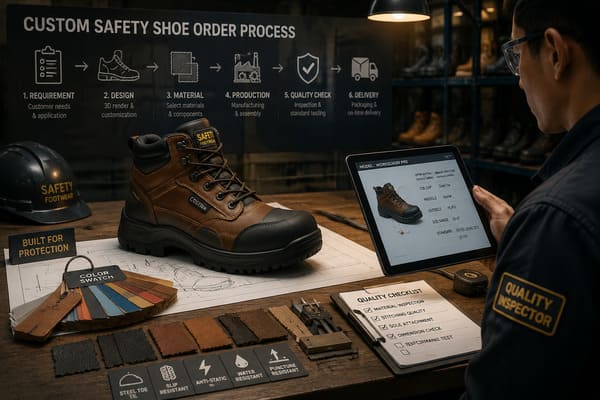
We once received a custom order from a Southeast Asian client. After sample approval, the client asked us to change the outsole color from black to dark grey. It sounds like a cosmetic change. But changing the color meant switching to a different rubber compounding supplier. That supplier’s rubber had a hardness five degrees higher than the original. That difference directly affected the slip resistance performance11.
We told the client immediately. We explained that the change would affect the SRC slip resistance rating and that re-testing was needed, which would push the delivery back by seven days. The client chose to wait. The goods shipped on the revised schedule with full performance compliance.
What Most Factories Won’t Tell You
Many factories will not have that conversation with you. They will say "no problem, we can change it," switch the supplier, skip the re-test, and ship the goods. You won’t find out until there is a complaint from your end customer, or until a market audit flags the discrepancy.
| Scenario | What a Reliable Manufacturer Does |
|---|---|
| Color change after sample approval | Checks if material source changes, flags performance impact |
| Logo addition to upper | Confirms stitching or embossing doesn’t affect structural integrity |
| Sole material substitution | Re-tests slip resistance and durability if compound changes |
| Lining material change | Checks impact on anti-static or breathability performance12 |
| MOQ reduction request | Communicates honestly about cost and lead time impact |
The question that reveals the most about a supplier’s real capability is this: "If I need to change one parameter after sample approval, what is your internal process?" A supplier who says "no problem, just tell us" is giving you a sales answer. A supplier who says "it depends on what changes — here is what we check and why" is giving you a manufacturing answer.
A good manufacturer is not the one who agrees to everything. It’s the one who tells you when something carries risk and explains exactly how they will handle it.
Conclusion
The right questions protect your order before problems start. Ask about manufacturing control, certification specifics, and change management — not just price and delivery. At Shoegan, we welcome every technical question you bring.
-
"EN ISO 20345 Safety Footwear Standard — Requirements and Test …", https://www.ejendals.com/jalas-safety-shoes/safety-standards-jalas-footwear/en-iso-20345-safety-footwear-standard/. Under EN ISO 20345, slip resistance is assessed using standardized test methods (EN ISO 13287) measuring the coefficient of friction on defined surfaces; the SRC classification requires the footwear to meet minimum friction thresholds on both a ceramic tile with sodium lauryl sulfate solution and a steel floor with glycerol, reflecting common workplace slip hazards. Evidence role: mechanism; source type: paper. Supports: How slip resistance in safety footwear is measured and what the SRC classification under EN ISO 20345 requires. Scope note: Slip resistance requirements differ across markets; the SRC classification is specific to the EN ISO framework and does not directly translate to ASTM or AS/NZS test methods. ↩
-
"Complete ISO 20345 overview | Safety Jogger", https://www.safetyjogger.com/en/eu/technical/iso_20345. EN ISO 20345, published jointly by the International Organization for Standardization and the European Committee for Standardization, specifies basic and additional requirements for safety footwear used in the workplace; the S3 classification requires, among other properties, a penetration-resistant midsole and a defined level of slip resistance (SRC). Evidence role: definition; source type: institution. Supports: The scope, classification system, and performance requirements of EN ISO 20345, including what the S3 designation specifies. Scope note: The standard is a paid document; publicly available summaries from national standards bodies or the ISO website describe scope but may not reproduce full technical specifications. ↩
-
"Supply chain movement risk in the sneaker industry – PMC – NIH", https://pmc.ncbi.nlm.nih.gov/articles/PMC8191717/. Research on global footwear supply chains, including studies from institutions such as the International Labour Organization and academic supply chain journals, documents widespread use of subcontracting in footwear production, particularly in export-oriented manufacturing hubs; subcontracting is identified as a factor that can reduce supply chain transparency and complicate quality oversight. Evidence role: statistic; source type: research. Supports: The prevalence of subcontracting in footwear manufacturing supply chains and the associated quality control risks. Scope note: A specific figure of 60–80% subcontracting for safety footwear suppliers is not directly established in published literature; the range cited in the article appears to be based on the author’s industry experience rather than a documented study. ↩
-
"Footwear Inspection: Quality Control and PSI Checklist", https://proqc.com/blog/footwear-inspection-quality-control-psi-checklist/. Industry quality control frameworks for footwear, such as those referenced by the International Labour Organization or footwear testing bodies, classify sole delamination as a critical defect; acceptable quality levels (AQL) for critical defects in safety footwear are typically set at or near zero, making an 8% rate a significant deviation from standard practice. Evidence role: general_support; source type: institution. Supports: What constitutes an acceptable defect rate in safety footwear production and how delamination is classified as a critical defect. Scope note: Specific AQL thresholds vary by buyer contract and market; a direct industry-wide benchmark for delamination rates in safety footwear is not universally published. ↩
-
"Industry Resources on Third-Party Audit Standards and FSMA … – FDA", https://www.fda.gov/food/importing-food-products-united-states/industry-resources-third-party-audit-standards-and-fsma-supplier-verification-requirements. Third-party factory audits, conducted by independent organizations such as Bureau Veritas, SGS, or Intertek, assess manufacturing facilities against defined criteria including quality management systems, production capacity, and social compliance standards; audit frameworks such as SA8000 or buyer-specific protocols provide structured methodologies for evaluating supplier claims. Evidence role: definition; source type: institution. Supports: That third-party factory audits are an established supply chain verification mechanism with defined processes and recognized providers. Scope note: Audit quality and scope vary significantly by provider and audit type; a passed audit does not guarantee ongoing compliance or the absence of subcontracting after the audit date. ↩
-
"U.S. Australia Free Trade Agreement Frequently Asked Questions", https://www.cbp.gov/trade/free-trade-agreements/australia/us-australia-free-trade-agreement-frequently-asked-questions. Safe Work Australia and Standards Australia recognize AS/NZS 2210 as the applicable series of standards for occupational protective footwear; personal protective equipment sold in Australia is expected to meet relevant Australian or jointly adopted Australian/New Zealand standards, and non-compliant goods may be subject to regulatory action at the border. Evidence role: historical_context; source type: government. Supports: That AS/NZS 2210 is the applicable standard for occupational safety footwear in Australia and New Zealand and that compliance is required for market entry. Scope note: Customs enforcement procedures vary; the article’s specific claim of a $12,000 cost outcome is anecdotal and not directly supported by regulatory documentation. ↩
-
"4.3 Determining the Scope of the Quality Management System [ISO …", https://www.iso-9001-checklist.co.uk/4.3-how-to-write-your-scope-for-iso-9001-with-7-examples.htm. ISO 9001, published by the International Organization for Standardization, specifies requirements for a quality management system that an organization must demonstrate to consistently provide products and services meeting customer and regulatory requirements; it does not certify that any specific product meets defined safety performance criteria. Evidence role: definition; source type: institution. Supports: That ISO 9001 certifies an organization’s quality management processes and does not constitute product-level safety performance certification. Scope note: ISO 9001 certification can indirectly support product quality by ensuring process controls are in place, but this distinction does not contradict the article’s core point. ↩
-
"1910.136 – Foot protection. | Occupational Safety and Health … – OSHA", http://www.osha.gov/laws-regs/regulations/standardnumber/1910/1910.136. ASTM F2413, published by ASTM International, establishes minimum requirements for the design, performance, testing, and classification of protective footwear in the United States, covering impact resistance, compression resistance, metatarsal protection, and other hazard-specific properties. Evidence role: definition; source type: institution. Supports: That ASTM F2413 is the governing standard for safety footwear performance in the United States and its key requirements. Scope note: ASTM F2413 is a US-centric standard; its adoption in Canada is partial and coexists with CSA Z195, so the characterization of it as a ‘North America’ standard is a simplification. ↩
-
"Personal Protective Equipment – Overview | Occupational Safety and …", http://www.osha.gov/personal-protective-equipment. The Gulf Standards Organization (GSO), established by the Gulf Cooperation Council member states, publishes technical standards for personal protective equipment including safety footwear; GSO standards for footwear are often harmonized with or derived from ISO standards but require separate certification for market access in GCC countries. Evidence role: definition; source type: institution. Supports: That the Gulf Standards Organization (GSO) issues safety footwear standards applicable to GCC member states and that compliance is required for market entry. Scope note: Specific GSO standard numbers and their current harmonization status with ISO 20345 should be verified directly with the GSO or national standards bodies of individual GCC member states. ↩
-
"1910.132 – General requirements. | Occupational Safety and Health …", http://www.osha.gov/laws-regs/regulations/standardnumber/1910/1910.132. GB 12011, issued by the Standardization Administration of China (SAC), specifies requirements for foot protection footwear used in occupational settings within China; compliance with GB standards is mandatory for personal protective equipment sold in the Chinese domestic market under the country’s work safety regulations. Evidence role: definition; source type: institution. Supports: That GB 12011 is the Chinese national standard governing safety footwear for the domestic market. Scope note: GB 12011 has been revised over time; buyers should confirm the current version in force and whether specific performance requirements align with or diverge from ISO 20345. ↩
-
"Development of a High Slip-resistant Footwear Outsole Using … – PMC", https://pmc.ncbi.nlm.nih.gov/articles/PMC4246531/. Materials science literature and footwear tribology research indicate that the hardness of rubber outsole compounds, typically measured on the Shore A scale, influences the real contact area between the sole and floor surface, which in turn affects the coefficient of friction; harder compounds generally produce lower friction coefficients on smooth or contaminated surfaces, directly impacting slip resistance test outcomes. Evidence role: mechanism; source type: paper. Supports: The relationship between rubber compound hardness and the slip resistance performance of footwear outsoles. Scope note: The relationship between hardness and slip resistance is influenced by multiple variables including surface texture, contamination type, and test method; a five-degree hardness change does not produce a uniform or universally quantifiable effect on slip resistance across all conditions. ↩
-
"EN ISO 20345 standard – Sir Safety System", https://www.sirsafety.com/en-iso-20345. EN ISO 20345 and related standards specify anti-static properties (classified as ‘A’) as an additional requirement for safety footwear, measured by electrical resistance testing; breathability or water vapor permeability requirements are addressed in standards such as EN ISO 20347 and are directly influenced by the material composition of the shoe lining and upper. Evidence role: mechanism; source type: institution. Supports: That anti-static and breathability are defined, testable performance properties in safety footwear standards that can be affected by lining material selection. Scope note: The specific sensitivity of anti-static and breathability test results to lining material substitutions depends on the magnitude of the material change; not all lining substitutions will produce a measurable performance difference. ↩
[…] spec comparison, and let them decide. They chose the 10-day delay. That order shipped, passed all EN ISO 20345 testing2, and that buyer has reordered with us six times […]
[…] had a client from the Middle East who had been buying EN ISO 20345 certified safety shoes3 from a trading company for three years. The price was around $18 FOB per pair. When he came to us […]