
I’ve seen too many buyers choose the wrong leather and pay for it later — not in dollars, but in complaints, returns, and workers with wet, sore feet.
Full-grain leather is the outermost, densest layer of a hide. It keeps the natural fiber structure intact.1 This makes it stronger, more breathable, and more water-resistant than any other leather type2. For safety shoes, it means longer wear life and fewer failures on the job.
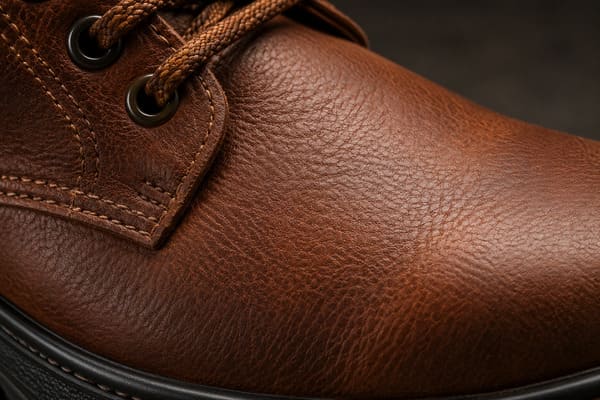
I’ve spent over 20 years in safety shoe manufacturing. In that time, I’ve seen the same mistake repeated by buyers at every level. They look at two shoes, feel the upper, and say, "They seem about the same." They’re not. The leather you choose for the upper is not a cosmetic decision. It’s a structural one. The upper is part of the protection system.3 And full-grain leather is the material that holds that system together longest.
Is Full-Grain Leather Good for Shoes?
Most buyers don’t find out the answer to this question until returns start coming in — and by then, the damage is done.
Yes. Full-grain leather is the best natural material for safety shoe uppers. It resists cracking, repels water, and molds to the foot over time. Its tight fiber structure gives it durability that no other leather grade can match in heavy industrial use.
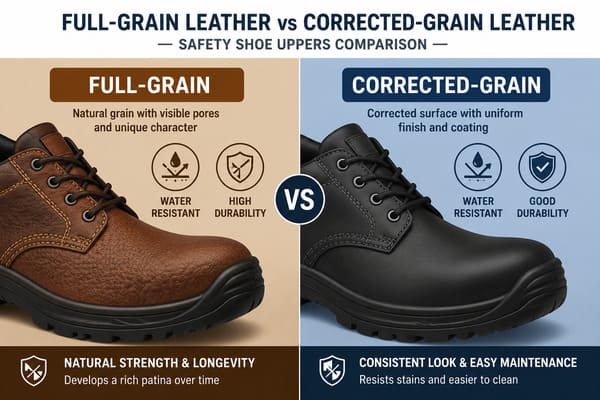
Early in my career, we were producing safety shoes for two clients at the same time. Both styles had steel toes. Both met the same protection standard. One used full-grain leather uppers. The other used corrected-grain leather. Six months after delivery, the corrected-grain batch started generating returns. The complaints were consistent: cracking along the toe box and water leaking through the upper. The full-grain batch had almost no complaints. I’ve never forgotten that. The upper isn’t decoration. It’s the first barrier between a worker’s foot and the environment.
Full-grain leather performs well for one specific reason. It keeps the outermost layer of the hide — the layer with the tightest, most compact fiber structure — completely intact. That layer hasn’t been sanded, buffed, or coated over. It’s natural. And that natural density is what gives full-grain leather its strength, its water resistance, and its ability to slowly conform to the shape of the foot. Once you remove or damage that layer, you lose all three of those properties at once.
Why the Outer Layer of the Hide Matters So Much
| Property | Full-Grain Leather | Corrected-Grain Leather |
|---|---|---|
| Fiber density | Highest — natural, untouched | Reduced — surface sanded down |
| Water resistance | Natural, from tight grain | Relies on coating, degrades faster |
| Break-in behavior | Conforms to foot shape over time | Stays rigid or cracks |
| Surface durability | High — no filler or coating to peel | Moderate — coating can flake |
The outer layer of a hide is like the outer rings of a tree trunk. It’s the most compressed, the most resilient, and the hardest to replicate. Once you sand it off to hide surface imperfections — which is what corrected-grain processing does — you’re left with a material that looks cleaner but performs worse. In safety footwear, where the upper faces heat, moisture, abrasion, and repeated flexing every single day, that difference shows up fast.
What Makes Full-Grain Leather Different From Other Leathers?
Many buyers touch a sample and think they can feel the difference. Usually, they can’t — and that’s exactly the problem.
Full-grain leather retains the hide’s original outermost fiber layer. Top-grain leather has that layer lightly sanded. Genuine leather comes from inner layers with much lower density. Bonded leather is scrap material pressed together.4 Each step down the grade means less durability and less natural performance.
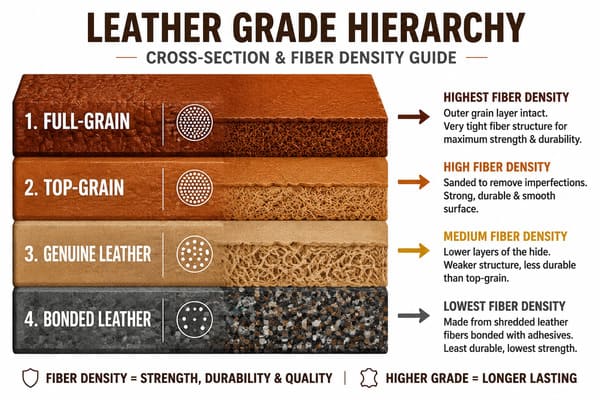
I use a simple comparison when buyers visit our factory. Imagine a cross-section of a log. Full-grain leather is the dense heartwood at the center. As you move outward, the material gets softer, less compact, and less reliable. The leather grades follow the same logic. Full-grain is at the top. Then top-grain. Then genuine leather. Then bonded leather at the bottom.
Here’s something I want every buyer to know, because this causes real confusion in the market. "Genuine leather" sounds like it means real, high-quality leather. It doesn’t.5 In the leather industry, "genuine leather" is a legal term for the lowest grade of real animal hide.6 It’s not a quality claim. It’s a category. I’ve had buyers come to me with a competitor’s sample, pointing at the label and asking why our shoes cost more when both say "genuine leather." I opened the shoe in front of them. The lining was synthetic. The upper was split leather — the lowest-grade hide layer — with an embossed grain pattern pressed onto the surface to make it look like full-grain. Everything on that label was technically accurate. None of it was what the buyer thought it was.
The Leather Grade Hierarchy — What Each Level Actually Means
| Grade | Source | Surface Treatment | Typical Performance |
|---|---|---|---|
| Full-Grain | Outermost hide layer | None — natural grain kept intact | Highest durability, breathability, water resistance |
| Top-Grain | Just below outermost layer | Light sanding to remove blemishes | Good performance, slightly reduced density |
| Genuine Leather | Inner hide layers | Heavy processing, often coated | Lower durability, limited breathability |
| Bonded Leather | Shredded leather scraps | Bonded with adhesive, pressed | Minimal durability, not suitable for safety footwear |
We ran a straightforward abrasion test in our factory. Same sole material. Same construction method. The only variable was the upper leather. Full-grain leather held up past 50,000 cycles on the Martindale test before showing surface wear. Corrected-grain leather started showing surface separation at around 20,000 to 25,000 cycles.7 That’s less than half the performance. For a worker doing a 10-hour shift in a steel plant or on a construction site, that gap is the difference between a shoe that lasts 14 months and one that fails in 6.
Breathability is the other difference that doesn’t show up in spec sheets but shows up in worker complaints. Full-grain leather has open, natural pores. Those pores let moisture vapor escape while still blocking liquid water.8 Corrected-grain leather has those pores filled or sealed during processing.9 After 8 hours of wear, the moisture has nowhere to go. Heat builds up. Odor builds up. Workers notice. That’s not a minor comfort issue — it’s a real-world durability and compliance problem.
What Are the Real Benefits of Full-Grain Leather in Safety Footwear?
Buyers often ask about protection ratings and sole specs. Very few ask about the upper material. That’s the part that usually fails first.
Full-grain leather in safety footwear offers longer service life, better water resistance, higher seam strength, and more effective waterproofing treatment adhesion.10 In real-world use, it reduces replacement frequency and lowers total cost per worker over time.
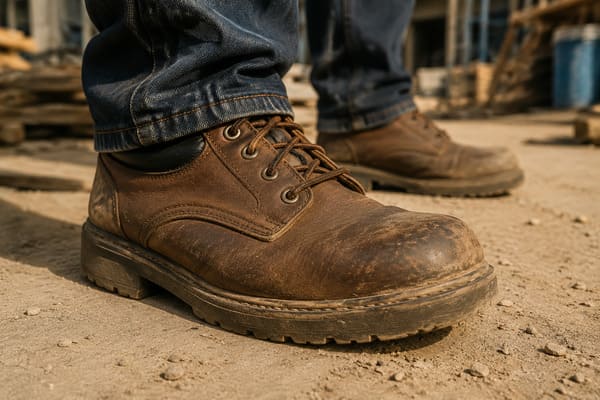
A European procurement manager visited our factory a few years ago. His first question wasn’t about certifications or MOQ. It was: "How long will your shoes actually last?" I showed him a pair of full-grain leather safety shoes that one of our own factory workers had been wearing for 14 months. The upper had scuff marks. There was visible wear on the toe. But the structure was intact. No cracking. No separation at the seam. The stitching was still holding. He told me the brand he’d been buying from had an average service life of 6 to 8 months. He placed an order that week.
Performance Comparison: Full-Grain Leather vs. Corrected-Grain in Safety Shoes
| Performance Factor | Full-Grain Leather | Corrected-Grain Leather |
|---|---|---|
| Average service life | 12–18 months (heavy use) | 6–9 months (heavy use) |
| Martindale abrasion resistance | 50,000+ cycles | 20,000–25,000 cycles |
| Seam tear strength | ~30% higher | Baseline |
| Waterproofing treatment adhesion | High — grain holds treatment | Low — coating reduces adhesion |
| Breathability | Natural pore structure open | Pores sealed or filled |
There’s one production-side benefit that doesn’t get mentioned often enough. Full-grain leather holds stitching better. The fiber density means the thread has more material to grip11. In our testing, seam tear strength on full-grain leather uppers is about 30% higher than on corrected-grain versions of the same shoe12. For safety footwear that sees heavy lateral stress — in mining, construction, or petrochemical environments — that number matters. A seam failure on a safety shoe isn’t just a warranty issue. It’s a safety incident waiting to happen.
Waterproofing is the third real-world benefit. When we apply DWR (durable water repellent) treatment to full-grain leather, it bonds to the surface effectively because the grain is tight and consistent. On corrected-grain leather, the surface coating acts as a barrier — the waterproofing treatment sits on top of the coating rather than bonding to the leather itself. That means the treatment wears off faster, and the shoe loses its water resistance much earlier in its service life.
Is Full-Grain Leather Worth the Extra Cost for Safety Shoes?
Every buyer asks this question eventually. The answer depends on one number they almost never think to check first.
Full-grain leather safety shoes typically cost $8–15 more per pair than corrected-grain alternatives. But they last 1.5 to 2 times longer. In high-use industrial environments, the total cost per worker per year is usually equal to or lower than cheaper alternatives — while protection performance stays higher throughout.
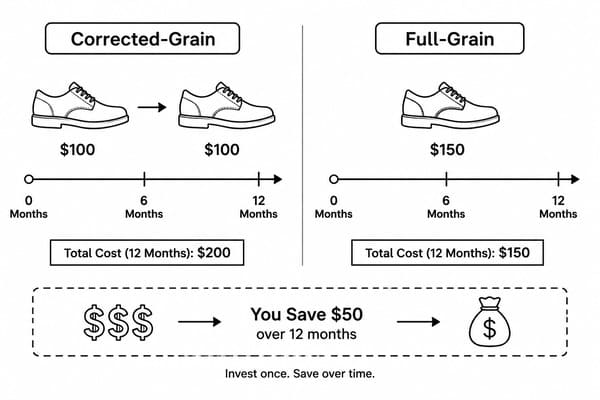
I’ve been asked this question more times than I can count. My answer is always the same question back: how often do your workers replace their shoes? If the answer is every 6 months, and full-grain leather extends that to 12 to 14 months, the math usually works in your favor before you even factor in the cost of processing returns, managing complaints, or dealing with a worker who was wearing a compromised shoe when something went wrong.
Total Cost Comparison: Full-Grain vs. Corrected-Grain Over 12 Months
| Factor | Corrected-Grain Leather | Full-Grain Leather |
|---|---|---|
| Unit cost (example) | $45 | $54 |
| Average service life | 6–8 months | 12–14 months |
| Pairs needed per worker/year | 2 | 1 |
| Annual cost per worker | ~$90 | ~$54 |
| Net saving per worker/year | — | ~$36 |
I have a client in the petrochemical sector. Before working with us, he was issuing two pairs of safety shoes per worker per year. After switching to our full-grain leather model, he moved to one pair per year. Each pair cost about $8 to $10 more than what he’d been buying. At the end of the year, he calculated a saving of $15 to $20 per worker. Across a workforce of several hundred people, that’s a real number.
That said, full-grain leather is not the right answer for every situation. Light-duty use, short-term projects, or markets where price sensitivity is the dominant buying factor — in those cases, corrected-grain leather or composite uppers are a reasonable choice. But for heavy industry, long-term use, and environments where the shoe faces daily abuse, full-grain leather delivers a lower total cost and a higher protection standard throughout its service life. The upfront price is higher. The overall cost is not.
Conclusion
Full-grain leather is not a premium feature. It is the foundation of a safety shoe that actually performs under real industrial conditions over time. At Shoegan, every mid-to-high end safety shoe we build starts with material choices like this — because protection should never be the first thing you compromise on. If you’re sourcing safety footwear and want to talk through material specifications, contact us at [email protected] or WhatsApp +8613008988018.
-
"[PDF] EARLY DETECTION OF LOOSENESS IN BOVINE HIDES USING …", https://www.journals.uc.edu/index.php/JALCA/article/download/2961/2255. A leather-science source describing the hide cross-section and grain layer supports that full-grain leather retains the natural outer grain surface and its dense collagen-fiber structure. Evidence role: definition; source type: education. Supports: Full-grain leather is the outermost, densest layer of a hide and keeps the natural fiber structure intact.. ↩
-
"[PDF] Factors affecting the water-vapor permeability of leather", https://nvlpubs.nist.gov/nistpubs/jres/44/jresv44n4p347_A1b.pdf. Comparative leather-material literature can support that intact grain structure is associated with higher mechanical durability, vapor permeability, and water resistance than more heavily corrected or split leathers. Evidence role: mechanism; source type: paper. Supports: Full-grain leather is stronger, more breathable, and more water-resistant than other leather types.. Scope note: The source may support the material mechanism and relative tendencies, not prove superiority over every leather type in all manufacturing conditions. ↩
-
"[PDF] ASTM F2413-11 Performance Requirements for Protective Footwear", https://facilities.uw.edu/partner-resources/files/media/performance-requirements-for-protective-footwear.pdf. Safety-footwear standards that specify upper requirements such as tear strength, abrasion resistance, water-vapor permeability, and water resistance support that the upper contributes to protective performance. Evidence role: expert_consensus; source type: institution. Supports: The shoe upper is a functional part of the safety footwear protection system.. Scope note: Standards define required performance characteristics but do not by themselves rank full-grain leather against other materials. ↩
-
"Bonded leather – Wikipedia", https://en.wikipedia.org/wiki/Bonded_leather. A neutral leather terminology reference supports the distinctions among full-grain, top-grain, split or genuine leather, and bonded leather by describing the source layer and processing method for each category. Evidence role: definition; source type: encyclopedia. Supports: Top-grain, genuine, and bonded leathers differ by hide layer and processing method.. Scope note: Commercial labeling terms vary by jurisdiction, so the source should be used to clarify terminology rather than establish a universal legal hierarchy. ↩
-
"Leather Guides – Federal Trade Commission", https://www.ftc.gov/legal-library/browse/rules/leather-guides. Consumer-protection or leather-labeling guidance can support that “genuine leather” generally indicates the material contains real leather but does not, by itself, certify high quality. Evidence role: definition; source type: government. Supports: The label “genuine leather” does not necessarily mean high-quality leather.. Scope note: The source may address labeling meaning rather than formally classifying “genuine leather” as the lowest industry grade. ↩
-
"Leather Guides – Federal Trade Commission", https://www.ftc.gov/legal-library/browse/rules/leather-guides. A source on leather terminology or labeling law can clarify whether “genuine leather” is a regulated material-description term and how it differs from quality grades such as full-grain and top-grain. Evidence role: definition; source type: government. Supports: “Genuine leather” is a labeling term that should not be read as a high-grade quality claim.. Scope note: This claim is jurisdiction-sensitive; many sources support that it is not a quality guarantee, but may not support the exact statement that it is legally the lowest grade everywhere. ↩
-
"[PDF] Abrasion Testing of Leather – Customer Care", https://customercare.pptgroup.com/hubfs/Martindale%20909%20BallPlateKit_A_EN.pdf?hsLang=en. A standards or laboratory-method source on the Martindale abrasion test supports the use of cycle counts to compare wear resistance of leather or textile surfaces. Evidence role: case_reference; source type: institution. Supports: Martindale cycle counts are a recognized way to compare abrasion resistance, though the article’s exact values come from factory testing.. Scope note: A neutral source can validate the test method, but the specific 50,000 and 20,000–25,000 cycle results are internal data unless independently published. ↩
-
"[PDF] Factors affecting the water-vapor permeability of leather", https://nvlpubs.nist.gov/nistpubs/jres/44/jresv44n4p347_A1b.pdf. Research on leather porosity, water-vapor permeability, and water resistance supports that leather can permit moisture-vapor transmission while resisting liquid-water penetration depending on structure and finishing. Evidence role: mechanism; source type: paper. Supports: The pore structure of full-grain leather can aid moisture-vapor escape while maintaining resistance to liquid water.. Scope note: The balance between vapor transmission and liquid-water resistance depends on tanning, finishing, thickness, and waterproofing treatment, not only on full-grain status. ↩
-
"Influence of Polyurethane Binders on the Surface Properties of …", https://journals.uc.edu/index.php/JALCA/article/view/8407. Leather finishing references describe corrected-grain processes such as buffing, filling, embossing, and coating, which can obscure or seal the natural grain surface. Evidence role: mechanism; source type: education. Supports: Corrected-grain leather is processed in ways that may fill or seal natural surface pores.. Scope note: The degree of pore sealing varies with the finish formulation and manufacturing process. ↩
-
"(PDF) A quantitative assessment of seam strength and efficiency …", https://www.researchgate.net/publication/397314921_A_quantitative_assessment_of_seam_strength_and_efficiency_across_various_seam_types_in_shoe_upper_leathers. Footwear-material studies and safety-footwear standards can support that upper materials are evaluated for durability, water resistance, seam strength, and related performance properties. Evidence role: general_support; source type: paper. Supports: Full-grain leather can improve service life, water resistance, seam strength, and waterproofing-treatment performance in safety footwear.. Scope note: External sources may support these performance criteria and mechanisms but may not prove the complete bundled claim for every full-grain leather safety shoe. ↩
-
"The Effect of Selected Factors on the Strength of Stitches of … – PMC", https://pmc.ncbi.nlm.nih.gov/articles/PMC9572404/. Leather-seam strength research supports that stitch holding and seam tear resistance depend on material structure, thickness, tensile strength, and fiber integrity around stitch holes. Evidence role: mechanism; source type: paper. Supports: Denser, intact leather structure can improve stitch holding because the thread is supported by more resistant material around the seam.. Scope note: This supports the physical mechanism of stitch retention, not the article’s specific percentage improvement unless matched testing is available. ↩
-
"SATRA Test Standard for Footwear – Partial Test on Tear Strength", https://www.haida-test.com/news/satra-test-standard-for-footwear-partial-test-on-tear-strength-113804.html. A footwear or leather testing source on seam tear strength methods can support how seam strength is measured and compared across upper materials. Evidence role: case_reference; source type: institution. Supports: Seam tear strength can be measured and compared between full-grain and corrected-grain leather uppers; the article reports a 30% internal-test difference.. Scope note: The 30% difference appears to be internal factory data and would require a published test report for direct verification. ↩