
A buyer once sent me photos of safety shoes he’d ordered from another supplier. The toe area was peeling. The upper had split at the seam. 2,000 pairs. Month four.
Full-grain leather keeps the outermost hide layer intact1, giving it a dense fiber structure that resists abrasion, moisture, and repeated bending. Split leather comes from the lower hide layers2, has a looser structure, and relies on a PU coating for appearance — a coating that cracks under real work conditions.
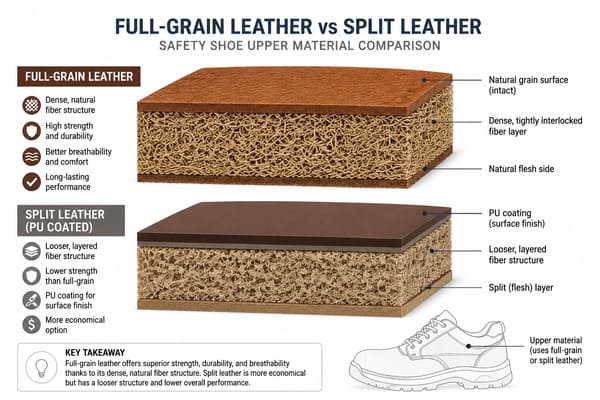
That buyer asked me: "How do I know this won’t happen again?" I told him to look at one thing — the leather cross-section. That single detail explained everything wrong with his previous order. And it’s the same detail that most buyers never check until it’s too late. The sections below break down exactly why leather grade matters, and what it means for your buyers, your reputation, and your next order.
What Makes Full-Grain Leather Better for Heavy-Duty Work?
Most buyers look at the shoe surface in a product photo and assume it tells them something about quality. It doesn’t. What matters is what’s underneath that surface — and how it holds up after six months on a job site.
Full-grain leather retains the outermost hide layer, where fiber density is highest. This gives it superior resistance to abrasion, repeated flexing, and moisture penetration. In heavy-duty environments, no other leather grade performs at the same level over time.
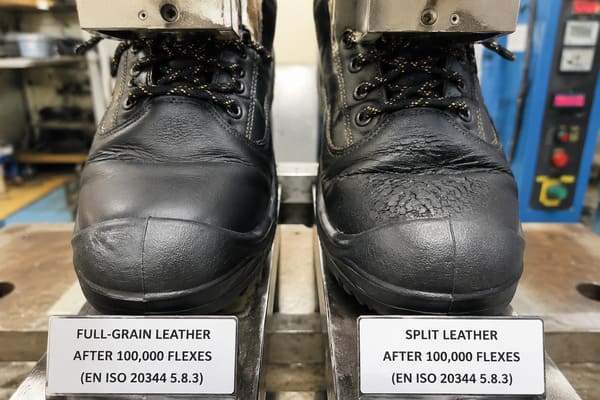
I once ran a side-by-side flex test in our factory. We put a full-grain upper and a split-leather upper with PU coating through 50,000 flex cycles. At 20,000 cycles, the split-leather sample started showing micro-cracks at the flex point behind the toe cap. The full-grain sample showed almost no surface damage at 50,000 cycles. That result wasn’t surprising to me. But it was eye-opening for the client who watched it happen.
Why Fiber Density Is the Real Performance Driver
The outermost layer of animal hide — called the grain layer — has the tightest, most interlocked fiber structure in the entire skin3. When you keep that layer intact, the leather behaves like a single, unified material. It bends without cracking. It resists water without a coating. It recovers its shape after compression.
A worker walking an 8-hour shift on a construction site flexes his shoe upper roughly 8,000 to 10,000 times per day4. Over a 6-month work period, that adds up to well over 1 million flex cycles. The table below shows how full-grain and split leather compare across the conditions that matter most in heavy-duty environments.
| Performance Factor | Full-Grain Leather | Split Leather (PU Coated) |
|---|---|---|
| Fiber structure | Dense, interlocked | Loose, layered |
| Abrasion resistance | High — natural surface holds | Low — depends on coating |
| Flex durability | 1M+ cycles without cracking | Coating cracks at 60–90 days under heavy use |
| Moisture resistance | Natural — pores resist penetration | Coating-dependent — fails when coating cracks |
| Shape retention | Strong — fibers hold structure | Weak — fibers delaminate over time |
In environments like steel mills, cement plants, and active construction sites, the upper takes mechanical punishment every single day. Full-grain leather is built for exactly that kind of punishment. Split leather is not.
Why Does Split Leather Cost Less But Wear Out Faster?
Price is always part of the conversation. I understand that. But when a buyer chooses split leather to save money on material cost, they’re often not calculating the full cost — including returns, complaints, and lost accounts.
Split leather is cut from the lower hide layers after the grain is removed. Raw material cost runs 40–60% lower than full-grain5. Manufacturers apply a thick PU coating to improve appearance. That coating looks clean in photos but cracks at the flex zone within 60–90 days under real work conditions.
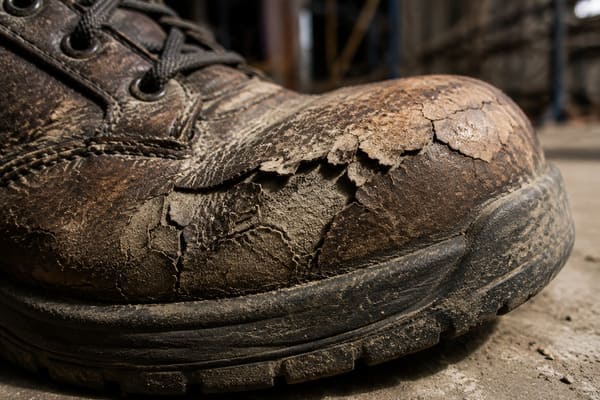
I had a client from the Middle East come to me after exactly this situation. He’d bought 3,000 pairs from a low-cost supplier. By month three, 30% of the pairs had visible upper damage. His end customer — a petrochemical contractor — refused the next shipment. That one material decision cost him the entire account.
The Real Cost Calculation Behind Split Leather
The PU coating on split leather is typically 0.3 to 0.5mm thick6. It’s applied to mask the rough, uneven surface of the lower hide. In a product photo, it looks smooth, clean, and even premium. But the coating has no flexibility of its own. Once it cracks — and it will crack — moisture enters the loose fiber structure underneath. The fibers start to separate. The upper loses its shape. The shoe fails.
Here’s how the cost picture actually looks when you factor in failure rate:
| Cost Factor | Split Leather (Apparent Saving) | Full-Grain Leather (True Value) |
|---|---|---|
| Raw material cost | 40–60% lower | Higher upfront |
| Useful lifespan under heavy use | 3–5 months | 12+ months |
| Failure rate at month 3–4 | High — coating cracks at flex zone | Low — surface holds under stress |
| Client complaint risk | High | Low |
| Account retention | At risk after first failure | Strong — end users trust the product |
The math is simple. A shoe that fails in four months and costs $18 is more expensive than a shoe that lasts twelve months and costs $28. The buyers who understand this are the ones who build long-term distribution businesses. The ones who don’t understand it come to me after they’ve already lost an account.
Which Leather Type Actually Meets Safety Standards?
This is a question I get often, and I want to answer it honestly. Certification is important. But certification alone does not tell you everything you need to know about leather quality.
Both full-grain and split leather can pass EN ISO 20345 and ASTM F2413 certification tests7. Lab tests measure specific thresholds under controlled conditions. Real-world performance — after months of twisting, kneeling, and wet exposure — is a different measurement entirely8.
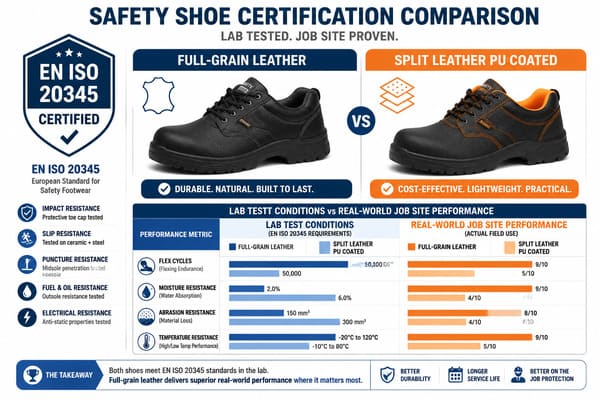
The standard lab tests for safety footwear uppers measure things like water penetration resistance after 80 minutes, abrasion resistance after 8,000 cycles, and flex resistance at a fixed angle for 30,000 cycles9. A well-coated split leather can hit those numbers in a controlled lab environment. I’ve seen it happen. The shoe passes. The certificate is issued. The shipment goes out.
What Certification Tests Don’t Measure
A worker in a cement plant doesn’t flex his shoe at a fixed angle for a fixed number of cycles. He twists his ankle stepping over rebar. He kneels in wet concrete for 20 minutes. He drags his foot across rough aggregate. These are not lab conditions. These are job site conditions.
The table below compares what certification tests actually measure versus what real-world use demands:
| Test Condition | Lab Standard | Real Job Site Reality |
|---|---|---|
| Flex angle | Fixed, controlled angle | Variable — twisting, kneeling, lateral movement |
| Flex cycles | 30,000 cycles at standard | 1M+ cycles over 6-month work period |
| Moisture exposure | 80-minute controlled test | Continuous wet exposure — rain, concrete, chemical splash |
| Surface abrasion | 8,000 cycles on flat surface | Irregular surfaces — gravel, metal edges, concrete |
| Temperature | Room temperature | 30–45°C in hot climates, sub-zero in cold storage |
I tell every client the same thing: the certification tells you the shoe passed on a specific day in a specific lab. The leather grade tells you what happens on day 200, in the rain, on a real job site. Both pieces of information matter. But they are not the same piece of information.
How Does Leather Quality Affect Comfort and Breathability?
Comfort is not a luxury specification. In occupational footwear, comfort directly affects compliance. A shoe a worker refuses to wear after lunch protects no one. And leather quality is one of the biggest factors driving that outcome.
Full-grain leather has natural pores that allow moisture vapor to pass through10. Split leather sealed with a thick PU coating blocks those pores11. Trapped moisture raises internal shoe temperature, increases fatigue, and leads to blisters — all of which reduce how long a worker will actually wear the shoe.
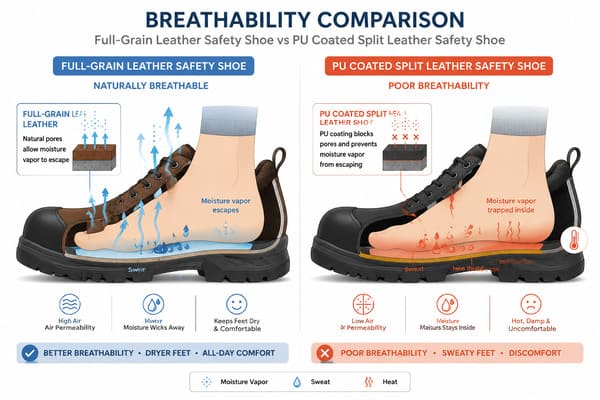
The average worker’s foot produces about 250ml of sweat per day during active use12. That moisture has to go somewhere. Full-grain leather allows moisture vapor to move through the material — not quickly, but enough to regulate temperature and reduce buildup. When you coat split leather with a thick PU layer, you seal those natural pores completely. The moisture stays inside the shoe.
The Link Between Breathability and Workplace Compliance
Research on occupational footwear shows that internal shoe temperature above 34°C significantly increases fatigue and the risk of blisters. In hot climates, this threshold is reached within the first two hours of a shift. Once a worker’s feet are hot and wet, his tolerance for wearing the shoe drops fast. By afternoon, workers in poorly ventilated safety shoes are loosening laces, removing insoles, or taking the shoes off entirely during breaks.
I’ve had clients in Southeast Asia — where workers wear safety shoes in 35°C heat — specifically request full-grain uppers because their workers were refusing to wear the previous split-leather shoes after lunch. That’s not a comfort complaint. That’s a safety compliance failure.
| Breathability Factor | Full-Grain Leather | Split Leather (PU Coated) |
|---|---|---|
| Natural pore structure | Intact — allows vapor transfer | Sealed by coating |
| Moisture management | Passive — vapor moves through hide | None — moisture stays inside shoe |
| Internal temperature | Lower — vapor transfer reduces heat | Higher — sealed environment traps heat |
| Fatigue risk | Lower | Higher above 34°C internal temp |
| Worker compliance | Higher — shoe remains wearable all day | Lower — workers resist wearing after midday |
Breathability is not a marketing feature. It is a functional requirement in any serious occupational footwear specification. And it is one of the first things that disappears when a manufacturer cuts cost by switching from full-grain to split leather with a PU surface.
Conclusion
Leather grade is decided once, at the sourcing stage. But the worker feels that decision every single day for the next twelve months. Choose the material that holds.
At Shoegan, we build every upper to perform in the field — not just in the lab. Contact us at [email protected] or WhatsApp +8613008988018.
-
"Polyurethane Electrospun Fiber Biomimetics Membrane for …", https://journals.uc.edu/index.php/JALCA/article/view/4358. A leather science or materials reference can support that full-grain leather is defined by retaining the natural grain surface of the hide, which is associated with a denser fiber network than lower split layers. Evidence role: definition; source type: education. Supports: Full-grain leather retains the outermost hide layer and therefore has a denser fiber structure than lower leather layers.. Scope note: Such a source would support the material definition and structure, but not necessarily prove superior performance in every safety-shoe design. ↩
-
"Differences in strength between the grain and corium layers of leather", https://www.academia.edu/2625763/Differences_in_strength_between_the_grain_and_corium_layers_of_leather. A leather technology reference can document that split leather is produced by separating the lower corium layers from the grain layer of a hide, producing a material with a different surface and fiber structure. Evidence role: definition; source type: education. Supports: Split leather is made from lower hide layers after the grain layer has been separated.. Scope note: This supports the origin and structure of split leather, not the specific failure timing claimed elsewhere in the article. ↩
-
"[PDF] EARLY DETECTION OF LOOSENESS IN BOVINE HIDES USING …", https://www.journals.uc.edu/index.php/JALCA/article/download/2961/2255. Histological and leather-science sources describe the grain layer of hide as having a compact collagen-fiber arrangement relative to deeper corium layers, supporting the article’s explanation of why the intact grain contributes to strength. Evidence role: mechanism; source type: paper. Supports: The hide’s grain layer has the most compact, interlocked fiber structure compared with lower layers.. Scope note: The source would explain the structural mechanism; performance in finished footwear also depends on tanning, thickness, finishing, and construction. ↩
-
"Does it matter for health if steps are taken during work or leisure? A …", https://pmc.ncbi.nlm.nih.gov/articles/PMC10251587/. Occupational activity and gait studies can be used to contextualize the estimate by reporting typical step counts during work shifts and the relationship between walking steps and repeated shoe flexion. Evidence role: statistic; source type: paper. Supports: An active worker may generate thousands of walking-related shoe flexions during an 8-hour shift.. Scope note: Available studies may report step counts rather than direct shoe-upper flex cycles, so the citation would support the estimate indirectly. ↩
-
"Leather Quality Chart: Decoding the World of Leather Grades", https://www.popovleather.com/blogs/from-the-workshop/the-ultimate-guide-to-leather-grades. A leather-industry cost or trade-statistics source could support that split leather is generally priced below full-grain leather because it comes from lower-value hide layers after the grain has been removed. Evidence role: statistic; source type: institution. Supports: Split leather raw material is substantially cheaper than full-grain leather, with the article specifying a 40–60% lower cost range.. Scope note: The exact 40–60% range is likely to vary by country, hide origin, thickness, tanning, and market date; a source may support the direction of the price difference more strongly than the precise range. ↩
-
"Chinese PU leather export manufacturer_PU leather …", https://www.polybestleather.com/products/pu-leather. Technical literature on coated leather or polyurethane-coated split leather can document common coating-layer thicknesses used to create a smooth finished surface on split substrates. Evidence role: statistic; source type: paper. Supports: PU coatings on split leather are commonly applied in measurable layers around the stated thickness range.. Scope note: Coating thickness varies by manufacturer, finish type, and product specification, so the source may establish a typical range rather than a universal value. ↩
-
"[PDF] ASTM F2413-11 Performance Requirements for Protective Footwear", https://facilities.uw.edu/partner-resources/files/media/performance-requirements-for-protective-footwear.pdf. The EN ISO 20345 and ASTM F2413 standards define performance requirements for protective footwear rather than mandating a single leather grade, which supports the point that more than one upper material can be used in certified footwear if the finished shoe meets the tests. Evidence role: definition; source type: institution. Supports: Safety-footwear certification standards are performance-based and do not automatically exclude full-grain or split leather uppers.. Scope note: The standards show material-neutral performance requirements; they do not demonstrate that every full-grain or split-leather shoe will pass certification. ↩
-
"The Impact of Footwear on Occupational Task Performance and …", https://pmc.ncbi.nlm.nih.gov/articles/PMC9518076/. Standards documentation and occupational-footwear research can support the distinction between controlled certification tests and field performance, noting that laboratory compliance evaluates defined hazards under specified conditions rather than all long-term workplace wear modes. Evidence role: general_support; source type: paper. Supports: Certification tests are controlled measurements and do not fully capture long-term field wear involving variable movement, moisture, and abrasion.. Scope note: This evidence would support the general limitation of laboratory tests; it would not quantify the exact difference in performance between full-grain and split leather in every workplace. ↩
-
"ISO/DIS 20344(en), Personal protective equipment — Test methods …", https://www.iso.org/obp/ui#!iso:std:iso:20344:dis:ed-3:v1:en. The relevant safety-footwear test standards or accredited laboratory guidance can verify the specified upper-material test methods, including water penetration, abrasion, and flex-resistance procedures used under controlled laboratory conditions. Evidence role: definition; source type: institution. Supports: Safety-footwear upper tests use defined laboratory procedures for water penetration, abrasion, and flex resistance.. Scope note: Exact cycle counts and durations should be checked against the current standard edition and the applicable footwear category, because requirements can differ by test method and standard revision. ↩
-
"[PDF] Factors affecting the water-vapor permeability of leather", https://nvlpubs.nist.gov/nistpubs/jres/44/jresv44n4p347_A1b.pdf. Leather comfort and permeability studies can show that natural leather has measurable water-vapor permeability due to its porous collagen structure, supporting the article’s claim about moisture-vapor transfer. Evidence role: mechanism; source type: paper. Supports: Full-grain leather’s porous structure can permit water-vapor transmission.. Scope note: Actual breathability depends on tanning, finishing, thickness, linings, membranes, and shoe construction, so the source would support the material mechanism rather than the performance of all finished shoes. ↩
-
"[PDF] Polyurethane Electrospun Fiber Biomimetics Membrane for …", https://journals.uc.edu/index.php/JALCA/article/download/4358/3309. Studies of coated leathers and polyurethane films can support that polymer surface coatings reduce water-vapor permeability by covering or sealing the porous leather substrate. Evidence role: mechanism; source type: paper. Supports: A polyurethane coating on split leather can reduce breathability by sealing the porous substrate.. Scope note: The degree of vapor blockage depends on coating formulation, thickness, and whether the coating is microporous, so the support may be contextual rather than absolute. ↩
-
"Lactate in human sweat: a critical review of research to the present day", https://pmc.ncbi.nlm.nih.gov/articles/PMC10717375/. A podiatry, dermatology, or occupational-health source can support that human feet contain many sweat glands and may produce approximately a quarter liter of perspiration per day under active or warm conditions. Evidence role: statistic; source type: government. Supports: A worker’s feet can produce about 250 ml of sweat per day during active use.. Scope note: Sweat volume varies substantially with temperature, workload, sock material, footwear design, and individual physiology. ↩