
A client from Germany came to us with a return problem. 30% of his customers reported ankle soreness after the first week. That one complaint changed everything I say about collar padding.
Collar padding in safety shoes is most commonly made from EVA foam, memory foam, PU foam, or neoprene. Each material serves a different purpose. The right choice depends on shift length, environment, and how much ankle support the worker needs throughout the day.
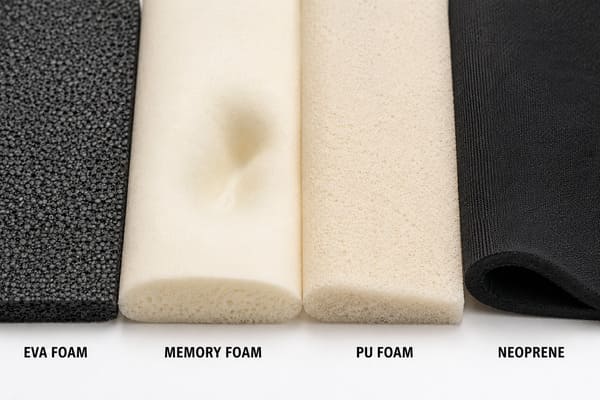
When I checked the sample that German client sent, the collar padding was basic EVA foam wrapped in a polyester lining. The shoe passed EN ISO 203451. But comfort was never part of the conversation. It looks like a small detail. But it decides whether a worker reaches for those shoes every morning — or leaves them in the locker.
What Materials Are Commonly Used for Collar Padding in Safety Shoes?
Most buyers never ask about collar padding until their workers start complaining. By then, the shoes are already in the field — and returns are expensive.
The four most common collar padding materials are EVA foam, memory foam, PU foam, and neoprene. EVA is the most affordable but compresses quickly. Memory foam molds to the ankle. PU foam offers better rebound and durability. Neoprene is used for cold or wet environments.
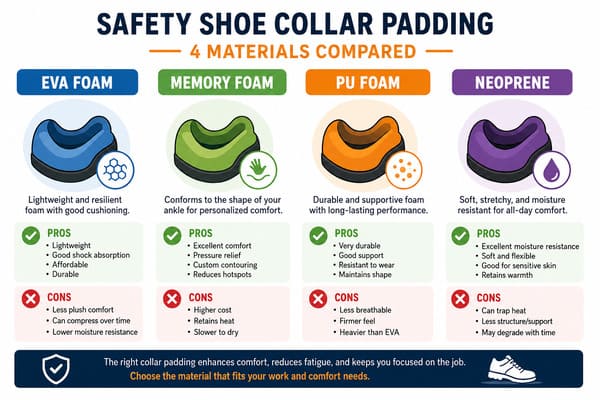
We use all four materials across our production line at Shoegan, and each one has a clear job.
EVA foam is the most common option on the market2. It costs the least and holds its shape well in the short term. But after 6–8 hours of continuous wear, it compresses and stops providing meaningful cushioning3. For short-shift or low-budget applications, it is acceptable. For full-day industrial use, it falls short.
Memory foam is softer and molds to the ankle shape within the first few minutes of wear. Workers in 10-hour shifts consistently prefer it. The key variable is density. We spec memory foam at 45–55 kg/m³ for collar padding4. Below that range, it bottoms out too quickly. Above it, the foam feels stiff and takes too long to respond.
PU foam sits between EVA and memory foam in terms of performance and price. It has better rebound than EVA and holds up longer than memory foam under daily compression. For mid-range safety shoes where budget matters but comfort cannot be ignored, PU foam is usually the right call.
Neoprene is what we use in cold storage and wet environment shoes5. It keeps warmth in, resists moisture, and maintains its structure even when wet. It is not the right choice for standard industrial use — it traps heat in warm environments — but for workers in freezer warehouses or outdoor winter conditions, nothing else compares.
When a buyer asks me "what’s standard," I always ask back: "what does your worker do for 8 hours a day?" That answer tells me which material belongs in the collar.
| Material | Best For | Weakness | Price Range |
|---|---|---|---|
| EVA Foam | Short shifts, budget shoes | Compresses after 6–8 hrs | Low |
| Memory Foam | Long shifts, ankle comfort | Heat retention if lining is wrong | Medium–High |
| PU Foam | Mid-range, daily industrial use | Less adaptive than memory foam | Medium |
| Neoprene | Cold/wet environments | Traps heat in warm conditions | Medium–High |
How Does Collar Padding Affect the Comfort and Fit of Safety Shoes?
Most return complaints about safety shoes are blamed on the outsole or the toe cap. The real cause is often the collar. Workers just cannot name it.
Collar padding directly affects break-in time, ankle stability, and friction levels throughout a shift. Padding that is too thin causes heel slippage and blisters6. Padding that is too thick creates a pressure ring around the ankle. The right thickness and density keeps the foot locked in without cutting off circulation.
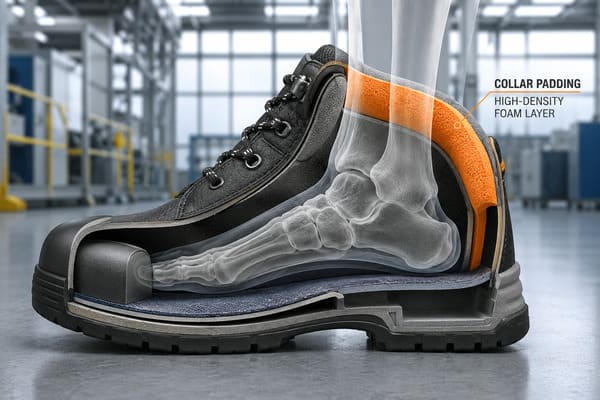
I remember walking the production floor with Egan early in my time here. He picked up two finished shoes — same last, same upper — and pressed his thumb into the collar of each one. One bounced back in under a second. The other took three seconds. He said: "that slow one will feel stiff on day one, and workers will blame the whole shoe."
He was right. Collar padding affects three things that workers feel directly.
Break-in speed. Foam that responds quickly reduces the stiff, tight feeling on day one. Workers who experience that stiffness often stop wearing the shoe before it has time to conform to their foot. A faster-responding foam shortens that window.
Ankle stability across a shift. At hour one, most foams feel adequate. At hour eight, the difference becomes clear. Foam that has compressed too much no longer holds the ankle in place. The foot begins to shift slightly inside the shoe, and that movement creates fatigue in the ankle and lower leg.
Friction and blister risk. Padding that is too thin allows the heel to lift slightly with each step. That lift creates friction between the heel and the shoe lining. Over a full shift, that friction becomes a blister. Padding that is too thick or too dense does the opposite — it presses into the ankle and creates a pressure ring by mid-shift.
The sweet spot for most full-shift industrial shoes is 10–15mm of medium-density foam7 paired with a moisture-wicking inner lining. That combination keeps the ankle supported without creating pressure, and it manages sweat well enough to prevent the secondary discomfort that comes from heat buildup.
Which Collar Padding Material Is Best for Long Hours of Wear?
After two years of reviewing return data from our European OEM clients, one answer came up consistently. It was not the answer most buyers expected.
Memory foam at 45–55 kg/m³ density performs best for long-hour wear. It molds to the ankle, maintains support across a full shift, and reduces comfort-related complaints significantly compared to EVA. It must be paired with a breathable or moisture-wicking lining to avoid heat buildup around the ankle.
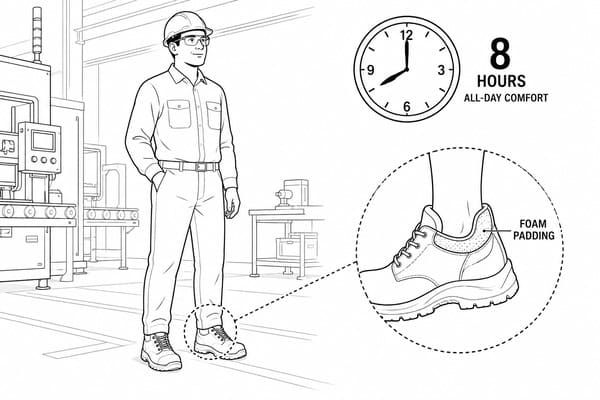
Across three European OEM clients, shoes built with memory foam collar padding at that density range had roughly 60% fewer comfort-related complaints8 compared to the same styles built with standard EVA foam. That number was consistent enough that we now recommend memory foam as the default for any shoe intended for shifts over eight hours.
But there was a catch. Two of those three clients were using a non-breathable polyester lining over the memory foam. Workers still complained about heat and sweat around the ankle by hour six. The foam was right, but the lining was wrong. The moisture had nowhere to go, and that created a secondary discomfort that cancelled out the benefit of the better foam.
This is a mistake I see often in mid-range shoe production. Buyers upgrade the foam but keep the cheapest available lining to control cost. The result is a shoe that feels better in the first two hours and worse in the last four.
Now when clients specify memory foam collar padding, I always push them to pair it with a mesh or moisture-wicking fabric lining. Both parts have to work together.
| Shift Length | Recommended Material | Lining Pairing | Notes |
|---|---|---|---|
| Under 6 hours | EVA or PU foam | Standard polyester acceptable | Cost-effective for light use |
| 6–8 hours | PU foam or low-density memory foam | Moisture-wicking preferred | Good balance of cost and comfort |
| 8–12 hours | Memory foam 45–55 kg/m³ | Mesh or moisture-wicking required | Highest comfort retention |
| Cold/wet environments | Neoprene | Sealed or thermal lining | Not suitable for warm conditions |
What Are the Disadvantages of Composite Toe?
Composite toe caps get recommended for the wrong reasons more often than I would like to admit. Lighter weight is real. But it is not the whole story.
Composite toe caps are lighter and non-metallic, which makes them suitable for electrical hazard zones and metal-detection environments9. However, they can fracture under repeated heavy impact, require more internal volume than steel, and may not hold up in high-stress industrial environments the way steel toe caps do.
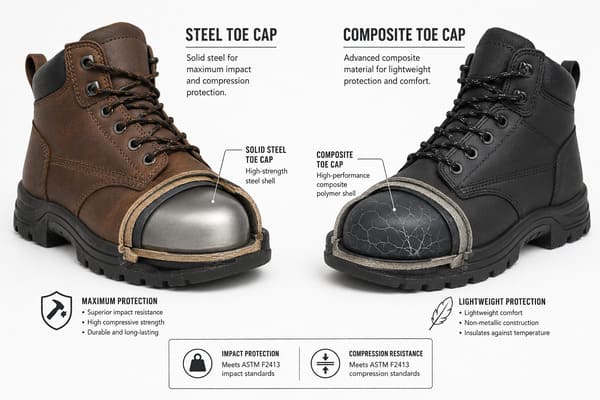
A procurement manager from an Australian distributor once told me: "we switched everything to composite toe because workers complained steel was too heavy." Six months later he was back. Three pairs had cracked toe caps from repeated impact in a heavy logistics environment. The shoes passed EN ISO 20345 at 200 joules — same as steel. But the real-world performance told a different story.
Here is what composite toe does well and where it falls short.
Weight advantage. Composite toe caps are meaningfully lighter than steel. For workers on their feet all day in environments where impact risk is low to moderate, that weight reduction reduces fatigue. It is a real benefit in the right context.
Non-metallic advantage. Composite caps do not conduct electricity and do not trigger metal detectors. For electrical workers, aviation ground crews, and food production facilities with metal detection requirements, composite is the correct choice. Steel simply cannot be used in those environments.
Impact limitation. Both steel and composite meet the 200-joule impact standard under EN ISO 2034510. But the way they respond to impact is different. Steel deforms and holds. Composite can fracture under repeated stress, especially in environments where the toe cap absorbs impact multiple times per shift over months of use11. A single-impact test in a lab does not reflect that reality.
Fit and volume. Composite materials require more thickness to achieve the same protection area as steel12. That means the toe box on a composite shoe needs more internal volume. On narrow lasts or for workers with narrower feet, this can affect fit and cause the foot to shift forward inside the shoe.
My direct recommendation: for electrical work, aviation, or food production — composite is the right call. For heavy manufacturing, mining, or any environment with repeated impact — steel toe is still the safer choice, and I tell clients that directly rather than letting them find out through a return complaint.
| Factor | Steel Toe | Composite Toe |
|---|---|---|
| Weight | Heavier | Lighter |
| Electrical safety | Conducts electricity | Non-conductive |
| Metal detection | Triggers detectors | Does not trigger |
| Impact performance | Deforms, holds shape | Can fracture under repeated impact |
| Toe box volume | Compact | Requires more internal space |
| Best environment | Heavy manufacturing, mining | Electrical, aviation, food production |
Conclusion
Collar padding and toe cap material both shape how a safety shoe performs over a full shift. Small choices in construction decide whether workers stay protected and comfortable all day. At Shoegan, we help clients make those choices right from the start — reach us at [email protected] or WhatsApp +8613008988018.
-
"Analysis of the Impact Resistance of Toecaps by the Finite Element …", https://pmc.ncbi.nlm.nih.gov/articles/PMC9819023/. EN ISO 20345 specifies basic and additional (optional) requirements for safety footwear, including a mandatory 200-joule impact resistance test for toe protection, and is the primary certification standard for occupational safety footwear in European and international markets. Evidence role: definition; source type: institution. Supports: EN ISO 20345 is the international standard specifying requirements for safety footwear used in professional environments. ↩
-
"EVA Foam Market Size, Share, Growth, Demand Analysis, Trends …", https://www.zionmarketresearch.com/report/eva-foam-market. EVA (ethylene-vinyl acetate) foam is extensively documented as a primary cushioning material in footwear due to its low cost, light weight, and adequate shock absorption properties, making it a standard choice across the footwear industry. Evidence role: general_support; source type: research. Supports: EVA foam is widely used as a cushioning and padding material in footwear manufacturing. Scope note: General footwear industry sources may not specifically address collar padding applications in safety shoes. ↩
-
"CAN RUNNERS PERCEIVE CHANGES IN HEEL CUSHIONING AS …", https://pmc.ncbi.nlm.nih.gov/articles/PMC5534152/. Research on foam material fatigue in footwear applications indicates that EVA foam exhibits measurable compression set under repeated or sustained loading, reducing its energy return and cushioning capacity over time. Evidence role: mechanism; source type: paper. Supports: EVA foam undergoes compression set and loses cushioning performance under sustained mechanical loading. Scope note: Published studies typically measure compression set under standardized mechanical testing rather than continuous human wear, so the 6–8 hour threshold cited in the article is not directly verifiable from laboratory data alone. ↩
-
"Memory foam – Wikipedia", https://en.wikipedia.org/wiki/Memory_foam. Material science literature on viscoelastic (memory) foams establishes that density is a primary determinant of load-bearing capacity and conformability, with lower densities prone to bottoming out and higher densities exhibiting reduced responsiveness. Evidence role: mechanism; source type: research. Supports: Foam density directly affects cushioning performance, with specific density ranges associated with optimal comfort and support in footwear applications. Scope note: Published sources may not specify the exact 45–55 kg/m³ range for collar padding; this range appears to reflect manufacturer experience rather than a formally standardized specification. ↩
-
"Noble-gas-infused neoprene closed-cell foams achieving ultra-low …", https://pmc.ncbi.nlm.nih.gov/articles/PMC9080917/. Neoprene (polychloroprene) is documented as a synthetic rubber with notable resistance to water, temperature extremes, and compression, properties that underpin its use in protective clothing and footwear for cold and wet environments. Evidence role: definition; source type: encyclopedia. Supports: Neoprene (polychloroprene) possesses thermal insulation and water-resistance properties that make it suitable for cold and wet environment applications. Scope note: General material property sources do not specifically address neoprene’s performance as collar padding in safety footwear under occupational conditions. ↩
-
"Friction Blisters of the Feet: A Critical Assessment of Current … – PMC", https://pmc.ncbi.nlm.nih.gov/articles/PMC10783476/. Biomechanical research on footwear-related skin injury identifies repetitive shear stress from heel movement within the shoe as a primary mechanism of blister formation, with inadequate collar fit and heel counter support identified as contributing factors. Evidence role: mechanism; source type: paper. Supports: Heel slippage within footwear creates repetitive friction that leads to blister formation on the heel and posterior ankle. Scope note: Studies on blister formation typically focus on athletic footwear; direct research on safety shoe collar padding thickness and blister incidence in occupational settings is limited. ↩
-
"Footwear comfort: a systematic search and narrative synthesis of the …", https://pmc.ncbi.nlm.nih.gov/articles/PMC8650278/. Ergonomic guidelines for occupational footwear design address collar padding as a factor in ankle stability and comfort, though specific thickness recommendations vary by application and are not universally standardized across published literature. Evidence role: expert_consensus; source type: research. Supports: Collar padding thickness in occupational footwear affects ankle support and comfort, with specific thickness ranges associated with optimal outcomes. Scope note: The 10–15mm range cited in the article appears to reflect manufacturer practice rather than a formally published ergonomic standard; independent verification of this specific range was not identified. ↩
-
"The Impact of Footwear on Occupational Task Performance and …", https://pmc.ncbi.nlm.nih.gov/articles/PMC9518076/. Studies comparing viscoelastic and EVA foam in footwear applications generally report that viscoelastic materials provide better pressure distribution and sustained cushioning over extended wear periods, which is consistent with reduced discomfort complaints in occupational settings. Evidence role: general_support; source type: paper. Supports: Memory foam (viscoelastic foam) provides superior comfort outcomes compared to standard EVA foam in footwear applications for extended wear. Scope note: The 60% figure cited in the article is derived from proprietary client return data and is not independently verifiable; published studies do not report this specific magnitude of improvement in safety footwear contexts. ↩
-
"Guide to OSHA-Approved Shoes – The Home Depot", https://www.homedepot.com/c/ab/guide-to-osha-approved-shoes-/9ba683603be9fa5395fab901b23e48fd. Safety footwear standards such as ASTM F2413 include electrical hazard (EH) ratings that require footwear to provide a secondary source of electric shock protection; composite toe caps, being non-metallic, are compatible with EH-rated constructions, whereas steel toe caps are not. Evidence role: general_support; source type: institution. Supports: Composite toe caps are non-conductive and can meet electrical hazard (EH) ratings in safety footwear standards. Scope note: EH rating requirements vary between ASTM (North American) and EN ISO (European) standards; the article does not specify which regulatory framework applies to the clients discussed. ↩
-
"Understanding EN ISO 20345 – Safety Footwear (formerly EN345)", https://www.wiseworksafe.com/blog/view/understanding-en-iso-20345-safety-footwear-formerly-en345-. Under EN ISO 20345, toe caps in safety footwear—whether steel, aluminum, or composite—must withstand an impact energy of 200 joules without the clearance falling below specified minimums, establishing a material-neutral performance threshold. Evidence role: statistic; source type: institution. Supports: EN ISO 20345 mandates a 200-joule impact resistance test for toe caps regardless of material type. ↩
-
"Assessing the Compressive and Impact Behavior of Plastic Safety …", https://pmc.ncbi.nlm.nih.gov/articles/PMC8703535/. Engineering literature on composite materials notes that fiber-reinforced polymers, unlike ductile metals, are susceptible to brittle fracture and fatigue crack propagation under cyclic loading, a failure mode relevant to composite toe caps subjected to repeated occupational impacts. Evidence role: mechanism; source type: paper. Supports: Composite materials used in toe caps can exhibit brittle fracture or fatigue failure under repeated impact loading, unlike steel which deforms plastically. Scope note: Published fatigue studies on composite toe caps specifically are limited; most available data concerns single-impact laboratory testing per EN ISO 20345 rather than cumulative real-world impact scenarios. ↩
-
"Analysis of the Impact Resistance of Toecaps by the Finite Element …", https://pmc.ncbi.nlm.nih.gov/articles/PMC9819023/. Engineering comparisons of toe cap materials indicate that composite materials (typically fiberglass or carbon fiber reinforced polymers) require greater wall thickness than steel to meet equivalent impact resistance thresholds, as their specific strength is lower than that of hardened steel, resulting in increased internal volume requirements within the toe box. Evidence role: mechanism; source type: research. Supports: Composite toe caps must be thicker than steel toe caps to achieve equivalent impact resistance due to the lower strength-to-weight ratio of composite materials. Scope note: Specific thickness comparisons between steel and composite toe caps meeting EN ISO 20345 are not widely published in open literature; this claim is supported by general composite materials engineering principles rather than footwear-specific studies. ↩