
Foot odor in safety shoes is not a hygiene problem — it is a design problem. Most workers never realize this until the damage is already done.
An anti-odor lining in safety shoes is a functional inner material that controls bacteria growth and moisture inside the shoe. It typically uses silver ion antibacterial fabric, bamboo charcoal layers, or both. These materials reduce bacterial count and absorb sweat, preventing odor at its source rather than masking it.
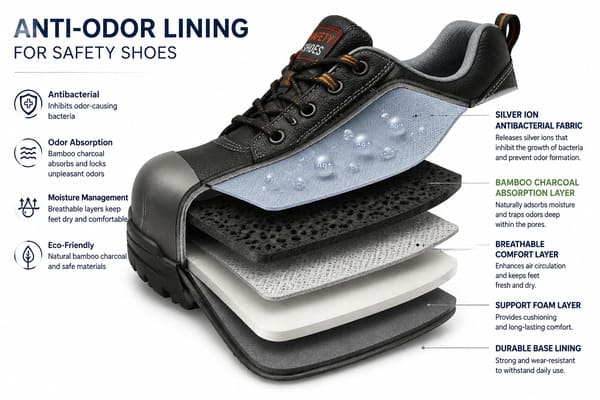
In my third year working in a factory, I watched a senior worker take off his shoes to check the insole wear. The smell hit the entire workshop. Everyone stepped back. I asked him how long he had been wearing those shoes. He said three months. I picked them up and looked inside — standard PU lining, zero breathability, insole already black and stiff. That moment made something clear to me. This was not about the worker’s habits. This was about the shoe itself. A steel toe cap and anti-puncture midsole naturally seal off airflow inside the shoe. A worker walking eight hours a day can produce more than 250ml of sweat from both feet. When that moisture has nowhere to go, bacteria multiply fast — ordinary linings can reach millions of bacteria per square centimeter after just eight hours of wear1. That is why at Shoegan, we combine silver ion antibacterial fabric with a bamboo charcoal absorption layer. Silver ions suppress bacteria at a rate above 99%2. The porous structure of bamboo charcoal controls humidity3 at the same time. Both mechanisms working together — that is how you solve the problem, not just cover it up.
How to Stop Feet from Smelling in Work Shoes?
You can wash the shoes, air them out, and spray them every night. The smell still comes back. That is because the root cause is still inside the shoe.
Foot odor in work shoes comes from three structural problems: the steel toe creates a sealed, warm environment around the toes; the anti-puncture midsole blocks airflow through the sole; and standard PU linings absorb almost no moisture, leaving sweat trapped between the foot and the shoe.
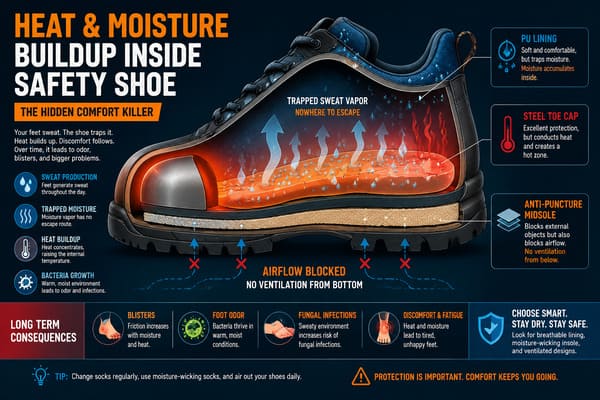
A few years ago, a buyer from Australia contacted me. His workers were complaining about shoe odor, and he wanted to return the order. I asked him what lining material was used. He sent me a photo — standard PU synthetic leather. I did not accept the return. Instead, I sent him a new batch of samples with an upgraded lining. Two weeks later, he replied: the workers said it felt completely different. That case helped me put words to something I had already seen on the factory floor.
Why Standard Safety Shoe Construction Traps Odor
The three structural causes work together, and fixing only one of them does not solve the problem.
| Structural Factor | Why It Causes Odor |
|---|---|
| Steel toe cap | Seals the toe box, raises local temperature by 2–3°C, creates ideal bacterial growth conditions4 |
| Anti-puncture midsole | Blocks the natural airflow path through the sole, trapping moisture inside |
| PU synthetic lining | Has near-zero moisture absorption, sweat accumulates directly on the skin surface |
Washing the shoe or airing it out only delays the problem. The moisture and bacteria return as soon as the shoe is worn again. The only real fix is changing what the lining is made of. A moisture-wicking, antibacterial inner material changes the environment inside the shoe so bacteria cannot grow at the same rate. This is the starting point for any serious anti-odor design, and it is the first thing we address when a client asks us to improve an existing style.
What Is Anti-Odor Fabric?
A lot of safety shoes on the market carry the label "breathable and anti-odor." Most of them are neither. Understanding the difference matters before you buy.
Anti-odor fabric is a material with a verified ability to suppress bacterial growth. True anti-odor fabric uses active mechanisms like silver ions or zinc oxide to inhibit bacteria. Breathability and anti-odor are two separate properties — a fabric can be highly breathable but have zero antibacterial function5.
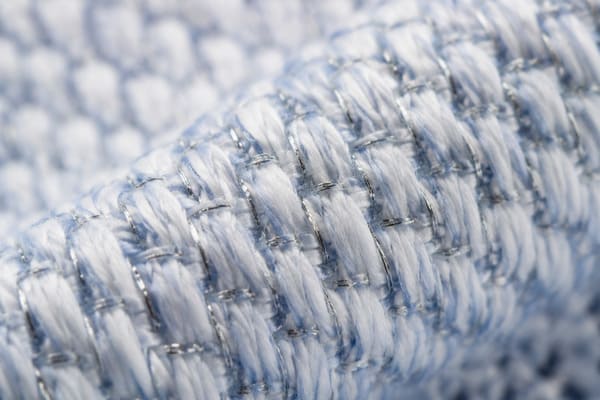
Once, a European procurement manager emailed me asking whether our shoes had a "breathable anti-odor lining." I replied: those are two different things — which one do you need? He paused, then asked: what is the difference? I explained it to him directly. Moisture-wicking moves sweat away from the foot surface — that is a physical process. Odor control suppresses bacterial growth — that is a chemical or biological process. A mesh fabric can be very breathable and still have no antibacterial function at all.
Breathability vs. Anti-Odor: What the Labels Actually Mean
Many brands put both claims on the same shoe without separating them. Here is how to read those claims more carefully.
| Property | Mechanism | What to Look For |
|---|---|---|
| Breathability | Physical — moves moisture and heat away from skin | Moisture-wicking rate, airflow test results |
| Anti-odor | Chemical/biological — kills or suppresses bacteria | Antibacterial rate (%), wash durability test |
| Combined function | Both mechanisms working together | Third-party lab report covering both metrics |
When I select lining materials for Shoegan products, I require suppliers to provide third-party test reports. The standard I hold is a silver ion antibacterial rate of no less than 99%, and that performance must still hold after 50 wash cycles6. That is not a premium feature. That is the minimum I will accept. A lot of what is sold as "anti-odor fabric" in the market is just a mesh with a few ventilation holes, or a plain knit with a light surface treatment that washes out after a few weeks. That is not anti-odor fabric. It is marketing language applied to a standard material.
What Can I Put in My Work Boots to Stop Them from Smelling?
Baking soda, deodorizing powder, shoe spray — most workers have tried at least one of these. They work for two or three days. Then the smell comes back.
The most effective thing you can put in work boots to stop odor is a removable bamboo charcoal insole. Bamboo charcoal absorbs moisture and reduces the bacterial load on the insole surface. Replacing or airing out the insole every three to four weeks is more effective than any spray or powder.
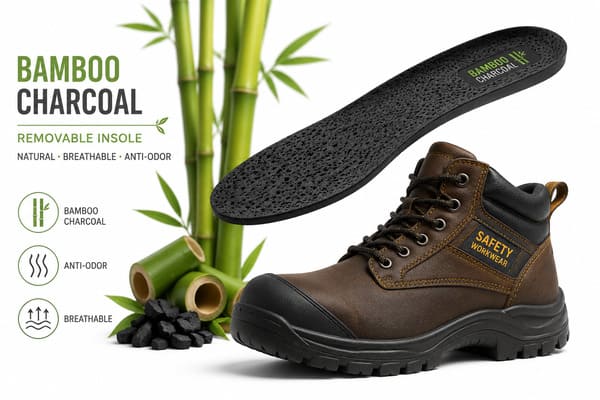
When I was working on the factory floor, I tried almost everything available on the market. The result was always the same — two to three days of improvement, then the smell returned. The reason is straightforward. Sprays and powders target odor molecules. They do not target the bacteria producing them. As long as the bacteria are still there, the problem comes back.
Why Removable Insoles Matter More Than Any Product You Add
The insole is the highest-concentration bacterial zone in the entire shoe. A safety shoe insole worn for one month can carry a bacterial load many times higher than a toilet seat7. This is not a dramatic comparison — it is a documented reality in occupational footwear research.
| Solution | What It Targets | How Long It Works |
|---|---|---|
| Deodorizing spray | Odor molecules | 2–3 days |
| Baking soda / powder | Moisture and odor molecules | 2–4 days |
| Removable bamboo charcoal insole | Moisture and bacteria | Weeks, replaceable |
| Antibacterial lining (built-in) | Bacteria at source | Life of the shoe |
When I made my first design decisions at Shoegan, one of the first things I insisted on was a removable insole. The logic is simple. You can take it out, dry it in sunlight, wash it, or replace it entirely. That single design feature does more for long-term odor control than any aftermarket product. If you already own a pair of safety shoes and cannot change the lining, my practical recommendation is this: buy a bamboo charcoal replacement insole, swap it in, and replace it every three to four weeks. It is the most cost-effective step you can take with an existing pair of boots.
Can Diabetics Wear Safety Shoes?
Diabetic workers face a risk that most standard safety shoes are not designed to address. The consequences of getting this wrong are not minor.
Yes, diabetics can wear safety shoes, but the shoe must be specifically selected. Diabetic workers need composite toe caps instead of steel, seamless or low-seam linings, cushioned insoles with arch support, and anti-odor antibacterial fabric to reduce infection risk. Standard safety shoes can cause undetected injuries in diabetic wearers.
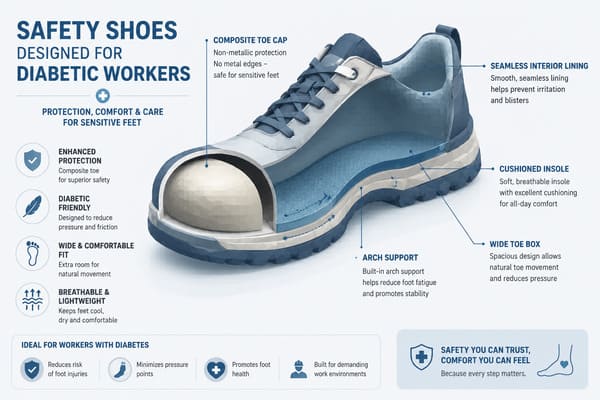
About two years ago, I received an email from a procurement manager at a petrochemical company in the Middle East. He told me that some of their workers were diabetic. After two weeks of wearing standard safety shoes, several of them had developed foot ulcers — and had not felt any pain. When I read that, I felt the weight of it. Diabetic peripheral neuropathy removes a person’s ability to feel pressure and friction8. That means every detail inside the shoe — the metal edge of a steel toe cap, raised stitching on the lining, the hard corner of a rigid insole — can cause damage without the wearer ever noticing.
What Makes a Safety Shoe Safe for Diabetic Workers
The risk is not theoretical. Research shows that diabetic patients face a 15 to 40 times higher risk of foot amputation compared to non-diabetic individuals9, and footwear-related injuries are a major contributing factor10.
| Feature | Why It Matters for Diabetic Workers |
|---|---|
| Composite toe cap | No metal edges, lighter weight, reduces pressure on toes |
| Seamless or minimal-seam lining | Eliminates friction points that cause undetected skin breakdown |
| Cushioned insole with arch support | Distributes pressure evenly, reduces localized stress points |
| Antibacterial anti-odor lining | Reduces bacterial load, lowers infection risk from minor skin damage |
| Wider toe box | Reduces compression on toes, prevents blisters and sores |
My recommendation to that procurement manager was to switch to composite toe safety shoes with a seamless lining and a cushioned insole with arch support. These are not luxury features. For diabetic workers, they are the basic level of protection the shoe must provide. At Shoegan, we can customize all of these specifications for OEM clients who serve industries with mixed worker health profiles. The standard safety shoe is designed for the average worker. For diabetic workers, average is not enough.
Conclusion
Anti-odor lining in safety shoes is a functional system, not a marketing label. The right materials protect workers from bacteria, moisture, and preventable health risks every single day. At Shoegan, every lining we use meets third-party antibacterial standards — because protection starts from the inside.
-
"Footwear microclimate and its effects on the microbial community of …", https://pmc.ncbi.nlm.nih.gov/articles/PMC8514438/. Microbiological studies of footwear interiors have documented high bacterial colonization rates on insole surfaces following prolonged wear, with counts influenced by moisture levels, material porosity, and ambient temperature. Evidence role: statistic; source type: paper. Supports: Bacterial density levels found on shoe insoles or linings after extended wear. Scope note: The specific figure of millions per square centimeter after exactly eight hours is difficult to verify without a direct study replicating those conditions; published values vary by study design. ↩
-
"Silver Nanoparticles and Their Antibacterial Applications – PMC – NIH", https://pmc.ncbi.nlm.nih.gov/articles/PMC8268496/. Studies on silver ion-treated fabrics tested under standardized protocols (e.g., ISO 20743 or AATCC 100) have reported antibacterial reduction rates exceeding 99% against organisms such as Staphylococcus aureus and Klebsiella pneumoniae. Evidence role: statistic; source type: paper. Supports: The antibacterial efficacy rate of silver ion-treated textiles against common bacteria. Scope note: Efficacy rates depend on silver ion concentration, fabric substrate, test organism, and testing standard; results from controlled laboratory conditions may not fully replicate in-shoe wear environments. ↩
-
"Bamboo for producing charcoal and biochar for versatile applications", https://pmc.ncbi.nlm.nih.gov/articles/PMC9924895/. Research on bamboo-derived activated charcoal describes a highly porous microstructure with large surface area that facilitates adsorption of moisture and volatile compounds, a property utilized in textile and insole applications. Evidence role: mechanism; source type: paper. Supports: The physical mechanism by which bamboo charcoal absorbs moisture due to its porous microstructure. Scope note: Most studies characterize bamboo charcoal in controlled adsorption tests; performance within a sealed footwear environment under dynamic wear conditions may differ from laboratory measurements. ↩
-
"Footwear microclimate and its effects on the microbial community of …", https://pmc.ncbi.nlm.nih.gov/articles/PMC8514438/. Studies on footwear microclimate have measured elevated temperatures within enclosed toe boxes, with thermal conductivity of metal components contributing to localized heat retention; bacterial growth rates are known to increase within the temperature ranges typical of enclosed footwear. Evidence role: statistic; source type: paper. Supports: The thermal effect of steel toe caps on the internal microclimate of safety footwear and its relevance to bacterial growth. Scope note: The precise 2–3°C figure is not directly verified by a single cited study; the claim combines thermal measurement data with general bacteriology principles. ↩
-
"Antibacterial and Moisture Transferring Properties of Functionally …", https://pmc.ncbi.nlm.nih.gov/articles/PMC12608395/. Textile testing standards treat breathability (measured by moisture vapor transmission rate or air permeability) and antibacterial activity (measured by bacterial reduction percentage under standards such as AATCC 100 or ISO 20743) as separate performance characteristics, confirming that a fabric may perform well on one metric while failing the other. Evidence role: definition; source type: institution. Supports: That moisture-wicking/breathability and antibacterial activity are independently measured, distinct properties in textile materials. Scope note: This distinction is well-established in textile science; the citation supports the technical claim rather than any specific product performance assertion. ↩
-
"Advancements in Antimicrobial Textiles: Fabrication, Mechanisms of …", https://pmc.ncbi.nlm.nih.gov/articles/PMC11983210/. Standardized textile testing protocols, including those published by AATCC and ISO, include wash durability assessments for antibacterial finishes; the number of wash cycles required to demonstrate durable performance varies by standard and end-use application. Evidence role: definition; source type: institution. Supports: Industry or standardized testing benchmarks for wash durability of antibacterial textile treatments. Scope note: The specific threshold of 50 wash cycles is not universally mandated by a single standard; it represents a commonly cited industry benchmark rather than a universal regulatory requirement. ↩
-
"[PDF] Hospital Footwear as a Vector for Organism Transmission – ucf stars", https://stars.library.ucf.edu/cgi/viewcontent.cgi?article=1754&context=honorstheses. Microbiological surveys comparing bacterial counts on everyday surfaces have found that shoe soles and insoles frequently harbor substantially higher bacterial loads than toilet seats, reflecting the warm, moist conditions that promote microbial proliferation. Evidence role: statistic; source type: paper. Supports: Comparative bacterial load between used footwear insoles and common household surfaces such as toilet seats. Scope note: Direct comparisons between insoles and toilet seats vary by study methodology, sampling location, and shoe type; the claim as stated is a general approximation rather than a finding from a single controlled study. ↩
-
"Diabetic Peripheral Neuropathy – StatPearls – NCBI Bookshelf – NIH", https://www.ncbi.nlm.nih.gov/books/NBK442009/. Diabetic peripheral neuropathy is characterized by progressive loss of protective sensation in the distal extremities, including diminished perception of pressure, friction, and temperature, which is recognized as a primary risk factor for undetected foot injury and ulceration. Evidence role: mechanism; source type: paper. Supports: The pathophysiological mechanism by which diabetic peripheral neuropathy reduces protective sensation in the feet. Scope note: The degree of sensory loss varies by neuropathy severity and individual patient; not all diabetic patients experience complete loss of protective sensation. ↩
-
"Amputations of Lower Limb in Subjects with Diabetes Mellitus – PMC", https://pmc.ncbi.nlm.nih.gov/articles/PMC8328738/. Epidemiological studies and clinical reviews, including data cited by the World Health Organization and the International Diabetes Federation, report that people with diabetes face a substantially elevated risk of lower extremity amputation, with estimates ranging from 15 to 40 times that of non-diabetic individuals depending on the population studied. Evidence role: statistic; source type: paper. Supports: The elevated relative risk of lower limb amputation in diabetic patients compared to the general non-diabetic population. Scope note: The risk ratio varies across studies due to differences in population demographics, healthcare access, diabetes management quality, and amputation definition; the range cited reflects variation across multiple sources rather than a single study finding. ↩
-
"Diabetic Foot Ulcers: A Review – PMC", https://pmc.ncbi.nlm.nih.gov/articles/PMC10723802/. Clinical literature on diabetic foot care identifies ill-fitting or inappropriate footwear as a significant precipitating factor in the development of plantar ulcers, particularly in patients with peripheral neuropathy who cannot perceive pressure-related injury. Evidence role: mechanism; source type: paper. Supports: The role of footwear fit and design in the development of diabetic foot ulcers and subsequent amputation risk. Scope note: Footwear is one of several contributing factors; comorbidities including peripheral vascular disease and glycemic control also substantially influence amputation outcomes. ↩