
A buyer from a Dutch PPE distributor asked me this exact question two years ago. He was placing an order for 800 pairs and assumed cut height was just about looks.
The main difference is function, not style. Low-cut shoes sit below the ankle and work best on flat, controlled surfaces. Mid-cut shoes rise 5–6 inches above the ankle and add support for uneven terrain1. The shaft height directly affects ankle protection, debris entry, and leg fatigue after long shifts2.

I told that Dutch buyer: the shaft height changes three things directly — ankle protection, debris entry, and how tired a worker’s leg feels after 10 hours. He ended up splitting his order into two SKUs after that conversation. Cut height is one of the first functional decisions in safety shoe selection, not the last.
Which Is Better, High-Cut or Low-Cut Safety Shoes?
I get this question at least once a week. My answer is always the same: neither is better — the job site decides.
There is no universally better option between high-cut and low-cut safety shoes. The right choice depends entirely on the work environment. Flat, controlled indoor floors favor low-cut. Uneven, outdoor, or high-risk terrain favors mid-cut or high-cut. The ground underfoot is what makes the decision.
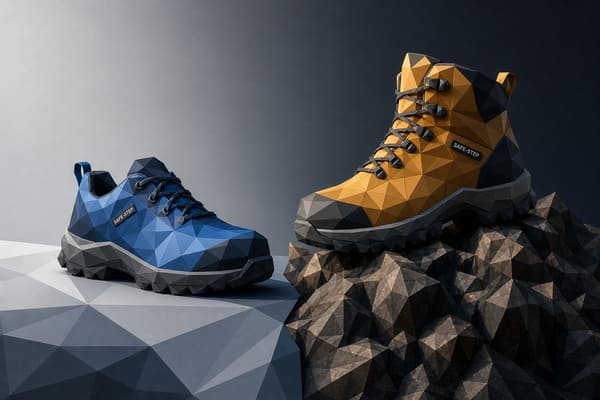
Last year, a construction contractor in the Middle East came to me after three workers sprained their ankles in one month. They were all wearing low-cut shoes on uneven gravel terrain. We switched them to mid-cut with ankle reinforcement, and the injury rate dropped to zero in the following quarter3. Low-cut is excellent on flat, controlled floors. The moment the ground changes, the shoe needs to change too.
How Does Terrain Affect Cut Height Selection?
The surface a worker stands on is the single most important variable in cut height selection. Here is how I break it down for buyers:
| Terrain Type | Recommended Cut | Reason |
|---|---|---|
| Flat concrete / warehouse floor | Low-cut | Maximum comfort, no ankle restriction needed |
| Mixed indoor/outdoor | Mid-cut | Balances mobility with partial ankle support |
| Uneven gravel / construction site | Mid-cut or High-cut | Ankle roll risk is real and frequent |
| Slopes, scaffolding, rough terrain | High-cut | Full ankle wrap reduces lateral movement risk |
| Wet or muddy outdoor conditions | Mid-cut or High-cut | Debris and moisture entry becomes a serious issue |
The table above is not a rule. It is a starting point. I always ask buyers to describe the actual floor their workers stand on, not the general industry. Two workers in the same factory can need two different cut heights if one operates a forklift and the other climbs metal stairs all day. The terrain is the specification.
What Are Low-Cut Shoes Good For?
About 60% of our indoor industrial orders are low-cut4. There is a reason for that. Workers in warehouses, electronics assembly lines, and light manufacturing spend 8–10 hours on flat, dry floors.
Low-cut safety shoes are best suited for indoor, flat work environments where ankle support is less critical. They offer better breathability, lower weight, and greater comfort during long shifts. They are widely used in warehouses, electronics assembly, and light manufacturing where floor conditions are stable and controlled.
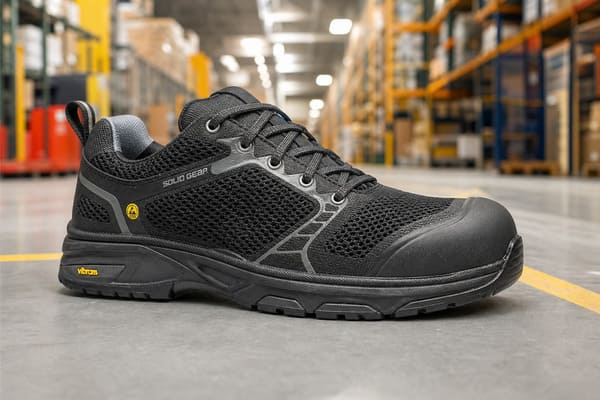
I had a client in Shenzhen who was struggling with low PPE compliance in his factory. Workers kept leaving their safety shoes under the desk. We redesigned their order as a low-cut composite toe with a mesh upper and anti-static sole. Compliance went from around 60% to over 90% within two months. Comfort drives compliance5. That is the real value of a good low-cut.
What Makes a Low-Cut Safety Shoe Perform Well Indoors?
Low-cut shoes are not a compromise. When the work environment is right, they are the smarter choice. Here is what separates a well-designed low-cut from a basic one:
| Feature | Why It Matters for Low-Cut |
|---|---|
| Breathable upper (mesh or perforated leather) | Workers wear these 8–10 hours on warm indoor floors — heat and sweat build up fast |
| Anti-static or ESD sole | Electronics and cleanroom environments require controlled static discharge |
| Composite toe cap | Reduces weight significantly compared to steel toe, improves all-day comfort |
| Anti-slip outsole | Even flat warehouse floors have spill zones and smooth tile sections |
| Cushioned insole | Long shifts on hard concrete floors create cumulative fatigue — cushioning reduces it6 |
At Shoegan, most of our low-cut orders come with composite toe caps and anti-static soles. That combination covers the two most common indoor hazards: impact and static discharge. We also see frequent requests for odor-control linings in low-cut styles, because breathability and hygiene are closely connected in high-wear indoor environments. A low-cut shoe that breathes well is one that workers will actually keep wearing. That is the compliance problem solved at the product level.
What Is a Mid-Cut Shoe?
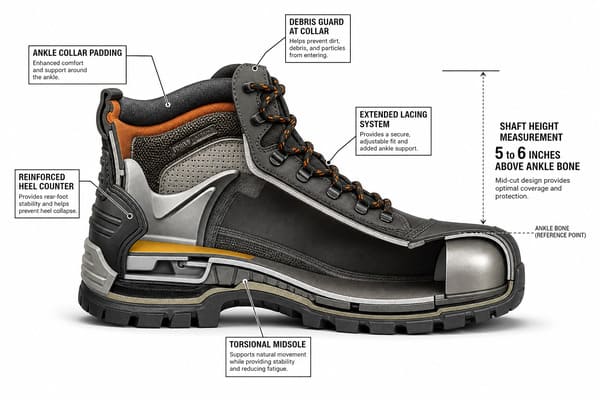
Mid-cut sits right above the ankle bone — typically a shaft height of around 5 to 6 inches. I describe it to buyers as "the shoe that does not force a trade-off."
A mid-cut safety shoe has a shaft height of approximately 5 to 6 inches, sitting just above the ankle bone. It provides partial ankle support and coverage without the full weight and heat of a high-cut boot. It is the most flexible option for workers who move across mixed terrain or between indoor and outdoor zones.
In our production data from last year, mid-cut styles made up about 35% of our export volume, and most of that went to construction, petrochemical, and outdoor logistics clients7. One buyer from Australia told me his site supervisors specifically requested mid-cut because workers could still move quickly between zones, but had enough ankle coverage for mixed terrain. That flexibility is exactly what mid-cut is designed for.
What Are the Structural Advantages of Mid-Cut Design?
Mid-cut is not just a height. It is a set of structural decisions that change how the shoe performs under real working conditions. Here is what I look at when we design or specify a mid-cut style:
| Structural Element | Mid-Cut Advantage |
|---|---|
| Ankle collar padding | Reduces friction and pressure at the ankle bone during movement |
| Reinforced heel counter | Stabilizes the foot on uneven surfaces without restricting stride |
| Extended shaft lacing | Allows the worker to adjust fit tightly around the ankle for better control |
| Debris guard at collar | Prevents gravel, dust, and small particles from entering the shoe |
| Torsional rigidity in midsole | Resists twisting forces when walking on slopes or irregular ground |
The ankle collar is the part that buyers often overlook. A poorly padded collar on a mid-cut shoe will cause blisters within the first week8. We use high-density foam with a moisture-wicking lining in all our mid-cut designs for exactly this reason. The shaft height creates the protection zone. The padding and lining determine whether workers will actually tolerate wearing it for a full shift. Both matter equally.
How Do You Choose Between Low-Cut and Mid-Cut for Your Workers?
I always ask five questions before I recommend a cut height: What surface are workers on? Do they carry heavy loads? Is ankle roll a realistic risk? Do they work indoors, outdoors, or both? And — how often do they need to take their shoes off during a shift?
To choose between low-cut and mid-cut safety shoes, assess the terrain, load weight, ankle injury risk, and work environment. Low-cut suits flat indoor conditions. Mid-cut suits mixed or outdoor environments with ankle risk. The correct cut height is a functional specification, not a personal preference.
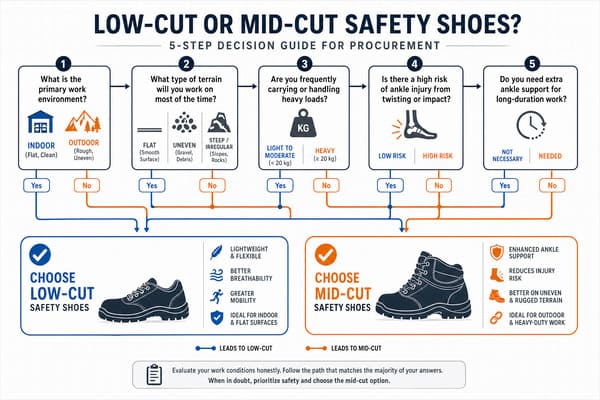
Those five questions have never failed me. Last year, a procurement manager from a UAE engineering firm sent me a spec sheet and asked me to quote one style for 1,200 workers across three sites. After I asked those five questions, we ended up with two styles — low-cut ESD for the indoor control room staff, and mid-cut puncture-resistant for the outdoor field crew. The total order was actually larger than his original plan, and both teams got shoes built for their actual conditions.
A Practical Decision Framework for Buyers
Here is the framework I use when helping buyers choose between low-cut and mid-cut. I have refined it over years of working with procurement teams across construction, manufacturing, petrochemical, and logistics industries.
| Question | Low-Cut | Mid-Cut |
|---|---|---|
| What is the floor surface? | Flat, dry, hard indoor floors | Uneven, mixed, or outdoor terrain |
| Do workers carry heavy loads? | Light to medium loads | Medium to heavy, especially on the move |
| Is ankle roll a risk? | Low risk | Moderate to high risk |
| Indoor, outdoor, or both? | Primarily indoor | Outdoor or both |
| How often are shoes removed? | Frequently (short breaks, clean areas) | Less frequently, worn for full shifts |
One thing I always tell buyers: do not spec one cut height for an entire workforce unless every worker is doing the same job on the same surface. Mixed sites need mixed specifications. The cost of getting this wrong is not the shoe price — it is the injury claim, the compliance failure, and the worker who stops wearing the shoe because it is uncomfortable for what they actually do. At Shoegan, we support buyers in building multi-SKU orders from a single supplier, with consistent quality, matching certifications, and coordinated lead times. That is how we help procurement teams get the right shoe to the right worker without managing five different vendors.
Conclusion
Cut height is a functional decision. Low-cut works on flat indoor floors. Mid-cut works on mixed or outdoor terrain. Match the shoe to the surface, not the budget. Shoegan builds mid-to-high end safety shoes for buyers who need the right shoe, not just any shoe.
-
"Employer Personal Protective Equipment Workplace …", http://www.osha.gov/laws-regs/standardinterpretations/2013-12-09. Industry classification bodies and occupational footwear standards define cut height categories by shaft measurement; the 5–6 inch range cited for mid-cut styles should be verified against applicable standards such as ASTM F2413 or equivalent EN ISO specifications. Evidence role: definition; source type: institution. Supports: The standardized shaft height range that defines mid-cut occupational footwear. Scope note: Shaft height terminology may vary across regional standards and manufacturers; a single authoritative global definition may not exist. ↩
-
"Shorter work boot shaft height improves ankle range of …", https://pubmed.ncbi.nlm.nih.gov/33200954/. Occupational biomechanics literature supports the role of footwear collar height in limiting ankle inversion range of motion and reducing debris ingress; evidence on the direct effect of shaft height on leg fatigue is less consolidated and may be mediated by overall shoe weight and fit. Evidence role: mechanism; source type: research. Supports: That footwear shaft height influences ankle joint protection, foreign body ingress, and lower-limb fatigue outcomes in occupational settings. Scope note: The three effects attributed to shaft height are not equally well-evidenced; debris entry and ankle protection have stronger direct support than leg fatigue, which is influenced by multiple footwear and task variables. ↩
-
"The effect of high-top and low-top shoes on ankle inversion … – PMC", https://pmc.ncbi.nlm.nih.gov/articles/PMC3943374/. Research on ankle sprain biomechanics suggests that footwear providing lateral ankle support can reduce inversion injury risk, particularly on uneven surfaces, though the magnitude of effect varies by study design and population. Evidence role: mechanism; source type: research. Supports: That higher-cut footwear reduces lateral ankle movement and associated sprain risk in occupational settings. Scope note: Most biomechanical studies on ankle support footwear are conducted in athletic rather than occupational contexts; direct extrapolation to industrial worksites requires caution. ↩
-
"Trends in safety footwear – Texas Department of Insurance", https://www.tdi.texas.gov/tips/safety/footwear.html. Market research on personal protective equipment footwear segments would provide independent verification of the distribution of cut-height preferences across indoor industrial applications; no publicly available industry-wide statistic is cited in the article. Evidence role: statistic; source type: institution. Supports: The relative market demand for low-cut versus higher-cut safety footwear in indoor industrial applications. Scope note: The 60% figure reflects a single supplier’s order data and may not be representative of the broader global or regional safety footwear market. ↩
-
"Strategies to improve compliance with personal protective equipment use …", https://pmc.ncbi.nlm.nih.gov/articles/PMC12341358/. Occupational health literature identifies discomfort as one of the most frequently cited barriers to consistent PPE use, including safety footwear, with compliance rates shown to improve when equipment is better fitted and less burdensome to wear. Evidence role: general_support; source type: research. Supports: That discomfort is a leading factor in PPE non-compliance among workers. Scope note: Compliance improvements are multifactorial; comfort alone may not account for the full magnitude of change reported in anecdotal cases. ↩
-
"Evidence of Health Risks Associated with Prolonged Standing at Work …", https://pmc.ncbi.nlm.nih.gov/articles/PMC4591921/. Ergonomics research on prolonged occupational standing indicates that footwear with adequate midsole cushioning can reduce peak plantar pressure and lower-limb muscle fatigue, with effects varying by insole material stiffness and worker body weight. Evidence role: mechanism; source type: research. Supports: That cushioned insoles attenuate impact forces and reduce lower-limb fatigue in workers who stand for prolonged periods on hard surfaces. Scope note: Optimal cushioning stiffness is debated; excessively soft insoles may increase instability and fatigue rather than reduce it, depending on the task. ↩
-
"Employer Personal Protective Equipment Workplace …", http://www.osha.gov/laws-regs/standardinterpretations/2013-12-09. Occupational safety regulations and sector-specific guidance from bodies such as OSHA, the HSE, or equivalent national authorities identify construction and petrochemical worksites as environments with elevated slip, trip, and ankle injury risk, supporting the use of higher-cut protective footwear. Evidence role: general_support; source type: government. Supports: That construction, petrochemical, and outdoor logistics industries have elevated requirements for ankle-protective footwear due to terrain and hazard profiles. Scope note: Regulatory guidance specifies hazard categories rather than prescribing specific cut heights; the link between sector and cut-height preference remains partly inferential. ↩
-
"Friction Blisters of the Feet: A Critical Assessment of Current …", https://pmc.ncbi.nlm.nih.gov/articles/PMC10783476/. Research on friction blister formation identifies repetitive shear stress at skin contact points as the primary mechanism; in footwear, the ankle collar is a recognized high-friction zone, particularly during the break-in period of new boots with insufficient padding or moisture management. Evidence role: mechanism; source type: research. Supports: That repetitive friction at the ankle collar of poorly fitted or inadequately padded footwear causes blister formation in occupational wearers. Scope note: The specific timeline of ‘within the first week’ is not established by research and varies with individual skin sensitivity, sock type, and wear duration per shift. ↩