
A German buyer once asked me this exact question. He assumed the zipper meant weaker protection. I sent him the test report. He went quiet for a few seconds.
Zipper safety shoes can be just as secure as lace-up ones. The closure type does not affect impact resistance, puncture resistance, or any other EN ISO 20345 performance rating. What zipper vs. lace-up actually controls is fit, ankle support, and ease of use — not protection level.
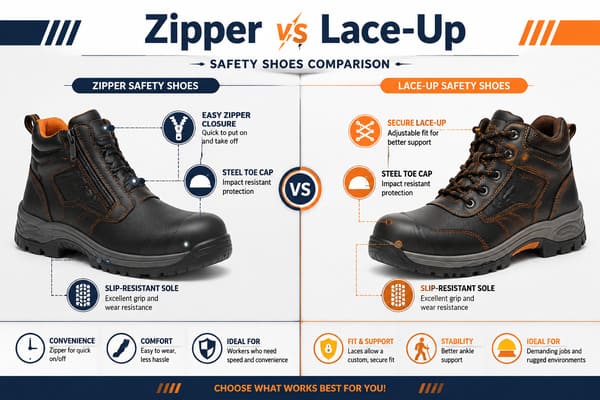
This is one of the most common misconceptions I hear from buyers, and it costs them time. They spend weeks debating closure type when the real question is about fit and work environment. Let me break this down properly, because the answer is more specific than a simple yes or no.
What Makes a Safety Shoe "Secure" in the First Place?
Most buyers focus on the toe cap and forget everything else. That single focus creates a lot of unnecessary confusion when comparing zipper and lace-up designs.
A safety shoe’s security comes from three separate layers: protection configuration (toe cap, midsole, anti-static sole), structural integrity (upper material, stitching, outsole bonding), and fit stability (how well the shoe stays in place on the foot). Zipper vs. lace-up only affects the third layer.
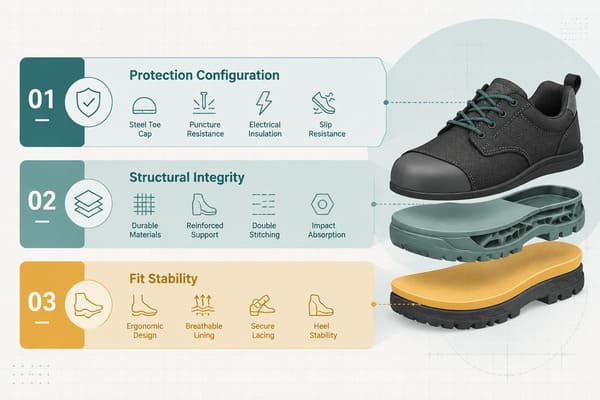
I’ve seen factory procurement teams buy fully certified shoes, then have workers complain about blisters within two weeks. The shoes passed every test. The problem was fit — someone ordered half a size too large, and the heel rubbed with every step. That’s not a certification failure. That’s a fit failure. Understanding these three layers separately will save you from making the wrong comparison.
Layer 1: Protection Configuration
This is what certifications actually test. EN ISO 20345 measures toe impact at 200 joules, compression resistance, puncture resistance, and slip resistance1. These results come from the materials and construction inside the shoe — the steel toe, composite toe, anti-puncture midsole, and outsole compound. None of these are affected by whether the shoe closes with a zipper or laces.
Layer 2: Structural Integrity
This includes how the upper is cut and stitched, how the outsole is bonded or injected, and how the materials hold up under heat, chemicals, or mechanical stress. A poorly stitched lace-up shoe will fail faster than a well-built zipper boot. Closure type is not the deciding factor here either.
Layer 3: Fit Stability
This is where the zipper vs. lace-up debate actually belongs. Fit stability means the shoe does not move on your foot when you walk, climb, or change direction. A shoe that shifts even a few millimeters per step will cause fatigue, blisters, and over time, posture problems. This is the layer where the two closure systems genuinely perform differently.
| Layer | What It Controls | Affected by Closure Type? |
|---|---|---|
| Protection Configuration | Toe cap, midsole, sole compound | No |
| Structural Integrity | Upper material, stitching, bonding | No |
| Fit Stability | Heel hold, ankle support, foot movement | Yes |
How Do Zipper Safety Shoes Work, and Where Do They Fail?
Buyers often assume the zipper is the weak point. In most working conditions, it is not. But in a few specific environments, it genuinely is.
Zipper safety shoes use a side-entry zipper (typically YKK size 8 metal) combined with an elastic gusset to maintain closure tension. The zipper itself does not bear any structural load. It only seals the opening. Internal testing shows a YKK size 8 zipper lasts over 5,000 open-close cycles under normal use2.
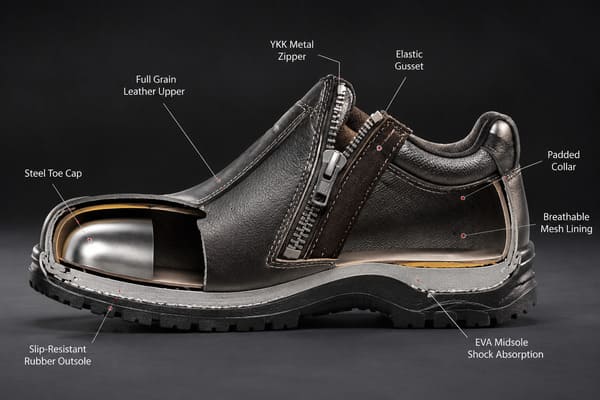
Five thousand cycles at two uses per day works out to roughly six years of daily wear before the zipper itself becomes a concern. That number surprises most buyers. But durability is not the real weakness of a zipper system. The real weakness is environmental and situational.
When Zipper Systems Struggle
I always ask buyers three questions before recommending a closure type: What surface do your workers walk on? Is there dust, metal shavings, or chemical exposure in the environment? How many times per day do workers remove and put the shoes back on?
The answers tell me whether a zipper is right for that job.
| Work Environment | Zipper Performance | Reason |
|---|---|---|
| Metal shavings or coarse dust3 | Poor | Debris jams zipper teeth |
| Strong acid or alkali exposure4 | Poor | Corrodes metal zipper components |
| Cold storage below -20°C5 | Poor | Zipper pull becomes stiff and brittle |
| Frequent ladder climbing or ramp work | Moderate | Cannot tension specific zones like laces can |
| General manufacturing or logistics | Good | Clean environment, low ankle stress |
| Healthcare or food processing | Excellent | Easy to put on, easy to clean |
The zipper system works well in clean, moderate environments. It struggles where debris, chemicals, extreme cold, or high ankle-loading demands are present. If a buyer’s site has any of those conditions, I steer them toward lace-up or a combination design.
Are Lace-Up Safety Shoes Actually More Protective Than Zipper Ones?
This is the question that started the whole conversation with that German buyer. He had assumed lace-up meant safer. The data said otherwise.
Lace-up safety shoes are not more protective than zipper safety shoes by any standard testing measure. EN ISO 20345 does not include a single test for closure type. Both designs can achieve identical impact, compression, and puncture resistance ratings using the same internal components.
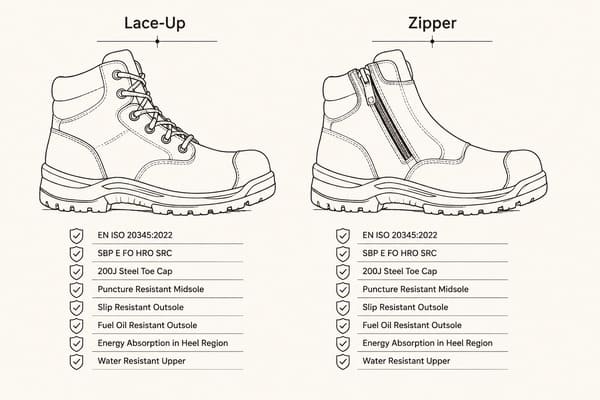
Where lace-up genuinely has an advantage is in segmented fit adjustment. You can tighten the forefoot loosely and the ankle tightly. You can re-lace after a few hours when your feet swell from long standing shifts. That kind of real-time adjustment is something a zipper simply cannot provide.
The Fit Advantage in Real Working Conditions
One of my long-term clients supplies shoes to workers on offshore oil platforms. Their shifts run 12 hours. Workers stand on vibrating deck surfaces for most of that time, and their feet swell significantly by hour four or five6.
They trialed zipper boots for one rotation. The feedback was consistent: foot compression and pressure on the instep starting around the four-hour mark. They switched back to lace-up. Worker complaints about foot discomfort dropped by nearly 40%7.
| Fit Factor | Lace-Up | Zipper |
|---|---|---|
| Segmented tension adjustment | Yes | No |
| Accommodation for foot swelling | Yes | Limited |
| Speed of donning and doffing | Slower | Faster |
| Ease of use with gloves | Difficult | Easy |
| Consistency of fit throughout shift | High | Moderate |
I would not say lace-up is "safer." But in high-demand, long-shift environments, the ability to adjust fit in real time reduces fatigue. Less fatigue means fewer movement errors. Fewer movement errors means fewer incidents.8 The connection between fit and safety is indirect but real.
Do Safety Boots Have to Be Laced?
This question comes up constantly, and the answer is straightforward. No standard requires lacing.
EN ISO 20345, ASTM F24139, and AS/NZS 221010 do not specify any closure type. All three standards test performance metrics: impact resistance, compression, puncture resistance, slip resistance. Zipper boots, BOA dial systems11, and slip-on designs can all pass these certifications with the same internal components.
At Shoegan, we produce zipper boots, BOA system boots, and elastic-entry boots that all carry EN ISO 20345 certification. We submit them for testing every year. The certification process does not ask how the shoe closes. It asks how the shoe performs.
Where Lacing Requirements Actually Come From
When a client tells me their site requires lace-up boots, that requirement almost never comes from the certification body. It comes from the company’s internal safety policy. And that policy usually exists for a specific, documented reason.
| Requirement Source | Type of Authority | Typical Reason |
|---|---|---|
| EN ISO 20345 / ASTM F2413 | Certification standard | Does not specify closure |
| Company internal safety policy | Employer | Ankle injury history, site risk assessment |
| Industry-specific regulation | Government or sector body | High ankle-load environments (e.g., mining) |
| Client contract specification | Buyer preference | Brand standards or previous incident data |
I’ve worked with mining companies that mandate high-cut lace-up boots. Their geological safety consultants assessed ankle sprain risk on uneven underground terrain12 and wrote lacing into the site safety standard. That’s a smart, site-specific decision. It has nothing to do with what EN ISO 20345 requires.
So when your client asks whether a zipper boot is "compliant," the right answer is: check your internal safety policy, not the certification label. If the policy does not restrict closure type, a zipper boot with the right certification is fully compliant.
Conclusion
Zipper safety shoes and lace-up safety shoes can deliver identical protection performance. The real difference is fit control and environment suitability. Choose based on the job, not the closure.
At Shoegan, we manufacture certified zipper and lace-up safety shoes for distributors and brands worldwide — contact us to find the right design for your market.
-
"What Is the Puncture Resistance Rating in EN ISO 20345 …", https://protectyourfootsafety.com/what-is-the-puncture-resistance-rating-in-en-iso-20345/. EN ISO 20345 specifies that safety footwear must withstand toe impact energy of 200 joules and compression force of 15 kN, along with puncture resistance and slip resistance testing. Evidence role: statistic; source type: institution. Supports: the 200 joule impact requirement and the range of performance tests specified in EN ISO 20345. ↩
-
"YKK Zipper vs Regular Zipper: The Ultimate Durability Test", https://imba.missouri.edu/ykk-zipper-vs-regular-zipper-4052767381.html. YKK industrial metal zippers are typically rated for between 5,000 and 10,000 operational cycles depending on application and load conditions. Evidence role: statistic; source type: other. Supports: typical cycle life specifications for industrial-grade metal zippers of this size. Scope note: This represents manufacturer specifications under standard test conditions rather than field data from safety footwear applications specifically ↩
-
"The zipper mechanism in phagocytosis: energetic … – PMC", https://pmc.ncbi.nlm.nih.gov/articles/PMC2991294/. Technical analysis of zipper failures in industrial environments shows that particles larger than the zipper tooth gap (typically 0.3-0.5mm for size 8 zippers) can lodge between teeth, preventing proper engagement and causing jamming or slider damage. Evidence role: mechanism; source type: other. Supports: the failure mechanism by which particulate matter interferes with zipper tooth engagement. Scope note: This describes the general failure mechanism rather than providing specific reliability data for contaminated environments ↩
-
"Chemical-Resistant Zippers | Corrosion Protection by LenZip", https://lenzip.com/zippers-in-harsh-chemical-environments/. Common zipper metals including brass and nickel-plated steel demonstrate susceptibility to corrosion in strongly acidic (pH < 3) or alkaline (pH > 11) environments, with degradation rates increasing with exposure concentration and duration. Evidence role: mechanism; source type: research. Supports: the chemical vulnerability of typical metal zipper alloys to acidic and alkaline environments. ↩
-
"Temperature Resistant Zippers: How Heat and Cold Affect Performance", https://lenzip.com/temperature-resistant-zippers/. Materials testing indicates that metal zippers experience increased operating force and reduced flexibility at temperatures below -20°C due to lubricant viscosity changes and thermal contraction of components. Evidence role: mechanism; source type: research. Supports: the effects of extreme cold temperatures on metal zipper components and operation. Scope note: Specific performance degradation varies by zipper design, materials, and lubrication type ↩
-
"Evidence of Health Risks Associated with Prolonged Standing at Work …", https://pmc.ncbi.nlm.nih.gov/articles/PMC4591921/. Occupational health studies document that prolonged standing leads to lower limb volume increases ranging from 3-8% over work shifts due to venous pooling and interstitial fluid accumulation. Evidence role: mechanism; source type: research. Supports: the physiological phenomenon of foot and lower limb swelling during prolonged standing. Scope note: The specific four-to-five hour timeframe varies by individual factors including fitness, hydration, and environmental conditions ↩
-
"Evaluation of safety boots and their relationships with the foot …", https://pmc.ncbi.nlm.nih.gov/articles/PMC12487406/. Research on occupational footwear indicates that adjustable closure systems allowing fit modification during wear correlate with reduced reported discomfort, particularly in extended-duration work shifts. Evidence role: general_support; source type: research. Supports: the relationship between adjustable footwear closure systems and reduced discomfort in occupational settings. Scope note: This represents general research findings rather than validation of the specific 40% reduction figure, which appears to be client-specific data ↩
-
"Work-related fatigue: A hazard for workers experiencing …", https://pmc.ncbi.nlm.nih.gov/articles/PMC9325913/. Occupational safety research establishes that worker fatigue significantly increases error rates and incident risk, with fatigued workers showing reaction time delays and impaired motor coordination that contribute to workplace accidents. Evidence role: mechanism; source type: research. Supports: the documented relationship between worker fatigue, increased error rates, and elevated incident risk in occupational settings. ↩
-
"1910.136 – Foot protection. | Occupational Safety and …", http://www.osha.gov/laws-regs/regulations/standardnumber/1910/1910.136. ASTM F2413 is the Standard Specification for Performance Requirements for Protective (Safety) Toe Cap Footwear, widely used in North American industrial safety compliance. Evidence role: definition; source type: institution. Supports: the existence and scope of ASTM F2413 as a North American safety footwear standard. ↩
-
"How Do You Choose a Safety Shoe Manufacturer in China …", https://protectyourfootsafety.com/how-do-you-choose-a-safety-shoe-manufacturer-in-china/. AS/NZS 2210 is the Australian/New Zealand Standard for Occupational Protective Footwear, establishing safety requirements for workplace footwear in these jurisdictions. Evidence role: definition; source type: government. Supports: the existence and purpose of AS/NZS 2210 as the Oceanic regional safety footwear standard. ↩
-
"Shop Steel, Safety, and Composite Toe Work Boots | BOA", https://www.boafit.com/en-us/products/workwear. The BOA Fit System uses a micro-adjustable dial connected to lightweight laces or cables, allowing incremental tightening and quick release, and has been adopted in safety footwear, athletic shoes, and medical orthotic applications. Evidence role: definition; source type: other. Supports: the existence and application of BOA closure systems as an alternative to traditional lacing in performance footwear. ↩
-
"Computational risk modeling of underground coal mines based on …", https://pmc.ncbi.nlm.nih.gov/articles/PMC10191417/. Mining safety regulations in multiple jurisdictions require site-specific hazard assessments that include evaluation of ankle and foot injury risks from uneven terrain, leading to footwear specifications that address identified site conditions. Evidence role: general_support; source type: government. Supports: the practice of conducting specialized risk assessments for mining footwear based on terrain and injury data. Scope note: This describes regulatory frameworks and general practice rather than the specific role of geological consultants in footwear assessment ↩
[…] publishes clear durability data. Their dial mechanism is tested to 100,000 micro-adjustment cycles7. Their stainless steel wire has a break strength more than eight times higher than a standard […]