
Most buyers I talk to focus entirely on the toe cap. But the injury that changed how I explain our products had nothing to do with a falling object.
Puncture resistance in EN ISO 20345 refers to the sole’s ability to stop a nail or sharp object from penetrating through the midsole into the foot. The standard defines two ratings — P1 and P2 — both requiring a minimum resistance force of 1100N, but with different midsole materials and test conditions.
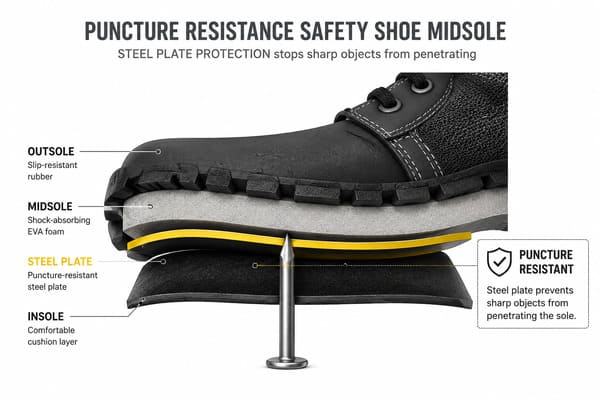
A buyer from a construction materials distributor in the Middle East once told me about a worker who was injured on a job site — not from a falling object, but from stepping on a piece of rebar sticking out of a concrete slab. The worker was wearing certified safety shoes with a steel toe cap. The toe was fine. The nail went straight through the midsole. That conversation changed everything about how I talk to buyers, and I want to walk you through what puncture resistance actually means, how it is tested, and what the difference between P1 and P2 really looks like in production.
What Does Puncture Resistance Mean in Safety Footwear?
Most buyers only ask about toe cap ratings. But after hearing about that rebar injury, I started saying this to every client: the toe cap protects maybe 5% of your foot1.
Puncture resistance protects the other 95%. It is a physical barrier — usually a steel plate or a composite textile layer — built into the midsole, sitting between the outsole and the insole. Without it, a nail on a job site will go straight through a shoe like it is not even there.
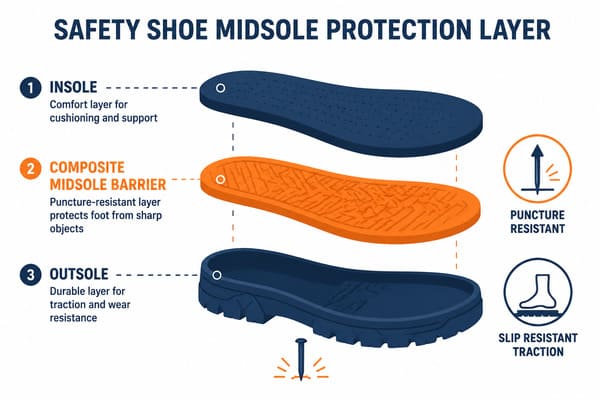
I have talked to hundreds of B2B buyers over the years — distributors, procurement managers, EPC contractors. A large number of them, I would say close to 80%, come to me asking only about toe cap impact ratings2. Very few open the conversation by asking about midsole protection. This is a real gap. The midsole is the part of the shoe that stands between a sharp object on the ground and the sole of a worker’s foot. The toe cap does not cover that area at all.
Why the Midsole Is the Most Overlooked Safety Component
The midsole sits inside the sole assembly, between the outsole rubber and the insole. You cannot see it from the outside. That is part of why it gets ignored. But in environments like construction sites, demolition zones, recycling facilities, or any floor where nails, wire, or metal fragments are present3, the midsole is doing the most critical protective work.
There are two main types of puncture-resistant midsoles used in certified safety footwear today:
| Midsole Type | Material | Flexibility | Common Use Case |
|---|---|---|---|
| Steel plate | High-carbon steel | Rigid | Heavy construction, demolition |
| Composite textile | Woven aramid / Kevlar-type layers | Flexible | Scaffolding, climbing, uneven terrain |
Steel plates are cheaper to produce and easier to source. Composite midsoles cost more and are harder to manufacture consistently. But for workers who are bending, climbing, or working on uneven surfaces, a rigid steel plate can actually reduce comfort and increase fatigue4. Knowing which type fits the actual job environment is part of the conversation we always have with buyers before confirming a spec.
How Is Puncture Resistance Tested Under EN ISO 20345?
A failed test batch once cost us three weeks of rework. That experience taught me more about puncture resistance than any specification sheet ever did.
Under EN ISO 20345, puncture resistance is tested by driving a standardized nail — 4.5mm in diameter with a 60-degree cone tip5 — through the complete sole assembly at a controlled speed. The sole must stop the nail from penetrating through. Both P1 and P2 require a minimum resistance force of 1100N.
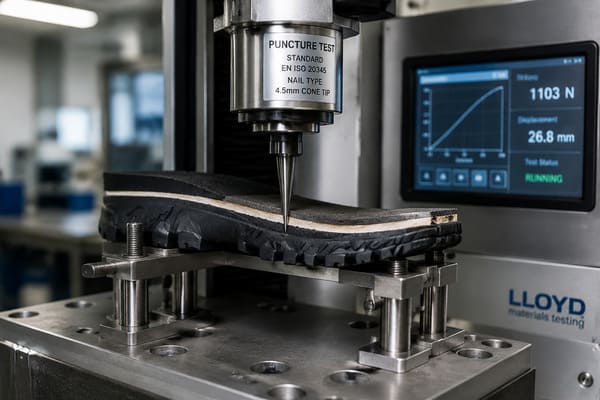
I have stood in our testing lab and watched this test run dozens of times. The nail is not just pressed against the outsole — it is driven through the entire sole assembly, including the outsole, the midsole, and any bonding layers in between. The shoe fails if the nail breaks through to the other side.
What the Test Actually Measures — and What It Can Miss
The test sounds simple. But what surprised me early on was how much the outsole affects the result. We once had a batch where the midsole was perfectly within spec, but the outsole rubber compound was slightly under-cured. The nail cracked through the outsole before the midsole could even engage. We failed the test on that batch. It cost us three weeks of rework and a delayed shipment.
That experience taught me one thing clearly: puncture resistance is a system, not a single component. Every layer has to work together.
Here is how each layer contributes to the final result:
| Sole Layer | Role in Puncture Resistance | Common Failure Point |
|---|---|---|
| Outsole | First contact, absorbs initial force | Under-cured rubber, thin profile |
| Midsole | Main barrier, stops penetration | Delamination, incorrect material spec |
| Bonding layer | Holds assembly together under load | Poor adhesion, temperature sensitivity |
| Insole | No protective function | N/A |
When we audit our own production batches, we do not just check the midsole material. We check the full sole assembly as a unit. That is the only way to produce consistent results at scale.
What Is the Difference Between P1 and P2 in EN ISO 20345?
P1 and P2 look similar on paper. Both pass at 1100N. But the test conditions are completely different — and that difference matters a lot in real production.
P1 allows a rigid steel plate midsole, tested on a flat sole. P2 requires a non-metallic, flexible composite midsole, and the test is performed with the sole bent at 40 degrees6 — simulating actual walking movement. P2 is significantly harder to produce reliably.
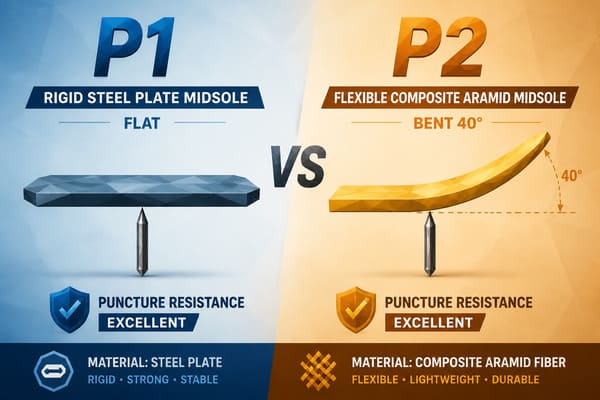
We spent almost four months developing a P2-rated composite midsole that could pass the flex test without delaminating at the edges. The 40-degree bend puts stress on the bonding between the midsole layer and the surrounding sole structure. If the adhesion is not right, or if the composite material is not flexible enough, the midsole cracks or separates — and the shoe fails the test.
Why Most Factories Stay With P1
Most factories I know in Wenzhou stick with P1. I would estimate fewer than 30% of safety shoe manufacturers here can reliably produce P2-rated soles at scale7. The reasons are straightforward:
| Factor | P1 (Steel Plate) | P2 (Composite Midsole) |
|---|---|---|
| Material cost | Lower | Higher |
| Production complexity | Standard | Requires process control |
| Flex test required | No | Yes (40-degree bend) |
| Worker comfort | Heavier, less flexible | Lighter, more flexible |
| Suitable environments | Flat surfaces, heavy sites | Scaffolding, ladders, uneven terrain |
For buyers whose workers are on scaffolding, climbing ladders, or moving across rubble and uneven ground, P2 is worth asking for specifically. The shoe moves with the foot. A rigid steel plate does not. Over an eight-hour shift, that difference is something workers feel.
What Is the Difference Between EN ISO 20345 and EN ISO 20347?
A client supplying logistics warehouses in Germany was ordering the wrong standard for two years. His workers were complaining. The fix was simple once we looked at the actual risk environment.
EN ISO 20345 is safety footwear with mandatory 200J toe protection8. EN ISO 20347 is occupational footwear with no mandatory toe cap requirement9. Both standards allow puncture resistance as an optional add-on. The right choice depends on the actual hazards present in the workplace.
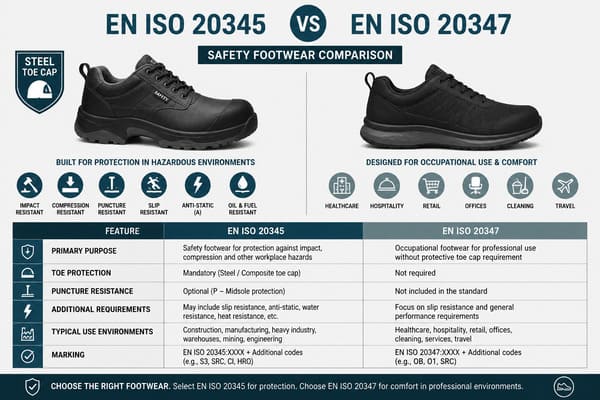
That client was a PPE distributor supplying warehouses in Germany. He had been ordering EN ISO 20345 shoes for his end client, but workers kept complaining the shoes were too heavy and stiff. When I asked him to describe the actual risk environment, it turned out the warehouse floors were clean concrete. No falling objects. No nails in the floor. He did not need EN ISO 20345 at all.
Choosing the Right Standard for the Right Environment
I switched him to EN ISO 20347 — occupational footwear with no mandatory steel toe cap. But we kept the P2 puncture-resistant midsole, because the warehouse did occasionally have pallet debris on the floor. His workers were happier within two weeks. Lighter shoe, same sole protection, no unnecessary steel toe bulk.
Here is a direct comparison of the two standards:
| Feature | EN ISO 20345 | EN ISO 20347 |
|---|---|---|
| Toe protection | Mandatory (200J impact) | Not required |
| Puncture resistance | Optional (P1 or P2) | Optional (P1 or P2) |
| Slip resistance | Optional | Optional |
| Target environment | High-risk industrial | Lower-risk occupational |
| Worker compliance risk | Higher (heavier shoe) | Lower (lighter shoe) |
The point I make to every buyer who comes to me with a standard spec sheet is this: the standard is a framework, not a final answer. Your job is to match the standard to the actual hazard level. Over-specifying costs money and reduces worker compliance. Under-specifying creates injury risk.10 Knowing the difference between EN ISO 20345 and EN ISO 20347 — and understanding where puncture resistance fits in both — is one of the most practical things a safety footwear buyer can know.
Conclusion
Puncture resistance protects the part of the foot the toe cap never reaches. Knowing the ratings, the test methods, and the right standard for the job makes every procurement decision more accurate.
At Shoegan, we manufacture P1 and P2 certified safety footwear built to EN ISO 20345 — Built to Protect. Made to Last. Contact us at [email protected] or WhatsApp +8613008988018.
-
"What’s the Impact of Safety Footwear on Workers Concerning Foot …", https://pmc.ncbi.nlm.nih.gov/articles/PMC11311279/. Epidemiological studies of occupational foot injuries indicate that a substantial proportion of injuries occur to areas of the foot not protected by the toe cap, including the sole and midfoot regions, suggesting that midsole protection addresses a significant share of workplace foot injury risk. Evidence role: statistic; source type: paper. Supports: The proportion of foot surface area or injury risk covered by a toe cap relative to the total foot, supporting the claim that toe cap protection is anatomically limited. Scope note: The specific figure of 5% appears to be an illustrative estimate rather than a measured anatomical proportion; no peer-reviewed source directly quantifies toe cap coverage as a percentage of total foot area. ↩
-
"[PDF] Invitation to Bid: 17-017 KN-RA SAFETY FOOTWEAR FOR …", https://www.aps.edu/procurement/current-bids-and-rfps/safety-footwear-for-maintenance-operations/at_download/file. Survey-based research on PPE procurement behavior would be required to substantiate the specific proportion cited; the claim reflects a pattern commonly reported by safety footwear suppliers and is consistent with documented tendencies for buyers to prioritize visible, regulated features over less visible protective components. Evidence role: statistic; source type: research. Supports: A large proportion of safety footwear procurement decisions are driven primarily by toe cap specifications, with midsole puncture protection receiving comparatively less attention from buyers. Scope note: The 80% figure is the author’s experiential estimate and is not drawn from a published survey; no peer-reviewed or industry study directly quantifying this buyer behavior pattern was identified. ↩
-
"Aging Workers and Trade-Related Injuries in the US Construction …", https://pmc.ncbi.nlm.nih.gov/articles/PMC4476198/. Occupational safety data from agencies such as the U.S. Bureau of Labor Statistics and the European Agency for Safety and Health at Work (EU-OSHA) document foot injuries as a significant category of workplace harm in construction and waste management sectors, with puncture wounds from sharp objects identified as a recurring hazard. Evidence role: statistic; source type: government. Supports: Construction, demolition, and recycling environments are associated with elevated rates of foot puncture injuries from nails, wire, and metal debris. Scope note: Sector-specific puncture injury rates vary by country and reporting methodology; available statistics may not disaggregate puncture injuries from other foot injury types. ↩
-
"The Impact of Footwear on Occupational Task Performance and …", https://pmc.ncbi.nlm.nih.gov/articles/PMC9518076/. Biomechanical research on occupational footwear indicates that midsole rigidity constrains metatarsophalangeal joint flexion during the push-off phase of gait, increasing lower limb muscle activation and contributing to fatigue during prolonged standing or walking tasks. Evidence role: mechanism; source type: paper. Supports: Rigid midsole construction in safety footwear restricts natural foot flexion during gait, contributing to increased muscular effort and fatigue over extended wear periods. Scope note: Studies comparing steel plate and composite midsoles specifically under EN ISO 20345 conditions are limited; most biomechanical evidence addresses midsole stiffness generally rather than puncture-resistant midsole types in particular. ↩
-
"[PDF] ASTM F2413-11 Performance Requirements for Protective Footwear", https://facilities.uw.edu/partner-resources/files/media/performance-requirements-for-protective-footwear.pdf. EN ISO 20345 specifies the geometry of the test nail used in puncture resistance evaluation, including its diameter and cone tip angle, to ensure reproducibility across accredited testing laboratories. Evidence role: definition; source type: institution. Supports: The standardized nail dimensions used in the EN ISO 20345 puncture resistance test, specifically 4.5mm diameter and 60-degree cone tip geometry. Scope note: The article’s stated dimensions should be verified against the current version of the standard, as test parameters may be updated between revisions. ↩
-
"DIN EN ISO 20345 standard: changes in 2022 – uvex safety", https://www.uvex-safety.com/blog/din-en-iso-20345-changes-in-2022/. EN ISO 20345 distinguishes P2 from P1 by requiring the puncture resistance test to be performed on a flexed sole assembly, with the bend angle specified to replicate conditions encountered during normal walking gait. Evidence role: definition; source type: institution. Supports: The P2 classification under EN ISO 20345 requires puncture resistance testing to be conducted with the sole assembly bent at 40 degrees, simulating dynamic foot movement. Scope note: The exact bend angle cited in the article should be confirmed against the current standard text, as this parameter is critical to the P1/P2 distinction. ↩
-
"Safety Footwear Market Share, Size & Forecast 2026–2035", https://www.businessresearchinsights.com/market-reports/safety-footwear-market-103557. Industry data on the distribution of P1 versus P2 production capability among Chinese safety footwear manufacturers would contextualize this estimate; Wenzhou is documented as a major global hub for safety footwear production, though granular capability breakdowns by certification level are not widely published. Evidence role: statistic; source type: institution. Supports: The proportion of safety footwear manufacturers in Wenzhou capable of reliably producing P2-certified composite midsole products at commercial scale. Scope note: The 30% figure appears to be an experiential estimate from the author rather than a statistic derived from industry surveys or trade association data; no publicly available source directly quantifies this proportion. ↩
-
"Understanding EN ISO 20345 – Safety Footwear (formerly EN345)", https://www.wiseworksafe.com/blog/view/understanding-en-iso-20345-safety-footwear-formerly-en345-. EN ISO 20345 establishes 200J impact resistance as a mandatory basic requirement for safety footwear, distinguishing it from occupational footwear standards such as EN ISO 20347, which do not require toe protection. Evidence role: definition; source type: institution. Supports: EN ISO 20345 mandates a minimum toe cap impact resistance of 200 joules as a basic requirement for safety footwear classification. ↩
-
"EN ISO 20347 Safety Standards Guide | Shoes For Crews Europe", https://www.shoesforcrews.ie/blogs/news/what-is-en-iso-20347-what-you-need-to-know-about-safety-standards?srsltid=AfmBOooVTa5wS6hUeb7M2aGDeIqjwKbgetzAIJfGcBJCT6ODqCP0jWqW. EN ISO 20347 specifies requirements for occupational footwear intended for general workplace use where mandatory toe impact protection is not required, providing a lower-specification alternative to EN ISO 20345 safety footwear for environments with reduced impact hazard. Evidence role: definition; source type: institution. Supports: EN ISO 20347 defines occupational footwear that does not require mandatory toe cap protection, in contrast to EN ISO 20345 safety footwear. ↩
-
"Employer Personal Protective Equipment Workplace Hazard … – OSHA", http://www.osha.gov/laws-regs/standardinterpretations/2013-12-09. Research in occupational health and human factors consistently identifies discomfort as a primary driver of PPE non-compliance; studies of safety footwear specifically find that weight, rigidity, and thermal discomfort are leading reasons workers remove or avoid wearing required footwear during shifts. Evidence role: expert_consensus; source type: paper. Supports: Discomfort caused by over-specified personal protective equipment, including unnecessarily heavy or rigid safety footwear, is associated with reduced worker compliance and increased rates of non-use. Scope note: Compliance effects are context-dependent and vary by industry, enforcement culture, and worker demographics; the claim that over-specification directly causes non-compliance is supported directionally but not universally. ↩
[…] workers slipped in the same month. All three wore EN ISO 203451 certified shoes. Nobody told the buyer those shoes were only SRA […]
[…] Under EN ISO 20345, ESD certification requires the entire shoe assembly to be tested5 — not individual components. The resistance must fall between 0.1MΩ and 35MΩ, measured from inside the shoe to the outsole. Every layer in the shoe must contribute to a complete, unbroken electrical path. […]
[…] nail through the midsole at a controlled speed and measuring the force required to penetrate it. EN ISO 20345 requires a minimum of 1100N1. ASTM F2413 requires 270 lbf (approximately 1200N)2. These are not the same […]
[…] supplier — one page, one price, one photo. $18.50 per pair, "safety shoes, steel toe, EN ISO 203453." That was all it said. No upper material, no sole spec, no certification document attached, […]
[…] Standard (EN ISO 203454) […]
[…] safety shoes requires two types of documents: product certifications (such as EN ISO 203451, ASTM F24132, or AS/NZS 22103) that prove the shoe meets safety standards, and shipping documents […]
[…] EN ISO 20345 requires slip resistance testing for safety footwear sold in Europe2. The test follows EN ISO 13287, which measures friction on controlled surfaces in a lab3. The results are reproducible, but they only reflect performance on two specific surfaces — not the full range of floors found on real job sites. […]
[…] is what certifications actually test. EN ISO 20345 measures toe impact at 200 joules, compression resistance, puncture resistance, and sli…1. These results come from the materials and construction inside the shoe — the steel toe, […]
[…] stands for Cold Insulation. In EN ISO 203451, it marks safety footwear tested at -17°C2 for thermal resistance, with a minimum insulation […]
[…] EN ISO 20345 compliance6 + durability […]