
I’ve been in this industry for over 20 years. I’ve seen brand owners lose $18,000 on a single recall — not because the shoe looked wrong, but because no one checked if it actually worked.
Starting a private label safety shoe brand means more than putting your logo on an existing product. It means choosing the right protection standard, finding a certified manufacturer, getting the right certifications for your target market, and budgeting realistically — usually $15,000 to $25,000 for one style in one market.
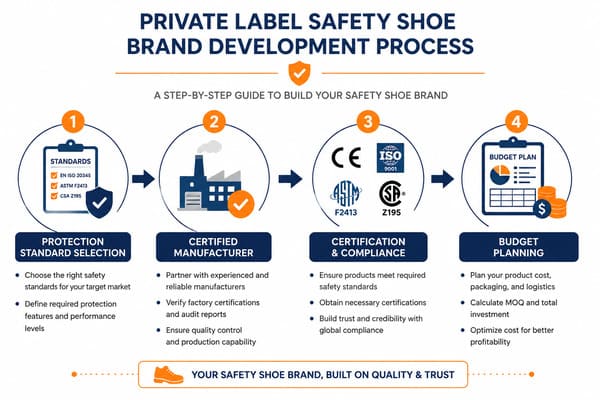
One of my clients from the Netherlands ordered 2,000 pairs from a factory in Fujian. The shoes looked right. The logo was clean. But when a safety inspector tested them on site, the steel toe failed at 140 joules instead of the required 2001. He recalled the entire batch. It cost him more than $18,000 and nearly ended his relationship with his biggest client. The shoe looked like a safety shoe. It just wasn’t one. That’s what happens when you start with the brand and skip the foundation. This guide walks through every step so you don’t make the same mistake.
What Does It Actually Mean to Private Label Safety Shoes?
Most people think private labeling means sending a logo file to a factory. That’s not private labeling — that’s repackaging. And it’s exactly where most brand failures begin.
Private labeling safety shoes means you define the protection standard first, then identify the end user and their work environment, and then build the shoe around those two requirements. The logo is the last thing you add — not the first.
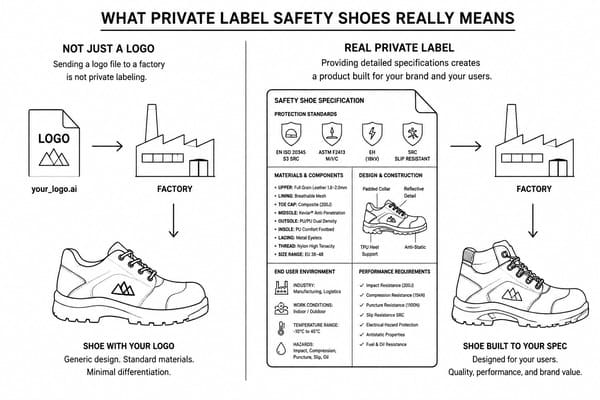
Early in my career, I worked on the factory floor. I watched how orders were handled when a brand owner just sent us a logo file and said "put it on the shoe." No spec sheet. No target market. No clarity on what standard the shoe needed to meet. We’d pick the closest existing mold and move forward. The brand owner had no idea what was inside the shoe they were selling.
Why the Protection Standard Has to Come First
The protection standard tells you everything about how the shoe needs to be built. EN ISO 20345 and ASTM F2413 are not interchangeable2. They test differently, require different materials, and have different labeling rules. If you don’t know which standard your target market requires before you start development, you will waste time and money retesting later.
Here is a simple breakdown of what the standard decision actually affects:
| Decision | What It Affects |
|---|---|
| Protection standard (e.g., EN ISO 20345) | Toe cap impact rating, midsole puncture resistance, slip resistance test method |
| End user environment | Material selection (chemical resistant, ESD, cold-resistant, etc.) |
| Target market | Which lab you need to use, which certification body will issue the mark |
| Shoe construction | Upper material, outsole compound, insole type, lining |
| Logo and branding | Label placement, packaging language, country of origin marking |
I’ve helped brand owners develop shoes for 7 different markets. The ones who understood this sequence from the beginning never had a compliance problem. The ones who started with the design and figured out the standard later almost always ran into issues — either at customs, during client audits, or on the job site. A private label safety shoe is a certified product first. It is a branded product second.
How Do You Find the Right Safety Shoe Manufacturer for Your Brand?
A certificate image is not a test report3. Most brand owners don’t know the difference — and some factories count on that.
The right way to verify a safety shoe manufacturer is to ask for a full third-party lab test report, not just a certificate. The report should include the lab name, accreditation number, sample reference, test date, and individual results for each protection category.
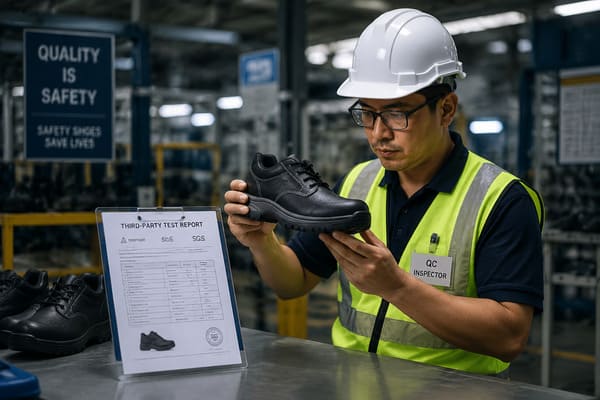
A client from Dubai came to me two years ago. He had been working with a factory that claimed 15 years of experience in safety shoes. When he asked for test reports, they sent him a certificate image — no report number, no lab name, no test date. He didn’t know what to look for, so he accepted it. His first container of 1,500 pairs arrived in the UAE and was flagged at customs because the GSO documentation was incomplete. The goods sat in a warehouse for 6 weeks. He paid over $4,000 in storage fees before the issue was resolved.
What to Actually Ask a Manufacturer Before You Sign Anything
Most buyers ask the wrong questions. "How many years have you been in business?" tells you very little. Here is what actually matters:
| Question to Ask | Why It Matters |
|---|---|
| Can you show me a full test report from an accredited third-party lab? | Confirms the shoe was actually tested, not just certified on paper |
| What is the sample reference number on that report? | Lets you verify the report is real and matches the product |
| Which certifications do you currently hold, and for which specific styles? | Certifications are style-specific — one certified shoe does not cover your new design |
| Have you exported to my target market before? | Confirms they understand the documentation requirements for your region |
| What is your process when a production batch fails internal QC? | Tells you how they handle problems, not just how they present success |
| Can I visit the factory or arrange a third-party inspection? | A manufacturer with nothing to hide will say yes without hesitation |
At Shoegan, we hold ISO 90014, EN ISO 20345, ASTM F2413, AS/NZS 2210, GSO, and GB 12011. When a client asks for a test report, we send the full document — lab name, accreditation number, test date, and individual results for every protection category. If a manufacturer hesitates when you ask for that level of detail, walk away.
What Certifications Do You Need for a Private Label Safety Shoe Brand?
One certification does not travel across borders. A CE mark means nothing at a US customs checkpoint. An ASTM label means nothing to a European safety inspector.
Each major market has its own mandatory safety shoe standard. Europe requires EN ISO 20345, the US and Canada require ASTM F2413, Australia and New Zealand require AS/NZS 2210, the Middle East requires GSO, and China requires GB 120115. You must certify specifically for each market you sell into.
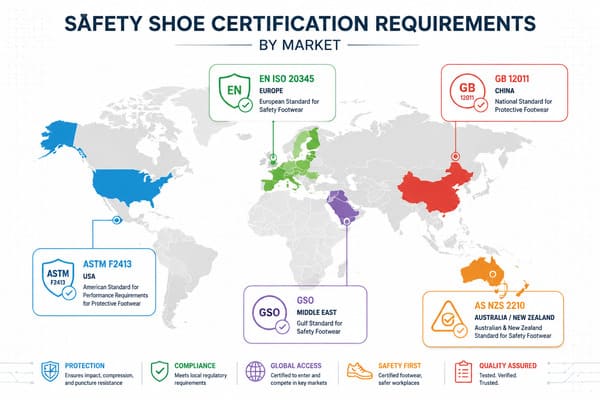
I had a client who came to me excited — he had already gotten his shoes EN ISO 20345 certified and was ready to expand into the US market. He assumed the CE mark would carry some weight. It doesn’t. ASTM F2413 tests impact resistance differently. The toe cap geometry requirements are different. The labeling requirements are different. He had to go back to the lab, retest, and wait another 8 weeks before he could ship to his US buyer. That delay cost him a $35,000 order that his buyer eventually placed with someone else.
A Practical Certification Map for New Brand Owners
Here is the certification framework I give every new client before they start development:
| Market | Required Standard | Key Testing Body Type | Notes |
|---|---|---|---|
| Europe (EU/EEA) | EN ISO 20345 | EU Notified Body6 | CE marking required on product and packaging7 |
| United States / Canada | ASTM F2413 | ANSI-accredited lab8 | No CE mark accepted; labeling rules are strict |
| Australia / New Zealand | AS/NZS 2210.3 | NATA-accredited lab or equivalent9 | Often required for government and mining contracts |
| Middle East / Gulf (GCC) | GSO 1651 | GSO-recognized lab | Required for customs clearance in most GCC countries |
| China | GB 12011 | CMA-accredited lab | Required for sale in the Chinese domestic market |
My recommendation is always the same: pick one market, certify it properly, and then expand. Trying to certify for three markets at once with a limited budget usually means none of them are done correctly. Each certification is style-specific, which means if you change the upper material, the outsole, or the toe cap, you may need to retest10. Build that into your planning from the start.
How Much Does It Cost to Start a Private Label Safety Shoe Brand?
Most manufacturers won’t give you a real number upfront. I will.
A realistic budget to launch one private label safety shoe style into one market — done correctly — is $15,000 to $25,000. This includes lab testing fees ($3,000–$6,000 per style), tooling costs ($2,000–$5,000 for custom molds), sampling, and a first production run of 500 pairs.
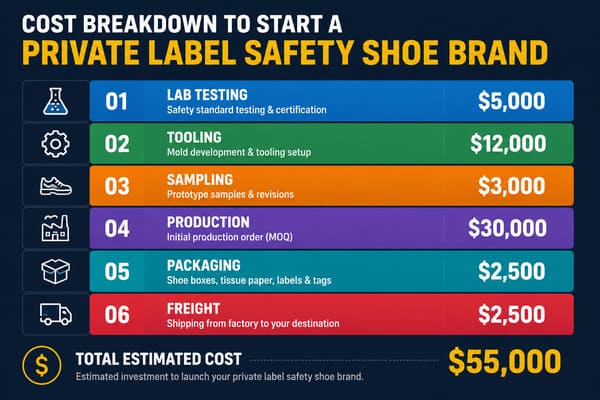
Here is a number most manufacturers won’t give you upfront: for a brand entering the European market with EN ISO 20345 certification, the lab testing fees alone typically run between $3,000 and $6,000 per style11. That’s before tooling, before sampling, before your first production order. On top of that, if you’re doing a custom mold, add another $2,000 to $5,000 depending on complexity12. I’m not saying this to scare anyone. I’m saying it because the brands that budget properly from the start are the ones still in business three years later. The ones who try to do it for $5,000 are usually the ones calling me after a recall.
A Realistic Cost Breakdown for One Style, One Market
Here is how the budget typically breaks down for a brand launching one style into the European market:
| Cost Item | Typical Range (USD) | Notes |
|---|---|---|
| Lab testing fees (EN ISO 20345) | $3,000 – $6,000 | Per style; retesting costs extra if changes are made |
| Custom mold / tooling | $2,000 – $5,000 | Depends on complexity; standard molds cost less |
| Sample development | $300 – $800 | Usually 2–3 rounds before approval |
| First production run (500 pairs) | $7,500 – $12,000 | Depends on style, materials, and protection features |
| Packaging and branding | $500 – $1,500 | Boxes, labels, inserts, hang tags |
| Freight and logistics | $800 – $2,000 | FOB Wenzhou/Ningbo/Shanghai; DDP available |
| Total estimate | $14,100 – $27,300 | For one style, one market, first order |
At Shoegan, our MOQ is 500 pairs and our standard lead time is 30 days for most styles. Custom styles may vary. We offer full OEM and ODM services — from design development to certified production to branded packaging. We also support DDP shipping, which most of our European and Middle East clients prefer because it removes customs risk on their end. The brands that treat this as a serious product launch — not a shortcut — are the ones that build something worth owning.
Conclusion
Starting a private label safety shoe brand takes more than a logo. It takes the right standard, the right manufacturer, the right certification, and a realistic budget.
Shoegan has 15+ years of manufacturing experience and full OEM/ODM capability — built to help serious brand owners launch with confidence.
-
"ASTM F2413-11 Performance Requirements for Protective …", https://facilities.uw.edu/partner-resources/files/media/performance-requirements-for-protective-footwear.pdf. EN ISO 20345:2011 specifies that safety footwear toe caps must withstand an impact energy of 200 joules, though the exact requirement varies by protection class and regional standard. Evidence role: statistic; source type: government. Supports: the minimum impact energy requirement for safety shoe toe caps under specific standards. Scope note: The 200-joule requirement is specific to certain European standards and protection classes; other standards like ASTM F2413 use different testing protocols and energy levels. ↩
-
"[PDF] ASTM F2413-11 Performance Requirements for Protective Footwear", https://facilities.uw.edu/partner-resources/files/media/performance-requirements-for-protective-footwear.pdf. EN ISO 20345 and ASTM F2413 employ different test methodologies, impact energy measurements, and classification systems, making direct equivalence between the standards impractical for compliance purposes. Evidence role: mechanism; source type: education. Supports: the technical differences between European and North American safety footwear standards. Scope note: While both standards address occupational footwear safety, specific technical differences would require examination of the full standard documents for comprehensive comparison. ↩
-
"General Certificate of Conformity | CPSC.gov", https://www.cpsc.gov/Business–Manufacturing/Testing-Certification/General-Certificate-of-Conformity. Under ISO/IEC 17025 accreditation principles, a test report contains detailed methodology, results, and measurement uncertainty, while a certificate of conformity is a summary declaration that may not include the underlying test data. Evidence role: definition; source type: institution. Supports: the distinction between certificates of conformity and detailed test reports in product certification. Scope note: This describes general laboratory accreditation principles rather than safety footwear-specific requirements. ↩
-
"ISO 9001:2015 – Quality management systems — Requirements", https://www.iso.org/standard/62085.html. ISO 9001 is an internationally recognized standard for quality management systems that specifies requirements for organizations to demonstrate their ability to consistently provide products and services that meet customer and regulatory requirements. Evidence role: definition; source type: institution. Supports: what ISO 9001 certification represents in manufacturing contexts. ↩
-
"1910.136 – Foot protection. | Occupational Safety and Health … – OSHA", http://www.osha.gov/laws-regs/regulations/standardnumber/1910/1910.136. The European Union’s PPE Regulation (EU) 2016/425 requires safety footwear to meet harmonized standards such as EN ISO 20345, while other jurisdictions reference their respective national or regional standards in occupational safety regulations. Evidence role: general_support; source type: government. Supports: that different jurisdictions mandate specific safety footwear standards for occupational use. Scope note: Mandatory status may vary by specific workplace type, industry sector, and whether the footwear is used in regulated occupational settings versus sold for general consumer use. ↩
-
"Notified body – Wikipedia", https://en.wikipedia.org/wiki/Notified_body. Under EU regulations, a Notified Body is an organization designated by an EU member state to assess the conformity of certain products before they are placed on the EU market, including personal protective equipment such as safety footwear. Evidence role: definition; source type: government. Supports: the role and definition of Notified Bodies in EU product certification. ↩
-
"CE marking – Wikipedia", https://en.wikipedia.org/wiki/CE_marking. EU Regulation 2016/425 on personal protective equipment requires the CE marking to be affixed visibly, legibly, and indelibly to the PPE or, where that is not possible, to the packaging, along with specified accompanying information. Evidence role: general_support; source type: government. Supports: CE marking placement requirements for personal protective equipment in the European Union. Scope note: Specific placement requirements may vary based on the type of PPE and practical considerations of the product design. ↩
-
"[PDF] ASTM F2413-11 Performance Requirements for Protective Footwear", https://facilities.uw.edu/partner-resources/files/media/performance-requirements-for-protective-footwear.pdf. The American National Standards Institute (ANSI) accredits testing laboratories under ISO/IEC 17025 to ensure technical competence for specific testing scopes, though ASTM standards themselves typically do not mandate specific laboratory accreditation for testing. Evidence role: mechanism; source type: institution. Supports: the role of ANSI accreditation in product testing for US standards. Scope note: While ANSI accreditation indicates laboratory competence, ASTM F2413 compliance testing may not legally require ANSI-accredited laboratories in all contexts, though such accreditation is widely preferred for credibility. ↩
-
"National Association of Testing Authorities – Wikipedia", https://en.wikipedia.org/wiki/National_Association_of_Testing_Authorities. The National Association of Testing Authorities (NATA) is Australia’s national accreditation body for laboratories and testing facilities, providing ISO/IEC 17025 accreditation that is often required or preferred for compliance testing of regulated products. Evidence role: definition; source type: institution. Supports: what NATA accreditation represents in the Australian testing context. ↩
-
"General Use Products: Certification and Testing | CPSC.gov", https://www.cpsc.gov/Business–Manufacturing/Testing-Certification/General-Use-Products-Certification-and-Testing. Under EU PPE Regulation 2016/425 and similar frameworks, significant modifications to certified personal protective equipment that could affect the level of protection or conditions of use require reassessment by the notified body to ensure continued conformity with the applicable standards. Evidence role: mechanism; source type: government. Supports: that material or design changes to certified PPE may require reassessment. Scope note: The specific threshold for what constitutes a ‘significant modification’ requiring retesting varies by product type, certification body interpretation, and the nature of the change. ↩
-
"Third-Party Testing Laboratory Accreditation & Small Entity … – CPSC", https://www.cpsc.gov/Business–Manufacturing/Testing-Certification/Lab-Accreditation. Third-party testing and certification costs for safety footwear vary significantly based on the complexity of testing required, the certification body selected, and the number of protection features being evaluated, with full certification programs typically ranging from several thousand to tens of thousands of dollars. Evidence role: statistic; source type: institution. Supports: typical cost ranges for third-party safety footwear testing and certification. Scope note: Specific costs are commercially determined by individual testing laboratories and certification bodies and may vary considerably based on scope, timeline, and additional services required. ↩
-
"Shoe Tooling for Mass Production – Shoemakers Academy", https://shoemakersacademy.com/shoe-tooling-for-mass-production/?srsltid=AfmBOorLu2c4GGOpaZFPoV3c81-g6bldNW-hi3FSeFJ-UzdT4ap8C9PD. Footwear tooling costs vary widely based on mold complexity, material type, production volume requirements, and manufacturing location, with custom molds for specialized footwear typically representing a significant upfront investment in product development. Evidence role: statistic; source type: other. Supports: typical cost ranges for custom tooling in footwear manufacturing. Scope note: Specific tooling costs are commercially sensitive and vary considerably based on manufacturer, design complexity, and regional manufacturing economics. ↩
[…] toe shoes from another supplier, and 130 pairs had sole delamination, with 40 pairs failing the EN ISO 20345 200-joule toe cap test2 at his local lab. He was furious, and honestly, he had every right to […]
[…] For safety shoes specifically, I also factor in the cost of preparing compliance documents. Test reports for EN ISO 20345 or ASTM F2413 can cost $800 to $1,500 per style to produce3. Some suppliers spread that cost across the order quantity quietly. I list it separately and […]