
Almost every buyer who asks me about CI-rated shoes says they need "cold-weather protection." But very few know the actual test temperature is -17°C. That gap costs people money.
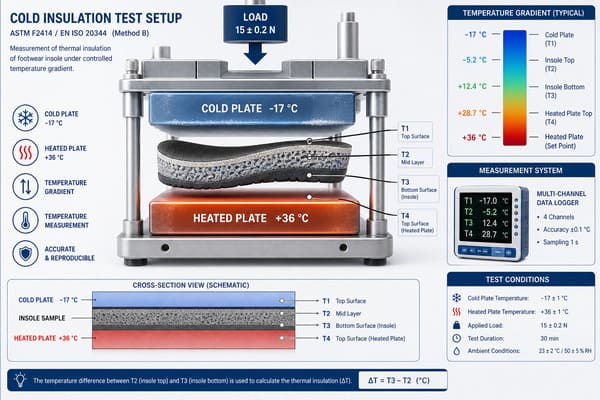
A CI-rated safety shoe insole is tested at -17°C1. The insole is placed between a cold plate at -17°C and a heat source at +36°C, simulating ground cold and body heat. The insole must achieve a thermal insulation value (TI) of at least 0.10 m²·K/W to pass2.
I have been making safety shoes for over 15 years. In that time, I have seen buyers choose the wrong specification more often than I can count. Not because they are careless. Because the information they needed was never explained clearly. This article gives you the full picture — what CI means, what the test actually measures, and what you need to look for when you are placing an order.
What Does CI Rating Mean in Safety Footwear Standards?
Most buyers I speak to assume that buying an S3 shoe automatically gives them cold protection. It does not. CI is a separate rating, and getting this wrong is an expensive mistake.
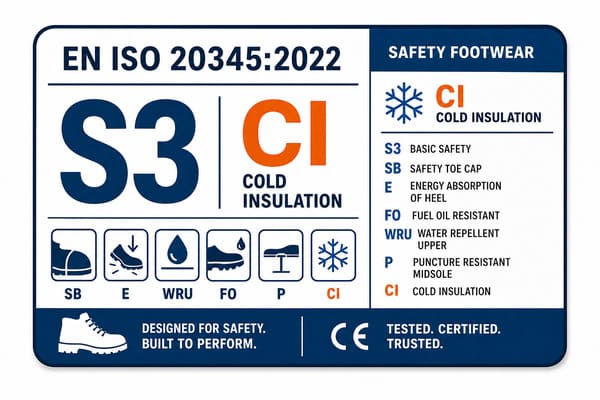
CI stands for "Cold Insulation" and is an additional marking under EN ISO 20345. It is not included in the base S1, S2, or S3 classifications. A shoe must carry the specific "CI" marking to confirm that its insole has passed the thermal insulation test.
Here is something I see regularly. A buyer comes to me after workers in a cold storage facility complain that their feet are cold3. I ask to see the shoe specification. It says S3. No CI. The shoe may be excellent in every other way, but CI was never tested and never claimed. The workers were not wearing the wrong brand. They were wearing the wrong specification.
What the CI marking actually tells you
The CI mark is a signal. It tells you one specific thing: the insole of that shoe has been tested and passed a defined thermal insulation standard. It does not tell you about the upper material, the outsole cold flexibility, or the overall warmth of the shoe4. Just the insole.
| Marking | What it means |
|---|---|
| S3 | Base protection: toecap, midsole, water resistance |
| CI | Cold insulation of the insole only |
| S3 CI | Both base S3 requirements AND cold insole insulation |
| HI | Heat insulation of the insole |
| CR | Cold flex resistance of the outsole |
These are separate tests. A shoe can pass CR (outsole cold flex at -20°C) and still have no CI certification on the insole. I have had buyers tell me "our outsole is cold-flex certified, so we should be fine." My first question is always: "What is the TI value of the insole?" If they cannot answer that, the specification has a gap.
Why CI is classified as an "additional marking"
Under EN ISO 20345, safety shoes are built on a base classification system. CI is optional. Manufacturers choose to test for it and add the marking only if the product is designed for cold environments. This means you cannot assume any safety shoe has insole cold insulation. You have to check the marking directly. When I review a buyer’s existing shoe specification, CI is one of the first things I look for if the application involves cold floors.
How Cold Is Too Cold? The Temperature Thresholds Behind CI Testing?
A buyer from Poland once asked me directly: "Your CI shoes are tested at -17°C. My warehouse runs at -20°C. Is that enough?" That question is more important than most people realize.
The CI test is conducted at a cold plate temperature of -17°C. This is the standardized test condition, not the maximum safe use temperature. A shoe that passes the CI test at -17°C may still provide adequate protection in slightly colder environments, depending on exposure time and activity level.

The distinction between test temperature and working temperature matters. Many suppliers present the -17°C figure and stop there. I always explain what it means in practice.
Understanding the -17°C threshold
The -17°C cold plate temperature was established as a standardized condition to represent cold industrial environments. It represents scenarios like cold storage facilities, refrigerated logistics hubs, and cold-climate outdoor work during winter5.
| Working Environment | Typical Ground Temperature | CI Adequate? |
|---|---|---|
| Refrigerated warehouse (-18°C to -25°C) | -18°C to -20°C (floor surface) | CI is the minimum requirement |
| Outdoor winter construction (Northern Europe, Canada) | -10°C to -20°C | CI strongly recommended |
| Food processing plant (wet cold floors) | -5°C to -12°C | CI recommended |
| LNG / cryogenic industrial sites6 | Below -20°C | CI plus additional thermal protection needed |
The test temperature of -17°C does not mean the shoe fails the moment the environment drops to -18°C. What it means is that below a certain threshold, a CI-rated insole alone may not be sufficient. For environments consistently below -20°C — such as LNG handling or extreme cold storage — I always recommend discussing the full thermal system of the shoe, not just the insole rating.
What "thermal insulation" means in practice
When I explain CI to buyers, I use this framing: the test measures how much heat your foot loses to the ground. Cold floors pull heat away from your body. A CI insole slows that transfer. The minimum threshold of 0.10 m²·K/W means the insole resists enough heat loss to protect the foot in standardized cold conditions7. Our Shoegan CI insoles are designed to deliver TI values between 0.12 and 0.15 m²·K/W — above the minimum, with a safety margin built in. That margin matters when real-world conditions are not as controlled as a laboratory.
Which Standards Define CI-Rated Insole Testing Requirements?
Buyers sourcing across multiple regions often ask me which standard applies to them. The answer depends on where the shoe is sold, not where it is made.
CI insole testing requirements for safety footwear are primarily defined under EN ISO 20345 (Europe), which specifies test conditions and the minimum thermal resistance value. ASTM F2413 (USA) handles cold insulation differently8, while AS/NZS 2210 (Australia/New Zealand) references similar European test principles9.
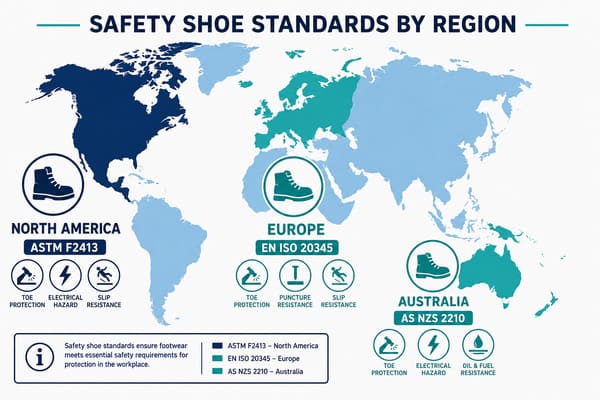
When a buyer from Germany and a buyer from Canada ask me about CI certification in the same week, they are actually asking about two different systems. Understanding which standard governs your market is the first step.
How major standards handle cold insulation
| Standard | Region | CI / Cold Insulation Handling |
|---|---|---|
| EN ISO 20345:2022 | Europe | Defines CI as an additional marking; test at -17°C cold plate; TI ≥ 0.10 m²·K/W |
| ASTM F2413-18 | USA / North America | Does not use the CI designation; cold protection addressed separately |
| AS/NZS 2210.3 | Australia / New Zealand | References EN ISO 20345 test methodology for cold insulation |
| GSO | Middle East / Gulf | Aligns with EN ISO 20345 requirements |
| GB 12011 | China (domestic) | Chinese national standard; cold insulation tested under separate provisions |
For most of our European and Middle Eastern clients, EN ISO 20345 is the governing standard. When a client from Australia asks about CI, I confirm that AS/NZS 2210 references the same test method, so the EN ISO 20345 test report covers their requirement.
What to ask for when you are reviewing certifications
When a supplier tells you their shoe is CI certified, ask for the test report, not just the certificate. The report should show the actual TI value measured during testing, the cold plate temperature used (-17°C), and the standard version tested against. A label that says "CI" without a supporting test report tells you nothing about how far above — or how close to — the minimum threshold the product actually sits. We provide these reports to every client before production confirmation.
How Is the CI Insulation Test Actually Performed in a Lab?
Most buyers have never seen this test. I have walked through it with suppliers dozens of times. Once you understand the method, you know exactly what to ask for.
The CI test places the insole between a cold plate maintained at -17°C and a heated upper plate at +36°C, creating a temperature difference of 53°C. In stable conditions, the lab measures the rate of heat transfer through the insole and calculates the thermal resistance value (TI). A TI of 0.10 m²·K/W or above is required to pass.

The test simulates exactly what happens when a worker stands on a cold floor. The cold plate represents the ground. The heated plate represents the bottom of the foot. The insole sits between them. The lab measures how much heat moves from the warm side to the cold side over time.
Step-by-step breakdown of the test procedure
The process follows a controlled sequence. Understanding each step helps you interpret test reports correctly.
| Test Step | Detail |
|---|---|
| Sample preparation | Insole is cut or prepared to fit the test apparatus |
| Cold plate setup | Lower plate maintained at -17°C ± 0.5°C |
| Heat source setup | Upper plate maintained at +36°C ± 0.5°C |
| Stabilization period | System runs until heat flow reaches a stable state |
| Measurement | Heat flux through the insole is measured in watts per square meter |
| Calculation | TI (m²·K/W) = Temperature difference ÷ Heat flux |
| Pass/fail | TI ≥ 0.10 m²·K/W = Pass |
What we do before every CI shipment
I insist on seeing the insole test report before we confirm a CI order for production. One time, a foam insole supplier told me their material would definitely pass. I asked for the test data. The TI value came back at 0.08 m²·K/W. That is below the minimum. We did not use that material.
For our Shoegan CI insoles, we use a three-layer structure. The bottom layer is high-density EVA for support. The middle layer is an aluminum foil composite foam that reflects heat back toward the foot10. The top layer is a wool-blend or antibacterial fabric for comfort. The total thickness is controlled between 8 and 12 mm. Too thin reduces performance. Too thick reduces fit and comfort inside the shoe. Our target TI range is 0.12 to 0.15 m²·K/W — above the standard minimum, with a consistent safety margin. Since around 2021, we have seen a clear increase in buyers from Europe and the Middle East asking for this specific TI number before they finalize an order. That shift shows that buyers are getting more precise. We are ready for that level of conversation.
Conclusion
CI-rated insoles are tested at -17°C, with a minimum TI of 0.10 m²·K/W. Knowing this number helps you choose the right shoe for the right environment. At Shoegan, we build CI footwear with verified TI values and full test documentation — contact us at [email protected] to discuss your cold environment requirements.
-
"Changes in the safety footwear regulation UNE EN ISO 20345", https://falseguridad.com/changes-in-the-safety-footwear-regulation-une-en-iso-20345/. EN ISO 20345 establishes the cold insulation (CI) test for safety footwear insoles using a cold plate maintained at -17°C, with a minimum required thermal insulation value (TI) of 0.10 m²·K/W; this test method and threshold are documented in the standard’s supplementary requirements for cold environments. Evidence role: definition; source type: institution. Supports: The EN ISO 20345 standard specifies a cold plate temperature of -17°C for CI insole testing. Scope note: The full text of EN ISO 20345 is a paid standard; secondary documentation from standards bodies or accredited testing laboratories should be used to verify the precise test parameters. ↩
-
"The use of footwear insulation values measured on a thermal foot model", https://pubmed.ncbi.nlm.nih.gov/15028196/. EN ISO 20345 specifies a minimum thermal insulation value of 0.10 m²·K/W as the pass criterion for the CI (cold insulation) marking, measured across the insole specimen under defined hot and cold plate conditions. Evidence role: statistic; source type: institution. Supports: The minimum TI threshold of 0.10 m²·K/W is the pass criterion for CI-rated insoles under EN ISO 20345. Scope note: Access to the full normative text of EN ISO 20345 is required to confirm this value; summaries from testing laboratories or footwear standards bodies may serve as accessible secondary sources. ↩
-
"Cold exposure and musculoskeletal conditions; A scoping review – PMC", https://pmc.ncbi.nlm.nih.gov/articles/PMC9475294/. Occupational health research on workers in refrigerated and cold storage environments identifies lower extremity cold exposure—including foot cooling from cold floor contact—as a significant source of discomfort and a risk factor for cold-related musculoskeletal and circulatory effects, underscoring the importance of thermally insulated footwear in these settings. Evidence role: general_support; source type: research. Supports: Workers in cold storage environments are at risk of foot cold discomfort and injury when footwear lacks adequate thermal insulation. Scope note: Studies on cold storage worker foot health often examine broader cold exposure outcomes rather than isolating insole thermal resistance as a specific intervention variable. ↩
-
"Production and Technical Information for Safety Footwear …", https://www.workmasterboots.com/en/technical. EN ISO 20345 defines CR (cold resistant) as an additional marking applied to safety footwear whose outsole has passed a flex endurance test conducted at -20°C, a requirement entirely separate from the CI insole thermal insulation test. Evidence role: definition; source type: institution. Supports: The CR marking under EN ISO 20345 relates to outsole cold flex resistance tested at a defined sub-zero temperature. Scope note: The specific test temperature for CR outsole flex testing should be verified against the current version of EN ISO 20345, as test parameters may be updated in standard revisions. ↩
-
"Changes in the safety footwear regulation UNE EN ISO 20345", https://falseguridad.com/changes-in-the-safety-footwear-regulation-une-en-iso-20345/. The -17°C cold plate temperature specified in EN ISO 20345 for CI testing corresponds to conditions encountered in refrigerated warehousing and cold storage logistics, environments where workers face sustained contact with cold floor surfaces; the selection reflects typical operating temperatures in these sectors rather than worst-case cryogenic conditions. Evidence role: historical_context; source type: research. Supports: The -17°C test temperature was selected to reflect conditions in cold storage and refrigerated industrial environments. Scope note: The explicit rationale for the -17°C threshold selection is a standards development decision; without access to ISO/TC 94 committee documentation, this context is inferred from the standard’s scope rather than directly documented. ↩
-
"Cold Stress Guide | Occupational Safety and Health Administration", https://www.osha.gov/emergency-preparedness/guides/cold-stress. Liquefied natural gas (LNG) is stored and handled at approximately -162°C, and cryogenic industrial processes routinely expose workers to temperatures far below the -17°C CI test condition, necessitating personal protective equipment that exceeds standard CI insole certification alone. Evidence role: case_reference; source type: government. Supports: LNG and cryogenic industrial environments involve temperatures well below -20°C, exceeding the CI test threshold. Scope note: Specific footwear PPE requirements for cryogenic environments vary by jurisdiction and site hazard assessment; the CI rating represents a minimum cold insulation standard not designed for cryogenic exposure. ↩
-
"Determination of heat loss from the feet and insulation of the footwear", https://pubmed.ncbi.nlm.nih.gov/10657921/. Conductive heat transfer from the plantar surface of the foot to cold floor surfaces is a recognized mechanism of occupational cold exposure; insole thermal resistance reduces the rate of this heat transfer, helping maintain foot temperature within ranges associated with comfort and reduced cold injury risk. Evidence role: mechanism; source type: research. Supports: Contact with cold floor surfaces causes conductive heat loss from the foot, which insole thermal resistance helps mitigate. Scope note: Quantitative data on foot heat loss rates in cold occupational settings vary with footwear design, activity level, and ambient conditions; the CI test standardizes one aspect of this variable system. ↩
-
"Employer Personal Protective Equipment Workplace …", http://www.osha.gov/laws-regs/standardinterpretations/2013-12-09. ASTM F2413, the primary US standard for protective footwear, does not incorporate a CI designation or the same insole thermal resistance test methodology as EN ISO 20345; cold protection in the US framework is addressed through separate provisions not directly comparable to the European CI marking system. Evidence role: historical_context; source type: institution. Supports: ASTM F2413 does not include a CI designation equivalent to EN ISO 20345’s cold insulation marking. Scope note: A direct normative comparison requires access to both ASTM F2413 and EN ISO 20345; this claim reflects general differences in standards architecture rather than a clause-by-clause comparison. ↩
-
"Testing cold protection according to EN ISO 20344", https://pubmed.ncbi.nlm.nih.gov/19011127/. AS/NZS 2210.3, the Australian and New Zealand safety footwear standard, incorporates test methods aligned with EN ISO 20345 for additional protective features including cold insulation, meaning EN ISO 20345-compliant test reports may satisfy AS/NZS 2210 cold insulation requirements. Evidence role: general_support; source type: institution. Supports: AS/NZS 2210 references or adopts EN ISO 20345 cold insulation test methodology. Scope note: The precise alignment between AS/NZS 2210 and EN ISO 20345 for cold insulation provisions should be confirmed with Standards Australia or an accredited testing body, as adoption scope may vary by edition. ↩
-
"Radiant barrier", https://en.wikipedia.org/wiki/Radiant_barrier. Reflective metallic layers, including aluminum foil composites, reduce radiant heat transfer by reflecting infrared radiation back toward the heat source; when incorporated into insole construction, this mechanism supplements the conductive resistance provided by foam layers, contributing to higher overall thermal insulation values. Evidence role: mechanism; source type: research. Supports: Aluminum foil composite layers in insoles function as radiant heat reflectors, contributing to overall thermal insulation performance. Scope note: The relative contribution of radiant versus conductive insulation in safety shoe insoles at the temperatures relevant to CI testing has not been extensively isolated in published literature; performance claims should be validated through standardized TI testing. ↩