
I have been in the safety shoe industry for over 20 years. Every few months, a buyer emails me asking: "I need electrical protection shoes — do you make them?" The problem is, that one phrase covers two completely opposite needs.
Electrically insulating shoes and antistatic shoes both deal with electricity, but they work in opposite directions. Insulating shoes block electricity from entering the body. Antistatic shoes let static electricity safely leave the body. Buying the wrong type does not just waste money — in some workplaces, it creates serious danger.
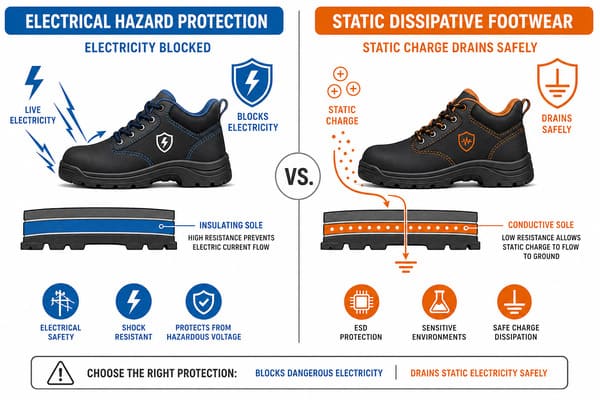
I want to walk you through exactly what each shoe does, who needs it, and how to tell them apart — so you never make the wrong call for your team or your customers.
Are Electrical Hazard Shoes the Same as ESD Shoes?
A buyer from the Middle East contacted me a few years ago. His factory had just purchased a batch of "electrical protection safety shoes," but the QC inspector rejected the entire order. I asked him to send me the spec sheet. One look told me everything — he had ordered ESD antistatic shoes, but his workers were doing low-voltage electrical maintenance work. They needed insulating shoes, not antistatic ones.
Electrical hazard (EH) shoes and ESD antistatic shoes are not the same. EH shoes are designed to block electric current from passing through the wearer. ESD shoes are designed to drain built-up static charge from the wearer’s body. The two shoes look almost identical but serve opposite protective functions.
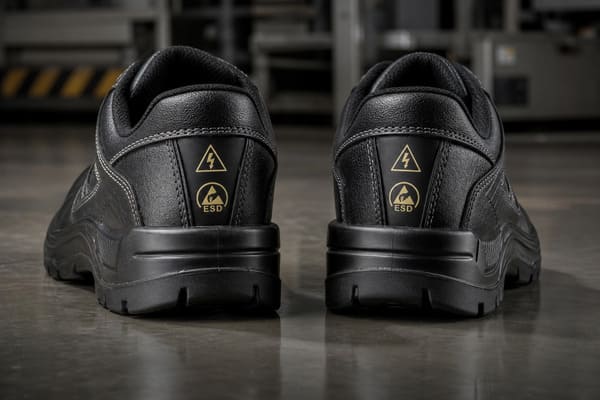
That buyer had ordered 500 pairs. None of them could be used for their actual job. This kind of mistake is more common in the market than most people think. The confusion comes from the fact that both shoe types carry the word "electrical" in their description, and both look like standard safety shoes from the outside. There is no visible difference to an untrained eye. The difference is entirely in the sole material, the resistance level, and the protection standard — not in the appearance. If you are sourcing safety shoes for a specific electrical environment, the first question you need to answer is: are you trying to keep electricity out, or get it out?
What Are Electrically Insulating Safety Shoes and How Do They Work?
Most people think of electrical protection as a simple on/off switch. Either a shoe protects you or it does not. The reality is more specific than that — and getting the details wrong can cost a worker their life.
Electrically insulating safety shoes work by creating a complete break in the electrical circuit between a live source and the ground. The sole must have a high enough resistance to prevent current from passing through the body. Under EN ISO 20345, Class I insulating shoes are tested at up to 15,000 volts, with leakage current held below 1mA.1
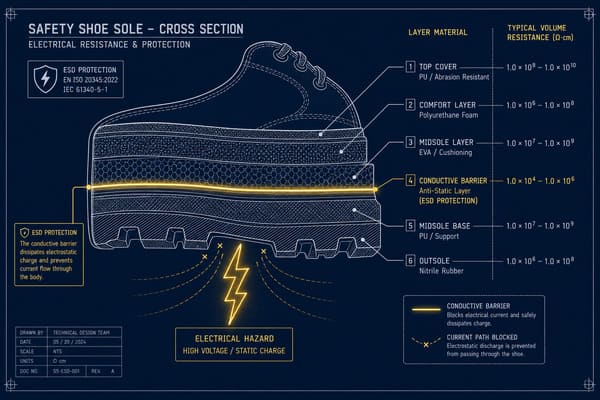
Here is a detail that many buyers do not know: electrically insulating shoes must not have any antistatic properties2. If the sole has even a small amount of conductivity, the insulating protection is gone. A real, compliant insulating shoe must use a fully non-conductive sole material — no compromise. This means insulating shoes and antistatic shoes cannot be made from the same sole compound. They are built from fundamentally different materials.
Who Works in Environments That Require Insulating Shoes?
The workers who need insulating shoes are those who may come into contact with live electrical sources during their work. This includes:
| Work Type | Example Risk |
|---|---|
| Electrical maintenance technicians3 | Accidental contact with live wiring |
| Power line workers | Ground faults and arc exposure |
| Industrial electricians | Contact with live panels or switchgear |
| Utility substation workers | High-voltage equipment proximity |
What Standards Cover Electrically Insulating Shoes?
Different markets use different standards for insulating footwear:
| Standard | Region | Key Test Parameter |
|---|---|---|
| EN ISO 20345 (Class I) | Europe | Up to 15,000V, leakage ≤ 1mA |
| ASTM F2413 (EH rating) | USA / North America | 18,000V, 60Hz for 1 minute |
| AS/NZS 2210 | Australia / New Zealand | Similar to EN ISO approach |
When we produce insulating shoes at Shoegan, we select sole materials that are tested and certified to the correct standard for the target market. The sole compound, thickness, and production QC process all matter. A shoe that looks like an insulating shoe but is not tested to the right standard gives workers a false sense of safety — which is worse than wearing no protection at all.
What Are Antistatic Safety Shoes and Who Needs Them?
Most workers who need antistatic shoes do not face a risk of electric shock at all. Their risk is invisible — and the thing being protected is not their body, but the products and equipment around them.
Antistatic (ESD) safety shoes reduce the buildup of static electricity on the body by providing a controlled path for static charge to drain to the ground. Under EN ISO 20345, the required resistance range is 100kΩ to 1,000MΩ4 — high enough to offer some shock protection, low enough to discharge static safely.
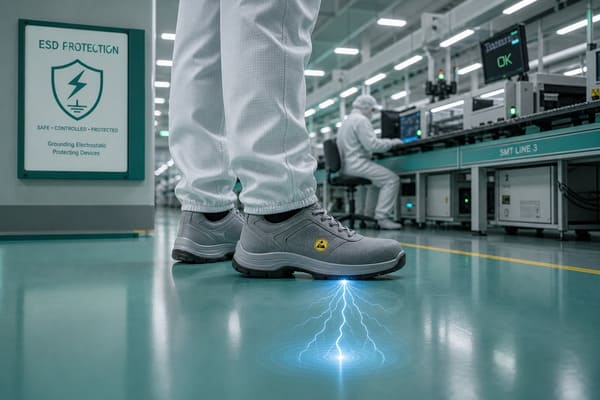
In 2023, I received an order from an electronics contract manufacturer in Southeast Asia. Their requirement was simple: every worker on the production line had to pass ESD compliance testing before entering the floor. The reason was a single component on their line — a chip with a market price above $800. One human body static discharge event, usually just a few thousand volts that the person cannot even feel, is enough to destroy it permanently.5 Their risk was not worker injury. It was product loss and equipment damage.
Who Needs Antistatic Safety Shoes?
The resistance range for antistatic shoes — 100kΩ to 1,000MΩ — is not an arbitrary number. It is an engineered balance point. Too low, and the worker has a shock risk if they accidentally contact a live source. Too high, and the static charge cannot leave the body fast enough to protect sensitive components.6 That specific window is the result of real engineering calculation.
| Industry | Why Antistatic Shoes Are Required |
|---|---|
| Electronics manufacturing7 | Prevent ESD damage to components and boards |
| Semiconductor fabrication8 | Protect wafers and micro-scale components |
| Chemical and explosive environments9 | Prevent static-ignited fires or explosions |
| Pharmaceutical production | Protect sensitive product integrity |
| Cleanroom environments | Control particle and charge contamination |
What Does the ESD Test Actually Measure?
When we test antistatic shoes in our facility, we are checking the resistance from the inside of the shoe to the outer sole surface10. The test simulates the real path that static charge travels — from the worker’s foot, through the insole, through the midsole, through the outsole, and into the ground. Every layer in that path affects the final resistance value. This is why insole material, insole treatment, and outsole compound all need to be specified correctly at the design stage — not adjusted after production.
Electrically Insulating vs. Antistatic Shoes: Which One Protects You From What?
I use a simple comparison to explain this when clients ask: an insulating shoe is a wall — it blocks electricity from the outside from entering the body. An antistatic shoe is a controlled drain — it lets electricity from the inside of the body flow slowly and safely out. Same general topic, opposite direction, completely different material logic.
Electrically insulating shoes protect the wearer from external electric shock by blocking current flow. Antistatic shoes protect the environment and equipment by safely grounding the wearer’s static charge. One blocks electricity in. The other lets electricity out. They cannot be combined in a single shoe.
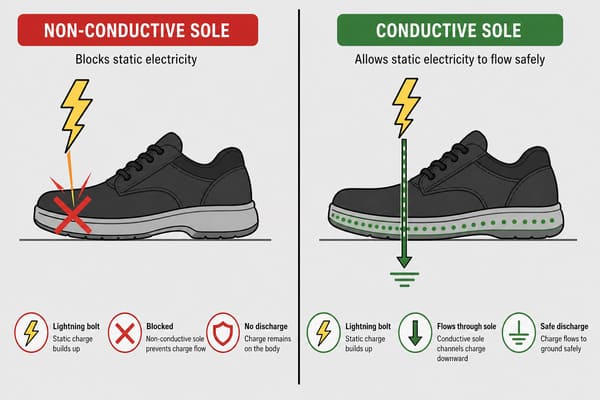
Here is a direct comparison between the two shoe types:
| Feature | Electrically Insulating Shoes | Antistatic (ESD) Shoes |
|---|---|---|
| Protection direction | Blocks electricity from entering body | Drains static charge from body to ground |
| Sole resistance | Very high (non-conductive) | 100kΩ – 1,000MΩ (controlled range) |
| Who it protects | The worker | Products, equipment, environment |
| Main hazard addressed | Electric shock from live sources | Static discharge damage or ignition |
| Can they be combined? | No — physically incompatible | No — same reason |
| Relevant standard (EU) | EN ISO 20345 Class I | EN ISO 20345 ESD classification |
| Relevant standard (US) | ASTM F2413 EH | ASTM F2413 SD |
What If Your Workplace Needs Both?
This is a real question I get from buyers working in complex industrial environments — places like oil refineries or chemical plants where workers may handle both live electrical components and flammable materials in the same shift.
The honest answer is: no single shoe can satisfy both requirements at the same time. The physical properties required are contradictory. A sole that is conductive enough to drain static charge will never pass insulation testing.11 A sole that is non-conductive enough to block electric shock will never pass antistatic testing.
| Scenario | Primary Hazard | Recommended Shoe Type | Secondary Risk Management |
|---|---|---|---|
| Electrical maintenance + static-sensitive area | Electric shock | Insulating shoes | Grounding wrist straps for ESD control |
| Explosive environment + occasional electrical proximity | Static ignition | Antistatic shoes | Work planning to avoid live contact |
| Cleanroom + low-voltage equipment | ESD damage | Antistatic shoes | Insulated tools and PPE for electrical tasks |
The right approach when both risks exist is to identify the primary hazard first, choose the shoe that addresses it, and then use other engineering controls to manage the secondary risk. This is standard practice in serious safety management. Trying to find a shoe that does both is the wrong starting point — because that shoe does not exist and cannot exist.
Conclusion
Insulating shoes block electricity out. Antistatic shoes let static charge out. The direction is opposite, the materials are different, and buying the wrong one can create real danger on the job. At Shoegan, we manufacture both types to EN ISO 20345, ASTM F2413, and other international standards — with full OEM customization available. If you are sourcing either type and want to get the specification right before you place an order, contact us at [email protected] or WhatsApp +8613008988018.
-
"What Is the Electrical Resistance Range for ESD Safety Shoes …", https://protectyourfootsafety.com/what-is-the-electrical-resistance-range-for-esd-safety-shoes/. The EN ISO 20345 standard specifies electrical insulation testing parameters for Class I footwear, including voltage exposure levels and maximum allowable leakage current thresholds. Evidence role: statistic; source type: institution. Supports: the specific voltage and leakage current parameters for Class I insulating footwear testing under EN ISO 20345. Scope note: Standard specifications may be updated periodically; verification should reference the current version year. ↩
-
"What Is the Difference Between ESD and Antistatic Safety Shoes …", https://protectyourfootsafety.com/what-is-the-difference-between-esd-and-antistatic-safety-shoes/. Electrical insulation requires high resistance to prevent current flow, while antistatic functionality requires controlled conductivity to dissipate static charge; these opposing electrical properties cannot coexist in the same material system. Evidence role: mechanism; source type: research. Supports: the physical and electrical principles that make insulating and antistatic properties mutually exclusive in footwear. ↩
-
"Electrical – Overview | Occupational Safety and Health …", http://www.osha.gov/electrical. Occupational safety data indicates that electrical workers, including maintenance technicians, face elevated risks of electrical shock and arc flash injuries due to proximity to live electrical systems. Evidence role: general_support; source type: government. Supports: occupational electrical hazards faced by maintenance technicians and electricians. Scope note: Risk levels vary significantly by industry sector, work practices, and regulatory environment. ↩
-
"What Is the Difference Between ESD and Antistatic Safety Shoes …", https://protectyourfootsafety.com/what-is-the-difference-between-esd-and-antistatic-safety-shoes/. EN ISO 20345 defines the electrical resistance range for antistatic footwear to control static electricity discharge while maintaining worker safety. Evidence role: statistic; source type: institution. Supports: the electrical resistance range specified for antistatic footwear classification under EN ISO 20345. ↩
-
"Human-body model – Wikipedia", https://en.wikipedia.org/wiki/Human-body_model. Human body electrostatic discharge events typically range from several hundred to several thousand volts and can exceed the damage threshold of many semiconductor components, which may be susceptible to voltages below 100V. Evidence role: mechanism; source type: research. Supports: the typical voltage range of human electrostatic discharge events and their capacity to damage sensitive electronic components. Scope note: Specific damage thresholds vary by component type and manufacturing process. ↩
-
"What Temperature Can an HRO-Rated Safety Shoe Outsole …", https://protectyourfootsafety.com/what-temperature-can-an-hro-rated-safety-shoe-outsole-withstand/. Antistatic footwear resistance specifications are engineered to provide sufficient conductivity for static charge dissipation while maintaining adequate resistance to limit current flow in case of accidental contact with electrical sources. Evidence role: mechanism; source type: research. Supports: the electrical safety principles that determine optimal resistance ranges for antistatic footwear. Scope note: The specific resistance values are determined by standards committees based on experimental data and workplace risk assessments. ↩
-
"What Is the Difference Between ESD and Antistatic Safety Shoes …", https://protectyourfootsafety.com/what-is-the-difference-between-esd-and-antistatic-safety-shoes/. Electronics manufacturing industry standards such as ANSI/ESD S20.20 establish comprehensive ESD control programs that typically include requirements for antistatic footwear as part of personnel grounding systems. Evidence role: general_support; source type: institution. Supports: industry standards requiring ESD control measures including footwear in electronics manufacturing environments. ↩
-
"Electrostatic Discharge in Semiconconductor Fabrication", https://www.semi.org/en/electrostatic-discharge-semiconconductor-fabrication-causes-and-solutions. Semiconductor devices, particularly at advanced technology nodes, exhibit extreme sensitivity to electrostatic discharge, with damage thresholds often below 100 volts, necessitating comprehensive ESD control measures throughout the manufacturing process. Evidence role: general_support; source type: research. Supports: the ESD sensitivity of semiconductor devices and the need for static control in fabrication environments. ↩
-
"ATEX directives – Wikipedia", https://en.wikipedia.org/wiki/ATEX_directives. Workplace safety regulations for explosive and flammable environments recognize static electricity as a potential ignition source and mandate static-dissipative footwear as part of comprehensive explosion prevention measures. Evidence role: general_support; source type: government. Supports: regulatory requirements for static control footwear in potentially explosive atmospheres. Scope note: Specific requirements depend on the classification of the hazardous area and the materials present. ↩
-
"What Is the Difference Between ESD and Antistatic Safety Shoes …", https://protectyourfootsafety.com/what-is-the-difference-between-esd-and-antistatic-safety-shoes/. Safety footwear testing standards specify measurement of electrical resistance through the complete path from the interior contact surface to the outer sole, simulating the actual conductive pathway during use. Evidence role: mechanism; source type: institution. Supports: the standardized testing methodology for measuring electrical resistance in antistatic footwear. ↩
-
"What Is the Electrical Resistance Range for ESD Safety Shoes …", https://protectyourfootsafety.com/what-is-the-electrical-resistance-range-for-esd-safety-shoes/. Insulating footwear requires resistance values typically exceeding several megohms to block hazardous current, while antistatic footwear operates in the kilohm to low megohm range for charge dissipation—ranges that do not overlap with acceptable safety margins. Evidence role: mechanism; source type: research. Supports: the quantitative difference in electrical resistance between insulating and antistatic footwear that makes dual functionality impossible. Scope note: Specific resistance thresholds vary by standard and testing conditions. ↩