
I’ve been in this industry for over 20 years, and one of the most common complaints I hear from new buyers is: "The shoes feel tight, but I ordered my normal size." It happens more than you’d think, and the reason is almost always the same.
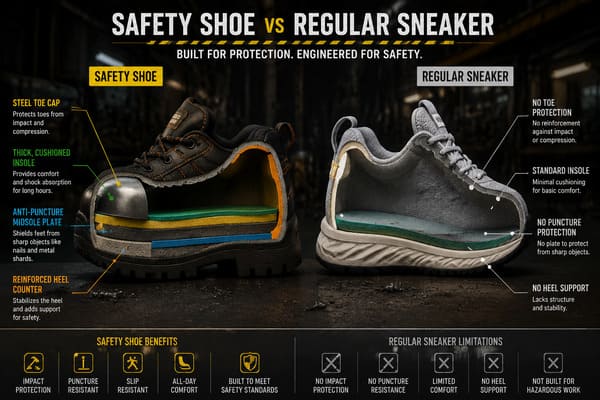
Safety shoes are not built like regular shoes. They contain a steel or composite toe cap, an anti-puncture midsole plate, a reinforced heel counter, and a thicker insole.1 All of these structural layers take up internal space that a regular shoe simply does not have, which means the same size number will fit differently.
In one order I handled for a construction company in the Middle East, nearly 30% of the first batch came back for exchange because workers found them too tight — even though the sizes matched their regular sneakers exactly. That experience taught me to always brief buyers on sizing before production starts, not after. If you are sourcing safety shoes for the first time, this guide will walk you through everything you need to know before you place an order.
Should You Size Up or Down for Safety Shoes?
My default advice to every new client is simple: start half a size up. But I learned this the hard way, and the full answer is more specific than that.
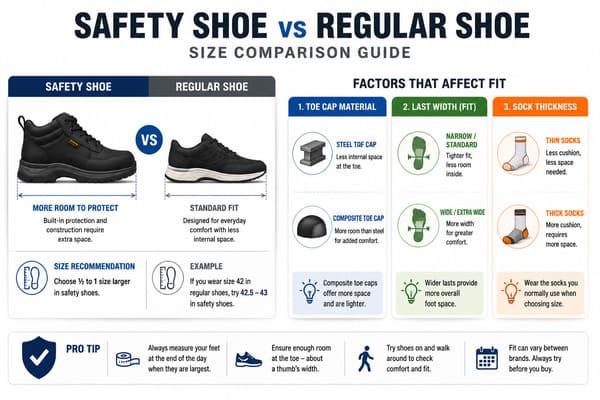
For most workers, going half a size up from their regular shoe size is the right starting point. The correct size depends on three factors: the toe cap material, the last width of the specific model, and the thickness of the socks the workers will wear on the job.
Years ago, a client ordered 500 pairs for a warehouse team, all in their normal sizes. Within two weeks, workers were complaining about toe pressure after long shifts. We had to remake 200 pairs. The fix was simple — half a size up resolved it for most workers. But that remake cost time, money, and trust. Here is what actually drives the sizing difference, broken down by the three factors that matter most.
Toe Cap Material
Steel toe caps have a fixed, rigid shell. That shell has a set internal volume that does not change, no matter how the shoe flexes.2 Composite toe caps can be molded into a wider range of shapes, which gives more room for design adjustments. As a general rule, steel toe models need more size allowance than composite toe models.
Last Width
Not all safety shoe models run the same width. Some of our models at Shoegan run narrow, and some run wide. A worker with a wide forefoot buying a narrow-last model will feel tightness even if the length is correct. Always ask the manufacturer for the last width specification before ordering in bulk.
Sock Thickness
A thick work sock alone can take up half a size of internal space.3 If your workers wear thin cotton socks, the fit will be different from workers wearing thick thermal socks on a cold-storage floor. This is a detail that many buyers overlook, and it causes a large share of fit complaints after delivery.
| Factor | Impact on Fit | Recommended Action |
|---|---|---|
| Steel toe cap | Reduces internal volume more than composite | Size up half a size as baseline |
| Composite toe cap | More shape flexibility, less volume loss | Standard sizing may work, but test first |
| Narrow last | Tighter across the forefoot | Request last width spec before ordering |
| Wide last | More room across the toe box | May suit workers with wider feet |
| Thick work socks | Reduces effective internal space | Add half a size to account for sock volume |
Sizing down almost never makes sense for safety shoes. The structural components do not compress the way soft shoe materials do, so a smaller size will not break in and loosen up over time.4
How Do I Find My Correct Safety Shoe Size?
The most reliable method I have seen work in bulk B2B orders is a three-step process we recommend to every client before confirming production. Skipping any one of these steps is where problems start.
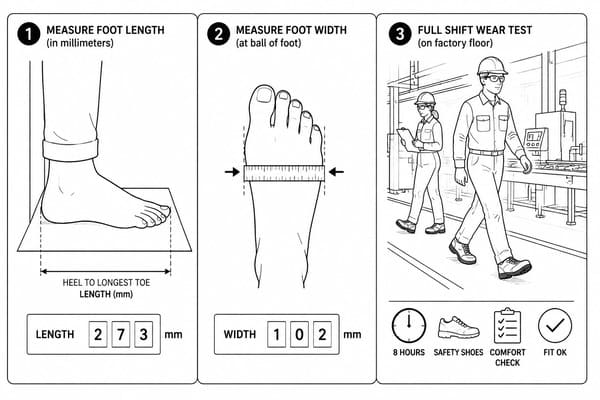
Measure foot length in millimeters while standing, check foot width at the widest point, then request a physical sample and run a real wear test with 5 to 10 workers for a full shift. This process eliminates most fit-related returns before production begins.
One client — a PPE distributor in Southeast Asia — skipped the wear test and ordered 1,000 pairs. Around 15% came back as wrong fit. After that experience, they made wear testing a standard step in their procurement process. It adds one to two weeks to the timeline, but it eliminates expensive remakes. Here is how to run each step correctly.
Step 1 — Measure Foot Length While Standing
Always measure with the worker standing, not sitting. Feet expand under body weight. A measurement taken while sitting can be up to 5mm shorter than the actual standing foot length.5 That gap is enough to cause fit problems across a large order. Measure from the heel to the tip of the longest toe, and record in millimeters.
Step 2 — Measure Foot Width
Measure at the widest point of the foot, which is usually across the ball of the foot. This measurement tells you whether the worker needs a standard or wide last. If the width measurement is at the upper end of the range for a given size, a wide-last model is the safer choice.
Step 3 — Run a Real Wear Test
Send physical samples to the end user before confirming production. Ask workers to wear them for a full shift — not just a few minutes in an office. Toe pressure, heel slippage, and arch discomfort only show up after hours of real use. Collect feedback from at least 5 to 10 workers to get a reliable picture, since individual foot shapes vary.
| Step | What to Do | Why It Matters |
|---|---|---|
| Measure standing | Record foot length in mm while worker stands | Feet are longer under body weight |
| Measure width | Check widest point across the ball of foot | Determines last width requirement |
| Wear test | Full shift test with 5–10 workers | Reveals pressure points that short tests miss |
Why Do Safety Shoe Sizes Vary by Country and Standard?
The size number is just a label. What actually determines how a shoe fits is the last — the foot-shaped mold the shoe is built around. And lasts are designed based on regional foot shape data, which differs significantly from one part of the world to another.
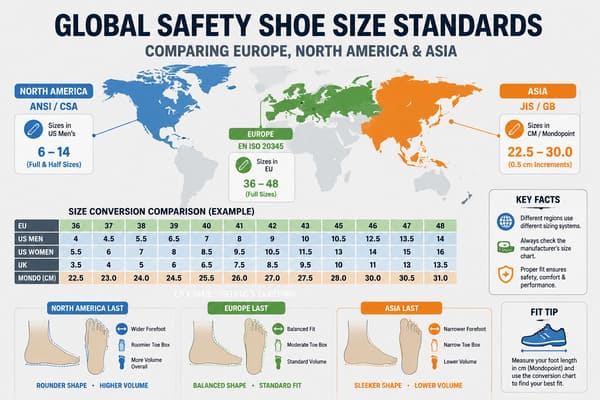
A EU 43 built on a European last will fit very differently from a EU 43 built on a Chinese last, even if the number is the same.6 European lasts tend to be narrower and longer. North American lasts are wider across the forefoot. Asian lasts are often shorter with a wider toe box.7
We maintain over 8 different last systems at Shoegan specifically to serve our global clients. Buyers from Germany, Australia, the Gulf, and North America all have different fit expectations, and the same last cannot serve all of them well. When a new client comes to us, one of the first questions I ask is: where are the end users located, and what is their average foot shape profile? That answer determines which last we recommend before we even talk about style or material.
How Regional Foot Shape Data Affects the Last
Last designers use population foot scan data to build the mold.8 European populations tend to have a longer, narrower foot with a higher arch. North American populations have a wider forefoot. Many Southeast Asian and East Asian populations have a shorter foot with a flatter arch and a broader toe box.9 If a shoe is built on the wrong last for the target market, the size number becomes meaningless — the shoe will not fit correctly no matter how carefully the worker measures their foot.
How International Size Standards Add Another Layer
Beyond the last, size conversion between international standards adds more complexity. The table below shows how common size systems compare, but these are approximations. The actual fit depends on the last, not just the number.
| EU Size | UK Size | US Size (Men) | Foot Length (mm) |
|---|---|---|---|
| 39 | 6 | 7 | 248 |
| 41 | 7.5 | 8.5 | 260 |
| 43 | 9 | 10 | 272 |
| 45 | 10.5 | 11.5 | 284 |
| 47 | 12 | 13 | 296 |
When sourcing from a manufacturer, always confirm which last system the model is built on, not just the size label. This is especially important for OEM orders where you are supplying shoes to workers in a different country from where the shoes are made.
Does the Toe Cap Affect How Safety Shoes Fit?
It affects fit more than most buyers expect. The toe cap is a rigid structure placed inside the front of the shoe, and every millimeter of its internal geometry directly affects how much room the toes have during a full shift.
Steel toe caps are rigid and have a fixed internal profile that does not change with use. Composite toe caps can be molded into a wider range of shapes, which allows for more internal height and width. The internal dimensions of the toe cap — not just the impact rating — determine whether the shoe will be comfortable over a long shift.
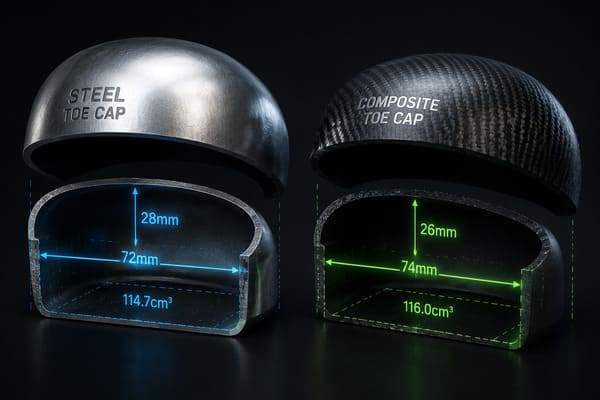
I’ll give you a specific example. We had a client in Europe sourcing steel toe boots for a logistics team. Workers kept complaining about toe numbness after 6-hour shifts. We looked at the data — the steel cap on that model had an internal height of 28mm, but the average toe height for their workforce was closer to 32mm. That 4mm difference was the problem.10 We switched them to a composite toe cap with a taller internal profile, and the complaints stopped completely.
Steel Cap vs. Composite Cap — Fit Differences
Steel caps are heavier and do not flex at all. Their internal shape is fixed at the time of manufacture and cannot be adjusted. If the cap geometry does not match the foot profile of the end user, the only options are to change the cap or change the size. Composite caps are lighter and can be molded into a wider range of shapes during production. This gives us more flexibility when designing a custom order for a specific workforce.
What We Check When Selecting a Toe Cap for a Custom Order
When a client comes to us with a custom order, we do not just check the impact and compression rating of the toe cap. We check three internal dimensions against the target foot profile.
| Dimension | What It Affects | What We Check Against |
|---|---|---|
| Internal height | Toe clearance during walking | Average toe height of target workforce |
| Internal width | Lateral space across the toes | Foot width data for the target region |
| Toe box volume | Overall comfort over long shifts | Shift duration and sock thickness |
If any of these dimensions are mismatched to the end user’s foot profile, the shoe will cause discomfort regardless of the protection rating. A shoe that workers refuse to wear because it hurts is not a safe shoe — it is a liability.11
Conclusion
Safety shoe sizing is more complex than regular shoe sizing because of the structural layers inside. Measure carefully, test before bulk production, and always match the last to your target market. At Shoegan, we help B2B clients get sizing right before production starts — not after. Contact us at [email protected] or WhatsApp +8613008988018.
-
"[PDF] ASTM F2413-11 Performance Requirements for Protective Footwear", https://facilities.uw.edu/partner-resources/files/media/performance-requirements-for-protective-footwear.pdf. ISO 20345 specifies the basic and additional requirements for safety footwear, including toe cap impact resistance, penetration-resistant midsole inserts, and heel energy absorption, establishing the structural components that differentiate safety footwear from ordinary footwear. Evidence role: definition; source type: institution. Supports: The mandatory and optional structural components required in safety footwear under international standards such as ISO 20345.. Scope note: The standard defines minimum performance requirements rather than prescribing exact construction methods; actual internal geometry varies by manufacturer and model. ↩
-
"Assessing the Compressive and Impact Behavior of Plastic Safety …", https://pmc.ncbi.nlm.nih.gov/articles/PMC8703535/. Studies comparing steel and composite toe cap materials under ISO 20345 impact and compression testing confirm that steel caps exhibit negligible deformation, maintaining a fixed internal profile, whereas composite materials such as fiberglass or carbon fiber composites allow greater design flexibility in molding internal geometry. Evidence role: mechanism; source type: paper. Supports: The material properties of steel versus composite toe caps and how rigidity affects internal geometry under load.. Scope note: Direct peer-reviewed studies specifically measuring internal volume change during flexion are limited; most published comparisons focus on impact and compression performance rather than volumetric fit characteristics. ↩
-
"Comparison of Physiological Effects Induced by Two Compression …", https://pmc.ncbi.nlm.nih.gov/articles/PMC10210207/. Footwear fitting research has documented that sock thickness contributes meaningfully to effective internal shoe volume reduction, with thicker occupational socks producing fit changes comparable to a half-size increment in standardized fitting assessments, supporting the practice of accounting for intended sock type when selecting shoe size. Evidence role: general_support; source type: paper. Supports: That sock thickness measurably reduces effective internal shoe volume and affects fit, warranting size adjustment.. Scope note: The precise half-size equivalence is an approximation that varies with sock material, compression properties, and shoe construction; no single published study establishes a universal conversion between sock thickness and size increment. ↩
-
"Effect of a steel toe cap on forefoot injury pattern in a cadaveric model", https://pubmed.ncbi.nlm.nih.gov/21733450/. Material testing conducted under ISO 20345 durability protocols confirms that steel and composite toe caps and penetration-resistant midsole plates retain their structural geometry throughout the rated service life of the footwear, unlike soft foam or leather uppers which exhibit measurable compression set with extended use. Evidence role: mechanism; source type: paper. Supports: That the rigid structural components of safety footwear, particularly toe caps and midsole plates, do not undergo meaningful compression or deformation during normal use.. Scope note: While rigid components do not compress, softer elements such as insoles and linings do compress over time; the overall fit of a safety shoe may change modestly with wear due to these non-structural components even as the rigid elements remain unchanged. ↩
-
"Evidence of Health Risks Associated with Prolonged Standing at …", https://pmc.ncbi.nlm.nih.gov/articles/PMC4591921/. Biomechanical research on foot morphology has documented that foot length increases under weight-bearing conditions due to arch flattening and soft tissue compression, with reported differences typically ranging from 4mm to 8mm depending on arch type and body weight. Evidence role: statistic; source type: paper. Supports: The quantified difference in foot length between weight-bearing and non-weight-bearing measurement positions.. Scope note: The specific 5mm figure cited in the article is a commonly referenced approximation; actual variation depends on individual arch height, body mass, and measurement methodology, and may differ from values in specific studies. ↩
-
"Shoe size – Wikipedia", https://en.wikipedia.org/wiki/Shoe_size. ISO 9407 and related footwear sizing standards define shoe sizes based on foot length measurements but do not standardize last width or three-dimensional shape, meaning that a given size number may correspond to substantially different internal geometries depending on the last used by the manufacturer. Evidence role: general_support; source type: institution. Supports: That shoe size labels do not guarantee consistent fit across manufacturers or regional last systems, as size numbers reference foot length but not last width or shape.. Scope note: ISO standards govern size labeling conventions rather than mandating last geometry, so the degree of fit variation between regional lasts is not quantified in the standard itself. ↩
-
"Forensic application of foot dimensions in ethnic differentiation …", https://pmc.ncbi.nlm.nih.gov/articles/PMC9987485/. Anthropometric studies using 3D foot scanning have identified statistically significant differences in foot width-to-length ratios, arch height, and toe box breadth across populations of different geographic origins, findings that are applied in regional footwear last design to improve fit. Evidence role: expert_consensus; source type: paper. Supports: Systematic differences in foot morphology across regional or ethnic populations that inform footwear last design.. Scope note: Population-level averages mask substantial individual variation; regional generalizations are useful for last design decisions but should not be applied to individual fit assessments without direct measurement. ↩
-
"Anthropometric Foot Variations in Children: A Cross‐Sectional Study …", https://pmc.ncbi.nlm.nih.gov/articles/PMC12314192/. Research in footwear ergonomics and engineering documents the use of large-scale 3D foot scanning surveys, such as the CAESAR and SizeUSA studies, to generate population foot shape data that informs last geometry, enabling manufacturers to optimize fit for target demographic groups. Evidence role: mechanism; source type: research. Supports: The use of population anthropometric foot scan databases in the design and construction of footwear lasts.. Scope note: The extent to which individual manufacturers apply population scan data versus proprietary or legacy last designs varies and is not uniformly documented in public literature. ↩
-
"Foot Morphology in Chinese Adolescents Aged Between 13 to 18 …", https://pmc.ncbi.nlm.nih.gov/articles/PMC6368825/. Anthropometric studies comparing foot morphology across ethnic groups have reported that East Asian populations exhibit significantly lower arch height indices and greater relative forefoot width compared to European populations of equivalent foot length, findings consistent with observed differences in footwear last design between these markets. Evidence role: statistic; source type: paper. Supports: Documented differences in arch height index and forefoot width between East or Southeast Asian and European population samples.. Scope note: Reported differences reflect population-level statistical averages with substantial within-group variation; individual foot shape may not conform to regional generalizations, and study samples vary in size, age distribution, and measurement methodology. ↩
-
"Evaluation of safety boots and their relationships with the foot … – PMC", https://pmc.ncbi.nlm.nih.gov/articles/PMC12487406/. Ergonomic studies on safety footwear comfort have identified insufficient toe box height as a primary contributor to toe pressure and numbness during extended wear, with researchers recommending minimum internal clearances that account for toe dorsiflexion during the gait cycle. Evidence role: mechanism; source type: paper. Supports: The relationship between toe cap internal clearance dimensions and foot discomfort or pressure-related symptoms during prolonged wear.. Scope note: The specific 4mm threshold cited in the article is drawn from a single anecdotal case; published research reports a range of recommended clearances that vary with gait biomechanics and individual toe morphology rather than a single universal value. ↩
-
"What’s the Impact of Safety Footwear on Workers Concerning Foot …", https://pmc.ncbi.nlm.nih.gov/articles/PMC11311279/. Occupational health research and guidance from bodies such as the National Institute for Occupational Safety and Health (NIOSH) and the Health and Safety Executive (HSE) identify comfort and fit as critical determinants of PPE compliance, noting that workers consistently report discomfort as a leading reason for not wearing required protective footwear, thereby negating its protective benefit. Evidence role: expert_consensus; source type: institution. Supports: That discomfort is a primary driver of PPE non-compliance and that non-compliant use of safety footwear increases occupational injury risk.. Scope note: Published compliance studies vary in methodology and workplace context ↩
[…] Thick thermal socks consume 5–8mm of interior space7 […]