
I’ve watched workers pull out brand-new insoles and replace them with cheap foam pads within the first week. That told me the insole we shipped wasn’t good enough.
A safety shoe insole is typically made from EVA (ethylene-vinyl acetate)1, PU (polyurethane), or a composite of both. The top cover may use fabric, bamboo charcoal2, or silver ion materials3 for moisture and odor control. Some insoles also include an anti-puncture layer or anti-static layer depending on the hazard requirement.
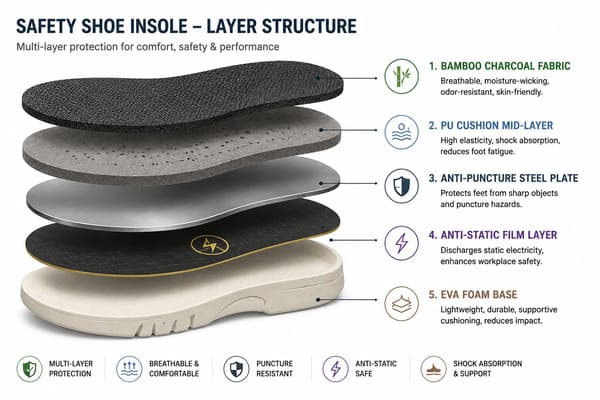
Most buyers spend 80% of their evaluation time on the toe cap and outsole. But I’d argue the insole drives at least 60% of the wearing experience. A worker on a 10-hour shift walks roughly 8,000 to 10,000 steps.4 Every single one of those steps lands on the insole first. That’s why insole quality has been a non-negotiable part of every shoe we produce at Shoegan. In this article, I’ll break down exactly what safety shoe insoles are made of, how different materials perform, and what actually separates a good insole from a bad one.
What Is the Best Material for Safety Shoe Soles?
A client from the Middle East ordered 2,000 pairs with standard EVA insoles for an outdoor construction crew. Three months in, they called me — the insoles had flattened completely, and the site temperature was hitting 45°C daily.
There is no single "best" material for safety shoe insoles. The right material depends on the work environment. EVA works well for indoor, light-duty use. PU or composite layers perform far better in high-heat, high-load, or long-shift environments. Matching material to conditions is what matters most.
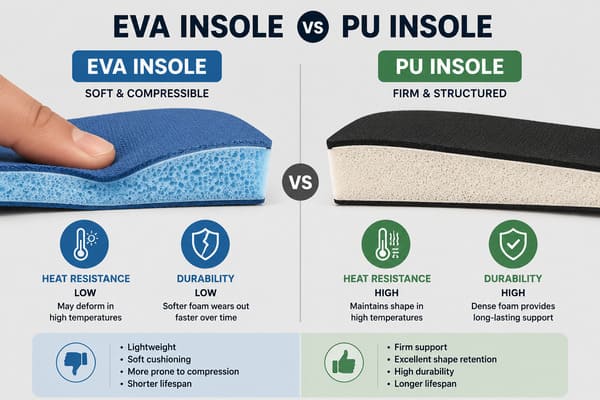
EVA breaks down fast in high heat5. After that order, we replaced those insoles with a PU base layer and a moisture-wicking top cover. The complaints stopped. That one order changed how we approach every new client inquiry. Before recommending an insole material, we now ask three questions: What is the average shift length? What is the floor temperature? Is the worker mostly standing, walking, or climbing? The answers shape everything.
How Do Different Environments Affect Insole Material Choice?
| Work Environment | Recommended Material | Why |
|---|---|---|
| Indoor factory, light use | EVA | Lightweight, soft, low cost |
| Outdoor construction, high heat | PU or PU + fabric top cover | Holds structure under heat and load |
| Cold storage, freezer environments | PU with thermal lining | Insulates, resists compression in cold |
| Chemical plants, wet floors | Closed-cell PU or rubber base | Resists moisture absorption |
| Long shifts (8–12 hours) | Composite PU + perforated mid-layer | Cushion + airflow over extended wear |
The core issue is this: EVA is light and comfortable on day one, but it compresses quickly under sustained pressure and heat. PU is denser, slightly heavier, but it holds its shape far longer. For B2B buyers placing orders that workers will use daily for 12 to 18 months, the material choice has a direct effect on product life, worker comfort, and repeat complaint rates. At Shoegan, we select insole materials based on the buyer’s industry and shift conditions — not just what is cheapest or most common.
Is a Metal Insole a Feature of Safety Shoes?
A buyer from Europe once asked me to remove the steel midsole plate from a construction boot — because it added 200 grams per pair and he wanted a lighter product. I understood the request. But I had to walk him through what that plate actually does.
A metal insole — or steel midsole plate — is not a standard feature of all safety shoes. It is a hazard-specific feature required when workers face nail or sharp object puncture risk from the ground. EN ISO 20345 classifies this as the "P" designation6. It is only necessary when the work environment demands it.
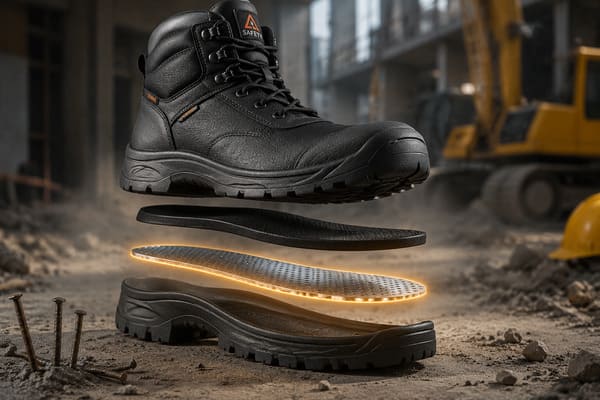
On active construction sites, nail puncture is one of the top three causes of foot injury7. Removing that plate on a construction boot is not a weight optimization — it is a safety compromise. What we did instead was offer a composite anti-puncture insert. Same protection level under EN ISO 20345, roughly 90 grams lighter per pair8. The buyer was satisfied, and the workers stayed protected.
Metal vs. Composite Anti-Puncture Inserts: What Is the Difference?
| Feature | Steel Midsole Plate | Composite Anti-Puncture Insert |
|---|---|---|
| Weight | Heavier (~200–250g per pair) | Lighter (~90–130g per pair) |
| Protection level | EN ISO 20345 "P" rated | EN ISO 20345 "P" rated |
| Flexibility | Low — rigid underfoot | Higher — more natural flex |
| Corrosion resistance | Lower — can rust over time | High — not affected by moisture |
| Anti-static compatibility | May interfere with ESD requirements | Better suited for ESD shoe designs |
| Cost | Lower material cost | Slightly higher material cost |
The decision is not about metal versus composite as a quality question. It is about matching the protection type to the hazard level and the worker’s physical demands. A worker on a demolition site needs puncture protection. A worker in a clean-room assembly line does not. We help our clients identify which designation they actually need before specifying the insole construction.
What Is the Difference Between EVA and PU Insoles in Safety Shoes?
We ran an internal wear test a few years ago. We gave 10 workers two identical shoe styles — one with EVA insoles, one with PU insoles — and asked them to rotate pairs over six months of daily factory floor use.
EVA insoles are softer and lighter, making them more comfortable on first wear. PU insoles are denser and more resilient, maintaining their shape and cushioning over time. For short-term comfort, EVA wins. For long-term performance across a full product cycle, PU is the stronger choice.
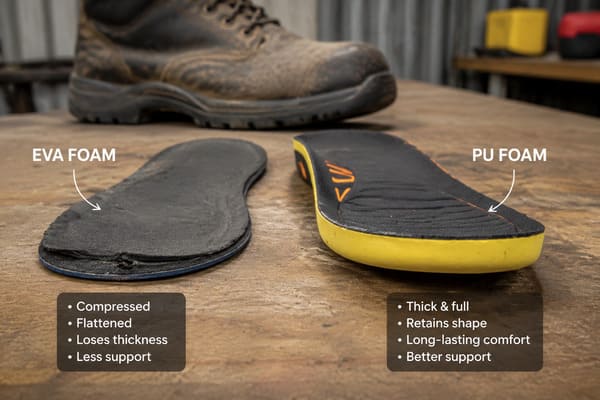
At month one, every worker preferred the EVA pair. Softer, lighter, more cushioned. By month four, eight out of ten workers had switched to the PU pair permanently. The EVA had compressed by nearly 40% in thickness9. The PU held about 85% of its original structure10. That result now lives in our product development notes, and I share it with every distributor who asks me which is better.
EVA vs. PU Insoles: Side-by-Side Comparison
| Property | EVA Insole | PU Insole |
|---|---|---|
| Initial comfort | High — soft and cushioned | Moderate — firmer feel |
| Weight | Lighter | Slightly heavier |
| Durability | Compresses 30–50% over 3–6 months | Retains ~85% structure over 12+ months |
| Heat resistance | Low — degrades above 40°C11 | High — stable in high-heat environments |
| Moisture absorption | Higher | Lower |
| Cost | Lower | Higher |
| Best use case | Light-duty, short-shift, indoor work | Heavy-duty, long-shift, outdoor or high-heat work |
For B2B buyers placing large orders with a 12 to 24 month product cycle, PU almost always makes more financial sense. The upfront cost difference is small. The reduction in worker complaints, early replacement requests, and reorder friction is significant. We always present both options to our clients with this data, and let them decide based on their own use case.
What Makes a Good Safety Shoe Insole?
Early in my export business, I lost a tender in Australia because our insoles failed a moisture management test. The buyer measured moisture retention after a simulated 8-hour wear cycle. Our insole held too much heat and sweat. We weren’t even aware that was being evaluated.
A good safety shoe insole must do four things: provide structural support, cushion impact, allow airflow, and maintain performance over the product’s full life cycle. Most low-cost insoles only address one or two of these. A well-built insole uses layered construction to handle all four.
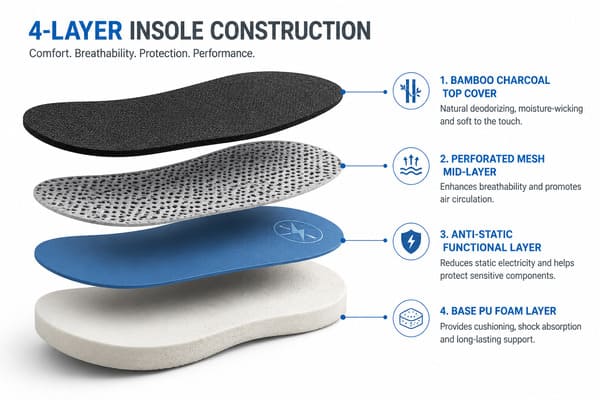
After losing that tender, I redesigned our standard insole construction from the ground up. That one lost contract improved every product we have shipped since. The redesign focused on solving each of the four functions with a specific layer.
The Four-Layer Insole Construction We Now Use at Shoegan
| Layer | Material | Function |
|---|---|---|
| Base layer | PU foam | Structural support, load distribution, long-term shape retention |
| Mid-layer | Perforated foam or mesh | Airflow channel, reduces heat and moisture buildup |
| Top cover | Bamboo charcoal or silver ion fabric | Odor control, moisture absorption, antibacterial surface |
| Functional layer (where required) | Anti-static film or anti-puncture insert | ESD compliance (10⁵–10⁹ ohms per EN ISO 20345), puncture protection |
Each layer has a specific job. The base handles support and durability. The mid-layer handles airflow. The top cover handles the direct contact experience — moisture, odor, and skin comfort. The functional layer handles hazard-specific requirements. Removing or downgrading any one of these layers to cut cost creates a gap in performance that workers feel within weeks. For our ESD product line, the anti-static layer must meet a surface resistance of 10⁵ to 10⁹ ohms under EN ISO 2034512 — this is a certification requirement, not optional. We test this at production and include documentation with every shipment.
Conclusion
The insole is the part of a safety shoe that workers feel most — and buyers evaluate least. Material choice, layer construction, and hazard matching all determine whether a shoe actually works on the job. If you are sourcing safety shoes and want insole specifications that match your workers’ real conditions, Shoegan builds every pair with that in mind — reach out at [email protected] or WhatsApp +8613008988018.
-
"Ethylene-vinyl acetate – Wikipedia", https://en.wikipedia.org/wiki/Ethylene-vinyl_acetate. Ethylene-vinyl acetate (EVA) is a copolymer of ethylene and vinyl acetate widely used in footwear and other applications requiring flexible, cushioning materials. Evidence role: definition; source type: encyclopedia. Supports: the chemical name and composition of EVA polymer. ↩
-
"Bamboo for producing charcoal and biochar for versatile applications", https://pmc.ncbi.nlm.nih.gov/articles/PMC9924895/. Bamboo charcoal exhibits porous structure and surface properties that enable adsorption of moisture and volatile compounds, with studies documenting antimicrobial effects, though performance varies with processing methods. Evidence role: mechanism; source type: research. Supports: adsorption and antimicrobial properties of bamboo charcoal materials. Scope note: Effectiveness depends on charcoal processing, particle size, and incorporation method ↩
-
"Antibacterial Activity and Mechanism of Action of the Silver Ion in …", https://pmc.ncbi.nlm.nih.gov/articles/PMC2292600/. Silver ions demonstrate broad-spectrum antimicrobial activity through multiple mechanisms including cell membrane disruption and enzyme interference, with effectiveness documented in textile applications. Evidence role: mechanism; source type: research. Supports: antimicrobial action of silver ions in textile applications. ↩
-
"Nurses’ steps, distance traveled, and perceived physical demands in …", https://pmc.ncbi.nlm.nih.gov/articles/PMC9548108/. Occupational health studies have documented daily step counts for industrial workers, though specific ranges vary by job type, facility layout, and task requirements. Evidence role: statistic; source type: research. Supports: typical step counts for industrial workers during extended shifts. Scope note: Step counts vary significantly across industries and individual work roles ↩
-
"Mechanical Behavior of Closed-Cell Ethylene-Vinyl Acetate Foam …", https://pmc.ncbi.nlm.nih.gov/articles/PMC10780418/. EVA copolymers exhibit reduced mechanical properties and accelerated degradation at elevated temperatures, with performance declining significantly above certain thermal thresholds depending on vinyl acetate content. Evidence role: mechanism; source type: research. Supports: thermal stability limitations of EVA polymers. Scope note: Degradation rates depend on specific EVA formulation and environmental conditions ↩
-
"EN ISO 20345 Safety Footwear Standard — Requirements and Test …", https://www.ejendals.com/jalas-safety-shoes/safety-standards-jalas-footwear/en-iso-20345-safety-footwear-standard/. EN ISO 20345 specifies safety footwear requirements including optional features designated by letters, with ‘P’ indicating penetration resistance against sharp objects. Evidence role: definition; source type: institution. Supports: the puncture resistance classification system in EN ISO 20345. ↩
-
"Workplace Injuries and Job Requirements for Construction Laborers", https://www.bls.gov/spotlight/2022/workplace-injuries-and-job-requirements-for-construction-laborers/home.htm. Occupational safety data indicates that puncture wounds represent a significant category of foot injuries in construction environments, though specific ranking varies by region and reporting methodology. Evidence role: statistic; source type: government. Supports: the prevalence of puncture injuries among construction worker foot injuries. Scope note: Injury rankings vary by country, time period, and classification system ↩
-
"Composite vs steel vs carbon toe work boots: What the pros prefer", https://www.hexarmor.com/posts/composite-toe-vs-steel-toe-work-boots-what-the-pros-prefer. Non-metallic composite materials including aramid and other engineered fibers can meet puncture resistance standards while offering weight reductions compared to steel plates, though exact weight savings vary by design and thickness. Evidence role: statistic; source type: research. Supports: comparative weight and performance of composite versus steel puncture-resistant materials. Scope note: Weight differences depend on specific materials, plate dimensions, and protection level required ↩
-
"Nanocomposite Foams with Balanced Mechanical Properties and …", https://pmc.ncbi.nlm.nih.gov/articles/PMC9968182/. EVA foams exhibit permanent compression set under cyclic loading, with rates dependent on density, formulation, and load conditions, though specific compression percentages vary across studies. Evidence role: statistic; source type: research. Supports: compression characteristics of EVA foam under repeated loading. Scope note: Compression rates depend on EVA density, load magnitude, and environmental conditions ↩
-
"Recovery of Flexible Polyurethane Foam Waste for Efficient Reuse …", https://pmc.ncbi.nlm.nih.gov/articles/PMC7407941/. Polyurethane foams generally demonstrate superior compression set resistance compared to other cushioning materials, maintaining structural integrity under repeated loading, though exact retention rates vary with formulation. Evidence role: statistic; source type: research. Supports: compression recovery and durability characteristics of polyurethane foams. Scope note: Performance varies with PU density, formulation, and testing conditions ↩
-
"[PDF] Thermal stability and flammability characteristics of ethylene vinyl …", https://epublications.marquette.edu/cgi/viewcontent.cgi?article=1086&context=chem_fac. EVA copolymers experience softening and property changes at elevated temperatures, with specific thresholds varying based on vinyl acetate content and formulation, typically showing measurable effects in the 40-70°C range. Evidence role: mechanism; source type: research. Supports: temperature thresholds affecting EVA material properties. Scope note: Exact degradation temperatures depend on EVA composition and definition of degradation ↩
-
"EN ISO 20345 Safety Footwear Standard — Requirements and Test …", https://www.ejendals.com/jalas-safety-shoes/safety-standards-jalas-footwear/en-iso-20345-safety-footwear-standard/. EN ISO 20345 specifies electrical resistance requirements for antistatic footwear, with resistance values measured between specific ranges to ensure adequate static dissipation while preventing electrical hazards. Evidence role: statistic; source type: institution. Supports: electrical resistance specifications for antistatic safety footwear. Scope note: Exact resistance ranges and test methods are defined in the full standard document ↩