
A few years ago, a German client came to me with a serious complaint. His workers had been wearing the shoes for just three months, and they were already dealing with foot odor and itching. Everyone assumed it was the outsole. They swapped it twice. Nothing changed. When I finally pulled the shoe apart myself, the lining had turned completely stiff — it felt like cardboard under my fingers. That was the moment I understood the real problem. Most people have no idea what a lining is actually supposed to do. It is not decoration. It is not just "a softer inner layer." Its job is to pull moisture away from the skin before sweat has a chance to build up, and to let that moisture evaporate. When that system fails, everything else falls apart.
A moisture-wicking lining works by using fiber structures — usually synthetic or treated natural fibers — to create capillary channels that draw sweat away from the skin surface1. This keeps the foot drier, reduces bacterial growth, and lowers the risk of odor, skin irritation, and discomfort during long shifts.
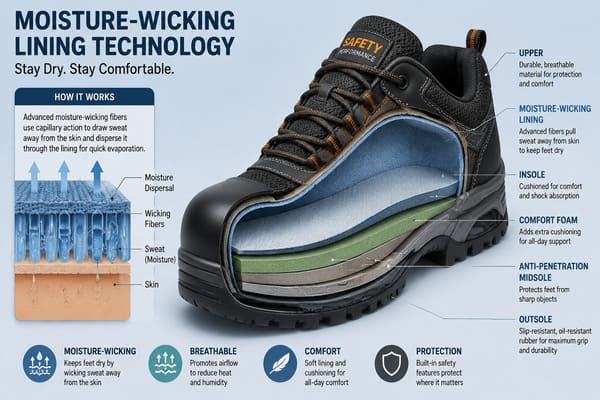
Most buyers focus on the outsole, the toe cap, or the upper material when they evaluate a safety shoe. The lining rarely gets mentioned. But after more than 15 years of manufacturing safety footwear at Shoegan, I can tell you that the lining is one of the first things that breaks down in real working conditions — and one of the last things people think to check. The sections below break down how this system actually works, what materials are involved, and what you should know before you specify a lining for your next order.
What Materials Are Used in Moisture-Wicking Linings?
You might think all moisture-wicking linings are the same. They are not. The material name on a spec sheet tells you very little about how the lining will actually perform on a factory floor after six months of daily use.
The most common moisture-wicking lining materials are Coolmax® polyester, bamboo charcoal fiber, silver-ion treated fabric, and mesh polyester. Each has a different balance of wicking speed, odor control, and cost. The right choice depends on the working environment and how long the shoe needs to stay comfortable.
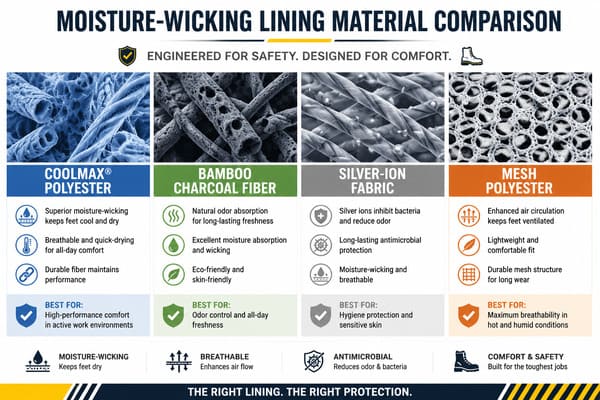
At our factory, we have tested at least six different lining materials over a combined testing period of more than two years. Here is what we found.
Coolmax® polyester is the fastest at moving moisture. Its fibers have a non-round cross-section, which creates physical capillary channels that actively pull sweat away from the skin2. It does not wait for the moisture to soak through — it moves it. Bamboo charcoal fiber is popular with our Middle East clients because the odor control is noticeably better, but its wicking speed is roughly 30% slower than Coolmax. Silver-ion treated fabric has strong antibacterial performance, but the cost is high. We use it mainly in our mid-to-high end custom styles. Standard mesh polyester is the most common and the most affordable, but the performance range is wide depending on how it is woven.
One time, a procurement manager came to me with a competitor’s sample and said, "They use Coolmax too." I pulled out my phone microscope on the spot and showed him the weave structure of both fabrics side by side. Same material name. Different construction. The capillary effect was more than twice as strong in ours. The material name is just a starting point. The structure is what determines performance.
| Material | Wicking Speed | Odor Control | Cost Level | Best Use Case |
|---|---|---|---|---|
| Coolmax® Polyester | High | Moderate | Medium | General industrial, long shifts |
| Bamboo Charcoal Fiber | Medium | High | Medium | Hot climates, odor-sensitive environments |
| Silver-Ion Treated Fabric | Medium | Very High | High | Custom mid-to-high end, medical-adjacent |
| Standard Mesh Polyester | Low–Medium | Low | Low | Budget styles, light-duty use |
How Does Sweat Build Up Inside Safety Shoes?
Most workers do not think about what happens inside their shoe during an eight-hour shift. By the time they feel discomfort, the damage is already done.
The human foot produces between 250 and 400 ml of sweat per day3. Inside a closed safety shoe, most of that moisture has nowhere to go. It soaks into the insole first, then into the lining. Without fast moisture transfer, the interior becomes a warm, sealed, humid environment within three to four hours — ideal conditions for bacterial growth4.
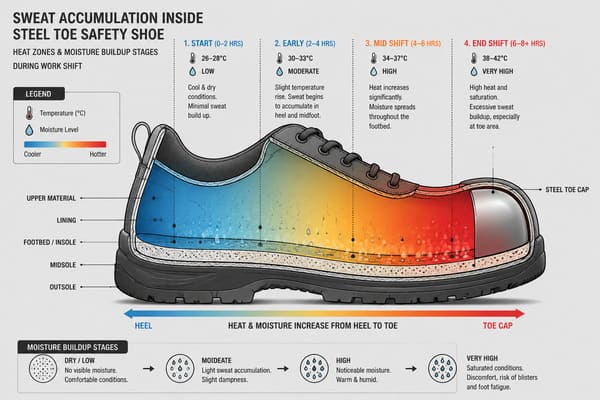
I ran a simple test with a client who supplies to a foundry. We had workers wear standard safety shoes for a full shift, then weighed the shoes immediately after they were taken off and compared that weight to a brand-new pair. The average moisture accumulation per shoe was 180 grams. The highest single reading was 240 grams in one shift.
The steel toe area is the worst zone. Steel conducts heat but releases it slowly, so the forefoot area runs 3 to 5°C hotter than the heel. Higher temperature means more active sweat glands, which means more moisture concentrated in exactly the area with the least ventilation.
Here is the sequence of what happens when moisture-wicking fails:
The Failure Sequence Inside a Safety Shoe
| Time Into Shift | What Happens |
|---|---|
| 0–1 hour | Foot begins sweating, insole absorbs initial moisture |
| 1–3 hours | Insole reaches saturation, moisture transfers to lining |
| 3–4 hours | Lining saturated, moisture sits against skin |
| 4–8 hours | Warm, sealed, humid environment — bacteria multiply rapidly |
| After repeated shifts | Lining fibers compress and harden, wicking function drops significantly |
The problem is not that feet sweat. The problem is that most safety shoes are not designed to manage what happens after that.
Does Moisture-Wicking Lining Really Reduce Odor?
A buyer from Brazil once asked me directly: "Can you guarantee your shoes won’t smell?" I told him honestly — no, I cannot guarantee that. But I can explain exactly why some shoes smell and others do not.
Odor in safety shoes comes from bacteria breaking down organic compounds in sweat5. Bacteria need moisture to multiply6. A moisture-wicking lining reduces odor by keeping the foot surface drier, which removes the conditions bacteria need to grow. But lining alone cannot solve the problem — it has to work as part of a system.
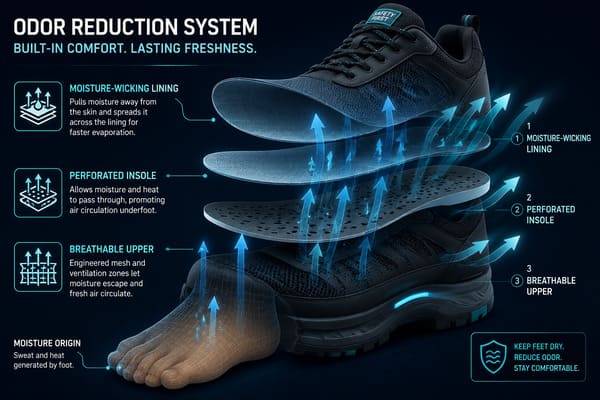
In our internal tests, replacing only the lining with a moisture-wicking version reduced odor by around 40%7. That is meaningful, but it is not the full picture. If the insole has no perforation, or the upper is fully sealed with no breathability, the moisture the lining pulls away from the skin has nowhere to go. It just migrates to a different part of the shoe interior. The humidity stays high. The bacteria keep growing.
When we combined three elements — moisture-wicking lining, perforated insole, and a breathable upper panel — odor reduction reached over 70% in the same test conditions. That is the difference between treating a symptom and fixing the system.
Odor Reduction by Configuration
| Configuration | Estimated Odor Reduction |
|---|---|
| Standard lining (no wicking) | Baseline |
| Moisture-wicking lining only | ~40% |
| Wicking lining + perforated insole | ~55% |
| Wicking lining + perforated insole + breathable upper | 70%+ |
This is why, when clients come to us for OEM customization, I always ask about the full shoe construction before recommending a lining spec. A good lining in a poorly ventilated shoe is like a drain in a sealed box. It has nowhere to send what it collects.
How Long Does a Moisture-Wicking Lining Last in Heavy-Use Conditions?
Durability is where a lot of buyers get surprised. The lining looks fine from the outside. The outsole is still solid. But the shoe stops feeling comfortable after a few months, and nobody can explain why.
In heavy-use industrial conditions, a standard moisture-wicking lining has an effective lifespan of roughly 6 to 9 months8. After that, repeated compression and sweat exposure collapse the fiber structure, and wicking speed can drop by 50 to 60%9. The shoe is still protective — but the comfort system has failed.
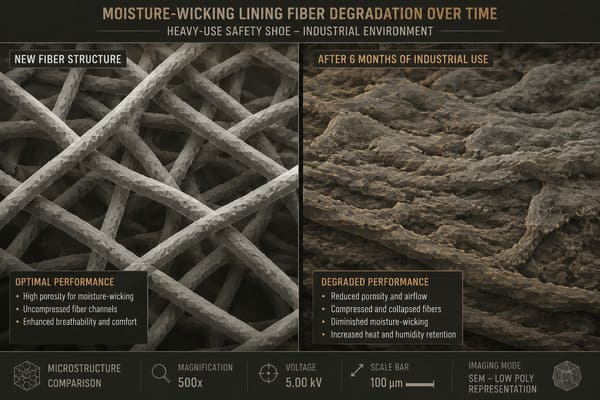
We sold a batch of shoes to a construction contractor in Australia. Six months in, their workers started reporting that their feet felt hot. The outsoles were fine. The uppers were fine. We got a few pairs back for testing. The lining fibers had compressed under repeated pressure and sweat saturation. The capillary structure had collapsed. Wicking speed was down by about 60%. This is normal material fatigue — it is not a defect — but it is something buyers need to know before they write the spec.
Lining Lifespan by Use Intensity
| Use Condition | Estimated Effective Lining Lifespan |
|---|---|
| Light duty (office, warehouse) | 12–18 months |
| Standard industrial (8-hour shifts, moderate sweat) | 9–12 months |
| Heavy industrial (foundry, construction, outdoor heat) | 6–9 months |
| Extreme conditions (chemical exposure, high heat) | 3–6 months |
What we now recommend to clients is to add a replaceable moisture-wicking insole as a second layer in the spec. The insole is easier to replace than the lining, and it acts as a buffer after the lining starts to age. With this setup, the effective comfort lifespan of the full shoe extends to 12 to 18 months, and we see a clear drop in post-sale complaints. It costs a little more upfront. But it costs far less than handling returns, complaints, and reorders caused by preventable discomfort.
Conclusion
A moisture-wicking lining is not a feature. It is a system — and when it works, workers stay drier, healthier, and more productive through every shift. At Shoegan, every shoe we build starts with protection and ends with comfort. If you are sourcing safety footwear that holds up in real conditions, talk to us — [email protected] or WhatsApp +8613008988018.
-
"[PDF] critical evaluation of wicking in performance fabrics", https://repository.gatech.edu/bitstreams/2ab3a6e9-97ed-4b04-92ce-11f96c34255f/download. Textile science research establishes that moisture transport in wicking fabrics is governed primarily by capillary pressure within inter-fiber and inter-yarn spaces, with fiber geometry, surface energy, and fabric construction collectively determining wicking rate and capacity. Evidence role: mechanism; source type: paper. Supports: That capillary action in fiber structures is the primary physical mechanism by which moisture-wicking textiles transport sweat away from the skin. ↩
-
"Design and Coupled Moisture–Thermal Transfer Simulation … – PMC", https://pmc.ncbi.nlm.nih.gov/articles/PMC11396311/. Textile engineering literature documents that fibers with non-circular cross-sectional geometries — such as trilobal or multi-channel profiles — generate capillary pressure differentials that accelerate lateral moisture transport, a principle underlying the design of performance wicking fabrics. Evidence role: mechanism; source type: paper. Supports: That non-circular fiber cross-sections in synthetic textiles create capillary channels that enhance moisture transport away from the skin. Scope note: Independent peer-reviewed sources describe the general mechanism; performance claims specific to the Coolmax® brand are primarily documented by the manufacturer and may not be fully replicated in neutral academic literature. ↩
-
"Physiology of sweat gland function: The roles of sweating and … – PMC", https://pmc.ncbi.nlm.nih.gov/articles/PMC6773238/. Research on plantar perspiration rates indicates that the human foot can produce substantial moisture daily, with estimates commonly ranging from 250 to 400 ml depending on activity level, ambient temperature, and individual physiology; precise figures vary across studies. Evidence role: statistic; source type: paper. Supports: The volume of sweat produced by the human foot per day, typically cited in the range of 250–400 ml. Scope note: Exact values differ across studies due to variation in measurement methodology, subject activity levels, and environmental conditions, so the cited range should be understood as an approximation rather than a universal constant. ↩
-
"Footwear microclimate and its effects on the microbial community of …", https://pmc.ncbi.nlm.nih.gov/articles/PMC8514438/. Occupational footwear research has characterized the shoe interior microclimate during prolonged wear, documenting progressive increases in temperature and relative humidity that create conditions conducive to microbial proliferation; studies on shoe microclimate typically report saturation of insole and lining materials within several hours of continuous wear. Evidence role: general_support; source type: paper. Supports: That the microclimate inside closed safety footwear reaches temperature and humidity conditions favorable to bacterial growth during a standard work shift. Scope note: The specific three-to-four-hour threshold cited in the article is not directly attributed to a published study; the general finding of rapid humidity buildup in closed footwear is supported in the literature, but precise timelines vary with shoe construction and wearer activity. ↩
-
"Advances in the treatment of axillary bromhidrosis – PMC – NIH", https://pmc.ncbi.nlm.nih.gov/articles/PMC11297419/. Dermatological and microbiological research identifies bacterial degradation of sweat constituents — particularly leucine catabolism to isovaleric acid by Staphylococcus and Corynebacterium species — as the primary biochemical mechanism underlying foot malodor. Evidence role: mechanism; source type: paper. Supports: That foot odor results from bacterial metabolism of organic compounds present in sweat, producing volatile malodorous byproducts. ↩
-
"Water Activity (aw) in Foods – FDA", https://www.fda.gov/inspections-compliance-enforcement-and-criminal-investigations/inspection-technical-guides/water-activity-aw-foods. Microbiology literature establishes water activity (aw) as a critical determinant of bacterial growth rates; most pathogenic and odor-causing bacteria require aw above 0.90 for active multiplication, providing a mechanistic basis for moisture reduction as a strategy to limit microbial activity in enclosed footwear environments. Evidence role: mechanism; source type: paper. Supports: That bacterial growth and multiplication are dependent on moisture availability, and that reducing moisture inhibits bacterial proliferation. ↩
-
"Sweat and odor in sportswear – A review – PMC – NIH", https://pmc.ncbi.nlm.nih.gov/articles/PMC10391722/. Studies evaluating odor control in footwear have used standardized sensory panel and instrumental methods to compare lining materials; moisture-wicking constructions consistently show reduced odor intensity relative to non-wicking controls, with the magnitude of reduction dependent on test conditions, lining material, and the presence of complementary ventilation features. Evidence role: statistic; source type: paper. Supports: That moisture-wicking lining materials reduce footwear odor compared to standard linings, with a quantifiable reduction attributable to decreased moisture availability for bacterial metabolism. Scope note: The specific 40% figure cited in the article derives from the manufacturer’s internal testing protocol, which may not align with standardized industry test methods; independently published studies report varying reduction percentages depending on methodology. ↩
-
"The Impact of Footwear on Occupational Task Performance and …", https://pmc.ncbi.nlm.nih.gov/articles/PMC9518076/. International standards for occupational footwear, including EN ISO 20345, specify test methods for lining abrasion resistance and durability, providing a framework for evaluating lining performance degradation; however, these standards define minimum performance thresholds rather than prescribing expected service lifespans under specific field conditions. Evidence role: general_support; source type: institution. Supports: That safety footwear linings degrade in performance over time under industrial use conditions, with lifespan varying by use intensity. Scope note: Published standards address minimum performance requirements rather than real-world service life under specific industrial conditions; the lifespan estimates cited in the article are based on field observation and internal testing rather than standardized durability protocols. ↩
-
"Effects of Compression Garments on Muscle Strength and Power …", https://pmc.ncbi.nlm.nih.gov/articles/PMC11944185/. Textile durability studies have documented measurable reductions in wicking rate and capillary transport efficiency in synthetic fabrics subjected to repeated compression cycles and laundering, attributable to fiber deformation and collapse of inter-fiber capillary spaces; the magnitude of degradation varies with fiber type, construction, and exposure conditions. Evidence role: statistic; source type: paper. Supports: That moisture-wicking performance in synthetic textile linings degrades significantly with repeated mechanical compression and sweat exposure over time. Scope note: The specific 50–60% figure cited in the article is based on the manufacturer’s internal testing; published studies report a range of degradation rates depending on test protocol, making direct numerical comparison difficult. ↩