
Most buyers focus on the toe cap and outsole. But it’s the lining that touches the worker’s foot for 10 hours a day — and when it fails, everything fails.
The lining inside a safety shoe is most commonly made of polyester textile, PU synthetic fabric, or genuine leather1. Each material serves a different purpose. Polyester is the industry default for cost and comfort. PU resists moisture. Leather molds to the foot over time and is preferred in premium products.
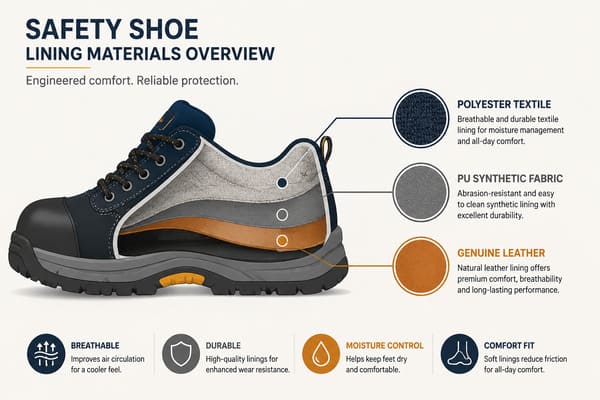
In my first year on the factory floor, I watched a batch of 2,000 pairs come back from a distributor in Malaysia. The toe cap was fine. The outsole was fine. The complaint? The lining had peeled and the shoes smelled terrible after 3 weeks of use. That was the moment I understood — the lining is what the worker actually lives in. Everything else is just structure. If you are sourcing safety shoes, or specifying them for your workforce, this is the component you cannot afford to overlook.
What Materials Are Used in Safety Shoes?
A safety shoe has at least 12 components2. Most buyers can name 3. The lining rarely makes the list — until something goes wrong.
Safety shoes use a range of materials across their components: steel or composite for the toe cap, rubber or PU for the outsole3, and textile, leather, or synthetic fabric for the lining. The lining choice directly affects breathability, durability, and worker comfort during long shifts.
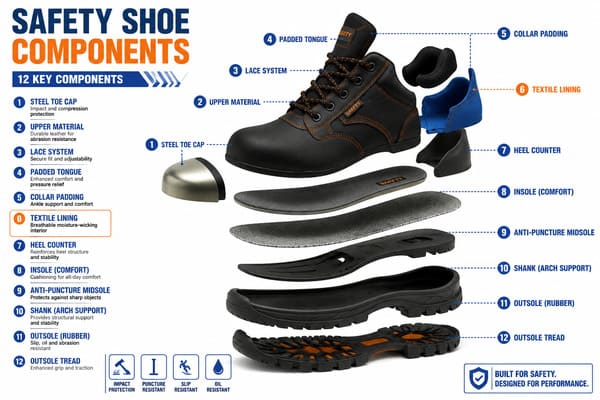
I’ve seen a $45 shoe fail in 6 weeks because of a $0.30 lining decision. The material choices we see across the market cover a wider range than most buyers expect.
Here is a breakdown of the most common lining materials and where each one fits:
| Lining Material | Key Benefit | Best Use Case |
|---|---|---|
| Polyester / mesh textile | Lightweight, breathable | Standard industrial environments |
| PU synthetic lining | Smooth surface, moisture resistant | Wet or chemical environments |
| Genuine leather lining | Durable, molds to foot | Premium OEM, long-shift workers |
| Moisture-wicking fabric | Pulls sweat away from skin | Hot climates, outdoor work |
| Antibacterial-treated lining | Controls odor at the source | Middle East, Southeast Asia markets |
| Fleece / thermal lining | Retains warmth | Cold storage, winter outdoor work |
Each of these materials comes with trade-offs. A moisture-wicking lining performs well in 35°C outdoor conditions but offers little protection if the worker is handling solvents. A smooth PU lining is easy to wipe clean but will trap heat during a 12-hour shift. The right material depends on the work environment first, and cost second. At Shoegan, this is the first question we ask when an OEM client comes to us with a new project — before we talk about price, before we talk about delivery.
What Material Is Used for the Inner Lining of Most Boots?
Most buyers assume all safety shoe linings are roughly the same. They are not — and the gap in quality is much larger than the gap in price.
The inner lining of most safety boots is a polyester textile, often stitched directly to the upper and backed with a thin layer of PU foam. It is the industry default because it balances cost, comfort, and production efficiency, with a typical material cost of $0.40–$0.80 per pair.

The problem is that quality varies enormously within this single category. A well-chosen, tightly woven polyester lining from a reliable mill lasts 12 months or more of daily use. A cheaper version starts pilling and separating at the seams within 8 weeks. I’ve seen both — and the difference in raw material cost is sometimes as little as $0.15 per pair.
Here is what separates a good polyester lining from a poor one:
Weave Density
A higher thread count means the fabric holds its shape longer under friction. Low-density weaves look similar at first glance but break down faster at the heel and toe box — the two areas that take the most wear.
Backing Layer
A thin PU foam backing adds cushioning and helps the lining stay bonded to the upper. Without it, the lining tends to separate from the shoe wall after repeated washing or heavy sweat exposure.
Surface Treatment
Better linings include an anti-pilling or moisture-management treatment applied at the mill level. This is not visible to the eye but makes a measurable difference in how the shoe performs after 3 months of daily use.
Stitching and Bonding Method
How the lining is attached matters as much as the material itself. A lining that is only glued — not stitched — is the first thing to fail in high-humidity environments4. We always specify double-stitched lining attachment on Shoegan production orders for this reason.
The $0.15 difference in lining material is real. But the cost of a return shipment, a distributor complaint, or a lost account is not $0.15. That is the math I ask every procurement buyer to think about before they approve a sample.
Which Safety Shoe Lining Material Is the Most Breathable?
A client in Saudi Arabia was supplying construction sites where ground temperature hits 50°C in summer5. His workers were complaining about foot odor and skin irritation after just 4 hours of wear6. The shoes he was sourcing used a standard PU lining.
The most breathable lining material for safety shoes is 3D spacer mesh. It creates physical air channels between the foot and the shoe wall, allowing continuous airflow during movement7. Moisture-wicking fabric is the second-best option, moving sweat away from the skin quickly in moderate heat conditions.
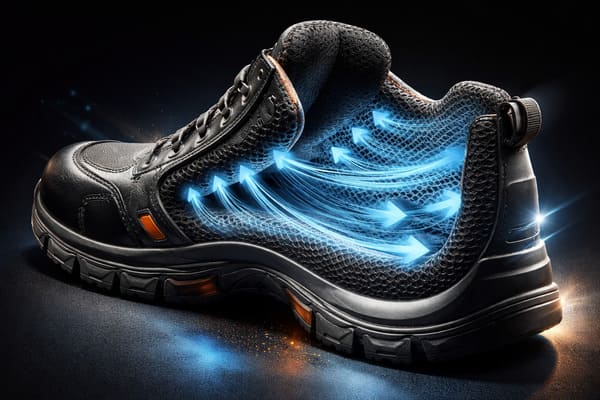
We switched that Saudi client to a 3D spacer mesh lining on his next OEM order. Complaints dropped significantly in the first season. Here is how the main lining materials rank by breathability in real working conditions:
| Lining Material | Breathability | Notes |
|---|---|---|
| 3D spacer mesh | ★★★★★ | Best airflow, physical air channels |
| Moisture-wicking fabric | ★★★★☆ | Fast sweat transfer, good in moderate heat |
| Genuine leather | ★★★☆☆ | Breathes after break-in, less effective in high humidity |
| Standard polyester textile | ★★☆☆☆ | Acceptable for mild conditions, traps heat over long shifts |
| PU synthetic lining | ★☆☆☆☆ | Lowest breathability, suited for short wear or wet environments |
The Trade-Off You Need to Know
The more breathable the lining, the less it resists chemicals and moisture penetration from the outside. For workers in chemical plants or wet processing environments, a smooth PU lining is actually the correct specification — even though it sits at the bottom of the breathability ranking. Breathability and protection are not always aligned, and the work environment has to drive the decision.
Climate and Shift Length Matter More Than Product Category
A safety shoe sold in Norway and the same model sold in Qatar cannot use the same lining and perform equally well. This is a sourcing mistake I see often — a buyer approves one lining spec for a global order and then receives complaints from specific regions. At Shoegan, we regularly help clients split their OEM orders by region, with lining specifications matched to the climate and shift conditions of each market.
How Do I Choose the Right Lining for My Safety Shoes?
A procurement manager from a German industrial distributor came to us 2 years ago. He had sourced 5,000 pairs from another supplier. Within 3 months, he had over 200 pairs returned — lining delamination and odor complaints. His end clients were unhappy.
To choose the right safety shoe lining, start with three questions: What is the work environment? How long is the shift? What are the specific complaints from current users? These three factors — environment, duration, and failure mode — determine the correct lining material before any other consideration.
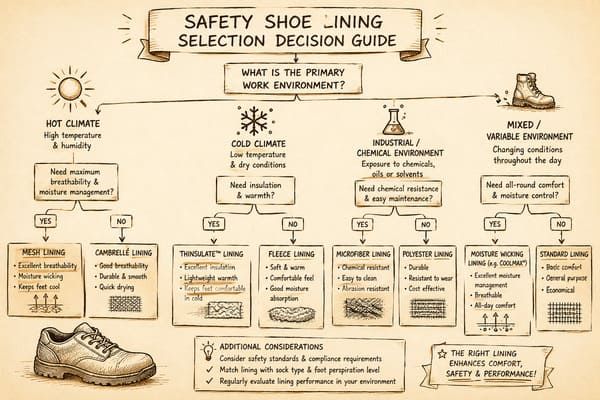
The first thing I asked that German buyer was not about price or delivery time. I asked those three questions. The answers pointed directly to the problem — he had specified a standard polyester lining for workers doing 12-hour shifts in a warm warehouse. The lining was not wrong for a 4-hour shift. It was wrong for his actual use case.
The Decision Framework I Use With Every OEM Client
| Work Environment | Recommended Lining |
|---|---|
| Hot outdoor environments (30°C+) | 3D mesh or moisture-wicking lining |
| Cold storage / winter outdoor (-20°C to 0°C) | Thermal fleece lining |
| Chemical or oil exposure | Smooth PU lining, easy to wipe clean |
| Long shifts (10–12 hours) | Antibacterial + cushioned lining combination |
| Premium OEM or branded products | Genuine leather lining for feel and durability |
Why Lining Substitution Is a Real Risk
Lining is one of the first places a low-cost factory will quietly substitute materials without telling the buyer8. A client approves a sample with leather lining, and the bulk order ships with a PU substitute. The shoes look identical in photos. The difference only shows up after 6 weeks of use — by which point the product is already in the market and the damage is done.
At Shoegan, every OEM order includes a lining specification sheet that locks in the material before production starts. The spec sheet is signed off before the first cutting order is placed. A $0.50 upgrade on lining material can save a client $50,000 in returns, warranty claims, and lost distributor relationships. That is not a number I made up — it is a number I have seen play out more than once across 20 years in this industry.
Conclusion
The lining is the part of a safety shoe that workers feel every hour of every shift. Getting it right is not complicated — but it requires asking the right questions before production starts. At Shoegan, we help B2B buyers specify the right lining for every market and environment. Contact us at [email protected] — Built to Protect. Made to Last.
-
"ISO 20345:2021 Safety Footwear Standard | PDF | Shoe – Scribd", https://www.scribd.com/document/841400516/ISO-20345-2021. ISO 20345:2021, the international standard for safety footwear, specifies material and performance requirements for shoe components including linings, providing a framework within which these material categories are recognized. Evidence role: general_support; source type: institution. Supports: That polyester, synthetic, and leather linings are standard materials used in safety footwear construction. Scope note: The standard defines performance thresholds rather than prescribing specific lining materials, so it provides contextual rather than direct confirmation of market prevalence. ↩
-
"Anatomy of safety shoes: toe cap, vamp, quarter, tong … – Pinterest", https://www.pinterest.com/pin/310537336803414760/. Technical literature on footwear construction, including guidance published by the Satra Technology Centre, identifies numerous discrete components in safety footwear assembly, encompassing the upper, lining, counter, insole board, midsole, outsole, and protective toe cap among others. Evidence role: definition; source type: institution. Supports: That safety footwear consists of multiple distinct structural components including upper, lining, insole, midsole, outsole, and protective elements. Scope note: The precise count of components varies by product design and how sub-elements are classified; the figure of 12 is not universally standardized. ↩
-
"Steel-toe boot – Wikipedia", https://en.wikipedia.org/wiki/Steel-toe_boot. EN ISO 20345:2021 specifies performance requirements for protective toe caps, recognizing metallic and non-metallic (composite) materials, and sets slip-resistance and abrasion criteria for outsole compounds including rubber and polyurethane. Evidence role: definition; source type: institution. Supports: That steel and composite toe caps and rubber or PU outsoles are standard material categories in certified safety footwear. Scope note: The standard defines performance requirements rather than mandating specific materials, so material categories reflect common industry practice rather than exclusive prescription. ↩
-
"Effect of Temperature and Humidity Coupling on the Ageing Failure …", https://pmc.ncbi.nlm.nih.gov/articles/PMC11013269/. Satra Technology Centre and related footwear testing literature document that adhesive bond strength in shoe construction is sensitive to moisture ingress and elevated humidity, with bond failure at the lining-upper interface being a recognized failure mode in accelerated wear testing. Evidence role: mechanism; source type: research. Supports: That adhesive bonds used in footwear construction degrade under sustained humidity and moisture exposure, leading to delamination of bonded components. Scope note: Specific comparative data on glued versus stitched lining attachment under defined humidity conditions is not widely published in open-access literature; the claim reflects industry practice rather than a single citable study. ↩
-
"Assessment of Heat Stress Exposure among Construction Workers …", https://pmc.ncbi.nlm.nih.gov/articles/PMC6527521/. Meteorological and occupational health reports from the Gulf region document surface temperatures on exposed ground and construction materials regularly exceeding 50°C during peak summer months, contributing to heat-related illness risk among outdoor workers. Evidence role: statistic; source type: government. Supports: That ground surface temperatures in Saudi Arabia and similar Gulf climates can reach or exceed 50°C during summer months, posing significant heat stress risks for outdoor workers. Scope note: Reported figures vary by surface type, time of day, and location; the 50°C figure represents peak conditions rather than average ambient air temperature. ↩
-
"Allergens causing contact dermatitis of the feet – PMC – NIH", https://pmc.ncbi.nlm.nih.gov/articles/PMC11393641/. Dermatological and occupational health literature documents that sustained occlusion of the foot in impermeable or low-breathability footwear elevates local skin temperature and moisture, promoting maceration, disruption of the skin barrier, and conditions favorable to contact dermatitis and fungal infection. Evidence role: mechanism; source type: paper. Supports: That prolonged occlusion of the foot in non-breathable footwear in hot conditions leads to skin maceration and irritation through moisture accumulation. Scope note: The specific 4-hour onset threshold cited in the article is not established in published clinical literature; irritation onset varies with individual susceptibility, ambient temperature, and activity level. ↩
-
"Study on the moisture permeability of warp-knitted Jacquard shoe …", https://pmc.ncbi.nlm.nih.gov/articles/PMC11985990/. Research on three-dimensional spacer fabrics documents their open-cell structure, which maintains a physical gap between face layers, facilitating air circulation and moisture vapor transmission at rates measurably higher than conventional woven or nonwoven linings. Evidence role: mechanism; source type: paper. Supports: That 3D spacer mesh fabrics provide superior airflow and moisture management in footwear applications due to their three-dimensional structure creating air channels. Scope note: Published studies typically evaluate spacer fabrics in general textile or medical applications; direct comparative testing within safety footwear lining contexts is less commonly reported in open literature. ↩
-
"[PDF] Innovative approaches to a more sustainable global supply chain", https://digitalcommons.pepperdine.edu/cgi/viewcontent.cgi?article=2653&context=etd. Supply chain integrity research and audit reports from organizations such as the Business Social Compliance Initiative (BSCI) and Bureau Veritas identify unauthorized material substitution as a recurring non-conformance finding in footwear factory audits, particularly affecting internal components less visible to end-user inspection. Evidence role: general_support; source type: institution. Supports: That unauthorized material substitution is a documented risk in apparel and footwear supply chains, particularly in low-cost manufacturing contexts. Scope note: Published audit data aggregates findings across product categories and regions; the specific prevalence of lining substitution in safety footwear is not separately quantified in publicly available reports. ↩