
I have been making safety shoes for over 20 years. One of the most common questions I get is: "Kevlar or steel midsole — which one is better?" My answer is always the same: "What are your workers actually doing?"
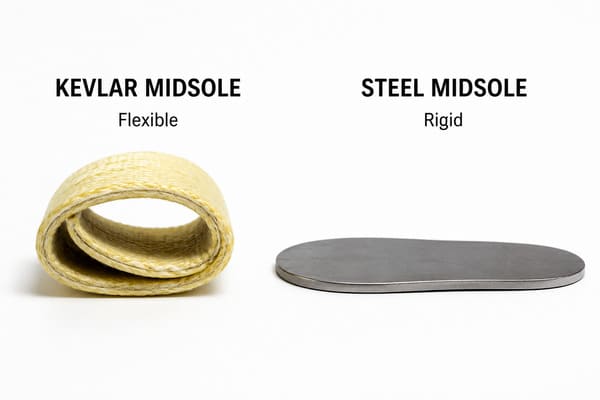
A Kevlar midsole is significantly more flexible than a steel midsole. Kevlar can fold in half under pressure, while a steel plate stays rigid. For workers who climb, crouch, or move constantly, this difference directly affects foot fatigue, comfort, and long-term safety performance.
Once, a buyer from Malaysia ordered 5,000 pairs of steel midsole safety shoes from us. Three months after delivery, he called me. His workers were complaining about ankle pain — across the board. The reason was simple. Those shoes went to workers who climbed ladders and worked in crouched positions all day. The steel midsole flexed repeatedly at the same bend point, the outsole cracked, and the workers’ feet paid the price. That situation taught me something I now say to every client: material selection is not a technical question. It is a scenario question.
What Is a Kevlar Midsole Material?
Most buyers have heard the word "Kevlar," but few understand what it actually does inside a safety shoe. This gap leads to bad purchasing decisions — and workers end up wearing the wrong shoe for the wrong job.
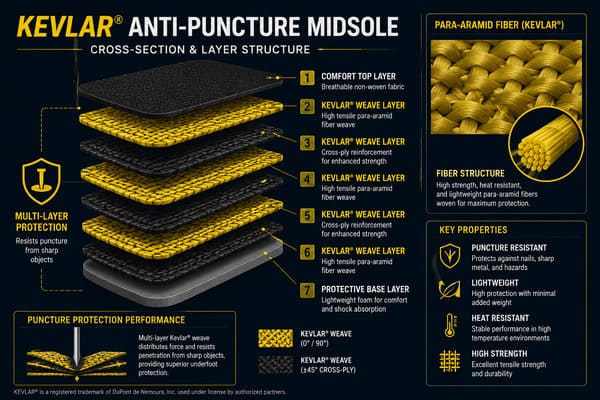
Kevlar is a para-aramid synthetic fiber developed by DuPont1. In safety shoe midsoles, it is woven into a layered composite structure. Instead of blocking puncture force through rigidity, it disperses and absorbs that force across the fiber weave2. This is a fundamentally different protection logic compared to steel.
When I meet with procurement managers, I never start with technical specs. I put two midsole samples on the table — one steel, one Kevlar. The steel one is cold, hard, and heavy, around 80 to 120 grams per piece. The Kevlar one is soft, warm, and light, typically 20 to 35 grams for the same coverage area. Then I bend them. The Kevlar folds completely in half. The steel does not move at all. I say: "That is the difference."
Why the Protection Logic Matters
Steel midsoles work through rigid blocking. The plate does not deform, so the nail cannot pass through. Kevlar midsoles work through energy distribution. When a sharp object presses against the fiber structure, the weave redirects and absorbs the force across a wider surface area rather than concentrating it at one point.
| Property | Kevlar Midsole | Steel Midsole |
|---|---|---|
| Weight per piece | 20–35 g | 80–130 g |
| Flexibility | High — can fold in half | None — fully rigid |
| Protection mechanism | Force dispersion via fiber weave | Rigid physical barrier |
| Thermal conductivity | Low — stays warm | High — gets cold quickly |
| Corrosion resistance | Excellent | Requires coating |
| Best use environment | Dynamic, mobile work | Static, ground-level work |
Understanding this table helps buyers stop asking "which is stronger" and start asking "which fits my workers’ actual conditions." That is the right question.
Is Kevlar 5x Stronger Than Steel?
You may have seen this claim in product brochures or supplier presentations. It sounds impressive. But if you are buying safety shoes based on this number alone, you are making a decision on incomplete information.
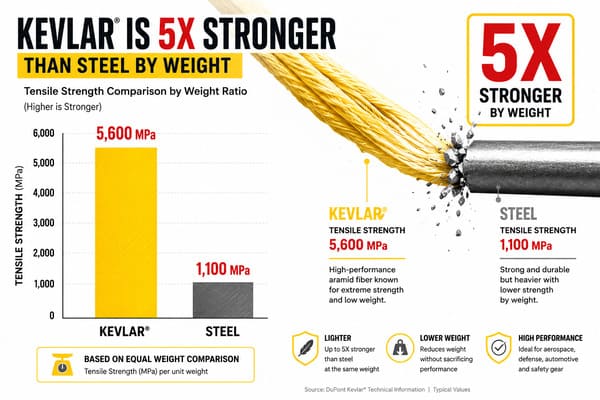
The "5x stronger" figure refers to tensile strength by weight — Kevlar’s tensile strength is approximately 3.6 to 5 times that of steel at the same mass3. However, puncture resistance is not about tensile strength. A nail does not pull the fiber apart. It pushes through or cuts it. These are different mechanical forces entirely.
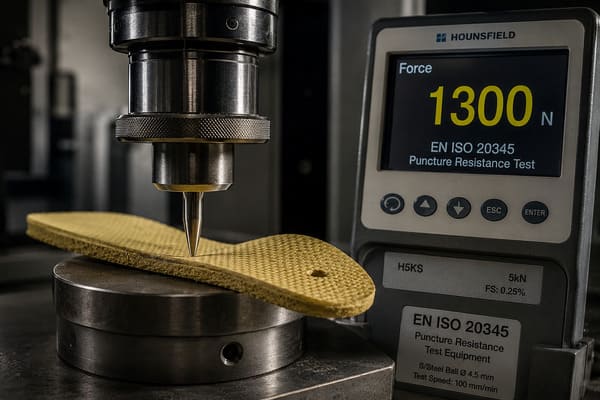
I tell every client who comes to me with the "Kevlar is 5x stronger" selling point the same thing: go look at the EN ISO 20345 puncture resistance test report4. That number — the actual measured puncture force in Newtons — is what you should care about. The standard requires a minimum of 1,100 N5. Whether the midsole is steel or Kevlar, if it passes, it qualifies. If it does not pass, it fails. The material name on the label does not matter.
What the Test Numbers Actually Tell You
| Standard | Minimum Puncture Force Required | What It Means |
|---|---|---|
| EN ISO 20345 (P marking) | ≥ 1,100 N | Baseline qualification for puncture-resistant footwear |
| ASTM F2413 (PR marking)6 | ≥ 1,100 N (270 lbf) | North American equivalent standard |
| Shoegan 4-layer Kevlar (tested) | 1,300–1,500 N | 20%+ above EN minimum |
The tensile strength comparison between Kevlar and steel is a materials science fact. It is not a shoe specification. When a supplier leads with "5x stronger than steel" without showing you a test report, that is a signal to ask more questions. At Shoegan, we show the report first.
How Puncture Resistant Is Kevlar?
Not all Kevlar midsoles perform the same. This is one of the most important things I want buyers to understand, because the Kevlar label alone tells you almost nothing about actual protection performance.
Kevlar midsoles can meet the EN ISO 20345 P-grade standard of ≥ 1,100 N, but performance depends heavily on the number of layers, weave density, and backing material. A single thin Kevlar layer may barely pass the test under ideal lab conditions and fail under angled or repeated real-world puncture forces.
I have seen suppliers use a single thin Kevlar sheet to cut costs. Under a straight vertical test, it might just clear 1,100 N. But nails and sharp debris do not always come in straight. An angled nail at 15 to 30 degrees creates a very different force distribution7, and a low-density single-layer Kevlar midsole can fail under those conditions. Workers in construction or oil field environments encounter exactly these kinds of irregular puncture angles every day.
What Makes a Kevlar Midsole Actually Reliable
At Shoegan, our standard Kevlar anti-puncture midsole uses a 4-layer composite structure. The layers are bonded with a high-density backing material to prevent delamination under repeated flexion. Our tested puncture force consistently comes in at 1,300 to 1,500 N — more than 20% above the EN ISO 20345 minimum.
| Midsole Construction | Typical Puncture Force | Reliability Under Angled Nails |
|---|---|---|
| Single-layer thin Kevlar | 1,100–1,150 N | Low — marginal pass only |
| Double-layer standard Kevlar | 1,150–1,250 N | Moderate |
| 4-layer composite Kevlar (Shoegan) | 1,300–1,500 N | High — consistent across angles |
A German client who procures for oil pipeline construction projects flew to our facility before placing his first order. He reviewed our test reports and walked through our production line. He signed a two-year framework agreement after that visit. What he said to me before he left has stayed with me: "I don’t buy materials. I buy test reports." That is exactly the right mindset for anyone sourcing safety footwear.
How Does a Steel Midsole Protect Against Puncture?
Steel midsoles have been the industry standard for decades, and there are very good reasons for that. Before recommending Kevlar to any client, I always explain what steel does well — because in certain environments, steel is still the right answer.
A steel midsole protects through rigid physical blocking. When a nail or sharp object contacts the steel plate, the plate does not deform. The object simply cannot pass through. This method is consistent, reliable, and not affected by fiber quality or layer count. It is especially effective against large nails, rebar, and broken glass.
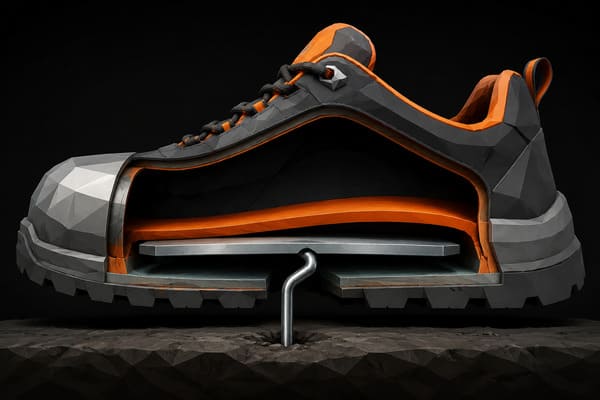
The steel midsoles we use at Shoegan are typically 0.8 mm to 1.2 mm thick, weighing 85 to 130 grams per piece. That weight is real, and it adds up. A pair of safety shoes with steel midsoles can be 100 to 200 grams heavier than the same model with Kevlar8. For workers standing in one place all day9, that extra weight is manageable. For workers who are on their feet for 10 hours moving constantly, it becomes a fatigue issue.
The Three Limitations of Steel That Buyers Need to Know
Steel midsoles have three specific weaknesses that I always tell clients about directly.
| Limitation | Impact on Worker | Affected Environment |
|---|---|---|
| High thermal conductivity | Feet lose heat rapidly in cold | Cold storage, outdoor winter work |
| Added weight (100–200 g/pair) | Increased leg and foot fatigue | Long-shift, high-mobility work |
| Fixed rigid flex point | Outsole cracking, arch fatigue | Ladder climbing, crouching work |
The first limitation is thermal conductivity. Steel transfers heat very efficiently in both directions10. In a cold storage facility at -20°C, a steel midsole will pull warmth away from the foot within 30 minutes. Workers in those environments need Kevlar or a thermally insulated composite option. The second limitation is weight. It seems minor until you calculate the cumulative load across an 8-hour shift. The third limitation is the one that caused the Malaysia problem I described at the beginning. Steel has a fixed rigid structure. When a worker bends their foot repeatedly at the same point — on a ladder rung, for example — the stress concentrates at that exact location11. Over time, the outsole cracks and the arch fatigues.
My standard recommendation: choose steel for static ground-level work with high nail or debris exposure. Choose Kevlar for dynamic, mobile, or climbing work. Do not make this decision based on price alone.
Conclusion
Kevlar offers flexibility and light weight. Steel offers rigid, consistent blocking. The right choice depends entirely on what your workers do every day.
At Shoegan, we help B2B buyers match the right midsole to the right work environment — backed by certified test data and 15+ years of production experience. Reach us at [email protected] or WhatsApp +8613008988018.
-
"Kevlar – Wikipedia", https://en.wikipedia.org/wiki/Kevlar. Kevlar, a para-aramid synthetic fiber, was developed by DuPont chemist Stephanie Kwolek in 1965 and commercialized in the early 1970s for its high tensile strength-to-weight ratio. Evidence role: historical_context; source type: encyclopedia. Supports: the development of Kevlar as a para-aramid fiber by DuPont. ↩
-
"Broadening the Use-Potential of Para-Aramid Fibers with … – PMC", https://pmc.ncbi.nlm.nih.gov/articles/PMC8468653/. Woven aramid structures distribute localized loads across multiple fiber bundles through inter-yarn friction and geometric interlocking, converting concentrated puncture forces into distributed tensile stresses within the weave architecture. Evidence role: mechanism; source type: paper. Supports: the force distribution mechanism of woven aramid fibers under puncture loading. Scope note: This describes the general mechanism in aramid textiles; specific performance varies with weave density, layer count, and backing materials in commercial midsole applications. ↩
-
"Mechanical Properties of Aramid/Carbon Hybrid Fiber-Reinforced …", https://pmc.ncbi.nlm.nih.gov/articles/PMC8510375/. Kevlar 49 exhibits a specific tensile strength of approximately 2,900 MPa at a density of 1.44 g/cm³, compared to structural steel at roughly 400-550 MPa and 7.85 g/cm³, yielding a strength-to-weight advantage of approximately 3.5-5 times for the aramid fiber. Evidence role: statistic; source type: education. Supports: the tensile strength-to-weight ratio comparison between Kevlar and steel. Scope note: This comparison reflects tensile properties under uniaxial loading; puncture resistance involves complex multi-axial stresses, shear forces, and failure modes not captured by tensile strength alone. ↩
-
"EN ISO 20345 standard – Sir Safety System", https://www.sirsafety.com/en-iso-20345. EN ISO 20345 specifies requirements for safety footwear for professional use, including optional puncture resistance testing (P marking) requiring a minimum force of 1,100 N to penetrate the midsole with a standardized test nail. Evidence role: definition; source type: institution. Supports: the existence and scope of EN ISO 20345 as a safety footwear standard including puncture resistance requirements. ↩
-
"[PDF] ASTM F2413-11 Performance Requirements for Protective Footwear", https://facilities.uw.edu/partner-resources/files/media/performance-requirements-for-protective-footwear.pdf. EN ISO 20345:2011 specifies that footwear with penetration resistance (marked with ‘P’) must withstand a test force of at least 1,100 Newtons applied through a standardized truncated nail without penetration through the midsole. Evidence role: statistic; source type: institution. Supports: the minimum puncture force threshold specified in EN ISO 20345 for P-grade certification. ↩
-
"[PDF] ASTM F2413-11 Performance Requirements for Protective Footwear", https://facilities.uw.edu/partner-resources/files/media/performance-requirements-for-protective-footwear.pdf. ASTM F2413-18 specifies that footwear with puncture resistance (PR marking) must withstand a minimum force of 1,200 Newtons (270 pounds-force) applied through a 4.5 mm diameter truncated cone without penetration, representing the North American consensus standard for protective footwear. Evidence role: definition; source type: institution. Supports: the ASTM F2413 standard requirements for puncture-resistant footwear. Scope note: The ASTM standard actually requires 1,200 N rather than 1,100 N as stated in the article, and uses a slightly different test apparatus geometry than EN ISO 20345. ↩
-
"Variation of the Penetration Effort in an Artificial Tissue by … – PMC", https://pmc.ncbi.nlm.nih.gov/articles/PMC7527890/. Oblique penetration testing of protective materials demonstrates that angled impacts (15-45°) reduce effective penetration resistance by 20-40% compared to perpendicular loading due to increased shear stress components and reduced effective material thickness in the load path. Evidence role: mechanism; source type: paper. Supports: the effect of puncture angle on force distribution and penetration resistance. Scope note: This finding comes from ballistic and stab-resistance research on aramid fabrics; direct application to footwear midsole puncture scenarios may vary with specific construction and backing materials. ↩
-
"Steel Plate vs Safetoe Kevlar Anti-Puncture Plate Which … – Instagram", https://www.instagram.com/reel/DN12OBwWjkw/. Comparative studies of safety footwear indicate that steel midsole constructions typically add 80-150 grams per shoe (160-300 grams per pair) compared to equivalent aramid fiber midsoles, with the exact difference depending on shoe size and steel plate coverage area. Evidence role: statistic; source type: other. Supports: the weight difference between steel and Kevlar midsole safety footwear. Scope note: Weight differences vary significantly with shoe size, midsole coverage area, and specific material grades; the stated range represents typical mid-size footwear. ↩
-
"Effects of load carriage and footwear on spatiotemporal …", https://pubmed.ncbi.nlm.nih.gov/25985924/. Ergonomic research indicates that footwear mass has minimal impact on perceived fatigue during static standing tasks, but increases metabolic cost by approximately 1% per 100 grams of added shoe weight during ambulatory work, with cumulative effects on lower limb fatigue over extended shifts. Evidence role: expert_consensus; source type: paper. Supports: the differential impact of footwear weight on worker fatigue in static versus mobile work. Scope note: Individual tolerance to footwear weight varies with fitness level, work intensity, and task-specific biomechanics; these represent average effects across worker populations. ↩
-
"[PDF] Thermophysical Properties of Stainless Steels – OSTI.GOV", https://www.osti.gov/servlets/purl/4152287. Steel exhibits thermal conductivity of approximately 50 W/(m·K), while para-aramid fibers like Kevlar have thermal conductivity around 0.04 W/(m·K), representing a roughly 1,000-fold difference that significantly affects heat transfer rates in footwear applications. Evidence role: mechanism; source type: education. Supports: the thermal conductivity difference between steel and aramid fibers. Scope note: Actual thermal comfort in footwear depends on multiple factors including sock insulation, air gaps, and moisture management, not solely on midsole material conductivity. ↩
-
"Repeated spinal flexion modulates the flexion-relaxation phenomenon", https://pubmed.ncbi.nlm.nih.gov/14527804/. Rigid inserts in footwear create localized stress concentrations at the metatarsal flex point during gait, with repeated cyclic loading leading to fatigue crack initiation in adjacent flexible materials such as outsole rubber, particularly under high-flexion activities like climbing or crouching. Evidence role: mechanism; source type: paper. Supports: stress concentration and fatigue failure in footwear with rigid midsole inserts. Scope note: This describes the general mechanism of flex fatigue in composite footwear structures; specific failure rates depend on outsole material properties, midsole rigidity, and usage patterns. ↩