
Most custom safety shoe orders go wrong before production even starts. The wrong spec, the wrong cert, the wrong material — and you only find out three months into delivery.
Before ordering custom safety shoes, you need to confirm four things: the certifications required by your target market, the protection features matched to your actual work environment, the materials used in the sole and upper, and the MOQ and lead time structure of your supplier. Getting these wrong costs more than the order itself.
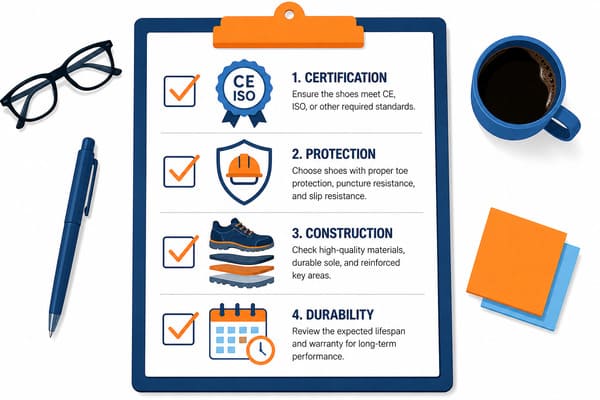
My first job in this industry was quality control on a factory floor. I inspected over 500 pairs of shoes every single day. I noticed something early on: 90% of the shoes that failed did not fail because of a production mistake. They failed because the order was already wrong before production started. Either the buyer did not explain the use environment clearly, or the factory did not ask about the target market. The shoes looked fine. But three months on a job site, and they fell apart. When I started my own export business, the first thing I built was a pre-order confirmation process. Every critical question gets answered before sampling starts. This article covers the most important checkpoints in that process.
What Certifications Should Custom Safety Shoes Meet?
A certificate on paper means nothing if the grade on that certificate does not match what your market actually requires. That gap is where most certification problems start.
Custom safety shoes must meet the specific certification standard of the destination market. EN ISO 20345 covers Europe, ASTM F2413 covers North America, AS/NZS 2210 covers Australia and New Zealand1, and GSO covers the Gulf region. Within each standard, protection grades such as S1, S1P, S2, and S3 carry different test requirements2. The grade must match the actual use environment.
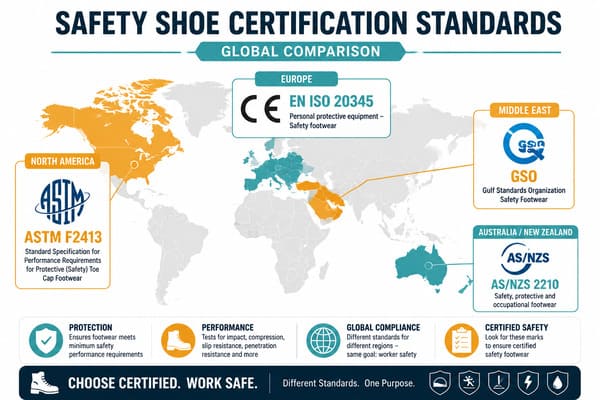
In 2021, a European buyer came to me after a serious problem with his previous supplier. He had ordered 3,000 pairs for the Dutch market. When the shipment arrived at the port, customs held the entire container. The test report showed an anti-puncture resistance value of 900 Newtons. EN ISO 20345 requires 1,100 Newtons for S1P grade3. The whole shipment was returned. The loss was over 30,000 euros, and the delivery schedule collapsed completely. His previous supplier had told him the shoes had CE certification. What the supplier did not tell him was that CE certification under EN ISO 20345 is not a single pass-or-fail stamp. It covers different grades — S1, S1P, S2, S3 — and each grade has its own set of test items and minimum values. The supplier had a certificate. The certificate just did not match the grade the buyer actually needed.
| Standard | Market | Key Grades / Classes |
|---|---|---|
| EN ISO 20345 | Europe | S1, S1P, S2, S3 |
| ASTM F2413 | USA / North America | EH, SD, PR, MT |
| AS/NZS 2210 | Australia / New Zealand | Safety footwear classes |
| GSO 2609 | Gulf / Middle East | Based on EN ISO 20345 |
| GB 12011 | China domestic | Multiple protection levels |
The most dangerous certification mistake is not having no certificate. It is having a certificate that does not match the protection grade your market requires. Before you confirm any custom order, ask your supplier to show you the test report, not just the certificate. Check the grade. Check the specific test values. Check whether those values match the destination market standard. At Shoegan, we hold EN ISO 20345, ASTM F2413, AS/NZS 2210, GSO, and GB 12011 certifications. When a client tells us their target market, we match the correct grade and test documentation from the beginning — not after the shoes are already made.
How Do You Choose the Right Protection Features for Your Industry?
Choosing protection features is not about picking from a checklist. It is about how well you understand where and how the shoes will actually be used.
The right protection features for safety shoes depend on the specific hazards in the work environment. Steel toe caps protect against impact and compression. Anti-puncture midsoles protect against sharp objects underfoot. ESD and anti-static properties protect workers in electronics or explosive environments. Heat-resistant soles protect against high-temperature ground surfaces. Each feature must match a real hazard, not a general assumption.
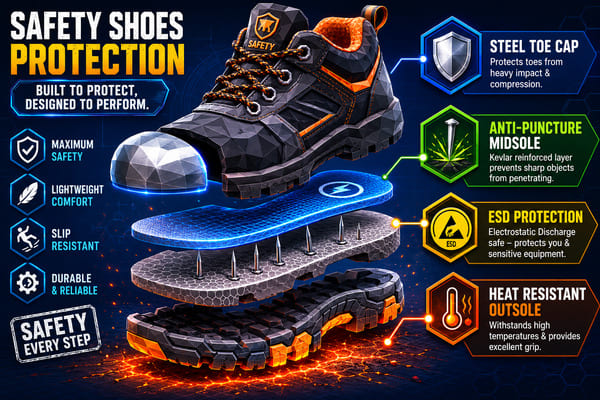
A Middle East buyer once told me he needed "standard safety shoes for construction sites." I asked one follow-up question: do the workers walk on asphalt surfaces? He said yes. I told him that standard PU soles begin to soften on ground surfaces above 60 degrees Celsius4. In hot climates on asphalt, that can happen in under four hours. When the sole softens, the anti-puncture layer loses structural integrity. He went quiet for a moment. Then he told me his last order had exactly this complaint — workers said the soles felt soft and spongy. He had assumed it was a quality defect. It was not. It was the wrong material configuration for the environment. We changed the outsole specification to a heat-resistant rubber composite and added HRO thermal resistance certification. The problem did not come back.
| Work Environment | Key Hazards | Recommended Features |
|---|---|---|
| Construction / civil works | Impact, puncture, heat | Steel toe, anti-puncture, HRO sole |
| Electronics manufacturing | Static discharge | ESD / anti-static protection |
| Chemical plants | Chemical exposure | Chemical-resistant upper and sole |
| Cold storage / logistics | Low temperature | Cold-resistant insulation lining |
| Oil and gas | Electrical hazard | Electrical insulation (EH rated) |
| General warehouse | Slip, fatigue | Slip-resistant sole, comfort insole |
The right protection configuration is a direct reflection of how well the buyer understands the use environment. When I receive a new inquiry, I always ask about the ground surface, the temperature range, the exposure risks, and whether workers stand for extended periods. These four questions usually determine 80% of the protection specification. If a supplier does not ask these questions before quoting, that is a warning sign.
What Materials Actually Affect Safety Shoe Performance?
Two shoes can look identical on the outside and perform completely differently in the field. The difference is almost always in the materials.
The materials that most affect safety shoe performance are the outsole compound, the toe cap material, the midsole, and the insole. PU outsoles offer lightweight comfort but degrade under heat or cold. Rubber outsoles handle extreme temperatures better. Steel toe caps are strong but heavy. Composite toe caps reduce weight while meeting the same impact standards5. Insole material directly affects fatigue over long shifts.
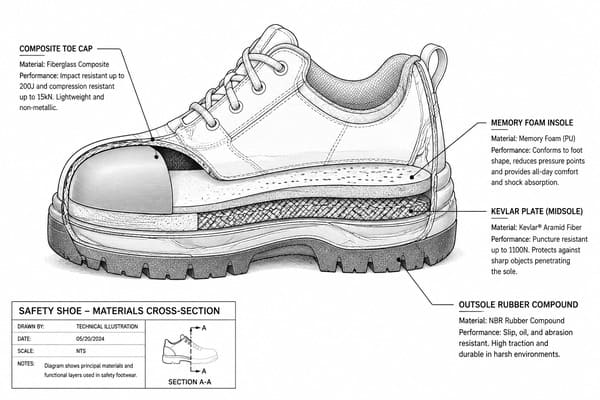
I ran an internal test some time ago. We took the same shoe model and built it with two different PU outsole materials. One was virgin PU from a certified supplier. The other was recycled PU from the open market, priced about 30% lower6. We put both pairs in a minus-15-degree Celsius environment to simulate cold storage conditions. After 48 hours, we ran a flex test. The virgin PU sole showed no cracking after 300 flex cycles. The recycled PU sole showed a visible crack at cycle 807. The two soles looked almost identical before testing. A buyer looking at samples would not be able to tell them apart. In real use, that difference means one shoe lasts 18 months and the other starts cracking at four months.
| Component | Material Option | Performance Impact |
|---|---|---|
| Outsole | Virgin PU | Lightweight, good for moderate temperature |
| Outsole | Rubber composite | Heat and cold resistant, more durable |
| Toe cap | Steel | High impact resistance, heavier |
| Toe cap | Composite (fiberglass / carbon) | Same protection rating, significantly lighter |
| Midsole | Anti-puncture steel plate | Standard puncture resistance |
| Midsole | Kevlar / composite fiber | Lighter, flexible, same protection level |
| Insole | Standard EVA | Basic cushioning, low cost |
| Insole | Memory foam | Better fatigue reduction, ~$1.20 more per pair |
The memory foam insole we use costs about 1.20 USD more per pair than a standard EVA insole. Workers who stand for eight consecutive hours report a clear difference in foot fatigue8 at the end of the shift. That 1.20 USD is usually the first thing buyers cut in the first round of price negotiation. I understand the budget pressure. But that 1.20 USD is also the difference between a worker who wants to keep wearing the shoe and a worker who takes it off the moment the shift ends.
How Does MOQ and Lead Time Work for Custom Orders?
MOQ and lead time are not arbitrary rules. They are the result of adding up every real step in the production process.
For custom safety shoes, a typical MOQ is 500 pairs per style and color9. Standard lead time is 30 days from sample approval10, not from order placement. Custom styles, new tooling, or material changes can extend this timeline. Any mid-order specification change — such as a color or material switch — resets part of the production schedule and should be factored into the delivery plan from the start.
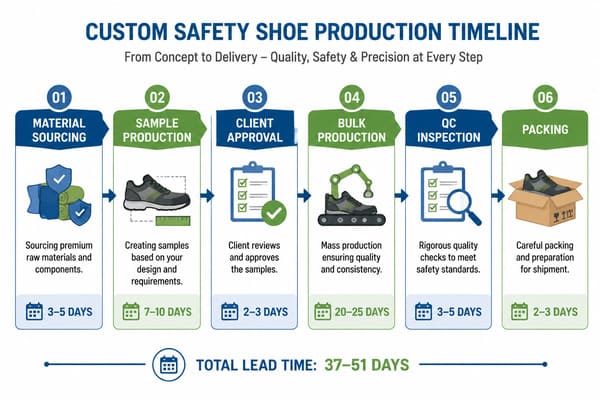
Last year, an Australian buyer placed his first order with us — 600 pairs of a custom style, with a 28-day delivery requirement. After sample approval, he also wanted to change the upper color. I walked him through the timeline honestly. A color change means sourcing new material. Material sourcing takes five to seven working days. Sample confirmation back and forth takes at least three days. That leaves fewer than 20 actual production days for 600 pairs. We could technically finish the quantity, but quality control would be under pressure. Once he understood the logic, he adjusted the delivery window to 35 days on his own. That shipment left port two days early. He was satisfied. I was not trying to set a difficult condition. I was showing him where the time actually goes.
| Stage | Typical Duration |
|---|---|
| Material sourcing (standard) | 3–5 working days |
| Material sourcing (new color / custom) | 5–7 working days |
| Sample production | 5–7 working days |
| Sample approval (client review) | 3–5 working days |
| Bulk production (500–1000 pairs) | 15–20 working days |
| QC inspection and packing | 2–3 working days |
| Total (standard custom order) | ~30 working days |
The 500-pair MOQ works the same way. Below that quantity, the cost of tooling and setup gets spread across too few units11. That cost has to come from somewhere, and it usually comes from material quality. I am not willing to let that happen on shoes that go to a real work environment. The MOQ is not a sales threshold. It is the minimum volume at which we can control every part of the process without cutting corners.
Conclusion
Check certifications, protection features, materials, and lead time before you place any custom safety shoe order. These four points decide whether the shoes work or fail in the field. Shoegan builds mid-to-high end custom safety shoes with 15+ years of production experience — reach us at [email protected] or WhatsApp +8613008988018.
-
"[PDF] ASTM F2413-11 Performance Requirements for Protective Footwear", https://facilities.uw.edu/partner-resources/files/media/performance-requirements-for-protective-footwear.pdf. These standards are published and maintained by their respective standards organizations (ISO for Europe, ASTM International for North America, and Standards Australia/Standards New Zealand), which define testing requirements and performance criteria for occupational safety footwear in each jurisdiction. Evidence role: general_support; source type: institution. Supports: that EN ISO 20345, ASTM F2413, and AS/NZS 2210 are the recognized safety footwear standards for Europe, North America, and Australia/New Zealand respectively. ↩
-
"Safety shoes Sb, S1, S1P, S2 or S3: what are the differences?", https://www.vdp.com/EN/Nieuws/order/desc/1/2311/235/safety-shoes-sb-s1-s1p-s2-or-s3-what-are-the-differences.html. EN ISO 20345 defines multiple safety categories: S1 requires closed heel region and antistatic properties; S1P adds puncture resistance; S2 adds water penetration resistance; and S3 combines S2 requirements with cleated outsole and puncture resistance, each with specified minimum performance thresholds. Evidence role: definition; source type: institution. Supports: that S1, S1P, S2, and S3 represent distinct protection grades within EN ISO 20345 with specific test requirements. ↩
-
"What is the EN ISO 20345 standard for safety footwear? – Oxwork", https://www.oxwork.com/en/blog/what-is-the-en-iso-20345-standard-for-safety-footwear?srsltid=AfmBOop3_98_6oub8hROce4xD_6o0_XCHFWIikc5aMzvwr5Wz5zsDHFy. EN ISO 20345 specifies that footwear classified as S1P must demonstrate puncture resistance of at least 1,100 Newtons when tested according to the standard’s prescribed methodology, ensuring protection against penetration by sharp objects. Evidence role: statistic; source type: institution. Supports: that EN ISO 20345 establishes 1,100 Newtons as the minimum puncture resistance threshold for S1P classification. ↩
-
"Mechanical Properties and Thermal Degradation Behaviour … – PMC", https://pmc.ncbi.nlm.nih.gov/articles/PMC12252175/. Polyurethane elastomers exhibit temperature-dependent mechanical properties, with many formulations showing reduced hardness and structural integrity when exposed to sustained temperatures in the 60-80°C range, though exact thresholds vary by polymer composition and additives. Evidence role: mechanism; source type: research. Supports: that polyurethane materials used in footwear soles experience softening at elevated temperatures. Scope note: The specific 60°C threshold depends on the particular PU formulation; different grades have different thermal performance characteristics. ↩
-
"Whats The Difference Steel vs Composite Toe Caps – Hazchem Safety", https://www.hazchemsafety.com/whats-the-difference-steel-vs-composite-toe-caps/. Research on safety footwear materials demonstrates that composite toe caps made from materials such as carbon fiber, fiberglass, or Kevlar can achieve the impact and compression resistance levels required by standards like ASTM F2413 and EN ISO 20345, typically at 30-50% lower weight than equivalent steel components. Evidence role: general_support; source type: research. Supports: that composite materials can meet the same impact protection standards as steel toe caps while offering weight advantages. Scope note: Performance equivalence applies to standardized test conditions; field durability and longevity may vary between materials depending on specific work environments. ↩
-
"A systematic review on the recycling of polyurethane products from …", https://www.sciencedirect.com/science/article/pii/S2773167725000044. Materials market analyses indicate that recycled polymers, including polyurethane, typically trade at 20-40% discounts to virgin material equivalents, reflecting lower feedstock costs offset partially by reprocessing expenses, though pricing varies by material grade, contamination levels, and market conditions. Evidence role: statistic; source type: other. Supports: that recycled polymer materials typically carry a cost discount compared to virgin materials. Scope note: Price differentials fluctuate based on virgin material prices, recycling technology, quality specifications, and supply-demand dynamics; the cited percentage represents a general range rather than a fixed discount. ↩
-
"Thermomechanical Properties of Virgin and Recycled … – PMC – NIH", https://pmc.ncbi.nlm.nih.gov/articles/PMC10647352/. Materials science research on recycled polymers demonstrates that reprocessing can degrade mechanical properties including flex fatigue resistance, tensile strength, and elongation at break, due to chain scission, contamination, and thermal degradation during recycling, though the extent of degradation depends heavily on recycling methods, source material quality, and number of processing cycles. Evidence role: mechanism; source type: research. Supports: that recycled polymers can exhibit reduced mechanical properties compared to virgin materials. Scope note: Performance of recycled materials varies significantly based on recycling technology, quality control, and material sourcing; high-quality recycled polymers with proper processing can approach virgin material performance. ↩
-
"Evidence of Health Risks Associated with Prolonged Standing at …", https://pmc.ncbi.nlm.nih.gov/articles/PMC4591921/. Occupational health research demonstrates that standing for extended periods (6-8+ hours) leads to measurable increases in lower limb discomfort, foot pressure, and perceived fatigue, with footwear cushioning properties shown to modulate these effects through pressure distribution and shock absorption. Evidence role: mechanism; source type: research. Supports: that prolonged standing causes foot fatigue and that footwear characteristics can influence this outcome. ↩
-
"Minimum Order Quantity (MOQ): Formula, Tips, & Benefits | NetSuite", https://www.netsuite.com/portal/resource/articles/inventory-management/minimum-order-quantity-moq.shtml. Footwear manufacturing economics typically establish MOQ thresholds in the 500-1500 pair range for custom orders, driven by fixed costs including tooling, material sourcing minimums, production line setup, and quality control processes that must be amortized across the production run. Evidence role: general_support; source type: other. Supports: that MOQ requirements in the 500-1000 pair range are common in custom footwear manufacturing. Scope note: MOQ varies significantly by factory capabilities, product complexity, and customization level; the cited figure represents a mid-range benchmark rather than a universal standard. ↩
-
"Lead Time in Manufacturing: A Complete Guide to Types, Strategies …", https://www.mrpeasy.com/blog/lead-time/. Industry analyses of footwear supply chains indicate that custom production lead times typically range from 30-60 days post-sample approval, encompassing material procurement (5-10 days), cutting and assembly (15-25 days), and quality control/finishing (5-10 days), with variation based on order complexity and factory capacity. Evidence role: general_support; source type: other. Supports: that 30-45 day lead times are typical for custom footwear production in the industry. Scope note: Lead times vary significantly by production location, order volume, material availability, and seasonal demand; the cited timeframe represents a baseline for standard custom orders without complications. ↩
-
"Economies of scale – Wikipedia", https://en.wikipedia.org/wiki/Economies_of_scale. Manufacturing economics demonstrates that fixed costs—including tooling, setup, quality systems, and overhead—remain constant regardless of production volume, resulting in higher per-unit costs for small batches as these fixed expenses are divided among fewer units, a fundamental principle of economies of scale. Evidence role: mechanism; source type: education. Supports: that fixed costs in manufacturing create economies of scale where per-unit costs decrease as production volume increases. ↩
[…] Fake safety shoe certifications mean the product was never tested to the standard it claims. A shoe labeled EN ISO 20345 S3 that failed to undergo the required 200-joule toe cap impact test loo…3 […]