
Choosing the wrong upper material costs more than money — it costs trust. When a shoe fails on a job site, the buyer gets the blame, not the material.
Microfiber and genuine leather both work as safety shoe uppers, but they perform very differently depending on the work environment. Microfiber offers better moisture resistance, consistency, and durability in harsh conditions. Full-grain leather suits buyers who need a premium look. Split leather is the one to avoid.
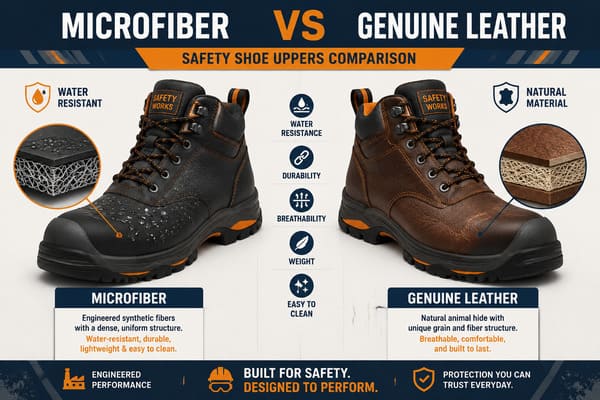
I have been making safety shoes for over 15 years. The question I get most from B2B buyers is not about toe caps or sole compounds — it is about the upper. And most of the time, the buyer is not asking the right question. They ask "leather or microfiber?" when they should be asking "what does this material actually do under real working conditions?" This article will help you build a clearer framework for that decision.
What Is the Difference Between Microfiber and Genuine Leather in Safety Shoes?
Most buyers treat "genuine leather" as a single category. It is not. The difference between full-grain leather and split leather is bigger than the difference between split leather and microfiber — and that gap is where a lot of bad purchasing decisions happen.
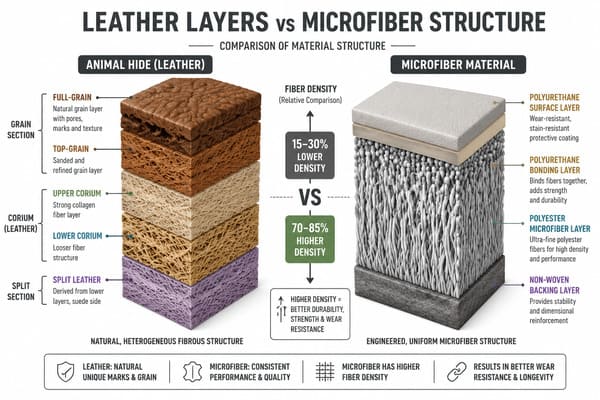
Genuine leather includes full-grain, top-grain, and split leather.1 Microfiber is a synthetic material made from ultra-fine polyester or nylon fibers bonded with polyurethane.2 The two materials differ in structure, water resistance, consistency, and long-term durability under industrial use.3
A few years ago, a buyer from the Middle East contacted me. He had received a batch of safety shoes from another supplier. The uppers had started cracking in under four months on a construction site. He sent me photos — the surface looked like an old dried-out belt. When I asked what material was used, the answer was split leather with a PU coating on top. Nobody had told him what that material could and could not handle.
We switched his next order to microfiber uppers. Same job site. Same workers. Same conditions. That batch lasted nearly eleven months before showing any serious wear. He now reorders twice a year.
Here is how the three main upper materials compare across the factors that matter most on a job site:
| Factor | Full-Grain Leather | Split Leather | Microfiber |
|---|---|---|---|
| Water absorption | Medium (40–60%) | High (60–80%) | Low (under 30%) |
| Surface durability | High | Low | High |
| Breathability | Good | Medium | Good (varies by grade) |
| Visual consistency | Natural variation | Natural variation | Very high |
| Cost | Highest | Lowest | Medium |
| Crack resistance in heat/dry | Medium | Low | High |
| OEM logo / surface treatment | Inconsistent | Inconsistent | Stable |
The water absorption numbers above come from our own material testing, not published specs. Split leather absorbs 60–80% of its own weight in water. After a full day on a wet or sweaty job site, that means heavier shoes and stiffer uppers. Workers feel it in their feet by the end of a shift.
The cross-section test is the most reliable way to tell these materials apart. Full-grain leather has a tight, even fiber structure when you cut through it. Split leather shows loose, spongy fibers underneath — even if the surface looks smooth and finished. When I receive raw material samples from suppliers, the first thing I do is cut a strip and look at the cross-section. If the fibers are loose, I send it back.
What Is the Best Upper Material for Safety Shoes?
There is no single best material. That answer depends on where the shoes will be used, who will wear them, and what the buyer needs the product to say about their brand.4
The best upper material for safety shoes depends on the work environment and end-user profile. Microfiber performs best in wet, high-wear, or high-heat conditions.5 Full-grain leather suits premium positioning or buyers with specific aesthetic requirements.6 Split leather is not recommended for serious industrial use.
I want to be direct about something. Too many buyers in this industry pay for a material’s name instead of its performance. "Genuine leather" sounds premium. It is often used as a selling point on product listings. But split leather is also genuine leather. The name tells you almost nothing about how the shoe will hold up.
Here is a simple way to match material to application:
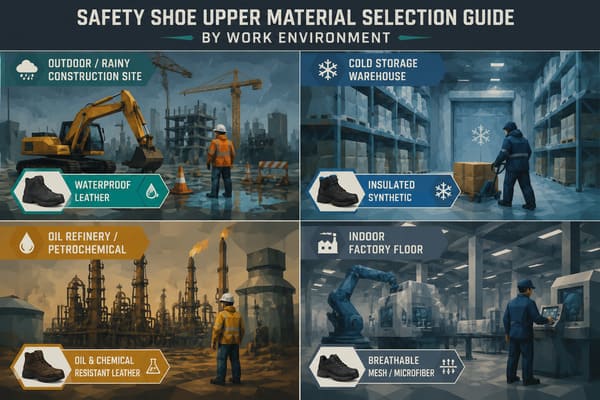
By Work Environment
| Environment | Recommended Upper | Reason |
|---|---|---|
| Outdoor construction, wet conditions | Microfiber | Low water absorption, crack-resistant |
| Oil and gas, chemical exposure | Microfiber or treated full-grain | Chemical resistance, durability |
| Cold storage, low-temperature sites | Microfiber | Stays flexible in cold, leather stiffens |
| Indoor light industrial | Full-grain or microfiber | Either works; choose by budget |
| Supervisory / management roles | Full-grain leather | Professional appearance, comfort |
By Buyer Profile
| Buyer Type | Best Choice | Why |
|---|---|---|
| PPE distributor, high-volume | Microfiber | Consistent quality, lower return rate |
| Brand owner, premium market | Full-grain leather | Supports price positioning |
| OEM buyer, strict brand visuals | Microfiber | Surface consistency for logo and finish |
| EPC contractor, bulk procurement | Microfiber | Long service life, lower total cost |
The buyers who get the best results are the ones who define the use case first and then choose the material. The buyers who get into trouble are the ones who start with a price point and work backward.
What Type of Leather Is Used in Safety Shoes?
Walk into any trade show and you will see "genuine leather" on half the product cards. That label covers three very different materials, and the price difference between them is significant.
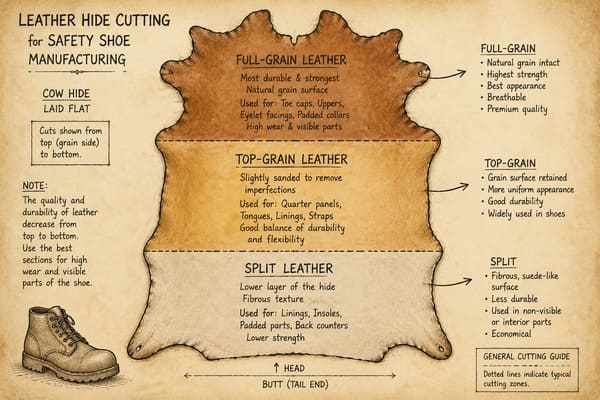
Safety shoes use three types of leather: full-grain, top-grain, and split leather. Full-grain is the strongest and most durable layer. Split leather is cut from the lower hide layers and is weaker.7 PU-coated split leather can look like full-grain but performs very differently.8
We still produce full-grain leather safety shoes. Several of our European brand clients specify it — mostly for end users in supervisory or site management roles where appearance matters. The look and feel of real leather carries weight in those markets. Our full-grain models run about 15–20% higher in factory cost compared to the same spec in microfiber. Whether that is worth it depends entirely on who you are selling to.
Here is a breakdown of the three leather types used in safety shoe production:
Full-Grain Leather
This is the top layer of the hide. The fiber structure is tight and dense. It is the most durable form of leather, handles abrasion well, and develops a surface finish over time.9 It breathes naturally and, when properly maintained, lasts a long time. The downside is cost and natural variation — no two hides are identical.
Top-Grain Leather
This is full-grain leather that has been sanded or buffed to remove surface imperfections. It is more uniform in appearance than full-grain but slightly weaker because the outer fiber layer has been removed.10 Still a solid choice for mid-range safety shoes.
Split Leather
This is cut from the lower layers of the hide, below the grain surface. The fiber structure is loose and weak. It absorbs water easily, cracks under heat and dry conditions, and wears out faster. Many low-cost safety shoes use split leather with a PU coating to mimic the look of full-grain. The coating hides the difference visually — but not structurally.
| Leather Type | Hide Layer | Fiber Density | Durability | Cost |
|---|---|---|---|---|
| Full-grain | Top | High | High | High |
| Top-grain | Upper-mid | Medium-high | Medium-high | Medium |
| Split | Lower | Low | Low | Low |
If you are buying safety shoes and want to verify what you are getting, ask for a cross-section cut of the upper material. That one step will tell you more than any product description.
Is Microfiber Leather Good for Safety Shoes?
Microfiber has a reputation problem. Because it is synthetic, some buyers assume it is a budget compromise. That assumption is wrong — and it is costing some buyers money in the form of early returns and worker complaints.
Microfiber leather is an excellent choice for safety shoe uppers. It resists water absorption, maintains flexibility in extreme temperatures, and offers high surface consistency for OEM production. In most industrial environments, it outlasts split leather and matches or exceeds full-grain leather in durability.
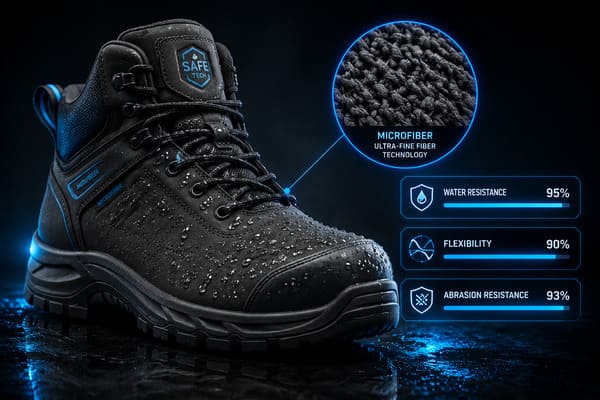
One advantage of microfiber that almost no OEM buyer thinks about is surface consistency. When we press a logo or apply a special surface finish to microfiber, the yield rate is stable. The surface is uniform across every panel, every pair, every batch. Full-grain leather has natural variations — two shoes cut from the same hide can have slightly different grain patterns or color depth when placed side by side.11 For buyers who care about brand visual consistency across thousands of pairs, that is a real production issue, not a cosmetic one.
Here is a direct comparison of microfiber against the leather types in the areas that matter most for B2B buyers:
Performance Comparison
| Performance Factor | Full-Grain Leather | Split Leather | Microfiber |
|---|---|---|---|
| Water resistance | Medium | Poor | Good |
| Cold flexibility | Medium | Poor | Good |
| Heat/crack resistance | Medium | Poor | Good |
| Abrasion resistance | High | Low | High |
| Surface consistency (OEM) | Low | Low | High |
| Logo / finish application | Variable | Variable | Stable |
| Maintenance required | Yes | Yes | Minimal |
| Weight | Medium | Medium | Light |
Microfiber also holds up better in cold storage environments. Leather stiffens significantly in low temperatures. Microfiber keeps its flexibility12, which matters for workers who move in and out of cold zones throughout a shift.
The core point is this: microfiber is not a cheap substitute for leather. It is a different material with different strengths. In many real-world applications, it is the stronger choice. The buyers who understand that make better purchasing decisions. The buyers who still think "leather equals quality" are often the ones calling me after a batch fails early.
Conclusion
Material name is not material performance. Know what your workers need, know what your buyers expect, and choose accordingly. Shoegan builds mid-to-high end safety shoes with full material transparency — contact us to find the right upper for your next order.
-
"(PPT) Types of leather – Academia.edu", https://www.academia.edu/87301663/Types_of_leather. A leather technology reference can document the common classification of leather by hide layer and finishing, including full-grain, corrected/top-grain, and split leather. Evidence role: definition; source type: education. Supports: Genuine leather includes full-grain, top-grain, and split leather.. ↩
-
"Advances in polyurethane (PU)-based microfiber synthetic leather", https://www.sciencedirect.com/science/article/pii/S1359836826000685. A materials science source can define synthetic microfiber leather as a nonwoven microfibrous substrate, commonly polyester or polyamide, impregnated or coated with polyurethane. Evidence role: definition; source type: paper. Supports: Microfiber is a synthetic material made from ultra-fine polyester or nylon fibers bonded with polyurethane.. Scope note: The exact fiber blend and binder system vary by manufacturer and grade. ↩
-
"Microfiber Faux Leather vs Real Leather Pros and Cons Explained", https://www.winiwecoleather.com/microfiber-faux-leather-vs-real-leather-pros-and-cons-explained_n144. Comparative materials literature on natural leather and polyurethane microfiber synthetic leather can support that their fiber structures and resulting physical properties differ, including water uptake and mechanical performance. Evidence role: general_support; source type: paper. Supports: Microfiber and genuine leather differ in structure, water resistance, consistency, and long-term durability under industrial use.. Scope note: Such sources usually compare material properties under laboratory tests rather than proving performance in every industrial footwear environment. ↩
-
"1910.136 – Foot protection. | Occupational Safety and Health … – OSHA", http://www.osha.gov/laws-regs/regulations/standardnumber/1910/1910.136. Occupational safety guidance on PPE selection supports that protective footwear should be chosen according to workplace hazards, exposure conditions, and user needs rather than by one universal material criterion. Evidence role: expert_consensus; source type: government. Supports: The best upper material for safety shoes depends on the specific use environment and wearer requirements.. Scope note: PPE guidance supports the selection principle but does not rank microfiber and leather upper materials directly. ↩
-
"Improving the Water Vapor Permeability and Moisture Absorption of …", https://ui.adsabs.harvard.edu/abs/2025JAPS..142E7454Z/abstract. Laboratory studies of polyurethane microfiber synthetic leather can support its low water uptake and resistance to abrasion or hydrothermal degradation relative to some leather constructions. Evidence role: general_support; source type: paper. Supports: Microfiber performs well in wet, high-wear, or high-heat conditions.. Scope note: The source would provide material-property support, not a direct field trial proving superiority in all wet, high-wear, or high-heat worksites. ↩
-
"Full Grain Leather vs. Top Grain Leather – What’s the …", https://buffalojackson.com/blogs/insight/full-grain-leather-vs-top-grain-leather?srsltid=AfmBOoq_JEuM_WymW3bjbeQnMechU7T6bDFmQZNeBSmjx8OzINRfpTse. Leather science and industry-neutral references describe full-grain leather as retaining the natural grain surface, which is associated with visible natural markings and a premium appearance in finished goods. Evidence role: general_support; source type: education. Supports: Full-grain leather is suited to premium or aesthetic-focused footwear positioning.. Scope note: The source can support the aesthetic and classification context, but market positioning depends on buyer preferences and region. ↩
-
"Differences in strength between the grain and corium layers of leather", https://www.academia.edu/2625763/Differences_in_strength_between_the_grain_and_corium_layers_of_leather. Leather technology sources describe split leather as material obtained after the grain layer is removed, with a looser fiber structure than the grain layer, which generally reduces strength and durability. Evidence role: mechanism; source type: education. Supports: Split leather comes from lower hide layers and is generally weaker than grain leather.. Scope note: Strength varies with tanning, thickness, coatings, and finishing, so the statement is a general material hierarchy rather than an absolute for every product. ↩
-
"What is PU Leather? It’s Worse Than You Think! – BTOD.com", https://www.btod.com/blog/what-is-pu-leather/?srsltid=AfmBOoq68l96BcRNoxHB2l_46pzjSlUWRx3NMuaO_hLOeGgQBisw4wkQ. A leather finishing or materials reference can explain that split leather may be coated or embossed to imitate grain leather, while its underlying fibrous structure remains different from full-grain leather. Evidence role: mechanism; source type: education. Supports: PU-coated split leather can visually imitate full-grain leather while retaining different structural performance characteristics.. Scope note: The source supports structural and finishing differences; actual performance depends on coating quality and test conditions. ↩
-
"Full-Grain vs. Genuine Leather: The Technical Benchmark for SLGs", https://hoplokleather.com/full-grain-vs-top-grain-leather-technical-guide/. Leather anatomy references can support that the grain layer contains densely interwoven collagen fibers and that full-grain leather generally has superior durability because this layer remains intact. Evidence role: mechanism; source type: education. Supports: Full-grain leather has a dense fiber structure and is generally the most durable leather layer.. Scope note: The source supports the general material mechanism; abrasion performance still varies by species, tanning, thickness, and finish. ↩
-
"Can someone please clarify this whole “full grain” “top grain” fiasco?", https://www.reddit.com/r/Leathercraft/comments/1qgaqbr/can_someone_please_clarify_this_whole_full_grain/. Leather references on corrected-grain or top-grain leather can support that sanding or buffing removes part of the natural grain surface, producing a more uniform appearance while altering the strongest surface layer. Evidence role: mechanism; source type: education. Supports: Top-grain leather is more uniform than full-grain but can be somewhat weaker because the outer grain surface is modified or removed.. Scope note: The degree of strength reduction depends on how much surface is removed and how the leather is finished. ↩
-
"Leather Dyeing by Plant-Derived Colorants in the Presence of …", https://pubmed.ncbi.nlm.nih.gov/35591660/. Leather science sources can document that natural hides vary in grain pattern, defects, and dye uptake, which can lead to visible variation between cut components. Evidence role: general_support; source type: education. Supports: Full-grain leather has natural variation in grain and color that can affect visual consistency between shoe components.. Scope note: The source supports the natural-variation mechanism but not the specific production frequency in safety shoe manufacturing. ↩
-
"Mechanical Parameters of Leather in Relation to Technological …", https://pmc.ncbi.nlm.nih.gov/articles/PMC9331295/. Footwear or polymer materials testing literature can support that leather and polyurethane-based synthetic leathers show different flexural behavior at low temperatures, with some microfiber PU materials retaining flexibility under cold-flex tests. Evidence role: mechanism; source type: paper. Supports: Microfiber can retain flexibility better than leather in low-temperature conditions.. Scope note: The claim depends strongly on leather treatment and microfiber formulation, so evidence should be read as grade-specific rather than universal. ↩