
Most safety shoe complaints don’t start at the toe cap. They start at the upper — and the coating choice is usually where things go wrong first.
PU-coated upper fabric is a textile base, usually polyester or nylon, with a layer of polyurethane applied to its surface.1 This coating adds abrasion resistance, water repellency, and surface durability.2 It is lighter and more breathable than full PU synthetic leather3, making it a common choice for industrial safety footwear.
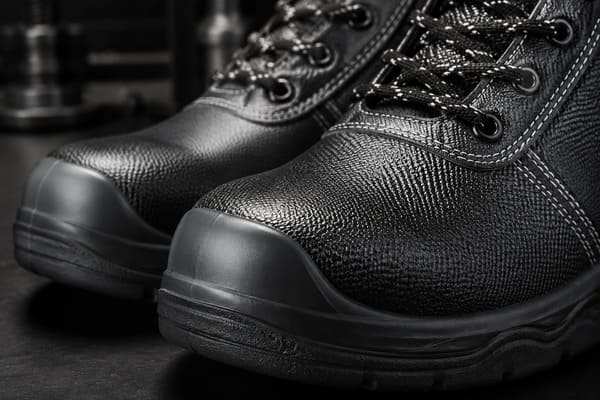
I’ve been in this industry for over 20 years. In my early days working on the factory floor, I watched workers sand, stitch, and laminate hundreds of pairs a day. The upper fabric was always the last thing anyone talked about in a product spec meeting — everyone cared about the toe cap standard, the outsole compound, the insole cushioning. But after tracking more than a dozen bulk order complaints over the years, I found that more than 60% of surface wear issues pointed back to the upper — specifically, poor coating adhesion or the wrong coating grade for the environment. That’s when I started treating upper fabric selection as seriously as sole construction.
What Is PU Upper Material in Shoes?
Same label, completely different product — and most buyers don’t know until the complaints come in.
PU upper material refers to either full polyurethane synthetic leather or a textile fabric with a PU coating applied to the surface. Full PU leather has no textile base. PU-coated fabric uses a woven or knit base layer, usually polyester, with polyurethane bonded on top. These two structures differ in weight, breathability, and production cost.
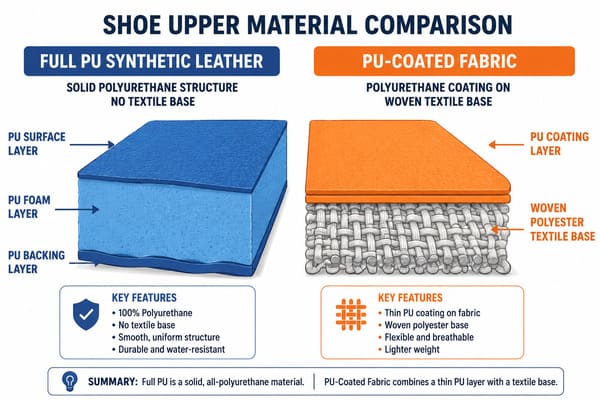
A client from Germany once sent me two samples from two different Chinese suppliers and asked me why they felt so different even though both were labeled "PU upper." One was full PU synthetic leather — no textile base, just layered polyurethane. The other was a polyester fabric with a PU coating on top. Without knowing this distinction, buyers can’t compare quotes accurately or set the right performance expectations.
Full PU Leather vs. PU-Coated Fabric: Key Differences
These two materials are often confused in spec sheets and supplier quotes. Here is how they actually compare across the factors that matter most in safety footwear procurement.
| Feature | Full PU Synthetic Leather | PU-Coated Fabric |
|---|---|---|
| Base structure | No textile base | Polyester or nylon textile base |
| Weight per shoe | Heavier | Lighter by 80–120g per shoe |
| Breathability | Lower | Higher |
| Production cost | 15–20% higher per pair | More cost-efficient |
| Surface durability | High | High (depends on coating grade) |
| Best use environment | Cold, dry, abrasion-heavy | Warm, active, moderate exposure |
| Flex performance | Good | Good to excellent with quality coating |
The key point here is that neither option is universally better. Full PU leather performs well in cold storage environments and heavy abrasion conditions.4 PU-coated fabric is a better fit for warm climates, active wear, and designs where weight matters. When a buyer receives two quotes with the same label but different prices, this structural difference is almost always the reason. Knowing which one you’re specifying protects you from receiving the wrong product — and from making unfair comparisons between suppliers who are quoting different things entirely.
What Are the Disadvantages of Polyurethane Shoes?
PU breaks down. The question is how fast — and whether your supplier told you that upfront.
The main disadvantages of polyurethane in safety shoes include hydrolysis, UV degradation, and heat sensitivity.5 In humid or high-temperature environments, standard-grade PU can begin to peel or crack within months.6 Low-grade PU coatings are especially vulnerable when exposed to combined heat and moisture over time.7
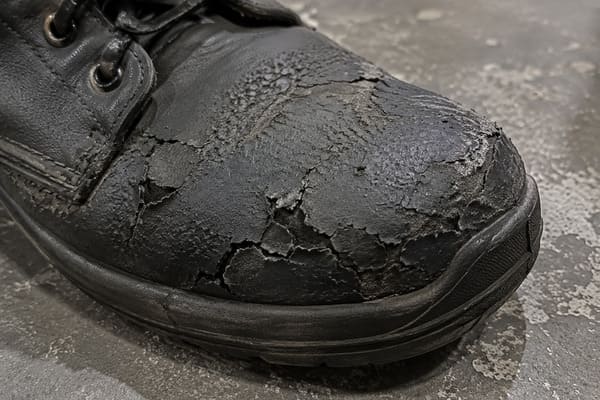
A procurement manager from a Middle East distributor contacted me after receiving 300 pairs that started peeling at the upper within 4 months of use. The shoes were used in a humid outdoor environment with temperatures regularly above 40°C. The original supplier had used standard-grade PU — the kind that works fine in a dry warehouse but breaks down fast under heat and moisture combined.
Common PU Failure Modes and How to Prevent Them
Understanding why PU fails helps you specify the right grade from the start. Here are the most common failure modes we see in returned orders, and what causes each one.
| Failure Mode | Cause | Typical Timeline | Prevention |
|---|---|---|---|
| Surface peeling | Hydrolysis from heat + moisture | 90 days–18 months | Use hydrolysis-resistant PU grade |
| Cracking | UV exposure and low-grade base resin8 | 6–12 months outdoors | UV-stabilized PU formulation |
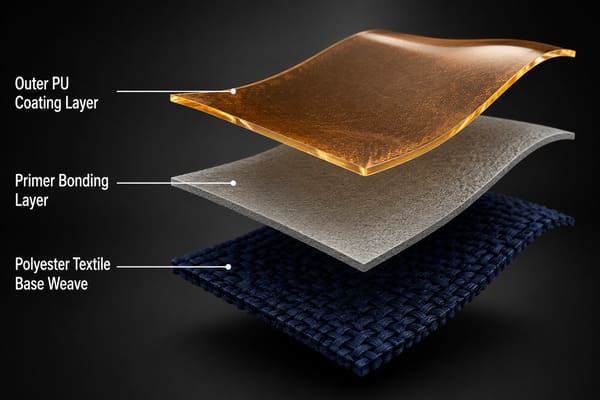
| Delamination | Poor adhesion between coating and fabric | 3–6 months with heavy flex | Proper bonding process and primer layer |
| Yellowing | UV and oxidation reaction | Visible after 3–6 months | UV inhibitors in coating compound |
| Stiffening in cold | Low-temperature brittleness | Immediate below -15°C | Cold-resistant PU or alternative material |
Hydrolysis is the most common issue we see in orders going to Southeast Asia, the Middle East, and coastal industrial sites. It typically starts showing visible damage between 6 and 18 months depending on conditions, but with low-grade PU in a harsh climate, I’ve seen it happen in as little as 90 days. We switched that Middle East client to hydrolysis-resistant PU coating on a 600D polyester base — no more complaints in the following order. The fix wasn’t expensive. The cost was in knowing what to specify.
What Does PU Coating Actually Do to the Upper Fabric?
The coating isn’t decoration. It’s doing real protective work — and the thickness decides how much.
PU coating bonds to the surface of the upper fabric to create a protective barrier.9 It resists abrasion, repels water and light oils, and holds the fabric structure together under repeated flex stress.10 Coating thickness typically ranges from 0.3mm to 0.6mm depending on the intended work environment and breathability requirements.11
When I walk clients through our material selection process, I usually show them a simple flex test on two fabric samples — one uncoated, one PU-coated — after 50,000 flex cycles. The uncoated fabric starts to fray and lose surface integrity around the 30,000-cycle mark. The PU-coated version holds clean past 50,000. That’s roughly equivalent to 12–18 months of daily wear in a medium-intensity work environment.
What PU Coating Protects Against — and Its Limits
PU coating handles a specific range of hazards well. Knowing where it performs and where it doesn’t helps you match the right material to the right job site.
| Protection Type | PU Coating Performance | Notes |
|---|---|---|
| Abrasion resistance | Strong | Depends on coating thickness and hardness grade |
| Water repellency | Good | Surface-level only, not waterproof without membrane |
| Oil splash resistance | Moderate to good | Light industrial oils; not for immersion |
| Light chemical contact | Moderate | Not suitable for strong acids or solvents |
| Flex stress | Excellent | Key advantage over uncoated fabric |
| UV resistance | Moderate | Requires UV-stabilized formulation for outdoor use |
| Heat resistance | Limited | Standard PU degrades above 60–70°C surface contact |
Coating thickness is one of the most overlooked variables in upper fabric specs. We typically work between 0.3mm and 0.6mm depending on the use case. Thinner coatings, around 0.3mm, are used in breathability-focused designs where air circulation matters more than heavy surface protection. Thicker coatings, from 0.5mm to 0.6mm, are used for chemical-adjacent environments or sites with heavy abrasion exposure like grinding, metalwork, or construction. The coating also acts as the first line of defense against oil splashes and light chemical contact. It won’t replace a chemical-resistant upper in a lab or processing plant — but for most general industrial environments, a properly specified PU coating does more protective work than most buyers realize.
Is PU-Coated Fabric More Durable Than Regular Fabric in Safety Shoes?
Saving $2.50 per pair sounds smart — until you calculate what the returns are actually costing you.
PU-coated fabric is more durable than uncoated fabric in most industrial environments.12 The coating adds abrasion resistance, prevents surface soiling, and extends the structural life of the upper. In real-world use, this typically reduces return rates and increases end-customer satisfaction across order cycles.
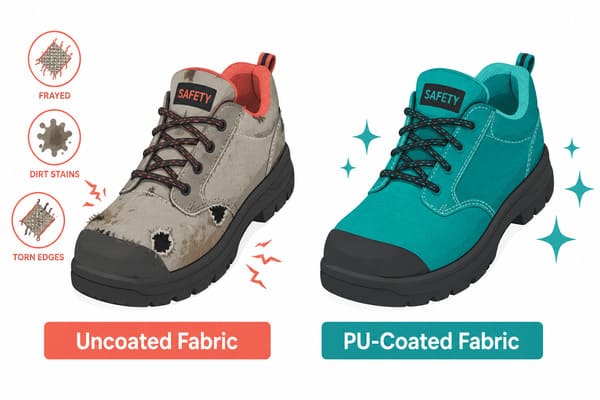
I had a client running a construction supply company in Australia. He was sourcing uncoated canvas-upper safety shoes because they were cheaper — about $2.50 less per pair. After 8 months, his site supervisors were reporting upper tears and visible soiling that couldn’t be cleaned off. He switched to PU-coated fabric uppers in his next order, and his return rate dropped from around 8% to under 2% over the next two order cycles.
Durability Comparison: PU-Coated vs. Uncoated Fabric Uppers
Here is how the two options compare across the performance factors that matter most in B2B procurement decisions.
| Performance Factor | Uncoated Fabric | PU-Coated Fabric |
|---|---|---|
| Abrasion resistance | Low to moderate | High |
| Surface soiling | Absorbs stains | Wipes clean easily |
| Flex durability | Starts fraying ~30,000 cycles | Holds past 50,000 cycles |
| Water resistance | None | Surface-level repellency |
| Breathability | High | Moderate (varies by coating weight) |
| Cost per pair | Lower | Slightly higher |
| Return rate impact | Higher in industrial use | Lower in industrial use |
| End-user satisfaction | Lower in demanding environments | Higher in demanding environments |
The $2.50 saving per pair was costing that Australian client far more in returns and reputation. PU-coated fabric isn’t always the answer — in low-risk, light-duty environments, uncoated fabric may be perfectly adequate. But in most industrial environments — construction, manufacturing, logistics, petrochemical, mining — PU-coated fabric is the more honest long-term choice. The durability improvement is real, the maintenance burden on the end-user drops, and the reorder rate reflects that. When we help clients spec their products, we always ask about the end-use environment before recommending a material. The coating grade and fabric base both need to match where the shoe is actually going to be worn.
Conclusion
Upper fabric coating is a small decision with a big impact on product life, return rates, and your reputation as a supplier.
At Shoegan, we help B2B buyers specify the right PU coating grade for the right environment — before the complaints start. Reach us at [email protected] or WhatsApp +8613008988018.
-
"Best Water-Resistant Jacket Materials: A Comprehensive Guide – Cs", https://cs.grinnell.edu/lunar-note/best-water-resistant-jacket-materials-a-comprehensive-guide-1767648478. A textile-coating reference should support that polyurethane coatings are commonly applied to woven or knitted textile substrates, including synthetic fibers such as polyester and nylon, to create coated fabrics. Evidence role: definition; source type: education. Supports: PU-coated upper fabric consists of a textile base, commonly polyester or nylon, with polyurethane applied to the surface.. Scope note: The source may describe coated textiles generally rather than safety-shoe uppers specifically. ↩
-
"(PDF) Polyurethane Impregnation for Improving the Mechanical and …", https://www.academia.edu/99559887/Polyurethane_Impregnation_for_Improving_the_Mechanical_and_the_Water_Resistance_of_Polypropylene_Based_Textiles. A materials or textile-finishing source should support that polyurethane coatings are used to improve coated fabrics’ abrasion resistance, water repellency, and surface durability. Evidence role: mechanism; source type: education. Supports: Polyurethane coating can improve abrasion resistance, water repellency, and durability of fabric surfaces.. Scope note: Performance depends on formulation, coating thickness, substrate, and test method. ↩
-
"Influence of Upper Footwear Material Properties on Foot Skin … – PMC", https://pmc.ncbi.nlm.nih.gov/articles/PMC9518374/. A textile or footwear-materials source should support that fabric-based uppers generally have lower mass and greater air or moisture-vapor permeability than dense synthetic leather constructions. Evidence role: general_support; source type: paper. Supports: PU-coated fabric can be lighter and more breathable than full PU synthetic leather.. Scope note: The comparison is contextual because weight and breathability vary by fabric density, coating add-on, synthetic-leather backing, and finishing process. ↩
-
"Recent Advances in Functional Polyurethane and Its Application in …", https://pubmed.ncbi.nlm.nih.gov/32887324/. A footwear-materials or polymer reference should support that polyurethane synthetic leather can provide abrasion-resistant upper surfaces and that low-temperature performance depends on polyurethane formulation. Evidence role: general_support; source type: paper. Supports: Full PU synthetic leather can be suitable for abrasion-heavy uses and, with appropriate formulation, cold environments.. Scope note: The evidence is likely to support material properties rather than prove suitability for every cold-storage workplace. ↩
-
"Thermal degradation and hydrolysis depolymerization of printing ink …", https://ui.adsabs.harvard.edu/abs/2024FrESE..18..128G/abstract. A polymer-science source should support that polyurethane materials can undergo hydrolytic degradation, photodegradation under ultraviolet exposure, and property loss under elevated heat. Evidence role: expert_consensus; source type: paper. Supports: Polyurethane used in footwear can be vulnerable to hydrolysis, UV degradation, and heat-related degradation.. Scope note: The source may address polyurethane polymers broadly rather than footwear-grade polyurethane specifically. ↩
-
"Chemical Structure and Thermal Properties versus Accelerated …", https://pmc.ncbi.nlm.nih.gov/articles/PMC11314303/. A polymer-degradation study should support that moisture and elevated temperature accelerate hydrolysis and mechanical deterioration in polyurethane materials, which can manifest as cracking, peeling, or loss of adhesion. Evidence role: mechanism; source type: paper. Supports: Humidity and heat can accelerate PU degradation and contribute to peeling or cracking.. Scope note: A neutral source may not confirm the specific “within months” timeline for all footwear applications, because degradation rate depends on formulation and exposure conditions. ↩
-
"Hydrolytic Degradation and Erosion of Polyester Biomaterials – PMC", https://pmc.ncbi.nlm.nih.gov/articles/PMC6350899/. A polymer-aging source should support that polyurethane resistance to hydrolysis varies by chemical structure and formulation, and that combined heat and moisture accelerate degradation. Evidence role: mechanism; source type: paper. Supports: PU coating vulnerability to heat and moisture depends on formulation quality and chemistry.. Scope note: The source may distinguish polyester-based and polyether-based polyurethanes rather than using the commercial term “low-grade PU.” ↩
-
"Degradation and stabilization of an aromatic polyurethane coating …", https://ui.adsabs.harvard.edu/abs/2014MatCo..65…76R/abstract. A polymer photodegradation source should support that ultraviolet radiation can degrade polyurethane materials through oxidation and chain scission, contributing to cracking and embrittlement. Evidence role: mechanism; source type: paper. Supports: UV exposure can contribute to cracking in PU materials, especially where resin formulation has limited stabilization.. Scope note: The evidence may support UV-related degradation generally but not rank specific commercial resin grades. ↩
-
"Antibacterial and waterproof breathable waterborne polyurethane …", https://ui.adsabs.harvard.edu/abs/2021CarbT…400067B/abstract. A coated-textiles reference should support that polymer coatings are applied and bonded to textile substrates to form a continuous functional surface layer or barrier. Evidence role: definition; source type: education. Supports: PU coating forms a bonded protective layer on textile fabric.. Scope note: The source may discuss coated fabrics broadly rather than footwear uppers specifically. ↩
-
"Permeability Properties and Abrasion Resistance of Coated …", https://www.academia.edu/71835498/Permeability_Properties_and_Abrasion_Resistance_of_Coated_Polypropylene_Fabrics. A textile-performance source should support that polyurethane-coated fabrics can provide abrasion resistance, liquid repellency, and improved flex or mechanical durability compared with uncoated substrates. Evidence role: mechanism; source type: paper. Supports: PU coating can improve abrasion resistance, liquid repellency, and flex durability of fabric.. Scope note: Oil repellency and flex durability are formulation- and test-dependent, so the source may provide general rather than footwear-specific confirmation. ↩
-
"Development of Breathable Waterproof Polyurethane-Coated Cotton …", https://pmc.ncbi.nlm.nih.gov/articles/PMC12509000/. A technical textile or coated-fabric reference should support that coating add-on or thickness is adjusted to balance barrier performance, durability, flexibility, and moisture or air permeability. Evidence role: general_support; source type: paper. Supports: PU coating thickness is selected according to performance and breathability requirements, with thicker coatings generally increasing protection and reducing permeability.. Scope note: The exact 0.3–0.6 mm range may require footwear-specific testing data or manufacturer specifications; neutral sources may only support the trade-off between coating thickness and performance. ↩
-
"Quantitative Assessment of Woven Fabric Surface Changes During …", https://pmc.ncbi.nlm.nih.gov/articles/PMC12348827/. A textile-testing or coated-fabric source should support that polymer coatings can improve fabric abrasion resistance and surface durability relative to uncoated fabrics under mechanical wear. Evidence role: general_support; source type: paper. Supports: PU-coated fabric generally has greater abrasion and surface durability than comparable uncoated fabric.. Scope note: The phrase “most industrial environments” is broader than typical laboratory evidence; applicability depends on the specific hazard, coating chemistry, substrate, and work conditions. ↩