
I’ve been in this industry for over 20 years. When I started on the factory floor, microfiber was the material you used when a client couldn’t afford leather. Nobody was proud of it.
Microfiber upper material in safety shoes is a synthetic fabric made from ultra-fine polyester or nylon fibers, bonded to a non-woven base and coated with PU1. It offers consistent appearance, moisture resistance, and durability2 — making it a practical and increasingly preferred choice for industrial footwear at scale.
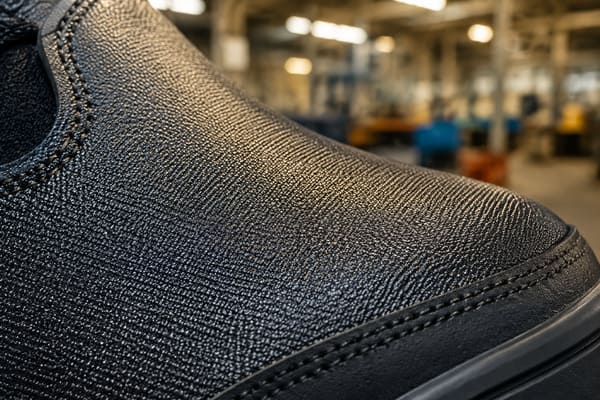
Fast forward to today — roughly 70% of the safety shoe uppers we produce at Shoegan are microfiber. That shift didn’t happen only because leather got more expensive, though it did. It happened because buyers started caring about consistency. I remember one order we did — 2,000 pairs in genuine split leather. By pair 800, the leather grain had visibly changed because it came from a different batch of hides3. The client noticed. We had to sort and re-pack by appearance. That never happens with microfiber. When I cut from a microfiber roll, pair 1 and pair 2,000 look and perform exactly the same. For a factory procurement manager ordering uniforms at scale, that matters more than material prestige.
Is Microfiber a Good Material for Shoes?
A buyer from the Middle East once called me frustrated. He had ordered microfiber safety shoes from another supplier, and within 3 months the surface was peeling and the toe area had cracked. He told me: "Microfiber is garbage."
High-grade microfiber — with a 0.4–0.6mm PU coating on a non-woven base — can last 18 to 24 months in daily industrial use4. Low-grade microfiber, using a thin coating on a weak base, fails within 3 to 6 months. The material is not the problem. The grade is.
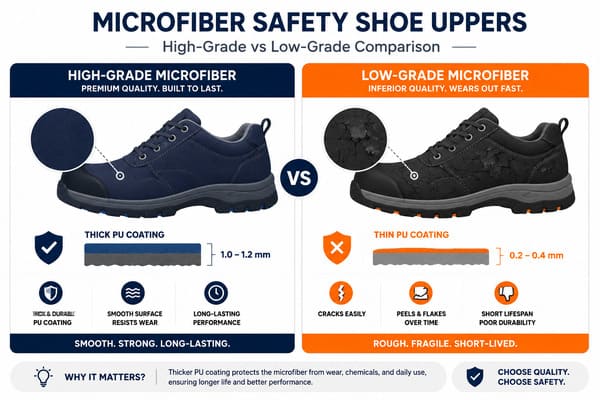
I asked him one question: "What was the price per pair?" He said $8 FOB. I told him the microfiber we use costs more than that per meter of raw material alone. That’s the real story behind this question. The grade lives inside the price, which is why this question can’t be answered without knowing what you actually paid.
What separates high-grade microfiber from low-grade?
The difference is not visible to the naked eye at first. It shows up after 6 months of use. Here is how the two grades compare across the factors that matter most in industrial environments:
| Performance Factor | High-Grade Microfiber | Low-Grade Microfiber |
|---|---|---|
| PU coating thickness | 0.4–0.6mm | 0.1–0.2mm |
| Surface cracking timeline | 18–24 months | 3–6 months |
| Abrasion resistance | High | Low to medium |
| Moisture resistance | Consistent | Degrades quickly |
| Color consistency across batches | Stable | Variable |
| Raw material cost per meter | $4–$7 USD | $1–$2 USD |
When a buyer asks me "is microfiber good?", I always redirect the question. The right question is: what grade of microfiber is in this shoe, and what did you pay for it? A well-specified microfiber upper from a reputable material supplier — brands like Alcantara-grade PU microfiber or equivalent industrial-grade stock — will outperform split leather in moisture resistance, uniformity, and ease of cleaning5. It will not outperform full-grain leather in breathability over long shifts. But for most industrial buyers, breathability is solved at the insole and lining level, not the upper. The upper’s job is to protect and last. High-grade microfiber does both.
What Is the Best Material for Safety Shoe Soles?
One of our clients runs a petrochemical facility in Shandong. He came to us after going through 3 sole suppliers in 2 years. The first gave him pure PU soles — great cushioning, but the oil resistance wasn’t enough6 for his floor conditions.
There is no single best sole material for safety shoes7. The right choice depends on floor conditions, chemical exposure, and shift length. A dual-density PU midsole with rubber outsole8 is the most widely effective combination for industrial environments requiring both slip resistance and comfort.
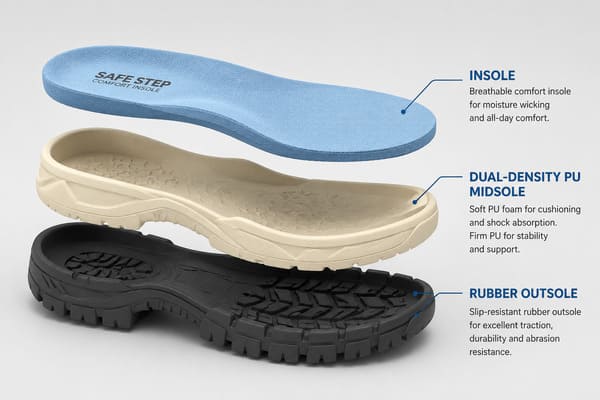
After 4 months on pure PU soles, workers at that facility were slipping. The second supplier switched him to rubber — slip resistance improved, but the soles weighed 480g per pair and workers were complaining of leg fatigue by end of shift. We recommended a PU midsole with a rubber outsole, dual-density construction. Slip resistance passed SRC testing9. Weight came down to 380g. Workers stopped complaining. That client has been reordering every 6 months for 3 years now.
How do sole materials compare for industrial use?
Each material has a specific strength. The mistake most buyers make is optimizing for one factor and ignoring the others. Here is a direct comparison:
| Sole Material | Slip Resistance | Oil Resistance | Weight | Cushioning | Best Use Case |
|---|---|---|---|---|---|
| Pure PU | Medium | Medium | Light | Excellent | Light industrial, logistics |
| Pure Rubber | High | High | Heavy | Low | Chemical plants, wet floors |
| TPU | High | High | Medium | Low | Outdoor, construction |
| PU + Rubber (dual-density) | High | High | Medium | Good | Petrochemical, manufacturing |
| EVA | Low | Low | Very light | Excellent | Clean room, short shifts only |
The dual-density construction — PU midsole absorbing impact, rubber outsole gripping the floor — is what we recommend most often for clients in heavy industry. It is not the cheapest option. It is the option that stops workers from complaining and stops clients from switching suppliers. Anyone who tells you there is one best sole material for all conditions is guessing. The right answer always starts with: what is the floor, what is on the floor, and how long is the shift?
Can Diabetics Wear Steel Toe Shoes?
About two years ago, I got an inquiry from an HSE manager at a food processing plant in Malaysia. He had roughly 40 diabetic workers on the line who still needed toe protection — but his occupational health team had flagged steel toe shoes as a pressure injury risk.
Diabetic workers should avoid standard steel toe safety shoes10. Steel toe caps create a hard pressure ridge at the toe joint — exactly where diabetic neuropathy increases injury risk. Composite toe shoes built on a wide-fit last, with seamless lining and anti-fatigue insoles11, are the safer alternative.
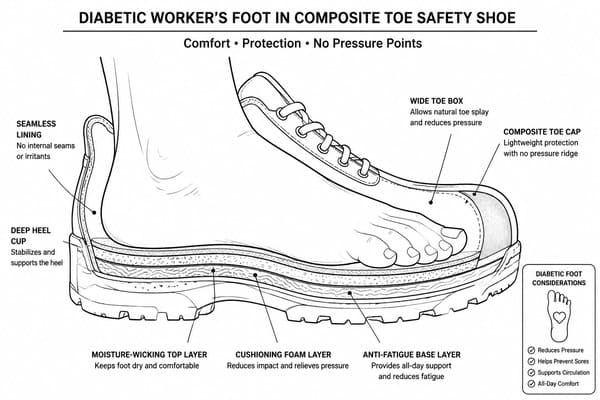
He asked me directly: "Can my workers wear steel toe shoes safely?" My honest answer was: not standard ones. Standard steel toe caps in a narrow last create a hard ridge right at the toe joint — exactly where diabetic neuropathy makes pressure most dangerous. We ended up supplying him with composite toe shoes built on a wide-fit last, with a seamless microfiber lining and a 6mm anti-fatigue insole. Zero pressure complaints in the first 6 months of use.
Why composite toe is the clinical choice for diabetic workers
This is not just a comfort question. For workers with diabetic neuropathy, reduced sensation means a pressure injury can develop before the worker feels any pain12. By the time it is noticed, the wound may already be serious. The shoe specification directly affects medical risk.
| Feature | Steel Toe (Standard) | Composite Toe (Wide Fit) |
|---|---|---|
| Cap weight | ~80–100g | ~50–65g |
| Cold transfer | Yes — worsens circulation issues | No |
| Toe box geometry | Narrow, rigid ridge | Slightly wider, more gradual curve |
| Pressure distribution | Concentrated at cap edge | More even across toe area |
| Lining seam risk | Present in most standard builds | Eliminated with seamless lining spec |
| Recommended for diabetic use | No | Yes, with correct last and insole |
Composite toe caps are about 30% lighter than steel, have no cold transfer issue, and the toe box geometry is slightly more forgiving. For diabetic workers, that difference is not cosmetic — it is clinical. If you are sourcing safety shoes for a workforce that includes diabetic employees, this needs to be part of your specification conversation before the order is placed, not after the first injury report.
What Makes Microfiber Different from Genuine Leather in Safety Shoes?
I’ll tell you what I tell every distributor who asks me this in person. I pull out two shoe samples — one microfiber upper, one genuine split leather upper, both from the same price range. I pour a small amount of water on each.
Microfiber resists moisture, offers consistent quality across batches, and requires less maintenance than leather. Genuine leather — especially full-grain — breathes better over long shifts and carries more brand equity. The right choice depends on end-use environment, buyer positioning, and budget.
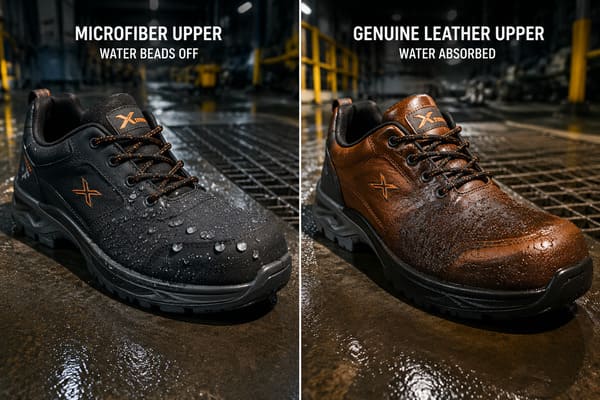
The leather darkens immediately and absorbs. The microfiber beads the water off. Then I tell them: that leather sample is what most "leather safety shoes" in the $25–$40 FOB range actually use — split leather or corrected grain, not full-grain. At that grade, leather offers no breathability advantage over mid-grade microfiber. It just feels more traditional.
Microfiber vs. leather: a direct comparison for safety shoe buyers
Full-grain leather is different. It breathes better over long shifts and develops a natural patina that some premium buyers value. But it also costs 40–60% more in raw material, requires more careful cutting to avoid hide defects, and adds 2–3 days to production. Here is how the two materials stack up across the factors that matter most to B2B buyers:
| Comparison Factor | High-Grade Microfiber | Split / Corrected Leather | Full-Grain Leather |
|---|---|---|---|
| Batch consistency | Excellent | Poor to medium | Medium |
| Moisture resistance | High | Low | Medium |
| Breathability | Medium | Medium | High |
| Maintenance required | Minimal | Regular conditioning | Regular conditioning |
| Raw material cost | Medium | Low to medium | High |
| Production complexity | Low | Medium | High |
| Brand perception | Functional | Traditional | Premium |
| Best market fit | Industrial PPE, logistics | Budget workwear | European premium workwear |
For most industrial PPE buyers — construction, manufacturing, logistics — microfiber at the right grade is the smarter specification. For buyers targeting the European premium workwear market where leather carries brand equity, full-grain still earns its place. The honest answer is that the upper material conversation should always start with: who is wearing these shoes, where, and what does the buyer’s customer actually care about?
Conclusion
Microfiber is not a compromise material. At the right grade, it outperforms leather in consistency, moisture resistance, and scalability for industrial buyers. The grade, the sole construction, and the fit specification matter far more than the material name on the product sheet. If you are sourcing safety shoes for industrial use and want a manufacturer who will give you straight answers on material specs, certifications, and construction — Shoegan builds safety footwear that protects workers and holds up to scrutiny.
Ready to spec your next order? Contact Shoegan at [email protected] or WhatsApp +8613008988018.
-
"Artificial leather – Wikipedia", https://en.wikipedia.org/wiki/Artificial_leather. A technical source on synthetic leather or microfiber nonwovens should support that microfiber shoe uppers are commonly made from very fine polyester or polyamide fibers combined with a polyurethane coating or matrix. Evidence role: definition; source type: paper. Supports: Microfiber upper material in safety shoes is a PU-coated synthetic fabric made from ultra-fine polyester or nylon fibers on a non-woven base.. Scope note: The source may describe microfiber synthetic leather generally rather than safety-shoe uppers specifically. ↩
-
"Development of Breathable Waterproof Polyurethane-Coated Cotton …", https://pmc.ncbi.nlm.nih.gov/articles/PMC12509000/. A textile or polymer-materials source should document that PU-coated microfiber or synthetic leather can provide uniform manufactured surfaces and resistance to water penetration, with durability depending on coating and substrate construction. Evidence role: general_support; source type: paper. Supports: Microfiber uppers offer consistent appearance, moisture resistance, and durability for industrial footwear.. Scope note: Such evidence supports the material properties in general and may not prove performance in every safety-footwear design. ↩
-
"Effects of skin and hide defects on quality grades and physical …", https://www.academia.edu/115549631/Effects_of_skin_and_hide_defects_on_quality_grades_and_physical_characteristics_of_crust_leather. A leather science or extension source should support that natural leather varies in grain, defects, and appearance because hides differ by animal, location on the hide, and processing batch. Evidence role: mechanism; source type: education. Supports: Genuine leather can show visible grain variation between batches of hides.. Scope note: The source would explain why batch variation occurs, not verify the specific 2,000-pair production anecdote. ↩
-
"[PDF] Case Study of Durability, Abrasion Resistance, and Colorfastness to …", https://ir.library.illinoisstate.edu/cgi/viewcontent.cgi?article=1001&context=urs2021fcs. A materials-testing source should support the relationship between PU coating thickness, substrate strength, abrasion resistance, and flex-crack resistance in coated synthetic leather used for footwear. Evidence role: mechanism; source type: paper. Supports: Thicker, higher-quality PU-coated microfiber uppers are more durable in industrial use than thin, low-grade alternatives.. Scope note: The source is likely to support the durability mechanism rather than directly verify the stated 18–24 month service-life estimate. ↩
-
"What Is PU Leather? Definition, Types, and Comparison with Real …", https://eleatherhub.com/blogs/info/what-is-pu-leather-and-how-to-identify-original-leather. A comparative textile or leather-materials source should support that coated synthetic leather surfaces generally resist water uptake and surface soiling more consistently than unfinished or split leather. Evidence role: general_support; source type: paper. Supports: High-grade PU microfiber can outperform split leather in moisture resistance, uniformity, and ease of cleaning.. Scope note: The comparison depends on the exact leather finish and microfiber grade; it does not establish superiority for all products. ↩
-
"Exploring the Mechanical and Thermal Impact of Natural Fillers on …", https://pmc.ncbi.nlm.nih.gov/articles/PMC11598618/. A polymer or footwear-materials source should support that polyurethane foams are used for cushioning in soles but that oil and chemical resistance varies by formulation and may be inferior to some rubber compounds. Evidence role: mechanism; source type: paper. Supports: Pure PU soles can provide cushioning but may be limited in oil resistance under some industrial floor conditions.. Scope note: The source would address general material behavior, not the specific petrochemical facility described in the article. ↩
-
"1910.136 – Foot protection. | Occupational Safety and Health … – OSHA", http://www.osha.gov/laws-regs/regulations/standardnumber/1910/1910.136. An occupational-safety or footwear-design source should support that outsole selection depends on workplace hazards such as contaminants, floor surface, slip risk, chemicals, and ergonomic demands. Evidence role: expert_consensus; source type: government. Supports: No single safety-shoe sole material is best for all workplaces; selection depends on the use environment.. Scope note: The source would support the principle of hazard-based selection, not rank every sole material in the article’s table. ↩
-
"Systematic Review of the Role of Footwear Constructions in … – PMC", https://pmc.ncbi.nlm.nih.gov/articles/PMC7039038/. A footwear engineering or occupational-safety source should support that midsoles and outsoles serve different functions, with softer polymer layers contributing cushioning and rubber outsoles commonly used for traction and abrasion resistance. Evidence role: mechanism; source type: research. Supports: A dual-density PU midsole and rubber outsole can combine cushioning with traction for industrial footwear.. Scope note: The source may support the functional rationale for PU-rubber dual density construction without proving it is the most widely effective combination in all industrial settings. ↩
-
"A simple guide to EN ISO 20345:2022 – Safety footwear", https://www.uvex-safety.ie/en/knowledge/safety-standards/safety-footwear/guide-to-en-iso-203452022/. A safety-footwear standard or institutional summary should explain that SRC was a slip-resistance classification under EN ISO 20345/20344 based on testing on ceramic tile with detergent and steel with glycerol. Evidence role: definition; source type: institution. Supports: SRC testing is a recognized safety-footwear slip-resistance test classification.. Scope note: The source can define SRC testing but cannot verify that the article’s client-specific footwear passed it. ↩
-
"IWGDF guidance on footwear and offloading interventions to prevent …", https://pubmed.ncbi.nlm.nih.gov/26813614/. A diabetic-foot clinical guideline should support that people with diabetic neuropathy require footwear that avoids pressure points, constriction, and internal trauma risks. Evidence role: expert_consensus; source type: institution. Supports: Workers with diabetic neuropathy may be at increased risk from standard rigid or narrow safety shoes that create pressure points.. Scope note: Clinical guidelines generally address therapeutic footwear and pressure avoidance; they may not specifically prohibit all steel-toe shoes. ↩
-
"Diabetic Foot Australia guideline on footwear for people with … – PMC", https://pmc.ncbi.nlm.nih.gov/articles/PMC5769299/. A diabetic-foot footwear guideline should support that protective footwear commonly aims to reduce pressure through adequate width, minimal internal seams, and cushioning or pressure-redistributing insoles. Evidence role: expert_consensus; source type: institution. Supports: Wide-fit construction, seamless lining, and cushioning insoles are safer design features for workers with diabetic foot-risk factors.. Scope note: The source would support these design features for pressure reduction but not necessarily the commercial term ‘anti-fatigue’. ↩
-
"Diabetic Peripheral Neuropathy – StatPearls – NCBI Bookshelf – NIH", https://www.ncbi.nlm.nih.gov/books/NBK442009/. A diabetic-foot guideline or medical review should support that peripheral neuropathy reduces protective sensation, allowing repetitive pressure or trauma to progress to ulceration before pain is perceived. Evidence role: mechanism; source type: paper. Supports: Diabetic neuropathy can allow pressure injuries to develop without the worker feeling pain.. ↩