
A customer once picked up two shoes — one full leather, one mesh — squeezed the mesh and said, "This doesn’t feel safe." I told him to step on both toe caps. He did. Then he went quiet.
Mesh panels in safety shoes do not reduce protection when placed correctly.1 The toe cap, midsole, and protective structure are independent of the upper material.2 A certified mesh safety shoe meets the same EN ISO 20345 or ASTM F2413 standards as a full leather one.3
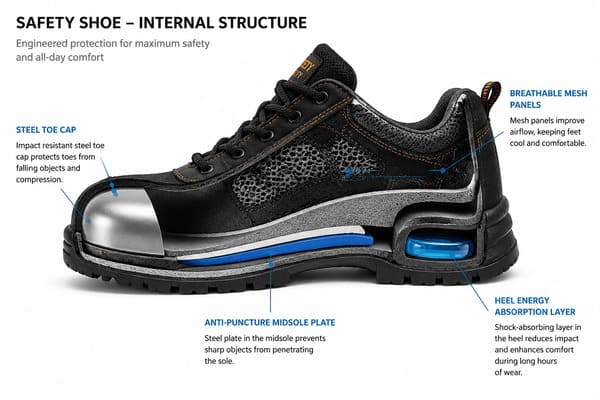
Both shoes had the same 200-joule steel toe cap4. The only difference was the upper material. That moment taught me something I now repeat to every new client: the human instinct for "protection" is based on what you can touch, but real protection comes from the structure you cannot see. We spend a lot of time showing clients certification documents and internal cross-section diagrams instead of asking them to squeeze the upper. That is the most fundamental difference between us and suppliers who sell shoes based on how solid they look.
What Are the Disadvantages of Mesh Shoes?
A buyer from the Middle East once called me to complain. His last batch of mesh safety shoes fell apart in three months. I asked where they failed. He sent photos.
The main disadvantage of mesh shoes is poor placement, not the material itself. Mesh placed directly over the toe box or heel — without reinforcement at the edges — will abrade and tear quickly5 under daily contact with sharp surfaces like shelf corners or machinery edges.
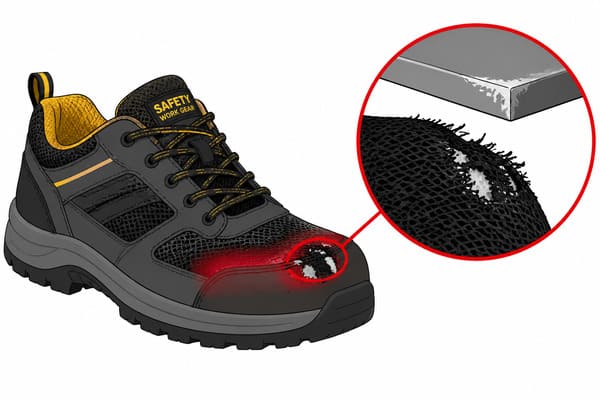
In those photos, the mesh was covering both sides of the toe box with no edge reinforcement at all. That area gets scraped against shelf edges and equipment frames every single day. The mesh wore through in weeks. It was not a material failure. It was a design failure.
Where Mesh Should and Should Not Be Placed
At Shoegan, we follow a placement rule that we have held for 15 years: the front toe zone and heel counter use leather or TPU reinforcement only. Mesh appears only on the arch sides and above the ankle. This is not a style preference. It is a structural decision.
The table below shows how we assign materials by zone:
| Shoe Zone | Recommended Material | Reason |
|---|---|---|
| Toe box front | Leather or TPU | High abrasion contact zone6 |
| Heel counter | Leather or TPU | Impact and edge contact |
| Arch sides | Mesh allowed | Low abrasion, high ventilation need |
| Ankle and above | Mesh allowed | Minimal mechanical stress |
In 15 years of production, not one client has filed a complaint about mesh tearing on our shoes. That is because mesh is placed where it belongs, not where it is cheapest to use. When a buyer tells me mesh shoes are unreliable, I do not argue. I ask to see the photos first. Nine times out of ten, the problem is placement. The other time, it is a shoe with no certification at all.
What Is an Advantage of Mesh Material in Shoes?
Most buyers think of mesh as a comfort feature. I used to think the same way. Then we ran a simple internal test that changed how I talk about mesh to every client.
The key advantage of mesh material in shoes is heat and moisture reduction inside the shoe. Mesh panels allow air to circulate7, which keeps the internal temperature and humidity lower. This directly reduces the risk of blisters, fungal infections, and foot fatigue8 during long work shifts.
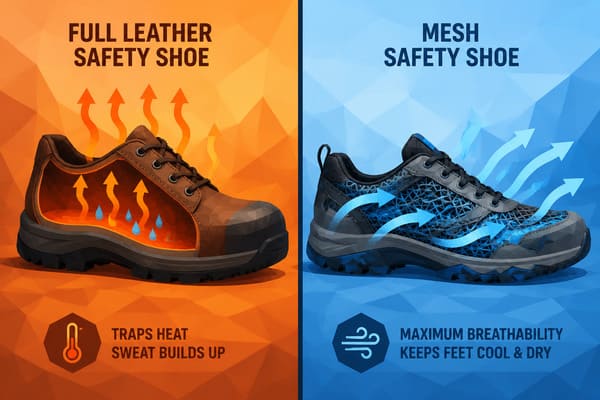
We took the same safety shoe model, built one in full leather and one with mesh panels on the arch sides. The same worker wore both versions on separate days, each for an 8-hour shift. We used temperature and humidity patches on the top of the foot to measure the difference.
What the Numbers Showed
The results were not subtle:
| Shoe Type | Internal Temperature | Internal Humidity |
|---|---|---|
| Full leather upper | Higher by ~7°C | Higher by ~30% |
| Mesh arch panels | Baseline | Baseline |
Seven degrees and thirty percent humidity sounds like a comfort difference. It is not. It is a health difference.
Why This Matters in Industrial Settings
Skin that stays warm and wet for 8 hours softens.9 Softened skin blisters faster and is more vulnerable to fungal infection.10 This is not a minor inconvenience. A worker who takes three days off due to a foot infection costs far more in lost production than the price difference between a leather shoe and a mesh one. When I present this data to industrial buyers, most of them stop thinking of mesh as a "lightweight option" and start thinking of it as a risk management tool. That is the right way to think about it.
What Is the 3 Shoe Rule?
A European industrial client once asked me why his workers went through safety shoes in 6 months, while he personally wore the same pair for two years. The answer had nothing to do with shoe quality.
The 3 shoe rule is a rotation principle from the fashion industry: owning three pairs and rotating them gives each pair time to recover its shape and dry out between uses11. Applied to industrial footwear, the same logic extends shoe lifespan significantly by allowing the midsole and lining to decompress and dry.
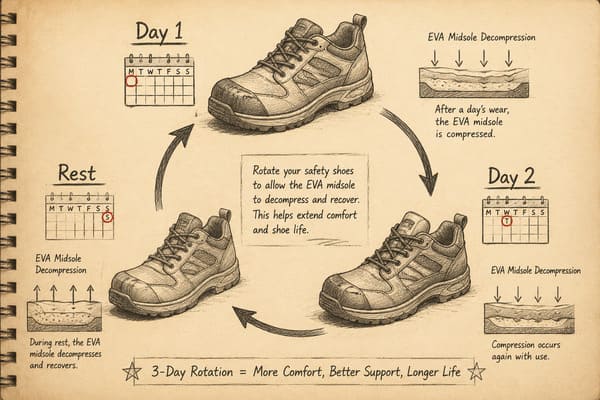
His workers wore the same pair every day. He rotated casually between several pairs. The EVA midsole in a safety shoe needs time to decompress after a full day of compression under body weight.12 When it never gets that time, it breaks down faster. The lining stays wet. Odor builds. The structure weakens from the inside.
Applying the 3 Shoe Rule to Industrial Procurement
I suggested he issue two pairs per worker and have them alternate daily. Here is what happened to his procurement cycle:
| Rotation System | Average Shoe Lifespan | Procurement Cycle |
|---|---|---|
| 1 pair per worker | ~6 months | Every 6 months |
| 2 pairs per worker (alternating) | ~10–11 months per pair | Every 10–11 months |
The total number of shoes in use stayed the same. But the procurement frequency dropped, and the cost per month went down. He did not need three pairs per worker to see the benefit. Two was enough. The principle is the same as the 3 shoe rule: rest time extends life. In industrial procurement, that is not a fashion tip. It is a cost reduction strategy. Mesh panels help here too, because better ventilation means the shoe dries faster between shifts, which makes even a single-pair rotation slightly more forgiving.
Do Mesh Panels Make Safety Shoes Less Safe?
This is the question I get most often from first-time buyers. It is also the question that reveals the most about how the market misunderstands safety shoe construction.
Mesh panels do not make safety shoes less safe. Under EN ISO 20345, the 200-joule impact test targets the toe cap, and the anti-puncture test targets the midsole. Neither test is affected by the upper material. A mesh safety shoe with full certification provides the same structural protection as a leather one.
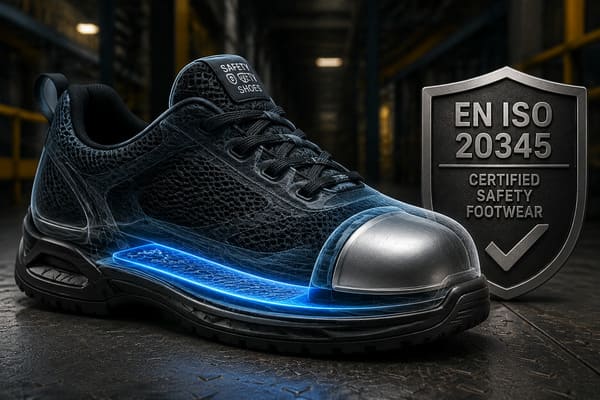
We send our mesh safety shoes to European certification bodies every production cycle. Every batch passes. Because the protective structure — the steel or composite toe cap, the anti-puncture midsole plate, the heel energy absorption layer — has never changed. Switching the upper from leather to mesh does not touch any of those components.
Where the Real Danger Comes From
The danger is not mesh. The danger is uncertified shoes sold as safety shoes.
| Product Type | Toe Cap | Certification | Real Protection |
|---|---|---|---|
| Certified mesh safety shoe | Steel or composite, 200J | EN ISO 20345 / ASTM F2413 | Full |
| Uncertified "mesh safety shoe" | None or decorative | None | None |
I have seen shoes quoted at $8 a pair. Mesh upper, lightweight, looks modern. No toe cap inside. The buyer thought it was a good deal. The worker thought it was comfortable. Nobody found out it was dangerous until someone got hurt. The correct way to evaluate a mesh safety shoe is to ask for the certification document and the internal structure diagram. Not to squeeze the upper with your hand. The upper material tells you nothing about the protection level. The certification number tells you everything. At Shoegan, every mesh safety shoe we produce carries the relevant certification for its target market — EN ISO 20345 for Europe, ASTM F2413 for North America, GSO for the Gulf region. The mesh is a ventilation feature. The protection is a non-negotiable foundation.
Conclusion
Mesh panels improve airflow and reduce foot health risks. They do not weaken protection when designed and certified correctly. The upper material is never the safety standard — the certification is. At Shoegan, every shoe is Built to Protect. Made to Last. — contact us at [email protected] or WhatsApp +8613008988018.
-
"[PDF] ASTM F2413-11 Performance Requirements for Protective Footwear", https://facilities.uw.edu/partner-resources/files/media/performance-requirements-for-protective-footwear.pdf. Safety-footwear standards evaluate protective performance through specified tests and classifications; a mesh upper does not by itself determine toe-impact or penetration resistance when the certified protective components are present. Evidence role: general_support; source type: institution. Supports: Mesh panels do not reduce safety protection when used in a properly designed and certified safety shoe.. Scope note: This supports the claim only for certified footwear and does not prove that every mesh design is durable or compliant. ↩
-
"[PDF] ASTM F2413-11 Performance Requirements for Protective Footwear", https://facilities.uw.edu/partner-resources/files/media/performance-requirements-for-protective-footwear.pdf. Standards for safety footwear specify separate performance requirements for components such as toe protection and penetration-resistant inserts, indicating that these protective elements are tested apart from the basic upper material. Evidence role: mechanism; source type: institution. Supports: Toe caps and penetration-resistant midsoles provide structural protection that is distinct from the shoe upper material.. Scope note: Safety standards may also include upper-related requirements, so the source supports component independence for toe and penetration protection rather than all possible hazards. ↩
-
"[PDF] ASTM F2413-11 Performance Requirements for Protective Footwear", https://facilities.uw.edu/partner-resources/files/media/performance-requirements-for-protective-footwear.pdf. EN ISO 20345 and ASTM F2413 define performance requirements for protective footwear rather than limiting compliance to leather uppers, so footwear with mesh uppers can meet the same standard if it passes the required tests. Evidence role: definition; source type: institution. Supports: Certified mesh safety shoes and certified leather safety shoes are evaluated under the same protective-footwear standards.. Scope note: The source would establish eligibility under the standards, not verify the certification status of any specific shoe model. ↩
-
"Understanding EN ISO 20345 – Safety Footwear (formerly EN345)", https://www.wiseworksafe.com/blog/view/understanding-en-iso-20345-safety-footwear-formerly-en345-. EN ISO 20345 defines safety footwear as including toe protection tested against a 200 J impact, which supports the stated impact rating for certified safety toe caps. Evidence role: definition; source type: institution. Supports: Certified safety footwear under EN ISO 20345 uses toe protection rated for 200-joule impact resistance.. Scope note: This supports the impact-energy rating under EN ISO 20345; ASTM F2413 uses related but differently expressed impact classifications. ↩
-
"Study on the moisture permeability of warp-knitted Jacquard shoe …", https://pmc.ncbi.nlm.nih.gov/articles/PMC11985990/. Footwear material research and testing standards treat abrasion resistance as a key performance property for uppers and reinforcements, supporting the concern that exposed textile mesh in high-contact areas may wear faster without protective overlays. Evidence role: mechanism; source type: paper. Supports: Unreinforced mesh in high-contact footwear zones is more vulnerable to abrasion and tearing.. Scope note: The source would support the abrasion mechanism generally, not the exact failure timeline described in the article. ↩
-
"Toe Box Shape of Running Shoes Affects In-Shoe Foot … – PMC", https://pmc.ncbi.nlm.nih.gov/articles/PMC11118738/. Footwear design and wear-analysis sources identify the toe region as a common high-wear area because it experiences frequent contact, flexing, and scuffing during use. Evidence role: general_support; source type: research. Supports: The front toe zone of footwear is a high-abrasion contact area.. Scope note: This supports the general classification of the toe area as high wear, not the specific material choices in the table. ↩
-
"Study on the moisture permeability of warp-knitted Jacquard shoe …", https://pmc.ncbi.nlm.nih.gov/articles/PMC11985990/. Studies of shoe microclimate and upper permeability show that more breathable upper materials increase air and moisture exchange inside footwear, which can lower heat and humidity accumulation. Evidence role: mechanism; source type: paper. Supports: Mesh panels can improve airflow and moisture exchange inside shoes.. Scope note: The source would support the ventilation mechanism generally and may not quantify the effect for the article’s specific shoe model. ↩
-
"Prevalence of Tinea pedis in military personnel: a systematic review …", https://pmc.ncbi.nlm.nih.gov/articles/PMC12462312/. Occupational and dermatological literature links prolonged heat, moisture, friction, and occlusive footwear with blister formation, fungal foot infections, and discomfort, supporting the health rationale for improved ventilation. Evidence role: expert_consensus; source type: paper. Supports: Lower heat and moisture inside footwear can reduce conditions associated with blisters, fungal infections, and fatigue.. Scope note: The evidence supports risk factors and plausibility; it does not prove that every mesh safety shoe directly reduces these outcomes in workplace trials. ↩
-
"Friction Blisters of the Feet: A Critical Assessment of Current … – PMC", https://pmc.ncbi.nlm.nih.gov/articles/PMC10783476/. Dermatology sources describe skin maceration as softening and breakdown caused by prolonged exposure to moisture, consistent with the article’s claim about warm, wet feet during long shifts. Evidence role: definition; source type: education. Supports: Prolonged moisture exposure softens skin through maceration.. Scope note: The source supports the biological process of maceration but may not specify an exact eight-hour threshold. ↩
-
"Friction Blisters of the Feet: A Critical Assessment of Current … – PMC", https://pmc.ncbi.nlm.nih.gov/articles/PMC10783476/. Medical literature identifies moisture-softened skin as more susceptible to friction injury and notes that warm, moist environments favor dermatophyte infections such as tinea pedis. Evidence role: mechanism; source type: paper. Supports: Macerated or moisture-softened foot skin is more prone to blisters and fungal infection.. Scope note: The source would support increased susceptibility in general, not predict the exact likelihood of blisters or infection for a specific worker. ↩
-
"TIP OF THE DAY: Shoes soak up sweat on hot days. Having more …", https://www.facebook.com/higdonmarathon/posts/tip-of-the-day-shoes-soak-up-sweat-on-hot-days-having-more-than-one-pair-allows-/1491960952296784/. Footwear hygiene and material-performance sources note that drying time reduces retained moisture and that foam and leather components can recover after loading, providing contextual support for rotating pairs between uses. Evidence role: general_support; source type: education. Supports: Rotating shoes can allow materials to dry and recover between wears.. Scope note: This supports the drying and recovery rationale, but the specific “three pairs” rule is a consumer convention rather than a formally standardized requirement. ↩
-
"Nanocomposite Foams with Balanced Mechanical Properties and …", https://pmc.ncbi.nlm.nih.gov/articles/PMC9968182/. Research on ethylene-vinyl acetate footwear foams documents compression, compression set, and recovery behavior under repeated loading, supporting the claim that EVA cushioning benefits from recovery time after use. Evidence role: mechanism; source type: paper. Supports: EVA midsoles compress under body weight and require recovery time after repeated loading.. Scope note: The evidence supports EVA foam recovery behavior generally and may not establish an optimal rest interval for industrial safety shoes. ↩