
Water keeps getting into your workers’ shoes, and you don’t know why. You ordered "waterproof" shoes, but they still fail. The problem might not be the shoes.
A water-resistant upper has a surface coating (usually DWR) that repels light water contact for a short time.1 A waterproof upper has a membrane layer inside the shoe (such as Gore-Tex or a TPU laminate) that blocks water from reaching the foot2, regardless of how wet the outer material gets.
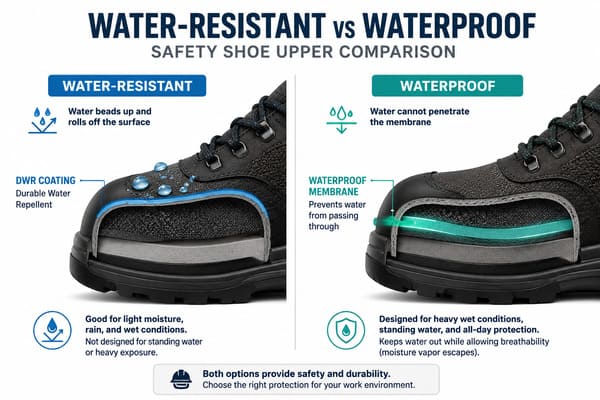
I have been in this industry for over 20 years. I have seen buyers mix up these two terms more times than I can count. One case stays with me. A buyer from the Netherlands ordered a batch of safety shoes with water-resistant leather uppers. His workers used them in a fish processing facility. Three months later, he came back with complaints. The shoes were letting in water. The shoes were not defective. They met every specification on his purchase order. The problem was that he had confused two very different things. That conversation is why I want to break this down clearly, from a manufacturer’s point of view.
Which Is Better, Water-Resistant or Waterproof?
You keep asking which one is better, but that is the wrong question. The wrong choice here means your workers end up with wet feet and you end up reordering in six months.
There is no universal answer. The right choice depends entirely on the work environment. Water-resistant is lighter, more breathable, and costs 20–30% less.3 Waterproof is essential when workers stand in wet conditions for extended periods. Choosing based on label alone, without considering the environment, leads to product failure.
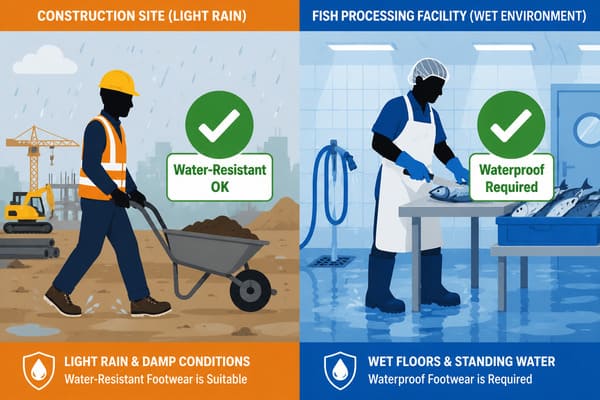
My answer to every buyer who asks this question is always the same: tell me where your workers stand, and for how long.
If your workers are on an outdoor construction site and occasionally get caught in rain, water-resistant is enough. It is lighter, it breathes better, and it costs less. There is no reason to pay for a membrane you do not need.
If your workers are in food processing, wastewater treatment, fisheries, or on wet concrete floors all day, waterproof is not optional. There is no compromise.
But here is something I always tell buyers before they place a waterproof order, because most suppliers will not say this upfront.
The Breathability Trade-Off You Need to Know
A waterproof membrane blocks water from getting in. It also limits moisture from getting out.4 We have tested this internally. The table below shows what we found when comparing the same shoe model with and without a TPU waterproof lining, after four hours of continuous wear.
| Condition | Average Internal Shoe Temperature | Moisture Build-Up |
|---|---|---|
| Without waterproof membrane | Baseline | Low |
| With TPU membrane only | +3–5°C above baseline | High |
| With TPU membrane + moisture-wicking lining | +1–2°C above baseline | Moderate |
The numbers show a real problem. A waterproof shoe without a moisture-wicking inner lining will make your workers’ feet sweat more.5 They end up wet from the inside instead of the outside. This is why every waterproof model we produce pairs the membrane with a moisture-wicking inner lining. Both are required. One without the other is an incomplete solution.
Can I Wear Water-Resistant Shoes in the Rain?
Yes, but most buyers do not understand how limited that protection actually is. If you send workers into a wet environment without knowing the failure conditions, you will be disappointed.
A new pair of DWR-treated leather shoes can resist moderate rain for roughly 20–30 minutes before water begins to penetrate.6 However, the coating degrades over time and fails faster at specific stress points. Water-resistant shoes are not designed for prolonged or repeated wet exposure.
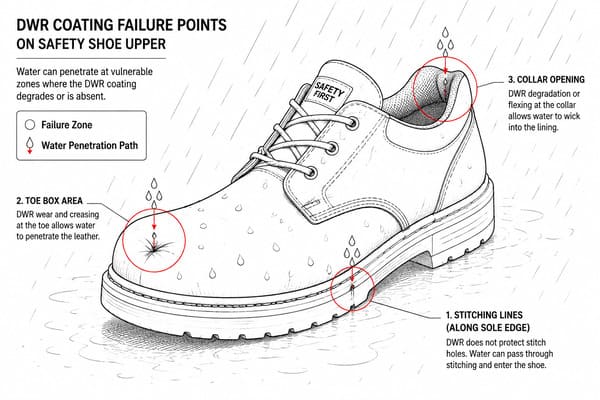
The surface of the shoe is rarely where failure starts. Three areas fail before the main upper does.
Where Water-Resistant Shoes Fail First
| Failure Point | Reason | Time to Failure |
|---|---|---|
| Stitching lines | Needle holes are direct water entry points | Among the first to fail in stitched constructions |
| Toe box and collar | Flexing during walking cracks the coating fastest here | Faster than flat areas of the upper |
| Overall coating life | DWR degrades with regular use and washing7 | Noticeable decline after 6–12 months of normal use |
Most buyers are not aware of the coating lifespan. After 6 to 12 months of regular use, DWR performance drops significantly.8 The shoe looks the same. The leather may still feel smooth. But the protection is largely gone.
For B2B buyers, this has a direct cost implication. If your workers face wet conditions every day, choosing water-resistant means you are likely replacing the shoes or reordering within six months. The lower unit price does not always mean lower total cost over time.
What Does WD-40 Do to Leather Boots?
This search term gets a lot of traffic, and I understand why workers reach for it. But from where I sit as a manufacturer, this question is usually a signal of a bigger problem.
WD-40 is a petroleum-based product.9 It can temporarily soften leather and displace moisture10, giving the surface a short-term water-repelling effect. However, it accelerates stitching degradation over time, leaves an oily residue that attracts dirt, and its water-repelling effect typically lasts only one to two wears.
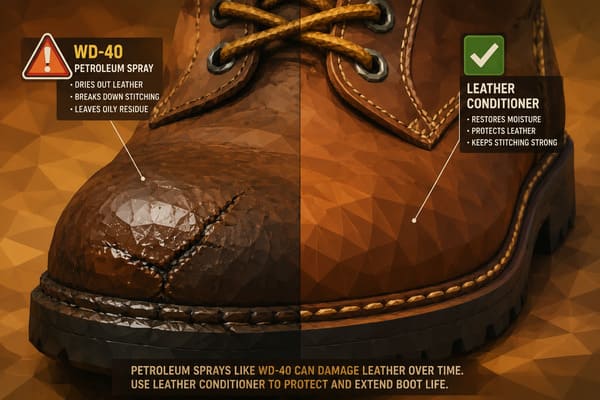
WD-40 is not a leather care product. It was not designed for this use. The short-term results look convincing, which is why it keeps circulating among workers. But the long-term effects work against the shoe.
What WD-40 Does vs. What Leather Actually Needs
| Factor | WD-40 | Proper Leather Conditioner |
|---|---|---|
| Water repellency | Short-term (1–2 wears) | Longer-lasting with regular reapplication |
| Effect on stitching | Accelerates degradation | Neutral or protective |
| Surface residue | Oily, attracts dust and debris | Clean finish |
| Leather fiber health | Dries out over time | Conditions and preserves |
| Recommended use | Not designed for leather | Specifically formulated for leather |
Here is the more important point. When a buyer starts asking about leather boot maintenance, it usually means their workers are dealing with genuinely wet conditions on a daily basis. In that situation, my honest recommendation is not to find a better leather care product. It is to have a conversation about whether the shoe construction itself needs to change. Maintenance is a patch. A waterproof membrane construction is the actual solution.
What Makes a Safety Shoe Upper Truly Waterproof?
The word "waterproof" is one of the most overused labels in this industry. I see it on products that would not pass a basic submersion test. As a manufacturer, I want to explain what genuine waterproof construction actually requires.
A truly waterproof safety shoe upper requires four things working together: a certified membrane layer, a properly constructed bootie or laminate, sealed seams at all stress points, and a fully bonded outsole junction. Any one of these missing, and the shoe is not waterproof, regardless of what the label says.
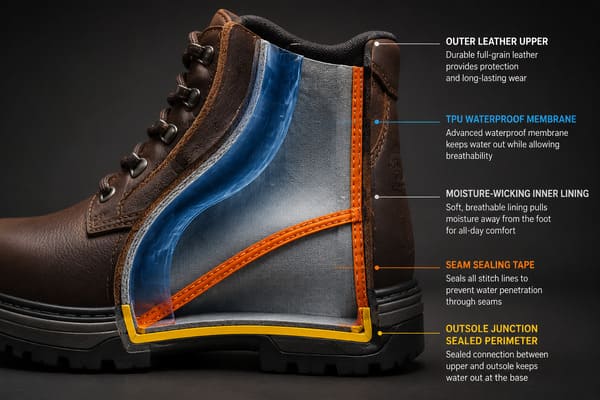
I break our waterproof construction down into four levels. Each one matters.
The Four Layers of Real Waterproof Construction
Layer 1: The Membrane
Gore-Tex is the industry benchmark. Its MVTR (moisture vapor transmission rate) reaches above 10,000 grams per square meter per 24 hours. We also use our own TPU laminate membranes, which cost 30–40% less than Gore-Tex and match its waterproof performance. The breathability numbers are slightly lower, but for many environments, that difference is not significant. Which membrane we recommend depends on the buyer’s working temperature range and budget.
Layer 2: Bootie Construction vs. Direct Laminate
A bootie construction wraps the membrane into a separate inner sock that is assembled inside the shoe. This method gives more reliable sealing and is what we specify for heavy wet environments. Direct lamination bonds the membrane to the upper material itself. It produces a thinner, lighter result, but seam handling is more technically demanding. We produce both. For buyers whose workers stand in water for hours at a time, we recommend bootie construction without hesitation.
Layer 3: Seam Sealing
This is the step that separates a real waterproof shoe from a shoe that just has a membrane. Needle holes in the stitching are water entry points.11 Without seam sealing tape applied by heat press at the tongue base and upper seams, water gets through the seams even if the membrane itself is intact. This step adds roughly 5–8% to production cost. It is also the step that determines whether the shoe actually performs as waterproof in the field.
Layer 4: The Outsole Junction
The bond between the upper and the outsole is the most overlooked failure point in waterproof footwear. In standard cement construction, incomplete adhesion at the perimeter allows water to wick in from the edge. On all our waterproof models, we use a full-perimeter hot-melt injection process to seal this junction. We do not use traditional stitched edge finishing on these models. This step closes the last gap in the waterproof structure.
Conclusion
The difference between waterproof and water-resistant is not about materials. It is about construction. Knowing this before you order protects your workers and your budget. At Shoegan, every waterproof safety shoe is built with all four construction layers, certified to EN ISO 20345 and ASTM F2413 standards, and ready for OEM customization from 500 pairs.
-
"Let it rain! New coatings make natural fabrics waterproof | MIT News", https://news.mit.edu/2018/coatings-make-natural-fabrics-waterproof-0629. A textile-science source defining durable water-repellent finishes supports that DWR treatments reduce surface wetting but do not by themselves make a material waterproof. Evidence role: definition; source type: education. Supports: Water-resistant uppers commonly rely on surface DWR-type coatings that repel limited water contact rather than fully block water ingress.. Scope note: This supports the coating mechanism generally; it does not verify performance for every shoe upper material or construction. ↩
-
"(PDF) Waterproof Process in Footwear Industry – Academia.edu", https://www.academia.edu/81288951/Waterproof_Process_in_Footwear_Industry. A materials or footwear-testing reference on waterproof breathable membranes supports that laminated polymer membranes can resist liquid-water penetration while being incorporated as inner layers in footwear. Evidence role: mechanism; source type: research. Supports: Waterproof footwear uppers commonly use internal membrane or laminate layers to prevent liquid water from reaching the foot.. Scope note: The source would establish the membrane principle, not that any specific finished shoe remains waterproof without proper seam and sole construction. ↩
-
"Review of Waterproof Breathable Membranes: Preparation … – PMC", https://pmc.ncbi.nlm.nih.gov/articles/PMC10419557/. A footwear or protective-clothing materials source comparing waterproof membrane constructions with non-membrane uppers can support the general trade-off in added material layers, breathability, and cost implications. Evidence role: general_support; source type: paper. Supports: Water-resistant footwear is generally lighter and more breathable than waterproof membrane footwear, and may be less expensive to manufacture.. Scope note: The specific 20–30% cost differential is likely manufacturer- and order-dependent; a neutral source may only support the direction of the trade-off rather than this exact percentage. ↩
-
"Review of Waterproof Breathable Membranes: Preparation … – PMC", https://pmc.ncbi.nlm.nih.gov/articles/PMC10419557/. Research on waterproof-breathable fabrics supports that membranes resist liquid-water penetration while moisture-vapor transport is constrained by membrane properties and garment or footwear construction. Evidence role: mechanism; source type: paper. Supports: Waterproof membranes block liquid water ingress but can reduce moisture escape compared with non-membrane constructions.. Scope note: The exact degree of vapor restriction varies by membrane chemistry, thickness, lining, temperature, and humidity gradient. ↩
-
"Influence of shoe upper structure on shoe microclimate and human …", https://pmc.ncbi.nlm.nih.gov/articles/PMC11191507/. Footwear comfort research on microclimate, sweat accumulation, and moisture-management linings supports that reduced vapor transport and poor moisture management increase perceived wetness inside shoes. Evidence role: mechanism; source type: paper. Supports: Waterproof footwear without effective moisture-management lining can increase internal moisture accumulation and perceived foot wetness.. Scope note: The source may support moisture accumulation and thermal discomfort rather than directly measuring sweat production in this exact safety-shoe configuration. ↩
-
"Should You Waterproof Gore-Tex Boots? – SectionHiker.com", https://sectionhiker.com/should-you-waterproof-gore-tex-boots-2/. A footwear or leather-testing source using water-penetration tests can contextualize how treated leather resists water for limited exposure durations before wetting through. Evidence role: statistic; source type: paper. Supports: DWR-treated leather footwear provides limited-duration resistance to rain before water penetration can occur.. Scope note: The exact 20–30 minute figure is highly dependent on leather type, coating chemistry, shoe construction, rainfall intensity, and wear condition; independent evidence may only provide comparable test ranges. ↩
-
"[PDF] Durability of Water-Repellent Finishes to Accelerated Laundering", https://digitalcommons.uri.edu/cgi/viewcontent.cgi?article=1788&context=theses. Textile research on durable water-repellent finishes supports that abrasion, laundering, and use reduce repellency by altering or removing the low-surface-energy finish. Evidence role: mechanism; source type: paper. Supports: DWR performance declines with use and washing.. Scope note: The degradation rate for footwear may differ from apparel fabrics because shoes experience different abrasion, flexing, and contamination patterns. ↩
-
"DWR is no longer “durable.” Time to rename it NDRW? – Reddit", https://www.reddit.com/r/Ultralight/comments/1l7rsmv/dwr_is_no_longer_durable_time_to_rename_it_ndrw/. A study or technical report on DWR durability after repeated wear, abrasion, or laundering can support the general finding that water repellency declines over time in use. Evidence role: statistic; source type: paper. Supports: DWR-treated footwear or materials can show substantial loss of water repellency after months of regular use.. Scope note: The 6–12 month timeframe is context-specific and may not be directly established unless the source studies footwear under comparable use conditions. ↩
-
"WD-40 AEROSOL – LUBRICATING OIL, GENERAL – UMD", https://www2.atmos.umd.edu/~russ/MSDS/wd40.htm. A safety data sheet or chemical database for WD-40 supports that the product contains petroleum-derived hydrocarbon distillates. Evidence role: definition; source type: other. Supports: WD-40 is petroleum-based or contains petroleum-derived distillates.. Scope note: The composition source identifies ingredients; it does not by itself establish effects on leather or stitching durability. ↩
-
"[PDF] MATERIAL SAFETY DATA SHEET Hess 5W30 Motor Oil", https://www.conncoll.edu/media/website-media/offices/ehs/envhealthdocs/5W30_Motor_Oil.pdf. Leather-conservation or materials guidance on oils and petroleum distillates can support that such substances may alter leather feel and moisture behavior while being unsuitable for long-term leather preservation. Evidence role: mechanism; source type: education. Supports: Petroleum-based oils or distillates may temporarily soften leather and displace moisture but are not appropriate long-term leather treatments.. Scope note: This would be contextual evidence about petroleum distillates or oils on leather, not necessarily a controlled study of WD-40 on safety boots. ↩
-
"(PDF) A STUDY OF WATERPROOF SEAMS – Academia.edu", https://www.academia.edu/124375232/A_STUDY_OF_WATERPROOF_SEAMS. Footwear or textile waterproofing references on seam sealing support that stitched seams create perforations that can permit water ingress unless sealed or taped. Evidence role: mechanism; source type: research. Supports: Stitching holes can provide paths for water entry in footwear uppers unless seams are sealed.. Scope note: The severity of leakage depends on thread type, seam design, membranes, sealants, and hydrostatic pressure. ↩