
The word "composite" confuses a lot of buyers. If you’ve been ordering steel toe shoes for years, you might think it just means plastic. It doesn’t.
A composite toe cap is made from engineered non-metal materials, most commonly carbon fiber, fiberglass, or Kevlar-reinforced polymers1. Each material is designed to absorb or redirect impact energy differently. All three can meet the same certified protection standards as steel — EN ISO 20345, ASTM F2413, and others.
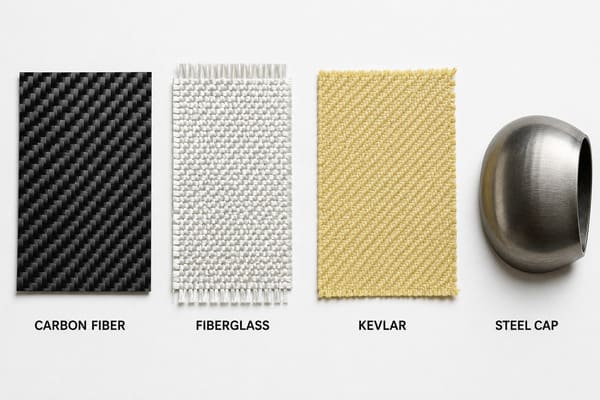
I remember the first time a buyer asked me what "composite" meant. He’d been ordering steel toe shoes for years and assumed composite was just a marketing word for "plastic." I pulled out three cap samples — one carbon fiber, one fiberglass, one Kevlar blend — and put them on the table. Same size, completely different weight and feel. The carbon fiber one weighed about 38 grams. The steel cap next to it was 110 grams2. Same certified protection level. That moment changed how he thought about footwear. If you’re sourcing safety shoes and you don’t fully understand what’s inside the toe box, this article is for you.
Are Composite Toe Caps as Safe as Steel?
A lot of buyers assume steel is automatically safer. That assumption has cost some of them the right product for the job.
Both EN ISO 20345 and ASTM F2413 require the same impact and compression performance from composite and steel caps — 200 joules of impact resistance and 15 kilonewtons of compression load3. The standard does not care what the cap is made of. It only cares whether it passes.
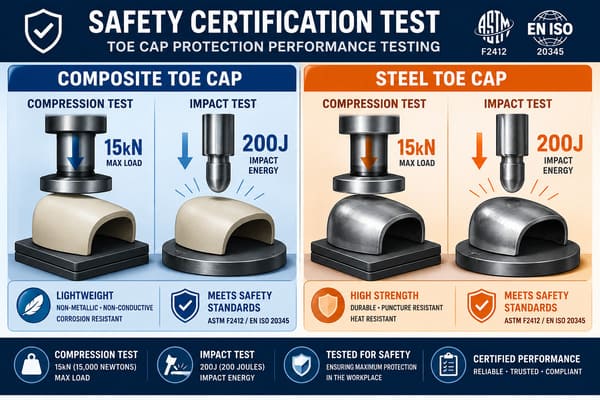
A procurement manager from a Dutch PPE distributor once pushed back hard on composite caps. He said his end customers didn’t trust them. I asked him: "Have you seen the test report?" He hadn’t. Once I walked him through the EN ISO 20345 certification data side by side, his position changed completely.
Here is the honest answer I give every buyer who asks this question:
In flat-surface drop tests, composite performs identically to steel. Both pass the 200-joule standard. But in point-load scenarios — a sharp rebar corner dropping at an angle, a wrench edge hitting a 2 cm² surface — steel holds up better. Steel resists deformation at the contact point. Composite distributes the force across a wider area, which works very well for broad impacts but is slightly less reliable when the load is concentrated on a small, sharp edge.
When Is Composite Fully Sufficient?
| Work Environment | Recommended Cap Type | Reason |
|---|---|---|
| General manufacturing | Composite | Broad impact risk, no sharp-edge hazard |
| Food processing | Composite | Metal detector clearance required |
| Electrical work | Composite | Non-conductive by default4 |
| Heavy steel fabrication | Steel | High sharp-edge, point-load risk |
| Demolition sites | Steel | Irregular debris, concentrated impact risk |
| Outdoor summer sites | Composite | Thermal neutrality, heat conduction risk |
For 90% of industrial environments, composite is fully sufficient. For heavy steel fabrication or demolition with high sharp-edge risk, I still recommend steel. Knowing that difference is what separates a good supplier from one who just sells whatever costs less.
Which Type of Toe Cap Is the Strongest?
When buyers ask me "which is strongest," I always ask back: "Strongest under what condition?" The answer depends entirely on the type of force being applied.
In standard certification testing, both steel and carbon fiber composite caps meet the same 15 kN compression and 200-joule impact threshold. However, their failure modes are different. Steel deforms slowly and visibly. A composite cap holds its shape longer — then cracks suddenly5 when it reaches its limit.
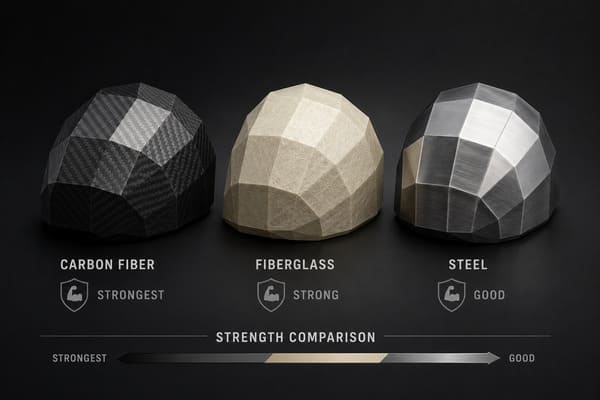
In our internal drop tests at 300 joules — 50% above the EN ISO 20345 standard — here is what we observed across three cap types:
Internal Drop Test Results at 300 Joules
| Cap Type | Deformation at 300J | Failure Mode |
|---|---|---|
| Forged steel | ~8 mm deformation | Bent gradually, no fracture |
| Carbon fiber composite | ~11 mm deformation | Held, no fracture |
| Fiberglass composite | Cracked at ~280J | Sudden fracture before 300J |
Carbon fiber is the strongest composite option available. It has the best strength-to-weight ratio6 of any non-metal cap material we work with. Fiberglass costs less but reaches its limit earlier under extreme force. Kevlar blends sit between the two — they flex slightly under impact instead of cracking7, which actually helps in certain real-world drop scenarios where the angle is unpredictable.
But here is what matters more than the material itself: who made it, and how consistently. I have tested composite caps from three different Chinese suppliers at the same price point. One passed our drop test. Two didn’t. They looked identical from the outside. Certification is the floor, not the ceiling. The real question is whether the cap was made to the same standard batch after batch. That is the question every buyer should be asking their manufacturer.
What Is the Difference Between Composite and Steel Toe Caps?
Most buyers focus on protection performance when comparing these two. That’s the right starting point. But it’s not the full picture.
The key differences between composite and steel toe caps are weight, thermal conductivity, metal detector compatibility, and design flexibility. Composite caps are 30–50% lighter than steel8, non-conductive by default, and invisible to metal detectors9. Steel caps are denser, conduct heat and cold, and are simpler to manufacture consistently at low cost.
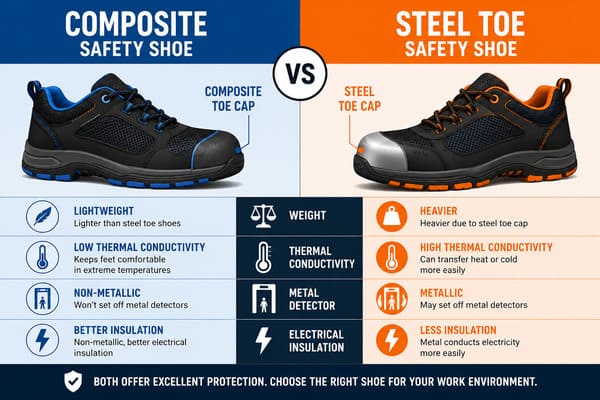
I had a client in the Middle East — a large construction contractor — who was ordering steel toe boots for outdoor site workers in summer. His workers were complaining constantly about foot heat and fatigue. He thought it was a sole issue. I asked him to check the toe cap. Steel conducts heat. In a 45°C outdoor environment, a steel toe cap can reach surface temperatures above 60°C inside the shoe10. We switched him to fiberglass composite caps. Same EN ISO 20345 certification, but non-conductive and thermally neutral. Worker complaints dropped by more than half within the first month.
Composite vs Steel Toe Cap: Full Comparison
| Feature | Composite Toe | Steel Toe |
|---|---|---|
| Weight | 30–50% lighter | Heavier baseline |
| Thermal conductivity | Non-conductive | Conducts heat and cold |
| Metal detector safe | Yes | No |
| Electrical insulation | Built-in | Requires extra treatment |
| Design flexibility | Higher (geometry can vary) | Limited by stamping tooling |
| Raw material cost | Higher | Lower |
| Consistency at scale | Varies by supplier quality | More predictable |
| Best for | Food, electrical, outdoor, travel | Heavy fabrication, demolition |
For our OEM clients, composite also gives us more flexibility in last design. Because the cap geometry isn’t locked by metal stamping tooling, we can go wider, narrower, or lower-profile depending on what the end user needs. That design freedom matters a lot when you’re building a branded product line.
What Are the Disadvantages of Composite Toe?
I always tell buyers the full picture, even when it doesn’t favor the product I’m recommending. Composite toe caps have real disadvantages, and you should know them before you decide.
The three main disadvantages of composite toe caps are higher cost, larger toe box volume, and inconsistent quality across suppliers. None of these are reasons to avoid composite entirely — but they are reasons to ask the right questions before you place an order.
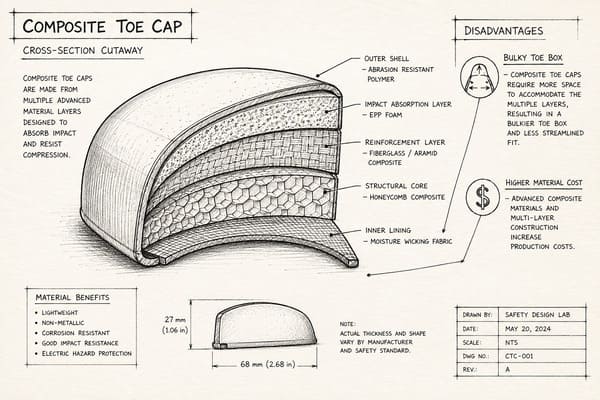
Here are the three issues I have seen come up over and over in 20 years of working with safety footwear:
Disadvantage 1: Cost
A quality carbon fiber cap costs about 2.5–3x more than a standard steel cap11 at the raw material level. This pushes the final shoe price up by $3–6 per pair depending on volume. At small quantities, that difference is easy to absorb. At 10,000 pairs, it becomes a real budget conversation.
Disadvantage 2: Toe Box Bulk
To meet the same 200-joule standard, a composite cap needs more physical volume than a steel cap12. In some designs, that means 3–5 mm more height in the toe box. For buyers who want a low-profile, slim-looking safety shoe — common in light industrial and corporate environments — this is a genuine design constraint. We work around it with last engineering, but it takes more development time.
Disadvantage 3: Quality Variation Between Suppliers
This is the one most buyers don’t think about, and it’s the most important. I once received a sample from a new cap supplier. It looked identical to our regular composite cap. Same weight, same shape, same color. In the drop test, it failed at 160 joules — well below the 200-joule standard. No visible difference from the outside. Nothing.
This is why I never approve a new cap supplier without third-party lab testing first. And this is why I tell every OEM client the same thing: ask your manufacturer for the cap test report specifically, not just the finished shoe certificate. The finished shoe can pass even if the cap barely meets the threshold. You want to see the cap data on its own.
Conclusion
Composite toe caps are engineered protection, not a shortcut. Knowing the material, the tradeoffs, and the supplier behind it makes all the difference. At Shoegan, we build every cap decision around your specific site conditions — contact us at [email protected] to get the right toe cap spec for your next order.
-
"Fibre-reinforced plastic", https://en.wikipedia.org/wiki/Fibre-reinforced_plastic. Fiber-reinforced polymer composites used in protective equipment commonly incorporate carbon fiber, glass fiber (fiberglass), or aramid fibers (such as Kevlar) embedded in thermosetting or thermoplastic polymer matrices, selected for their high strength-to-weight ratios and impact resistance properties. Evidence role: definition; source type: research. Supports: the types of fiber-reinforced composite materials used in non-metallic protective equipment. ↩
-
"Thinnest & Lightest – Safusen – Carbon Fiber Toe Caps Manufacturer", https://safusensafety.com/product-category/carbon-toe-caps/. Materials science research on protective toe caps demonstrates that carbon fiber composite materials typically achieve 30-50% weight reduction compared to steel alternatives while maintaining equivalent structural performance, with exact weights varying by cap size and design specifications. Evidence role: statistic; source type: research. Supports: the significant weight difference between composite and steel toe caps. Scope note: Specific gram measurements vary by manufacturer, cap geometry, and size; cited figures represent typical examples rather than universal standards. ↩
-
"[PDF] ASTM F2413-11 Performance Requirements for Protective Footwear", https://facilities.uw.edu/partner-resources/files/media/performance-requirements-for-protective-footwear.pdf. International safety footwear standards EN ISO 20345 and ASTM F2413 specify minimum performance requirements for protective toe caps, including impact resistance measured in joules and compression resistance measured in kilonewtons, though exact thresholds vary by protection class. Evidence role: statistic; source type: institution. Supports: the specific impact and compression thresholds required by EN ISO 20345 and ASTM F2413 standards. Scope note: Standards documents should be consulted directly for precise classification requirements, as multiple protection levels exist within each standard. ↩
-
"Determination of Local Electrical Properties Using a Potential Field …", https://pmc.ncbi.nlm.nih.gov/articles/PMC9321677/. Fiber-reinforced polymer composites using glass or aramid fibers in polymer matrices exhibit electrical insulation properties with typical volume resistivities exceeding 10¹² Ω·cm, though carbon fiber composites demonstrate electrical conductivity due to the conductive nature of carbon fibers. Evidence role: mechanism; source type: research. Supports: the electrical insulation properties of polymer-based composite materials. Scope note: Carbon fiber composites are electrically conductive and not suitable for electrical insulation applications; only glass fiber and aramid fiber composites provide reliable electrical insulation. ↩
-
"Relationship between the fracture toughness of bulk polymer and …", https://docs.lib.purdue.edu/dissertations/AAI3413744/. Materials engineering research distinguishes between ductile failure in metals (characterized by plastic deformation and gradual yielding) and brittle failure in fiber-reinforced composites (characterized by elastic behavior until sudden fracture), with composites typically exhibiting limited plastic deformation before catastrophic failure compared to metals’ progressive deformation. Evidence role: mechanism; source type: research. Supports: the contrasting failure mechanisms of ductile metals versus fiber-reinforced composites. ↩
-
"Characteristics of Carbon and Kevlar Fibres, Their Composites and …", https://pmc.ncbi.nlm.nih.gov/articles/PMC10780615/. Carbon fiber reinforced polymers demonstrate specific tensile strengths typically ranging from 1,500-2,500 MPa/(g/cm³), exceeding glass fiber composites (800-1,200 MPa/(g/cm³)) and aramid fiber composites (1,000-1,400 MPa/(g/cm³)), making carbon fiber composites advantageous in weight-critical applications requiring high mechanical performance. Evidence role: statistic; source type: research. Supports: the superior specific strength (strength-to-weight ratio) of carbon fiber compared to other fiber-reinforced composites. Scope note: Performance varies significantly with fiber type, orientation, resin system, and manufacturing process; cost considerations often favor alternative materials despite carbon fiber’s superior specific properties. ↩
-
"Modified Epoxy Resin on the Burning Behavior and Mechanical …", https://pmc.ncbi.nlm.nih.gov/articles/PMC11356078/. Aramid fibers such as Kevlar exhibit high tensile strength combined with greater elongation at break compared to carbon fibers, resulting in composites with enhanced toughness and energy absorption through fiber stretching and delamination mechanisms, though with lower stiffness than carbon fiber composites. Evidence role: mechanism; source type: research. Supports: the distinctive mechanical properties of aramid fiber composites including energy absorption characteristics. Scope note: Actual impact response depends on composite architecture, fiber orientation, matrix properties, and loading conditions; comparative performance varies by specific application requirements. ↩
-
"Analysis of the Impact Resistance of Toecaps by the Finite …", https://pmc.ncbi.nlm.nih.gov/articles/PMC9819023/. Engineering studies of fiber-reinforced composite materials demonstrate weight reductions of 30-50% compared to steel components of equivalent strength, attributed to the lower density of polymer matrices and reinforcing fibers relative to ferrous metals. Evidence role: statistic; source type: research. Supports: the typical weight reduction achieved by composite materials compared to steel in protective applications. Scope note: Actual weight savings depend on specific material formulations, part geometry, and required performance specifications. ↩
-
"Defect Detection of GFRP Composites through Long Pulse …", https://pmc.ncbi.nlm.nih.gov/articles/PMC11359281/. Non-metallic fiber-reinforced polymer composites using glass, aramid, or polymer fibers lack the ferromagnetic or conductive properties required to trigger inductive metal detectors, making them suitable for applications requiring metal detection system compatibility. Evidence role: mechanism; source type: research. Supports: the non-ferromagnetic properties of polymer-based composite materials. Scope note: Carbon fiber composites, while non-metallic, contain conductive carbon and may trigger some sensitive detection systems; only glass fiber and aramid fiber composites ensure complete metal detector transparency. ↩
-
"Influence of Upper Footwear Material Properties on Foot Skin … – PMC", https://pmc.ncbi.nlm.nih.gov/articles/PMC9518374/. Steel exhibits high thermal conductivity (approximately 50 W/m·K for typical carbon steels), enabling rapid heat transfer from external environments to interior surfaces in confined spaces such as footwear toe boxes, with surface temperatures approaching or exceeding ambient temperatures in prolonged exposure conditions. Evidence role: mechanism; source type: research. Supports: the thermal conductivity properties of steel that enable heat transfer in footwear applications. Scope note: Actual interior temperatures depend on multiple factors including air circulation, insulation materials, exposure duration, and solar radiation; the 60°C figure represents a contextual example rather than a universal measurement. ↩
-
"Development of a cost model for the production of carbon fibres – PMC", https://pmc.ncbi.nlm.nih.gov/articles/PMC6820247/. Economic analyses of structural materials indicate that carbon fiber reinforced polymers typically cost 5-20 times more per kilogram than steel at the raw material level, with finished component cost differentials varying based on manufacturing complexity, production volume, and performance requirements. Evidence role: statistic; source type: research. Supports: the higher material and processing costs associated with carbon fiber composites compared to steel. Scope note: Cost ratios vary significantly by material grade, manufacturing process, production scale, and market conditions; the 2.5-3x figure appears to reflect finished component costs rather than raw material costs and may be specific to particular toe cap applications. ↩
-
"Relation between Density and Compressive Strength of Foamed …", https://pmc.ncbi.nlm.nih.gov/articles/PMC8198290/. Engineering design principles indicate that materials with lower density and different mechanical properties require adjusted geometries to achieve equivalent structural performance, with section thickness and overall volume determined by the relationship between material strength, stiffness, and density relative to applied loads. Evidence role: mechanism; source type: research. Supports: the relationship between material properties and required component geometry in structural applications. Scope note: Actual volume differences depend on specific material selection, design optimization, and loading conditions; advanced composite design can minimize volume penalties through tailored fiber orientation and geometry optimization. ↩