
I have been making safety shoes for over 15 years. Early on, a client from the Middle East ordered 3,000 pairs. Three months later, he came back to complain — not about the toe cap bonding, not about impact protection. Workers were coming home with sore feet after a single shift. We pulled apart an old pair and found a flat EVA insole inside, hard as cardboard. That was the moment I started taking insoles seriously. Memory foam changes one simple thing: the shoe adapts to the foot, not the other way around.
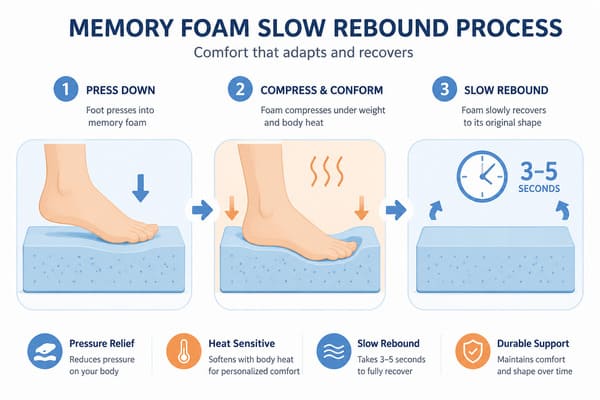
A memory foam insole is made from viscoelastic polyurethane foam. It softens under body heat and compresses slowly under body weight, then returns to its original shape over 3 to 5 seconds1. This slow response lets the foam mold to the exact shape of the wearer’s foot, reducing pressure points and distributing load more evenly across the sole.

Most buyers focus on the toe cap, the outsole, and the certification label. The insole gets skipped. But the insole is what the foot actually touches for 8 to 10 hours a day. Getting it wrong means worker fatigue, complaints, and returns. Getting it right means the shoe performs the way it was designed to.
How Does Memory Foam Work Inside a Safety Shoe?
Workers who switch from a standard insole to memory foam often say the first day feels strange. The shoe feels "too soft." By day three, they stop noticing — because the shoe has already started fitting them.
Memory foam works through slow rebound. It compresses under heat and weight, then recovers over 3 to 5 seconds. Standard EVA foam rebounds almost instantly and does not retain foot shape. Memory foam takes about 30 minutes to fully mold to a foot, and after that, every step lands in a custom-shaped surface.
We ran internal wear tests comparing memory foam and standard EVA insoles on the same worker over an 8-hour shift. The peak pressure at the heel was about 22% lower with memory foam2. That number sounds small on its own. But a typical worker takes 8,000 steps a day3. Multiply that pressure difference by 8,000, and the impact on fatigue and joint stress becomes very real.
The key mechanism is viscoelasticity — a combination of viscosity and elasticity. Viscosity slows the compression. Elasticity allows recovery. Together, they create a surface that responds to the individual shape and movement of the foot rather than pushing back with a fixed, uniform force.
What makes memory foam different from EVA or PU foam?
| Property | Memory Foam | Standard EVA | PU Foam |
|---|---|---|---|
| Rebound speed | 3–5 seconds | Instant | 1–2 seconds |
| Foot molding | Yes | No | Partial |
| Temperature sensitivity | High | Low | Medium |
| Durability (daily use) | 12–18 months | 6–10 months | 10–14 months |
| Cost relative to EVA | +20–30% | Baseline | +10–15% |
The temperature sensitivity of memory foam is worth noting. Below 10°C, the foam stiffens and loses most of its molding effect4. For cold-environment applications — refrigerated warehouses, outdoor winter work — memory foam alone is not the right answer. A layered insole system with a temperature-stable base is a better choice.
Memory Foam vs. Standard Insole: Which One Protects Your Feet Better?
A distributor I work with has been supplying safety shoes across Southeast Asia for over a decade. He once supplied two factories at the same time — one with memory foam insoles, one with standard PU. Six months in, he told me the repair return rate from the memory foam factory was nearly 30% lower. Not because the upper or outsole was better. Workers were more willing to wear the shoes, and the wear was more even.
Memory foam insoles reduce peak pressure on the heel and forefoot, improve load distribution, and support longer wear compliance. Standard insoles cost less and perform better in cold environments. Neither is universally better — the right choice depends on the work environment, shift length, and budget.
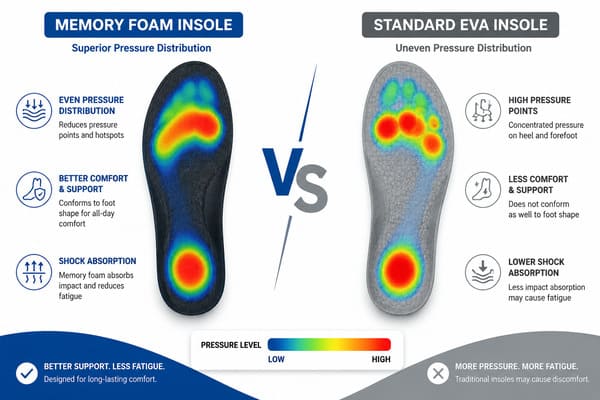
That said, I always give clients an honest picture of memory foam’s weaknesses.
First, low-density memory foam collapses. Foam below 40 kg/m³ density starts breaking down after about 6 months of daily use5. It looks fine from the outside, but the cushioning is gone. Second, cold temperature performance drops sharply. Third, cost is 15% to 25% higher than standard PU insoles on average.
How to decide which insole is right for your order
| Condition | Recommended Insole |
|---|---|
| Indoor, moderate temperature, long shifts | Memory foam (45–55 kg/m³) |
| Cold storage or outdoor winter work | PU base + thermal layer |
| High-frequency walking (construction, warehouse) | Layered: memory foam top + PU base |
| Short shifts, budget-sensitive orders | Standard EVA or PU |
| High hygiene requirements (food, pharma) | Memory foam with antimicrobial treatment |
The answer to "which protects better" is not a material name. It is a configuration matched to the actual working conditions.
Is Memory Foam Good for Long Shifts on Hard Floors?
I once visited the procurement manager of a food processing plant. His workers stood on full ceramic tile floors for over 10 hours a day. He asked me directly: should we switch to full memory foam insoles? My answer was no.
Pure memory foam is too soft for extended standing on hard floors. Without firm arch support underneath, the foot sinks too deep, the arch collapses, and the ankle begins to compensate6. A layered system — memory foam on top for pressure relief, a firmer mid-density base underneath for structural support — performs better over a full shift.
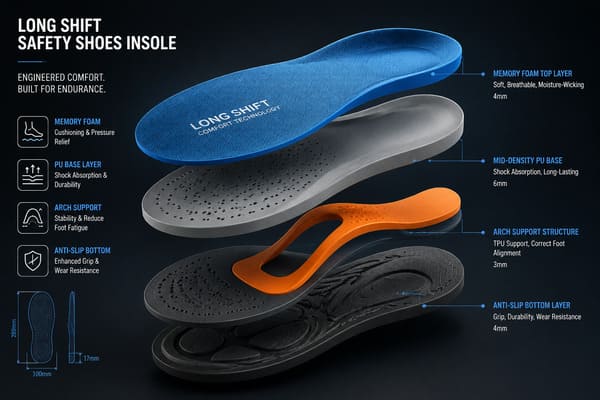
We developed a custom insole configuration for that factory: 4mm memory foam top layer, 6mm mid-density PU base. After 10 continuous hours of wear testing, the fatigue score was about 18% lower than with a full memory foam insole7. The difference comes from arch support. A foot that is fully sunk into soft foam has no stable platform to push off from. Over time, the lower leg muscles work harder to compensate. That is what causes the deep fatigue that workers describe after a long shift on hard floors.
Recommended insole structure by floor type and shift length
| Floor Type | Shift Length | Recommended Structure |
|---|---|---|
| Hard tile or concrete | Over 8 hours | 4mm memory foam + 6mm PU base |
| Rubber mat floor | 6–8 hours | Full memory foam (45–55 kg/m³) |
| Metal grating | Any shift | Anti-fatigue foam + rigid arch support |
| Outdoor unpaved surface | Varies | PU base with heel cup |
The goal is not maximum softness. The goal is the right softness in the right places. Where the heel strikes, you want cushioning. Where the arch sits, you need structure.
What Are the Best Memory Foam Insoles for Work Boots?
When I help OEM clients select insole configurations, I always start with three questions: How many steps does the worker take per day? What is the temperature in the working environment? How long does this pair of shoes need to last?
The best memory foam insoles for work boots use foam with a density between 45 and 55 kg/m³, an antimicrobial surface treatment, and a removable design. This combination balances cushioning, hygiene, and long-term value. Density below 40 kg/m³ collapses too fast. Above 60 kg/m³, the rebound is too slow and comfort drops.
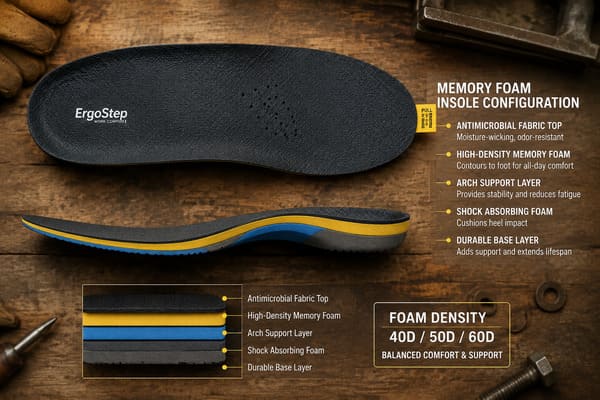
Density is the single most important number when evaluating memory foam quality. Most low-price insoles use foam in the 30 to 38 kg/m³ range. It feels soft at first. Six months in, it has compressed to almost nothing. This is one of the main reasons workers complain that "the shoes felt fine at first but got uncomfortable fast."
Key specs to evaluate when selecting memory foam insoles for work boots
| Spec | Recommended Range | Why It Matters |
|---|---|---|
| Foam density | 45–55 kg/m³ | Controls durability and rebound speed |
| Top layer thickness | 3–5mm | Balances cushioning without excess sink |
| Base layer material | PU or EVA (mid-density) | Provides arch support and shape retention |
| Antimicrobial treatment | Required | Safety shoe interior reaches 85%+ humidity after 8 hours8 |
| Removable design | Strongly recommended | Replaceable insoles extend shoe life by 30%+ |
| Temperature range | 10°C to 40°C | Standard memory foam loses effect below 10°C |
Antimicrobial treatment is something many buyers overlook. A well-sealed safety shoe creates a very humid environment inside after a full shift — humidity levels can exceed 85%. That environment breeds bacteria and odor fast. Adding an antimicrobial layer to the insole surface is a small cost addition that directly reduces complaints about odor and hygiene, especially for clients supplying food processing, pharmaceutical, or hospital environments.
Removable insole design also matters more than most people expect. A quality memory foam insole costs roughly 5% to 8% of the total shoe price to replace. A replaceable insole can extend the functional life of the shoe by over 30%9. For clients buying 2,000 to 5,000 pairs per order, that math adds up fast.
Conclusion
Memory foam insoles improve comfort, reduce fatigue, and extend wear compliance — but only when the density, layering, and environment are matched correctly. The right insole is a system, not a material. At Shoegan, we help clients configure insoles that fit their workers and their working conditions — built to protect, made to last.
-
"Bio-Based Viscoelastic Polyurethane Foams – PMC – NIH", https://pmc.ncbi.nlm.nih.gov/articles/PMC12846099/. Viscoelastic polyurethane foams exhibit time-dependent deformation under load, with recovery rates influenced by temperature and foam density; the combination of viscous damping and elastic restoring forces produces the characteristic slow rebound associated with memory foam materials. Evidence role: mechanism; source type: research. Supports: The viscoelastic properties of polyurethane foam, including temperature-dependent softening and slow elastic recovery. Scope note: Specific rebound times vary by foam formulation and density; a single cited value may not apply universally across commercial products ↩
-
"Comparison of plantar pressure in three types of insole given to … – PMC", https://pmc.ncbi.nlm.nih.gov/articles/PMC5685010/. Peer-reviewed studies on insole materials have documented reductions in peak plantar pressure with viscoelastic insoles compared to standard EVA, though reported magnitudes vary by study design, subject population, and foam specification. Evidence role: statistic; source type: research. Supports: That memory foam or viscoelastic insoles measurably reduce peak plantar pressure at the heel compared to standard foam insoles. Scope note: Published figures may differ from the 22% reduction cited, as results depend on foam density, subject weight, and measurement methodology ↩
-
"How many steps/day are enough? for adults – PMC", https://pmc.ncbi.nlm.nih.gov/articles/PMC3197470/. Occupational health research using pedometry has documented daily step counts among industrial workers, with estimates commonly ranging from 7,000 to 10,000 steps depending on job role and facility layout. Evidence role: statistic; source type: research. Supports: That workers in industrial or manufacturing settings take approximately 8,000 steps per day on average. Scope note: Step counts vary substantially by occupation, facility size, and individual work pace; 8,000 steps is an approximation rather than a universal figure ↩
-
"A Review of Research on the Effect of Temperature on the Properties of …", https://pmc.ncbi.nlm.nih.gov/articles/PMC9654075/. The temperature-dependent stiffness of viscoelastic polyurethane foams is attributable to changes in polymer chain mobility near the glass transition region; at lower temperatures, reduced molecular motion increases foam modulus and diminishes the material’s ability to conform to applied loads. Evidence role: mechanism; source type: research. Supports: That viscoelastic polyurethane foam exhibits increased stiffness and reduced conformability at low temperatures. Scope note: The precise temperature at which performance degradation becomes functionally significant depends on foam formulation; 10°C is an approximation that may not apply to all commercial memory foam products ↩
-
"The Impact of Footwear on Occupational Task Performance …", https://pmc.ncbi.nlm.nih.gov/articles/PMC9518076/. Compression fatigue testing of polyurethane foams demonstrates that lower-density formulations exhibit greater permanent set and loss of load-bearing capacity under cyclic loading, with degradation rate inversely correlated with foam density. Evidence role: general_support; source type: research. Supports: That lower-density polyurethane foams exhibit faster mechanical degradation under repeated compressive loading. Scope note: The specific threshold of 40 kg/m³ and the 6-month timeline are approximations; actual degradation depends on load magnitude, frequency, temperature, and foam chemistry ↩
-
"Effects of Arch Support Pad Stiffness on Lower-Limb … – PMC", https://pmc.ncbi.nlm.nih.gov/articles/PMC12473336/. Biomechanical research on foot mechanics has demonstrated that reduced medial arch support is associated with increased pronation, altered ankle kinematics, and elevated activation of lower-limb stabilizing muscles, contributing to accelerated fatigue during prolonged weight-bearing tasks. Evidence role: mechanism; source type: research. Supports: That insufficient arch support leads to compensatory ankle and lower-limb muscle activity, increasing fatigue during prolonged standing or walking. Scope note: The degree of compensation and fatigue varies by individual foot morphology, footwear stiffness, and floor surface characteristics ↩
-
"Influence of Footwear on Foot Comfort of Workers Engaged in Prolonged …", https://pmc.ncbi.nlm.nih.gov/articles/PMC13023067/. Biomechanical studies on prolonged occupational standing have found that insoles incorporating both cushioning and arch support elements reduce lower-limb muscle fatigue and discomfort compared to uniformly compliant surfaces, as the structured base provides a stable platform for push-off mechanics. Evidence role: general_support; source type: research. Supports: That insoles combining cushioning with structured arch support reduce subjective or objective fatigue measures compared to uniformly soft insoles during prolonged standing. Scope note: The specific 18% figure is derived from an internal test; published studies report varying magnitudes of fatigue reduction depending on measurement method and subject population ↩
-
"Influence of shoe upper structure on shoe microclimate and … – PMC – NIH", https://pmc.ncbi.nlm.nih.gov/articles/PMC11191507/. Research on footwear microclimate has documented that relative humidity inside closed occupational footwear can reach or exceed 80–90% during prolonged wear, creating conditions conducive to microbial growth and skin maceration. Evidence role: statistic; source type: research. Supports: That the interior microclimate of closed safety footwear reaches high relative humidity levels during extended wear. Scope note: Measured humidity levels vary by shoe construction, material breathability, ambient temperature, and wearer activity level; 85% is a representative approximation ↩
-
"Major equipment life cycle cost analysis", https://dr.lib.iastate.edu/bitstreams/9cc741a3-8603-4628-8890-d1ae29f0bded/download. Footwear lifecycle analyses indicate that insole degradation is a primary driver of comfort loss in occupational footwear, and that timely insole replacement can restore cushioning performance and delay the need for full shoe replacement. Evidence role: general_support; source type: research. Supports: That replacing worn insoles prolongs the functional service life of footwear. Scope note: The 30% figure is an approximation; actual service life extension depends on shoe construction quality, usage intensity, and the relative rate of insole versus outsole degradation ↩