
Choosing the wrong outsole material can cause returns, injuries, and lost clients. Many buyers ask for TPU without knowing what it actually does — or where it fails.
A TPU outsole is a shoe sole made from thermoplastic polyurethane, a type of plastic with high abrasion resistance and light weight. It performs well in dry, outdoor, and moderate-temperature environments. However, it softens under high heat and breaks down in humid conditions, making material selection highly dependent on the work environment.
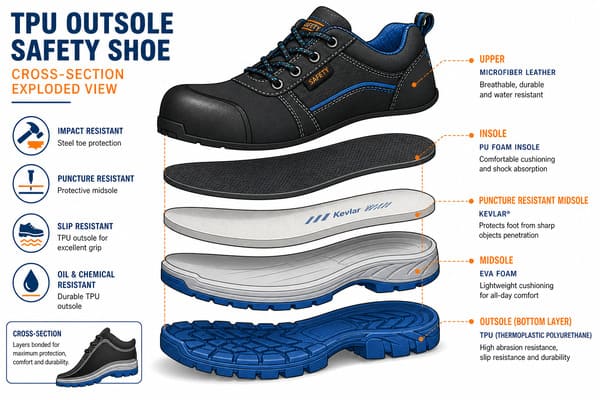
I have been making safety shoes for over 15 years. In that time, I have seen TPU outsoles praised as the future of safety footwear — and I have also seen them crumble apart in a client’s warehouse eight months after delivery. The truth about TPU is not simple, and it is not what most product pages tell you. Let me walk you through what I actually know from the factory floor and from real client cases.
Are TPU Soles Good or Bad?
TPU soles are not good or bad. They are specific. The problem starts when buyers treat "TPU" as a quality label instead of a material description.
TPU soles offer strong abrasion resistance, low weight, and good energy return. They work well in dry, moderate-temperature environments such as outdoor construction. They perform poorly in high-heat settings, oil-covered floors, and high-humidity climates where the material can degrade over time.
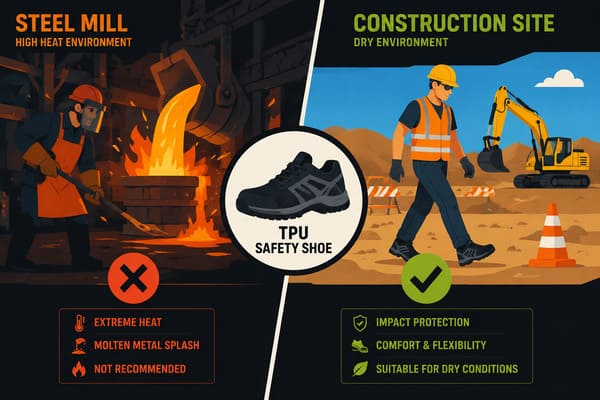
One of my distributors came to me a few years ago wanting to switch his entire product line to TPU. His reason was simple: he had read that TPU is better than rubber. I did not say yes right away. I asked him one question: what environments do your end users actually work in? He listed three — a steel mill, a food processing plant, and outdoor construction sites. I told him TPU was only right for one of those three.
Steel mill floors run hot. TPU begins to soften and deform at temperatures above 80°C1, and in some steel environments, floor surface temperatures go well beyond that. Food processing plants are wet and warm year-round. TPU is vulnerable to hydrolysis — a chemical breakdown process that happens when the material is exposed to moisture and heat over time2. Outdoor construction, however, is exactly where TPU earns its reputation: dry ground, variable terrain, and workers who need light footwear for long shifts.
He split the order into three sole materials based on my recommendation. His return rate dropped to near zero that year. TPU is not better. It is only better in the right place.
| Work Environment | TPU Performance | Recommended Alternative |
|---|---|---|
| Steel mill / high heat | Poor — softens above 80°C | Heat-resistant rubber |
| Food processing / wet | Poor — hydrolysis risk | Rubber or PU hybrid |
| Outdoor construction | Good — light, abrasion-resistant | TPU is suitable |
| Oil-covered floors | Below average — lower slip resistance | High-grade rubber |
| Cold storage / low temp | Poor — becomes brittle | Rubber or special compound |
Which Sole Is Better, TPU or Rubber?
Most buyers frame this as a competition. It is not. TPU and rubber solve different problems, and picking one over the other without knowing the work environment is a mistake that costs real money.
Rubber outsoles offer better slip resistance on oily or wet surfaces, higher heat tolerance, and greater flexibility in cold temperatures. TPU outsoles are lighter, more abrasion-resistant in controlled conditions, and provide better energy return. Neither material wins across all categories — the work environment determines which one is right.
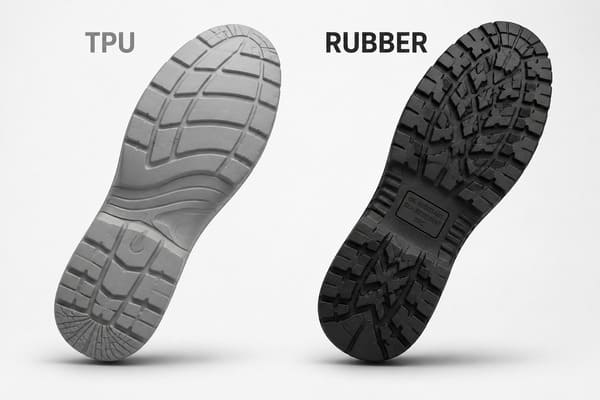
I ran an informal comparison at a heavy machinery client’s facility. Two groups of workers, same job station, same shift length. One group wore TPU-soled safety shoes, the other wore high-grade rubber-soled shoes. After six months, I photographed both pairs. The TPU soles showed more visible wear — not less.
The reason was the floor surface. That workshop had iron shavings and irregular metal debris on the ground all day. TPU is a harder material. When force concentrates on a single raised point — like a metal chip — it cuts into the TPU faster than into rubber. Rubber has elasticity. It absorbs and distributes that pressure, so it wears more evenly over time.
Where Each Material Has the Real Advantage
TPU Strengths
- Weight reduction of 80–120g per pair compared to rubber3, which matters significantly for workers on their feet for 8–10 hours
- Higher abrasion resistance in lab conditions (DIN 53516 Taber test results show 3–5x improvement over standard rubber4)
- Better energy return, which reduces fatigue on flat, hard surfaces
Rubber Strengths
- Slip resistance on oily surfaces is approximately 30% higher than standard TPU formulations5
- Stable performance from -30°C to above 100°C depending on compound6
- No hydrolysis risk — rubber does not break down from moisture exposure
| Performance Category | TPU | Rubber |
|---|---|---|
| Abrasion resistance (lab) | High | Moderate |
| Abrasion resistance (real floor) | Varies by surface | More consistent |
| Slip resistance on oil | Lower | Higher |
| Heat resistance | Up to ~80°C | Up to 120°C+ |
| Cold flexibility | Brittle below -15°C7 | Flexible to -30°C |
| Weight | Light | Heavier |
| Hydrolysis resistance | Vulnerable | Not affected |
Is TPU Good for Shoe Soles?
TPU became popular in safety shoes for one real reason: workers wanted lighter footwear. That is a legitimate need. But somewhere along the way, "lighter" became confused with "better," and that confusion has caused problems.
TPU is good for shoe soles when the working conditions match its strengths — dry surfaces, moderate temperatures, and environments where weight reduction improves worker comfort and reduces fatigue. In these conditions, TPU delivers measurable performance benefits over traditional rubber.
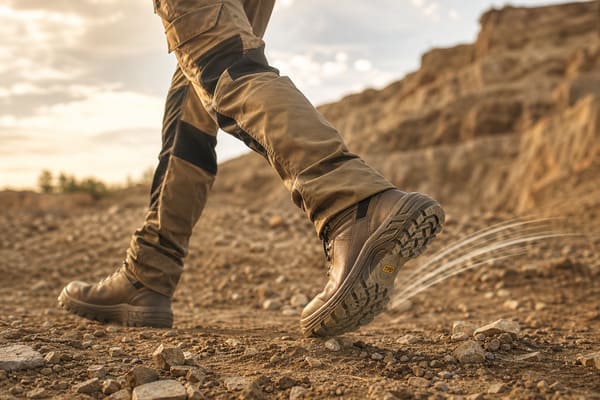
I had a European client who wanted to upgrade his product line to TPU soles specifically so he could charge a higher price. His logic made sense on paper — TPU sounds more technical, it is lighter, and it photographs well. But when I looked at his end users, most of them were mechanical workers operating on oil-exposed floors. I told him directly: you are about to sell a more expensive shoe with worse slip resistance for your specific customer. That is not an upgrade.
TPU entered the safety shoe market because of the lightweight trend in industrial PPE8. Workers pushed back against heavy boots. Ergonomics research confirmed that reducing shoe weight lowers fatigue and musculoskeletal strain over long shifts9. TPU answered that demand. It is a real advantage — but only in the right context.
When TPU Is the Right Choice
Environmental Conditions That Favor TPU
- Dry ground surfaces without oil, chemical, or water contamination
- Ambient and floor temperatures that stay below 60°C
- Environments without long-term humidity above 70–80%
Worker Conditions That Favor TPU
- Shifts of 8 hours or more where weight reduction has a direct fatigue impact
- Jobs requiring frequent movement across flat or moderate terrain
- Workers who have complained about heavy footwear in previous product cycles
Using TPU as a premium label without checking these conditions is a shortcut that eventually damages trust with end users. Protection should never come at the cost of real-world performance.
How Long Do TPU Outsoles Last Compared to Other Materials?
The number that gets quoted most often is this: TPU is 3 to 5 times more abrasion-resistant than rubber. That number is real. It comes from the DIN 53516 Taber abrasion test. But that test uses a standard pressure, a standard grinding wheel, and a standard temperature. It does not test what your workers are actually standing on.
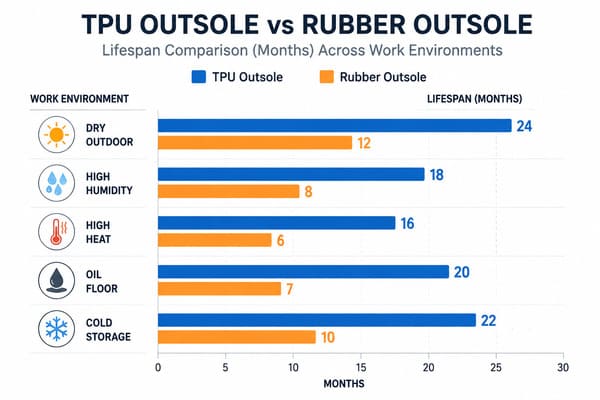
TPU outsoles typically last 12–18 months under standard dry-use conditions10. In high-humidity or high-heat environments, service life can drop to 6–10 months due to hydrolysis or heat deformation. Rubber outsoles in humid or oily environments often outlast TPU by 30–50% in real-world use11.
A few years ago, we supplied 3,000 pairs of TPU-soled safety shoes to a client in Southeast Asia. Every pair passed factory inspection. Eight months later, the client sent photos. The soles had cracked down the middle. Some had broken into pieces. He thought we had cut corners on materials. I spent a long time explaining what had actually happened.
That region has humidity consistently above 80% and temperatures above 30°C for most of the year. In those conditions, TPU undergoes hydrolysis. The ester bonds in the polyurethane chain break down slowly. You cannot see it happening from the outside. The surface looks fine until the internal structure has already failed — and then the sole cracks suddenly and completely. It is not a manufacturing defect. It is a material-environment mismatch.
In the same period, another batch of rubber-soled shoes we supplied to a similar climate ran 18 months without any structural issues.
Lifespan Comparison by Environment
| Environment | TPU Outsole Lifespan | Rubber Outsole Lifespan |
|---|---|---|
| Dry, outdoor (construction) | 14–18 months | 10–14 months |
| High humidity (>80% RH) | 6–10 months | 16–20 months |
| High heat (>60°C floor temp) | 4–8 months | 12–18 months |
| Oil-exposed floors | 10–14 months | 14–18 months |
| Cold storage (<-15°C) | 6–10 months | 12–16 months |
After that Southeast Asia case, I added a standard note to every quote we send to clients in humid regions: humid environment — recommend rubber outsole. It is one line. It has saved multiple clients from the same problem.
The real lesson is this: laboratory durability data tells you how a material performs under ideal conditions. It does not tell you how it performs in your client’s actual facility. The gap between those two numbers is where returns happen.
Conclusion
TPU outsoles are not a universal upgrade. They are a specific material that works well in specific conditions. Match the material to the environment, not the trend.
At Shoegan, we help B2B clients choose the right outsole for every application — because the right shoe protects workers and protects your business reputation.
-
"Wear Behavior and Multi-Technique Characterization of 3D Printed TPU …", https://pmc.ncbi.nlm.nih.gov/articles/PMC12986624/. Thermoplastic polyurethane exhibits a heat deflection temperature that varies by formulation, with many standard grades beginning to lose dimensional stability between 60°C and 90°C under load, as documented in polymer materials databases and manufacturer technical datasheets. Evidence role: mechanism; source type: research. Supports: The temperature range at which thermoplastic polyurethane loses structural integrity under load. Scope note: Exact softening temperature varies significantly by TPU grade and applied load; a single threshold figure may not apply universally across all formulations used in footwear. ↩
-
"Poly(3-hydroxybutyrate) Modified with Thermoplastic Polyurethane and …", https://pmc.ncbi.nlm.nih.gov/articles/PMC11678418/. Ester-based polyurethanes are susceptible to hydrolytic degradation, wherein water molecules cleave ester linkages in the polymer backbone, a process accelerated by elevated temperature and humidity, as described in polymer degradation literature. Evidence role: mechanism; source type: research. Supports: The chemical mechanism by which ester-based polyurethane degrades in the presence of moisture and elevated temperature. Scope note: Ether-based TPU formulations are significantly more hydrolysis-resistant than ester-based variants; the claim applies primarily to ester-type TPU commonly used in footwear outsoles. ↩
-
"Which boot outsole should you choose? TPU, Nitrile or Rubber?", https://www.badgeraustralia.com.au/blog/which-boot-outsole-should-you-choose-tpu-nitrile-or-rubber/?srsltid=AfmBOooBE4NEpDU-ECkHAKzbKUbxH2vb2VcNm1XhGy_US_WfiwVyASCk. The density of thermoplastic polyurethane (approximately 1.1–1.25 g/cm³) is generally lower than that of solid rubber compounds (approximately 1.1–1.5 g/cm³ depending on formulation), with the actual weight differential per pair depending on outsole geometry, thickness, and the specific rubber compound used as the comparator. Evidence role: statistic; source type: research. Supports: The weight difference between TPU and rubber outsoles of equivalent dimensions in safety footwear. Scope note: The 80–120g figure depends on outsole volume and specific material grades; foamed rubber or lightweight rubber compounds may reduce this differential significantly. ↩
-
"Abrasion Behaviors of Silica-Reinforced Solution Styrene …", https://pmc.ncbi.nlm.nih.gov/articles/PMC11280858/. Standardized abrasion tests such as DIN 53516 and ISO 4649 are used to compare outsole materials; published results from polymer testing laboratories generally show TPU outperforming standard rubber compounds in controlled abrasion scenarios, though the magnitude varies by specific formulations tested. Evidence role: statistic; source type: research. Supports: Comparative abrasion resistance values for TPU versus rubber under standardized laboratory test conditions. Scope note: The 3–5x figure is not attributed to a specific published study; actual ratios depend heavily on the rubber compound grade used as the baseline comparator. ↩
-
"Effect of Floor Coatings on Slip-Resistance of Safety Shoes", https://www.academia.edu/102647314/Effect_of_Floor_Coatings_on_Slip_Resistance_of_Safety_Shoes. Slip resistance testing under EN ISO 13287 and related standards measures the coefficient of friction of outsole materials on contaminated surfaces; rubber compounds generally demonstrate higher friction values than TPU on oil-wetted floors, though the specific differential depends on rubber formulation and surface conditions. Evidence role: statistic; source type: research. Supports: Comparative slip resistance performance of rubber versus TPU outsoles on oil-contaminated surfaces. Scope note: The 30% figure is not attributed to a specific published test; actual slip resistance differences vary by rubber compound, TPU grade, surface texture, and contaminant type. ↩
-
"Scorch-preventing outsole adhesive for rubber-face insulating …", https://eureka.patsnap.com/patent-CN107556546A. The thermal performance of rubber outsoles varies substantially by compound type; nitrile, neoprene, and natural rubber formulations differ in their low-temperature flexibility and high-temperature stability, with specific grades engineered for extreme temperature applications in industrial footwear. Evidence role: general_support; source type: research. Supports: The operational temperature range of rubber compounds used in safety footwear outsoles. Scope note: The stated range of -30°C to above 100°C applies to select rubber compounds; not all rubber outsole formulations perform across this full range, and the claim requires qualification by compound type. ↩
-
"Testing cold protection according to EN ISO 20344", https://pubmed.ncbi.nlm.nih.gov/19011127/. The cold-flex performance of TPU outsoles is assessed under standards such as EN ISO 20344, which specifies cold-crack resistance testing; the glass transition temperature and brittle point of TPU vary by formulation, with standard grades typically exhibiting reduced flexibility below approximately -15°C to -20°C. Evidence role: mechanism; source type: research. Supports: The low-temperature threshold at which TPU outsoles lose flexibility and become susceptible to brittle fracture. Scope note: The -15°C threshold is formulation-dependent; specialty low-temperature TPU grades may maintain flexibility at lower temperatures, and the figure should be verified against specific product technical datasheets. ↩
-
"Impact of personal protective equipment in preventing … – PMC", https://pmc.ncbi.nlm.nih.gov/articles/PMC12715716/. Industry and occupational health literature from the early 2000s onward documents increasing emphasis on reducing the physical burden of PPE, including safety footwear, as part of broader ergonomic risk management strategies in occupational safety standards and guidelines. Evidence role: historical_context; source type: institution. Supports: The role of ergonomic and weight-reduction trends in driving material innovation in industrial safety footwear. Scope note: A direct citation linking TPU’s specific market entry in safety footwear to a documented lightweight PPE trend was not identified; the claim reflects a plausible industry narrative that would benefit from corroboration by a market research report or trade association publication. ↩
-
"The Impact of Footwear on Occupational Task Performance …", https://pmc.ncbi.nlm.nih.gov/articles/PMC9518076/. Occupational ergonomics research has examined the relationship between footwear mass and worker fatigue, with studies indicating that heavier footwear increases metabolic cost and lower-limb muscle loading during prolonged standing and walking tasks. Evidence role: expert_consensus; source type: research. Supports: That footwear mass reduction is associated with decreased lower-limb fatigue and musculoskeletal load in occupational settings. Scope note: The magnitude of fatigue reduction attributable specifically to outsole weight versus other footwear design factors has not been uniformly quantified across studies. ↩
-
"Employer Personal Protective Equipment Workplace Hazard …", https://www.osha.gov/laws-regs/standardinterpretations/2013-12-09. Published guidance on safety footwear replacement intervals from occupational health institutions and standards bodies typically references wear indicators and inspection criteria rather than fixed lifespan figures; the 12–18 month estimate reflects practitioner experience and may vary by worker activity level and floor surface. Evidence role: general_support; source type: institution. Supports: Expected service life of TPU outsoles in occupational footwear under normal dry working conditions. Scope note: No standardized published lifespan figure for TPU outsoles under dry conditions was identified; the stated range is an operational estimate rather than a value derived from controlled longitudinal wear studies. ↩
-
"What’s the Impact of Safety Footwear on Workers Concerning …", https://pmc.ncbi.nlm.nih.gov/articles/PMC11311279/. Field durability comparisons between rubber and TPU outsoles in adverse environments are limited in published literature; the stated 30–50% lifespan advantage for rubber in humid or oily conditions reflects practitioner observations rather than controlled longitudinal studies. Evidence role: statistic; source type: research. Supports: Comparative service life of rubber versus TPU outsoles under high-humidity or oil-contaminated working conditions. Scope note: This figure is derived from the author’s operational experience rather than peer-reviewed field research; controlled comparative studies across standardized humid and oily environments are not cited. ↩