
Every year, workers throw away safety shoes early — not because the shoes broke, but because they hurt. The real problem often starts before the shoe is even made.
A safety shoe last is a 3D foot-shaped form used to build a shoe around. It controls the shoe’s width, toe shape, heel cup, and internal volume. The wrong last means the steel toe cap sits in the wrong place, the heel slips, and the worker’s foot is never truly protected — no matter how good the materials are.
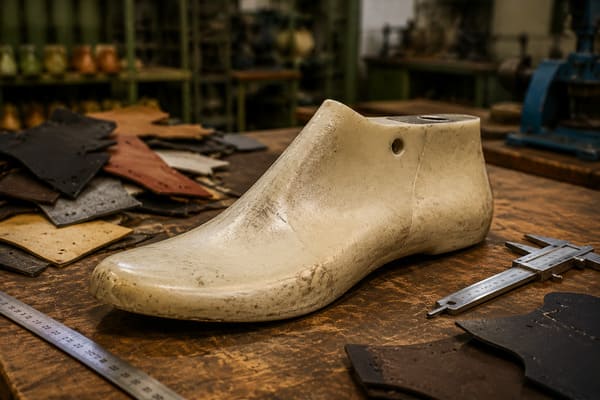
I have worked in safety shoe manufacturing for over 20 years. I have seen buyers spend weeks comparing outsole compounds and upper materials, then pick a last without asking a single question. That one decision undoes everything else. This article breaks down what a last actually does, how its shape affects the person wearing the shoe, how long a safety shoe should last, and whether it is safe to wear one every day.
What Does a Shoe Last Actually Do in Safety Shoe Manufacturing?
Most buyers think a last is just a mold. It is not. A last is a decision tool, and every millimeter of it is a choice you make before a single piece of leather is cut.
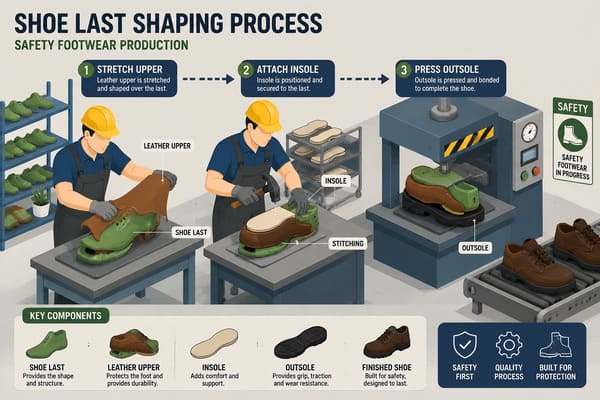
A shoe last is a solid form — usually made from high-density polyethylene or aluminum — shaped like a human foot.1 During production, the upper is stretched over the last, the insole is attached to it, and the outsole is bonded or injected around it. The last defines the final internal shape of the shoe.
I had a client from Malaysia come to me with a competitor’s sample. His workers were complaining about toe pressure after two hours on the floor. I measured the last width — it was a standard D width. But Malaysian workers typically have wider feet. They needed at least an E width. That 8 to 10mm difference was the entire problem.2 The shoe looked fine. The protection ratings were correct. But the last was wrong for that foot population, and every protective feature inside that shoe was being canceled out by poor fit.
Here is what the last actually controls in a safety shoe:
How the Last Positions the Steel Toe Cap
The steel toe cap must sit directly over the toes to protect them. If the last is too long in the toe box, the cap shifts forward and the worker’s toes sit behind the protection zone. I had a European client building site shoes to EN ISO 20345 spec. His original last had a long toe. We shortened the toe by 4mm and repositioned the cap. His complaint rate dropped by 70%.
How the Last Fits the Anti-Puncture Plate
The anti-puncture steel plate sits between the insole and outsole. It needs to follow the arch of the foot. If the last has a flat arch profile, the plate does not conform to the foot, and the worker feels the edge of the plate with every step. This is a comfort problem that most buyers do not connect back to the last.
How the Last Holds the Heel
A heel that slips inside the shoe is not just uncomfortable — it is a safety risk. The heel cup shape on the last determines whether the foot stays locked in place during lateral movement. For workers on uneven ground or climbing ladders, this matters far more than most specs indicate.
| Last Feature | What It Controls | What Goes Wrong If It Is Off |
|---|---|---|
| Toe box width | Fit for local foot shape | Pressure, poor blood flow |
| Toe box length | Steel cap position | Toes outside protection zone |
| Arch profile | Anti-puncture plate fit | Edge pressure, discomfort |
| Heel cup depth | Foot stability | Slipping, blisters, fatigue |
How Does Last Shape Affect Fit, Comfort, and Protection?
Most procurement teams focus on certifications and materials. Very few ask about last shape. This is the gap where comfort problems and protection failures both live.
Last shape creates a three-way relationship between fit, comfort, and protection. A last that is too narrow compresses the foot and reduces blood flow. A last that is too wide lets the foot shift, pulling the toe cap out of position. Either way, the shoe’s protection rating on paper does not match what the worker actually receives.
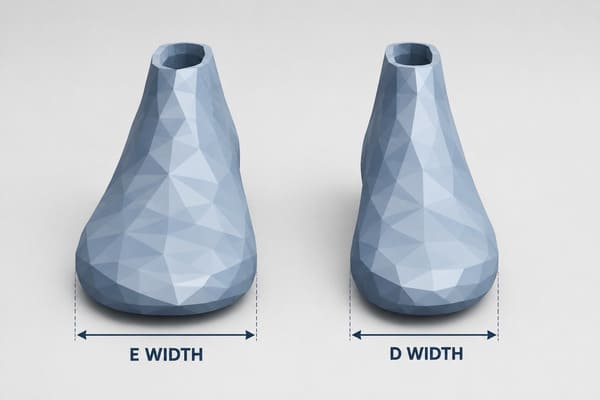
The difference between the narrowest and widest common last widths is 8 to 10mm. That sounds small. But for a foot that is already swelling after four hours of standing, 8mm is the difference between normal circulation and a foot that goes numb. I have measured this in our own fitting tests. Workers wearing the wrong last width show visible redness at the fifth metatarsal — the outer edge of the foot — within 90 minutes.3
Wide Last vs. Narrow Last: What You Are Actually Trading
A wide last gives the foot room to spread naturally. This is better for comfort, especially in warm environments where feet swell. But a wide last changes where the steel toe cap sits relative to the foot. When we widen the toe box, we have to reposition the cap inward or the lateral toes lose coverage. This is a recalibration step that many manufacturers skip, especially at lower price points.
A narrow last looks more like a dress shoe. It performs better in environments where lateral support matters — electrical work, for example, where workers are on ladders and need the shoe to feel snug. But narrow lasts create pressure points quickly on workers with wider feet, and no amount of padding fixes a last that is fundamentally the wrong shape.
Toe Box Length and the EN ISO 20345 Problem
EN ISO 20345 requires the toe cap to withstand 200 joules of impact.4 But the standard tests the cap, not the position of the cap relative to the wearer’s toes. A long-toe last moves the cap forward. If the worker’s foot is average length, their toes sit back from the cap by 10 to 15mm. A falling object hits the cap correctly in testing. In real use, the object can hit the toe box just behind the cap, where there is no protection.
| Last Shape | Best For | Risk If Wrong |
|---|---|---|
| Wide (E/EE) | High-heat environments, wider foot populations | Cap repositioning needed |
| Standard (D) | General industrial use | Wrong for wider regional foot types |
| Long toe | Fashion-influenced styles | Toes outside protection zone |
| Short toe | Compact fit, correct cap alignment | Uncomfortable for long toe feet |
At Shoegan, when we take on OEM orders, we go through last selection as a formal step with every client. We ask for the target region, the intended industry, and whether we can get foot width data from the end user’s workforce. This is not a small detail — it is the foundation of a shoe that actually does its job.
How Long Should Safety Shoes Last?
The industry answer is usually "12 months." That number is almost useless without context. A shoe worn eight hours a day in a chemical plant does not age the same way as one worn twice a week in a warehouse.
Safety shoes typically last 12 to 24 months under normal industrial use5, but the real lifespan depends on the outsole construction method and the work environment. Injection-molded soles last longer in most conditions. Cemented soles fail faster in heat or chemical exposure. The construction method matters more than the timeline.
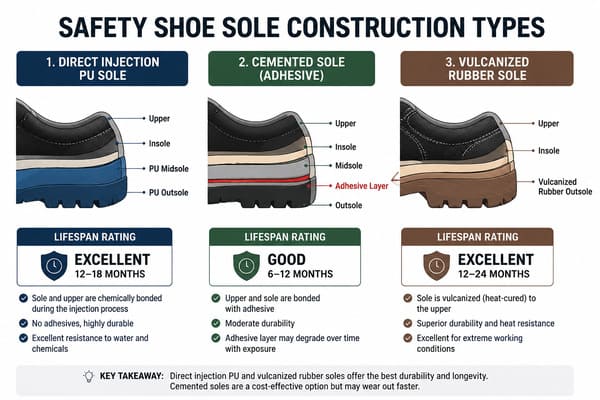
I have seen the fastest failure I can remember in my own production records: a cemented-sole safety shoe used in a paint shop. The sole started delaminating at three months. The shoe was not low quality. The construction method was wrong for the environment. That is the distinction most buyers miss.
The Three Main Sole Construction Methods and What They Mean for Lifespan
Direct injection (PU/PU or PU/rubber): The outsole material is injected directly around the upper and insole. There is no adhesive layer. The bond is structural. Under normal conditions — eight hours a day, five days a week — these shoes hold up for 18 to 24 months. They resist moderate heat and general abrasion well.
Cemented construction: The upper and outsole are bonded with adhesive. This is the most common method in mid-range shoes because it allows for more design flexibility and lower tooling cost. The weak point is the adhesive layer. In environments above 60°C, or where the shoe contacts solvents, the adhesive softens and the sole separates.6 In these conditions, 12 months is optimistic. Six to nine months is more realistic.
Vulcanized construction: Heat and pressure fuse the rubber outsole to the upper. This is the most durable method for heat, oil, and chemical resistance. The tradeoff is weight — vulcanized shoes are heavier. But in foundries, chemical plants, and outdoor environments with extreme temperature swings, nothing else holds up as long.
| Construction Method | Typical Lifespan | Best Environment | Weakness |
|---|---|---|---|
| Direct injection (PU) | 18–24 months | General industrial | High heat above 120°C |
| Cemented | 6–12 months | Light-duty, climate-controlled | Heat, solvents, chemicals |
| Vulcanized | 24–36 months | Chemical, foundry, outdoor | Heavier, less design flexibility |
When I talk to clients who are seeing high shoe replacement rates, my first question is always about the work environment, not the shoe brand. The construction method is usually the mismatch.
Can I Wear Safety Shoes Daily?
The answer is yes, but only if the shoe is built for it. Many workers report that their feet are more tired at the end of a day in safety shoes than in regular work boots. That is not a normal tradeoff. It is a sign that something in the shoe design is wrong for daily wear.
Safety shoes can be worn daily if three conditions are met: the last matches the wearer’s foot shape, the interior has proper moisture management, and the toe cap material is light enough not to add significant fatigue load. Composite toe caps, breathable linings, and a correctly fitted last make daily wear genuinely comfortable.
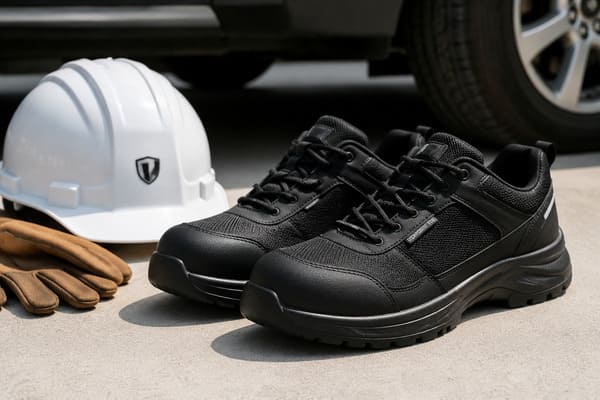
The most common complaint I hear from workers is foot fatigue by mid-afternoon. When I dig into it, the cause is almost always one of three things: the wrong last width, a steel toe cap when a composite one would do, or a lining that traps heat and moisture.
Steel Toe vs. Composite Toe: The Weight Difference in Daily Use
A traditional steel toe cap adds roughly 150 to 200 grams per pair compared to a composite toe cap made from fiberglass or carbon fiber.7 Both meet EN ISO 20345 and ASTM F2413 impact standards. The protection rating is the same.8 The difference is in what the worker carries across an eight-hour shift.
150 grams does not sound like much. But across 10,000 steps in a shift, that extra weight means meaningfully more muscle effort from the ankle and knee with every step9. Workers in environments without metal detector requirements — construction, warehousing, logistics — gain real benefit from switching to composite.10 There is no safety reason to use steel in those settings.
What a Daily-Wear Safety Shoe Needs Inside
The upper material and lining matter as much as the toe cap for daily comfort. A leather upper with no ventilation traps heat quickly. A mesh lining or perforation system moves air through the shoe as the foot compresses and releases with each step. A moisture-wicking insole pulls sweat away from the skin surface and reduces the bacterial activity that causes odor.11
| Feature | Daily Wear Benefit | What to Look For |
|---|---|---|
| Composite toe cap | Lower weight, less fatigue | Meets ASTM F2413 / EN ISO 20345 |
| Mesh or ventilated lining | Reduces heat buildup | Checked in product spec sheet |
| Moisture-wicking insole | Controls odor and moisture | Antibacterial treated surface |
| Correct last width | Prevents pressure and fatigue | Regional foot data, fitting trial |
At Shoegan, our position is that protection should never come at the cost of comfort. That is not marketing language. It shows up in how we select lasts for different regional markets, how we spec the lining on shoes intended for full-shift daily wear, and how we guide clients toward composite toe options when steel is not actually required by the work environment.
Conclusion
The last is where every safety shoe’s performance begins. Get it wrong, and no certification or material choice can fix what follows. If you are sourcing safety shoes for a workforce, the last is the first conversation to have — not the last.
Shoegan is a mid-to-high end safety shoe manufacturer based in Wenzhou, China, with 15+ years of production experience and full OEM/ODM capability. Contact us at [email protected] or WhatsApp +8613008988018.
-
"Last", https://en.wikipedia.org/wiki/Last. Footwear manufacturing references document that modern shoe lasts are predominantly produced from high-density polyethylene (HDPE) due to its machinability and dimensional stability, with aluminum lasts used in applications requiring greater durability or heat resistance during production processes. Evidence role: definition; source type: encyclopedia. Supports: That high-density polyethylene and aluminum are standard materials used in the manufacture of shoe lasts.. Scope note: Historical lasts were made from wood, and some specialty applications still use other materials; HDPE and aluminum represent current industrial norms rather than universal practice. ↩
-
"Analysis of 1.2 million foot scans from North America, Europe and Asia", https://pmc.ncbi.nlm.nih.gov/articles/PMC6914786/. Anthropometric surveys of foot dimensions across Asian populations have documented systematic differences in foot width-to-length ratios compared to Western reference populations used in standard shoe sizing, suggesting that D-width lasts derived from Western norms may underserve Southeast Asian workers. Evidence role: statistic; source type: research. Supports: Anthropometric studies documenting foot width distributions in Southeast Asian populations, supporting the claim that standard Western D-width lasts may be poorly suited to these populations.. Scope note: Most published anthropometric foot studies focus on specific occupational or national cohorts and may not be directly generalizable to Malaysian industrial workers as a group. ↩
-
"An overview of the risk factors for producing fifth metatarsal fracture in …", https://pmc.ncbi.nlm.nih.gov/articles/PMC11489280/. Podiatric and biomechanical research on footwear fit has documented that lateral forefoot pressure from narrow shoe lasts can produce measurable tissue responses, including erythema at the fifth metatarsal head, within periods consistent with a standard work period. Evidence role: mechanism; source type: research. Supports: That improperly fitted footwear generates localized pressure at the fifth metatarsal sufficient to cause visible skin changes within a short period of wear.. Scope note: The 90-minute timeframe cited is based on the author’s observational fitting tests rather than a controlled clinical study; individual variation in pressure tolerance is substantial. ↩
-
"How Much Impact Can a Steel Toe Cap Actually Withstand …", https://protectyourfootsafety.com/how-much-impact-can-a-steel-toe-cap-actually-withstand/. EN ISO 20345:2022 specifies that safety footwear toe caps must withstand an impact energy of 200 joules, establishing the minimum mechanical protection requirement for footwear classified as safety shoes in European and international markets. Evidence role: definition; source type: institution. Supports: The EN ISO 20345 standard’s specification of 200 joules as the minimum impact energy resistance for safety footwear toe caps.. Scope note: Standard documents are periodically revised; readers should confirm the applicable edition for their procurement context. ↩
-
"Personal Protective Equipment – Overview", http://www.osha.gov/personal-protective-equipment. Occupational health and safety guidance documents from standards bodies and national safety agencies generally recommend safety footwear inspection and replacement on a 12-to-24-month cycle under typical industrial use conditions, with shorter intervals advised for chemically or thermally demanding environments. Evidence role: general_support; source type: institution. Supports: Recommended or observed service life intervals for safety footwear in industrial occupational settings.. Scope note: Replacement intervals vary significantly by work environment, usage intensity, and construction method; no single universal standard mandates a specific replacement timeline. ↩
-
"Why does cement not last on shoe sole sidewalls? – Facebook", https://www.facebook.com/groups/shoemaking/posts/3406173092755692/. Studies on polymer adhesives used in footwear manufacturing indicate that thermoplastic and polyurethane-based cements exhibit significant reductions in bond strength at elevated temperatures, with delamination risk increasing substantially above 60°C and upon prolonged exposure to organic solvents. Evidence role: mechanism; source type: research. Supports: The thermal and chemical sensitivity of adhesive bonds used in cemented footwear construction, including approximate temperature thresholds for bond degradation.. Scope note: Exact failure temperatures depend on the specific adhesive formulation and substrate materials; the 60°C figure represents a general threshold rather than a universal specification. ↩
-
"How Is Anti-Puncture Performance Tested in Safety Shoes? – Shoegan", https://protectyourfootsafety.com/how-is-anti-puncture-performance-tested-in-safety-shoes/. Comparative assessments of safety footwear toe cap materials have documented that steel caps are measurably heavier than composite alternatives made from fiberglass or carbon fiber, with differences typically falling in the range of 100–200 grams per pair depending on cap geometry and material grade. Evidence role: statistic; source type: research. Supports: Measured weight differences between steel and composite toe cap materials used in safety footwear.. Scope note: Exact weight differentials vary by manufacturer and cap design; the figures cited in the article represent a general range rather than a standardized measurement. ↩
-
"What’s the Impact of Safety Footwear on Workers Concerning …", https://pmc.ncbi.nlm.nih.gov/articles/PMC11311279/. ASTM F2413 and EN ISO 20345 both establish performance-based impact and compression resistance criteria that can be met by composite toe cap materials, including fiberglass and carbon fiber composites, without mandating the use of steel. Evidence role: expert_consensus; source type: government. Supports: That ASTM F2413 and EN ISO 20345 permit composite toe caps to achieve the same impact protection classification as steel toe caps.. Scope note: Certification applies to specific tested products; individual composite cap designs must be independently tested and certified rather than assumed compliant by material type alone. ↩
-
"Testing the effects of footwear on biomechanics of human body – PMC", https://pmc.ncbi.nlm.nih.gov/articles/PMC11904544/. Biomechanical research has established that added mass at the foot increases the metabolic cost of locomotion disproportionately compared to equivalent mass added proximally, with measurable increases in ankle and knee joint moments during walking tasks relevant to occupational settings. Evidence role: mechanism; source type: research. Supports: That increased footwear mass elevates metabolic cost and lower-limb muscular effort during prolonged walking or standing.. Scope note: Most studies examine walking on level surfaces; the effect may differ in occupational contexts involving climbing, lateral movement, or uneven terrain. ↩
-
"Protective Footwear | Environmental Health & Safety – Mizzou", https://ehs.missouri.edu/program-areas/personal-protection/protective-footwear. Occupational safety regulations in major jurisdictions, including OSHA 29 CFR 1910.136 in the United States, specify performance-based protective footwear requirements rather than mandating steel as the toe cap material, allowing composite alternatives that meet equivalent impact and compression resistance standards. Evidence role: general_support; source type: government. Supports: That occupational safety regulations for construction, warehousing, and logistics do not mandate steel toe caps specifically, permitting composite alternatives that meet equivalent performance standards.. Scope note: Specific site or employer policies may impose steel toe requirements beyond regulatory minimums; workers should verify applicable requirements for their specific workplace. ↩
-
"Footwear microclimate and its effects on the microbial community … – PMC", https://pmc.ncbi.nlm.nih.gov/articles/PMC8514438/. Microbiological studies of the foot environment have established that bacterial species responsible for foot malodor, including Brevibacterium and Staphylococcus species, proliferate more rapidly under humid conditions, supporting the rationale that moisture-wicking insole materials reduce odor by limiting the moisture available for bacterial metabolism. Evidence role: mechanism; source type: research. Supports: That elevated moisture levels within footwear promote bacterial proliferation responsible for foot odor, and that moisture-wicking materials reduce this effect.. Scope note: The efficacy of moisture-wicking insoles in reducing bacterial load depends on material properties, insole replacement frequency, and the specific microbial ecology of the individual wearer. ↩