
I still remember a conversation I had with a buyer from the Middle East about three years ago. He had ordered 2,000 pairs of safety shoes from another supplier — smooth full-grain leather upper, looked great in the sample. Six months later, he came back frustrated. Workers were complaining the shoes were stiff, hot, and uncomfortable after hour four on shift. He asked me: "What did they do wrong?" My answer was simple — they chose the wrong leather for the wrong environment.
Nubuck leather is made from the outer grain layer of cattle hide, buffed to create a soft, velvety surface.1 It keeps the structural strength of full-grain leather while improving breathability and break-in comfort.2 For safety shoes in construction, manufacturing, and logistics, it is one of the most balanced upper materials available.
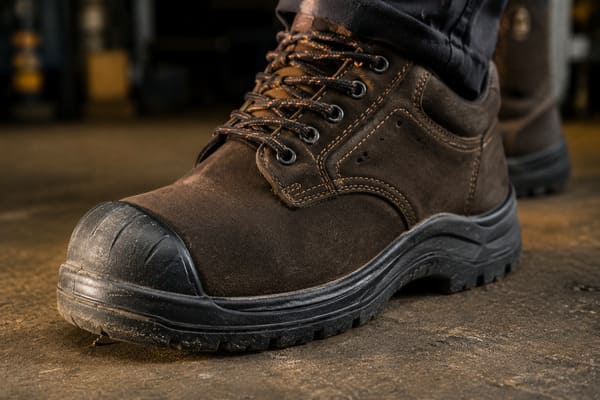
That conversation with the Middle East buyer is why I think material education matters before any order is placed. Nubuck is one of those materials that gets misunderstood constantly, and the misunderstanding costs buyers real money. Most buyers I talk to spend 80% of their questions on the toe cap — steel or composite — and maybe 5% on the upper material. But the worker spends 10 hours a day inside that upper. The leather choice affects breathability, break-in time, sweat accumulation, and how long the shoe actually lasts in the field.3 It deserves more attention. In this article, I want to break down exactly what nubuck leather is, how it compares to other materials, and whether it is the right choice for your next safety shoe order.
What Type of Leather Is Used in Safety Shoes?
Most buyers I speak with assume all leather is roughly the same. It is not. The upper material is one of the most important decisions in a safety shoe, and the differences between leather types are significant in real working conditions.
The most common upper materials in safety shoes are full-grain leather, split leather, nubuck, crazy horse leather, and synthetic PU.4 Each has a different strength, breathability level, and price point. Full-grain is the most durable. Split leather is the cheapest but cracks fastest.5 Nubuck sits between the two — strong, breathable, and comfortable.
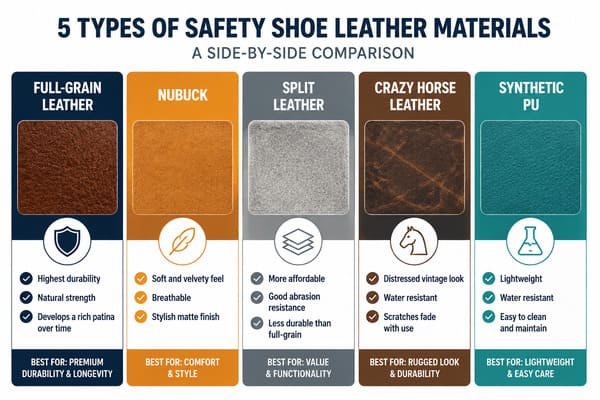
In my 20+ years in this industry, I have worked with almost every upper material on the market. Here is what I have seen across real production and real field use.
How Do the Main Leather Types Compare?
| Material | Source Layer | Durability | Breathability | Break-in Time | Typical Use Case |
|---|---|---|---|---|---|
| Full-grain leather | Outer grain | Highest | Moderate | 10–14 days | Premium safety shoes |
| Nubuck | Outer grain (buffed) | High | Good | 3–5 days | Mid-to-high end safety shoes |
| Crazy horse leather | Outer grain (waxed) | High | Low | 7–10 days | Outdoor and heavy-duty boots |
| Split leather | Inner split | Low | Poor | 2–3 days | Low-cost safety shoes |
| Synthetic PU | Man-made | Moderate | Poor | 1–2 days | Lightweight, budget footwear |
Full-grain leather is the strongest and most durable — it is what we use in our premium lines. Split leather is cheaper, but in my experience it starts cracking within 3 to 6 months under real working conditions. Synthetic PU is lightweight and low-cost, but breathability is poor and long-term durability does not compare. Crazy horse leather looks rugged and handles outdoor abuse well, but it is heavy. Nubuck sits in a specific sweet spot — it is made from the outer grain layer, so it keeps the structural strength of full-grain, but the surface treatment changes how it feels and performs entirely. For buyers looking at mid-to-high end safety shoes across a range of industries, nubuck is the material I recommend most consistently.
Is Nubuck Leather Good for Work Boots?
A few years ago, we ran an informal durability comparison in our factory — not a lab test, just real-world feedback collected from three clients in different industries. The results told me something specific about where nubuck works well and where it needs extra manufacturing support.
Yes, nubuck leather is good for work boots in most industrial environments. It offers strong abrasion resistance, better breathability than smooth leather, and a shorter break-in period. In wet or chemical-exposed conditions, it performs best when paired with a waterproof membrane lining and proper surface treatment.6
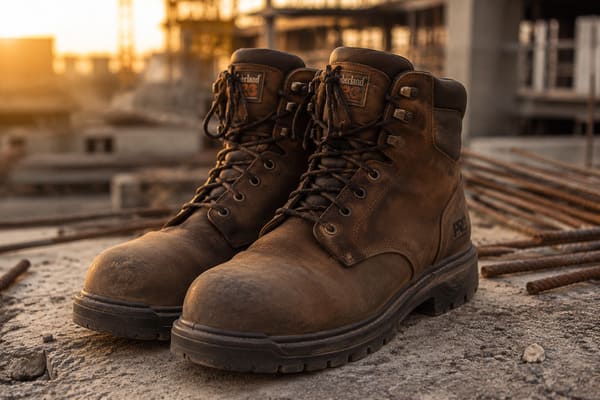
One client was a construction company in Southeast Asia, one was a warehouse operation in Germany, and one was a manufacturing plant in the UAE. All three were using nubuck upper safety shoes from our production line, in different environments and different conditions.
What Did Real-World Field Use Show?
After 12 months, the feedback from the construction and warehouse clients was consistently positive. The shoes held up well, workers found them comfortable from week one, and the abrasion on the upper was minor. The UAE client had mixed results — some workers in outdoor, wet-ground conditions reported the upper absorbing moisture after heavy rain.
| Environment | Performance | Key Finding |
|---|---|---|
| Construction (Southeast Asia) | Strong | Good abrasion resistance, comfortable from early use |
| Warehouse logistics (Germany) | Strong | Low odor complaints, consistent fit over time |
| Outdoor manufacturing (UAE) | Mixed | Moisture absorption in wet conditions without waterproof lining |
That told me something specific: nubuck performs well in dry to moderate environments, but it needs a waterproof membrane lining and surface treatment if it is going into wet or chemical-exposed conditions. Without that, you are setting the shoe up to fail. The leather itself is not the problem — the finishing decisions made during manufacturing are. This is exactly the kind of detail that separates a well-built safety shoe from one that looks good in a sample and disappoints in the field. When we produce nubuck safety shoes at Shoegan, the lining and surface treatment decisions are made based on the end-use environment, not just the visual finish. That is what mid-to-high end manufacturing actually means in practice.
What Makes Nubuck Leather Different from Regular Leather?
I explain this to buyers regularly, and the confusion usually comes from one place — nubuck and suede look similar on the surface, so people assume they are the same material. They are not.
Nubuck is made from the outer grain layer of cattle hide, lightly buffed to create a soft, velvety texture. Suede is made from the inner split of the hide, which is a weaker fiber layer.7 Nubuck keeps 85 to 90% of the structural integrity of full-grain leather.8 Suede does not.
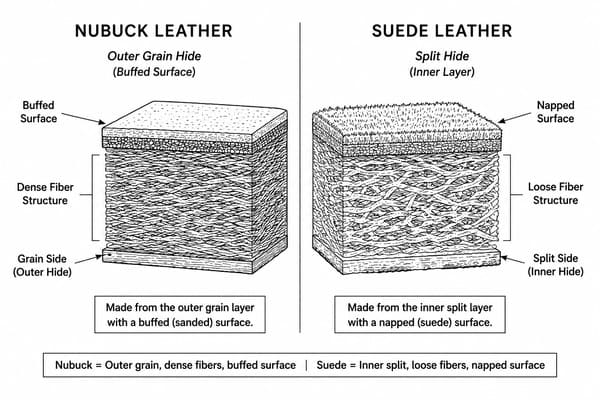
Imagine taking a piece of full-grain leather and lightly sanding the surface with very fine sandpaper. That is essentially what nubuck is. The hide used is the same top-grain, outer layer — the strongest, densest part of the animal hide. The buffing process creates a fine, velvety texture on the surface. Suede comes from the inner split of the hide — a weaker, looser fiber layer. This is why nubuck and suede look similar but perform very differently.
How Does the Buffing Process Affect Performance?
The surface buffing opens the fiber slightly. This does two things at once — it improves breathability, and it gives the leather a softer initial feel.9 The core density of the hide is not changed. This is why nubuck can offer better comfort than smooth full-grain leather while still maintaining strong structural performance.
| Property | Full-Grain Leather | Nubuck Leather | Suede Leather |
|---|---|---|---|
| Hide layer used | Outer grain | Outer grain (buffed) | Inner split |
| Surface texture | Smooth | Velvety | Soft, loose |
| Structural strength | Highest | High (85–90% of full-grain) | Low |
| Breathability | Moderate | Good | Moderate |
| Water resistance (untreated) | Good | Moderate | Poor |
| Break-in time | Long | Short to moderate | Very short |
In our production, we measure upper material thickness at 1.8mm to 2.0mm for nubuck safety shoes. That is the range where you get the right balance of flexibility and protection. Go thinner and durability drops. Go thicker and the break-in time increases significantly. This specific thickness range is something we have refined across hundreds of production runs, and it is one of the details that buyers rarely ask about but that directly affects how the shoe performs after the first week of use.
What Are the Key Benefits of Nubuck Leather in Safety Shoes?
After producing over 500,000 pairs of safety shoes across different upper materials, I have a clear picture of where nubuck performs and why. The benefits are not marketing language — they come from production data and field feedback.
The key benefits of nubuck leather in safety shoes are strong abrasion resistance, better breathability than smooth leather, faster break-in comfort, and a surface that maintains its appearance longer under daily working conditions. These make it well-suited for construction, manufacturing, and logistics environments.
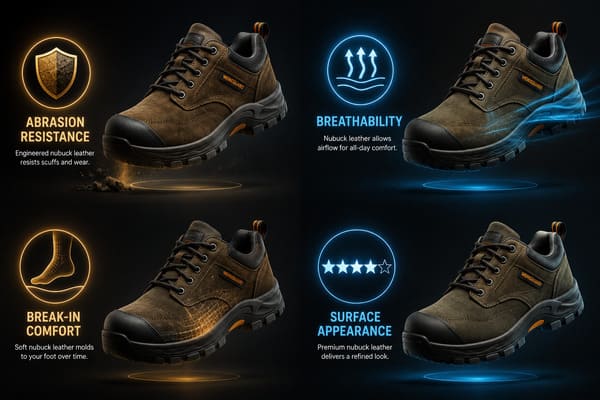
Here is what I have observed about nubuck specifically in real working conditions across the industries we serve.
How Does Nubuck Perform Across the Four Key Areas?
Abrasion resistance is the first thing buyers in construction and manufacturing care about. In our internal abrasion tests, nubuck upper samples consistently outperform PU synthetic and split leather at the same price point. The dense grain structure handles scuffing and surface contact well. For environments where the upper is in constant contact with rough surfaces, edges, or debris, this matters every single day.
Breathability is the second area where nubuck stands out. The buffed surface creates slightly more surface area for air exchange than smooth full-grain. Workers on 8 to 12-hour shifts report noticeably less moisture buildup inside nubuck shoes compared to smooth leather.10 This directly reduces odor — one of the top complaints I hear from end users every year. Odor and moisture buildup are not just comfort issues. They affect whether workers actually wear the safety shoes they are given, which is a compliance and safety issue for the buyer.11
Break-in comfort is something that smooth full-grain leather genuinely struggles with. Full-grain leather can take 10 to 14 days to soften to the foot. Nubuck typically breaks in within 3 to 5 days.12 That difference matters on a job site. An uncomfortable new shoe gets left at home, which means a worker is either in unsafe footwear or no safety footwear at all. A shoe that workers actually wear from day one is a better safety shoe, regardless of the protection spec on paper.
Surface appearance over time is the fourth benefit, and it matters more than buyers expect. Smooth leather shows every scratch and scuff clearly. Nubuck’s texture absorbs minor surface damage visually — small marks blend into the grain. A pair of nubuck safety shoes looks presentable for significantly longer without any maintenance. For buyers who care about brand image in the field, or who supply safety shoes to client-facing roles, this is a real advantage.
| Benefit | Why It Matters | Who It Affects Most |
|---|---|---|
| Abrasion resistance | Upper lasts longer under daily contact with rough surfaces | Construction, manufacturing |
| Breathability | Less moisture and odor buildup on long shifts | All industries, especially hot climates |
| Break-in comfort | Workers wear the shoes from day one | All industries |
| Surface appearance | Shoes look presentable longer without maintenance | Logistics, client-facing roles |
Nubuck is the right material for mid-to-high end safety shoes in construction, general manufacturing, and logistics environments. It is not the cheapest option, and it should not be. But when it is manufactured correctly — with the right thickness, lining, and surface treatment — it delivers a combination of comfort, durability, and performance that most other materials at the same price point simply do not match.
Conclusion
Nubuck leather offers a strong balance of durability, breathability, and comfort for safety shoes. The right material choice, paired with correct manufacturing decisions, determines real-world performance. At Shoegan, we build every pair around that principle — Built to Protect. Made to Last. Contact us at [email protected] to discuss your next order.
-
"Nubuck – Wikipedia", https://en.wikipedia.org/wiki/Nubuck. A leather materials reference describes nubuck as top-grain cattle leather that has been sanded or buffed on the grain side to produce a fine, velvety nap. Evidence role: definition; source type: encyclopedia. Supports: Nubuck leather is made from the outer grain layer of cattle hide and buffed to create a soft, velvety surface.. ↩
-
"Mechanical Parameters of Leather in Relation to Technological …", https://pmc.ncbi.nlm.nih.gov/articles/PMC9331295/. Leather science sources describe the grain layer as the densest and mechanically strongest part of hide, which provides contextual support for nubuck retaining much of full-grain leather’s strength; evidence on breathability and break-in comfort is more indirect and depends on finishing and shoe construction. Evidence role: mechanism; source type: paper. Supports: Nubuck keeps much of full-grain leather’s structural strength while improving breathability and break-in comfort.. Scope note: This would support the material mechanism contextually, not prove every nubuck safety shoe has superior breathability or comfort. ↩
-
"Influence of shoe upper structure on shoe microclimate and human …", https://pmc.ncbi.nlm.nih.gov/articles/PMC11191507/. Footwear comfort research links upper material properties such as water-vapour permeability, stiffness, and durability to thermal comfort, moisture accumulation, and wear performance, supporting the relevance of leather selection to safety-shoe performance. Evidence role: expert_consensus; source type: paper. Supports: Leather choice affects breathability, break-in time, sweat accumulation, and field durability of safety shoes.. Scope note: The source is likely to address footwear materials generally rather than this author’s specific product lines or field observations. ↩
-
"The Impact of Footwear on Occupational Task Performance and …", https://pmc.ncbi.nlm.nih.gov/articles/PMC9518076/. Occupational-footwear and leather technology references list natural leathers and synthetic polymers, including coated polyurethane materials, as common categories for shoe uppers, providing contextual support for the material categories named here. Evidence role: general_support; source type: institution. Supports: Full-grain leather, split leather, nubuck, crazy horse leather, and synthetic PU are common upper materials in safety shoes.. Scope note: A neutral source may verify the broad categories of upper materials but may not rank these exact five materials as the most common across all markets. ↩
-
"Usage Quality of Semi Processed Full Grain Leather – ResearchGate", https://www.researchgate.net/publication/362851541_Usage_Quality_of_Semi_Processed_Full_Grain_Leather. Leather technology literature explains that full-grain leather retains the dense grain surface while split leather is derived from lower layers with looser fiber structure, supporting the general durability hierarchy between full-grain and split leather. Evidence role: mechanism; source type: paper. Supports: Full-grain leather is generally more durable than split leather, while split leather is lower-cost and more prone to cracking.. Scope note: The statement about price and cracking speed is market- and finish-dependent; external evidence would support the general material hierarchy rather than an exact failure timeline. ↩
-
"Water vapor permeability of bovine leather for making professional …", https://www.academia.edu/66041456/Water_vapor_permeability_of_bovine_leather_for_making_professional_footwear. Safety-footwear standards and leather testing literature distinguish water penetration, water absorption, and chemical resistance as performance properties that require appropriate materials and treatments, supporting the need for membranes or finishes in wet or chemical environments. Evidence role: expert_consensus; source type: institution. Supports: Nubuck safety footwear used in wet or chemical-exposed conditions benefits from waterproof lining and surface treatment.. Scope note: This supports the design principle generally; the required construction depends on the specific hazard, chemical, and applicable safety standard. ↩
-
"Suede", https://en.wikipedia.org/wiki/Suede. Leather references define suede as leather finished from the flesh side or split layer and describe split layers as having a looser fiber network than the grain layer, supporting the distinction between suede and nubuck. Evidence role: definition; source type: encyclopedia. Supports: Suede is made from the inner split of the hide and is structurally weaker than grain-layer leather.. Scope note: The degree of weakness depends on hide quality, split thickness, tanning, and finishing. ↩
-
"[PDF] Improving Tearing Resistance of Leather – Part 2 Prevention and …", https://journals.uc.edu/index.php/JALCA/article/download/4694/3617/6018. Mechanical testing studies on buffed or corrected-grain leathers can document how surface abrasion affects tensile, tear, or flex strength relative to full-grain leather, which would be needed to substantiate any percentage retention claim. Evidence role: statistic; source type: paper. Supports: Nubuck retains about 85–90% of the structural integrity of full-grain leather.. Scope note: The exact 85–90% figure may not be generalizable without specifying hide type, tanning method, buffing depth, thickness, and test method. ↩
-
"[PDF] Factors affecting the water-vapor permeability of leather", https://nvlpubs.nist.gov/nistpubs/jres/44/jresv44n4p347_A1b.pdf. Leather and footwear-material studies measuring water-vapour permeability and softness after mechanical finishing would support the mechanism that surface buffing changes hand feel and moisture transport. Evidence role: mechanism; source type: paper. Supports: Surface buffing can increase softness and influence breathability by altering the leather surface.. Scope note: The effect size depends on buffing depth, finish chemistry, thickness, and lining construction, so the evidence would be mechanistic rather than universal. ↩
-
"Influence of Upper Footwear Material Properties on Foot Skin …", https://pmc.ncbi.nlm.nih.gov/articles/PMC9518374/. Occupational footwear comfort research shows that water-vapour permeability and heat-moisture management of upper materials affect perceived dampness during prolonged wear, providing contextual support for the reported worker feedback. Evidence role: general_support; source type: paper. Supports: Breathable upper materials can reduce perceived moisture buildup during long work shifts, and nubuck may be perceived as drier than smooth leather.. Scope note: This does not independently verify the author’s worker reports or prove nubuck outperforms every smooth leather; it supports the underlying comfort mechanism. ↩
-
"PPE Heat Burden", https://www.cdc.gov/niosh/heat-stress/recommendations/ppe.html. Occupational safety literature on personal protective equipment compliance identifies comfort, fit, heat, and user acceptability as factors affecting whether workers consistently wear required protective equipment. Evidence role: expert_consensus; source type: government. Supports: Comfort and moisture-related discomfort can affect worker compliance with required safety footwear.. Scope note: Most PPE compliance studies address multiple PPE types; application to safety footwear is relevant but may be partly extrapolated unless the source is footwear-specific. ↩
-
"The Impact of Footwear on Occupational Task Performance and …", https://pmc.ncbi.nlm.nih.gov/articles/PMC9518076/. Footwear ergonomics studies identify upper stiffness and material flexibility as factors in perceived break-in and comfort, offering contextual support for comparing break-in behavior between leather uppers. Evidence role: general_support; source type: paper. Supports: Leather upper stiffness influences break-in time, and nubuck may require less break-in than smooth full-grain leather.. Scope note: The exact 10–14 day and 3–5 day figures appear to be manufacturer experience and may not be directly verified by independent studies. ↩