
Most buyers focus on the toe cap and the sole. Ankle protection is the part they don’t think about — until someone gets hurt.
Ankle protection in safety boots refers to the structural design around the collar and upper ankle zone that controls lateral movement, absorbs impact, and reduces the risk of twisting or spraining. It includes padding, rigid guards, internal frames, and collar engineering — not just boot height.
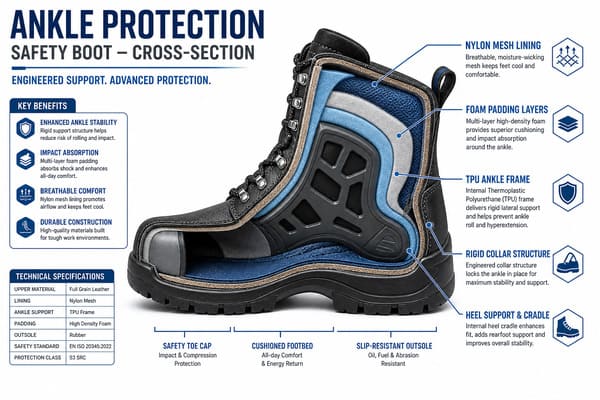
I remember a client from the Middle East who came to us after one of his workers twisted his ankle on a construction site. The boots weren’t cheap — steel toe, solid sole, everything looked right on paper. But when we opened up the boot, there was nothing supporting the ankle zone at all. Just a thin layer of fabric stitched to the upper. That injury cost his company three weeks of lost labor and a compensation claim. After 20 years in this industry, I’ve learned that the ankle is where stability starts. If the boot doesn’t control that zone, everything else — the toe cap, the sole, the certification — matters a lot less than people think. I want to walk through exactly how ankle protection is designed, what structures work, and what materials we use at Shoegan to get this right.
Why Does Ankle Protection Matter in Safety Boots?
The ankle carries constant stress on the job — uneven ground, heavy loads, sudden direction changes all push it to its limit.
According to the U.S. Bureau of Labor Statistics, ankle and foot injuries account for over 60,000 workplace injuries every year in the U.S. alone1. A twisted ankle is one of the most common, and it is almost entirely preventable with the right boot design2.

What I find frustrating is that many cheap boots claim "high-cut design" as ankle protection. But a high collar with no internal structure is just fabric. I’ve tested boots from competitors where the collar was 18cm tall but had less than 5mm of foam padding and zero lateral reinforcement. That’s not protection. That’s marketing.
Height Alone Is Not Protection
Real ankle protection is structural, not cosmetic. The height of a boot tells you almost nothing about its ability to resist lateral force. What actually matters is what’s built inside the collar — the materials, the frame, and how the collar responds when the ankle rolls under load.
| Design Feature | What It Does | Is It Protective? |
|---|---|---|
| High collar only | Covers the ankle | No — without structure, it bends with the ankle |
| Foam padding | Adds cushion and reduces abrasion | Partially — comfort, not lateral control |
| Rigid ankle guard | Resists lateral impact and rolling | Yes — direct structural protection |
| Internal TPU/nylon frame | Controls ankle flex without full rigidity | Yes — best balance for most work environments |
Many buyers don’t ask about internal construction because they can’t see it. We always open up samples and show the cross-section to clients during product reviews. If a supplier won’t do that, that tells you something.
What Are the Common Ankle Protection Structures Used in Safety Boots?
Most workers get hurt not because they wore the wrong size — they got hurt because the boot had no structure where structure was needed most.
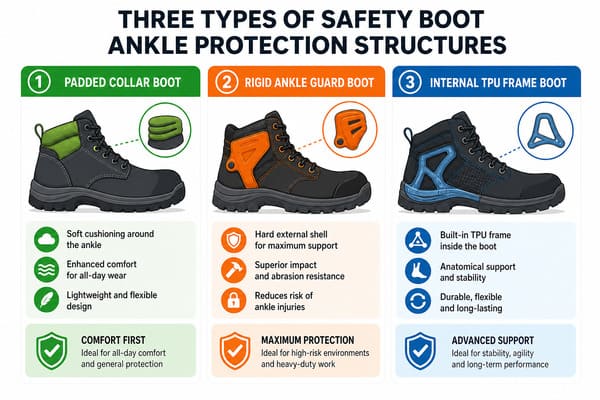
The three main ankle protection structures in safety boots are: the padded collar, the rigid ankle guard, and the internal TPU or nylon ankle frame. Each suits different work environments, and choosing the wrong one for the job increases injury risk regardless of other boot features.
From hundreds of custom projects over the years, I’ve seen which structures actually work and which ones only look good on a spec sheet.
Padded Collar, Rigid Guard, and Internal Frame — What’s the Difference?
The padded collar is soft, comfort-first, and good for logistics and light manufacturing where the main goal is all-day wearability. It reduces friction and adds some basic cushioning, but it provides minimal lateral control.
The rigid ankle guard is impact-rated and built for environments where falling objects and unstable ground are real risks. We use this most often for mining clients.3 It adds real structural resistance but can reduce flexibility and increase fatigue on long shifts.
The internal TPU or nylon ankle frame is the middle ground — supportive without being stiff4, and it’s what most of our mid-to-high end boots at Shoegan are built around. It guides ankle movement rather than blocking it completely.
| Structure Type | Best Environment | Lateral Support | Comfort Level |
|---|---|---|---|
| Padded collar | Logistics, light manufacturing | Low | High |
| Rigid ankle guard | Mining, heavy construction | High | Moderate |
| Internal TPU/nylon frame | General industry, warehousing | Moderate–High | High |
One client in Australia ordered 2,000 pairs for a warehouse operation. They originally spec’d a padded collar only. We recommended adding an internal TPU frame after reviewing their incident report — 7 out of their last 12 foot injuries were ankle rolls, not toe impacts5. They agreed to the change. Zero ankle injury reports in the 8 months after switching. That’s what choosing the right structure actually means in practice.
How Does the Collar Design Affect Ankle Support and Comfort?
A collar that’s too stiff creates blisters within a week. A collar that’s too soft gives the ankle nothing to work with.
The collar design directly affects how much support the ankle receives and how comfortable the boot feels over a full work shift. Key factors include collar height, foam density, lining material, and the placement of the flex point relative to the worker’s actual ankle joint.
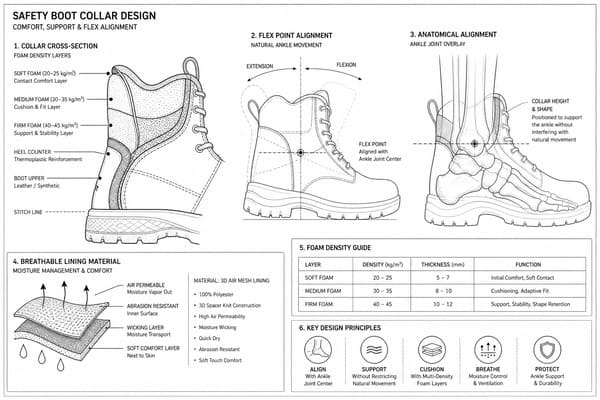
This is where I spend the most time with ODM clients — because the collar is the part the worker feels every single day, from the first hour to the tenth hour of a shift.
The Flex Point Problem Most Manufacturers Ignore
I once visited a factory in Guangdong where workers had literally cut the collars off their safety boots with scissors. The collar was rubbing against their ankles so badly they couldn’t finish a full shift. When I looked at the boot, the flex point of the collar was sitting 2cm above the natural ankle joint. That 2cm misalignment was causing the edge of the collar to dig in every time the worker took a step. A small design mistake. A big daily problem.
| Collar Variable | If Wrong | If Right |
|---|---|---|
| Flex point placement | Collar edge digs into ankle on every step | Collar moves with the joint naturally |
| Foam density | Too hard causes pressure points, too soft gives no support | Balanced — cushion with structure |
| Collar height | Too high restricts movement, too low gives no coverage | Matched to the work task |
| Lining material | Rough lining causes abrasion over long shifts | Breathable, smooth lining reduces friction |
The foam density, the lining material, the collar height, and the flex point all have to be calibrated together. At Shoegan, we prototype at least three collar variations for every new custom style before we approve a final sample. This process adds time. It also eliminates the kind of complaints that make workers reach for scissors.
What Materials Are Used for Ankle Protection in Safety Boots?
The right material in the wrong environment fails quietly — and the worker pays for it.
Common materials used for ankle protection in safety boots include high-density EVA foam, TPU ankle guards, nylon internal frames, and low-temperature flexible foam compounds. Material selection must match the specific work environment, especially temperature, load type, and shift length.
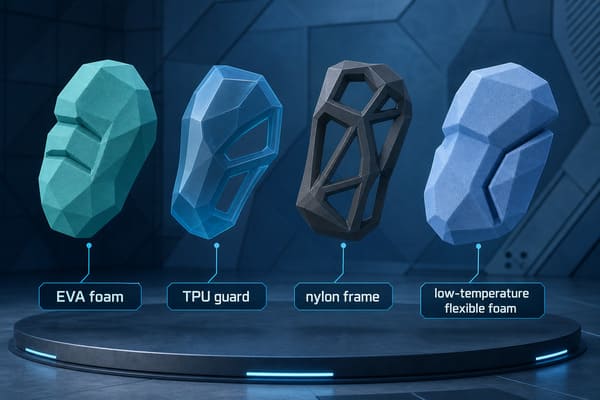
Material choice is driven by the work environment, and this is where most manufacturers make mistakes — they pick a material that looks good at room temperature and never test it under real conditions.
What Happens to Ankle Materials Under Real Conditions
For construction and logistics, we use high-density EVA foam collars with a nylon mesh lining — light, breathable, and cushioned without being heavy6. For mining and heavy industry, we use TPU ankle guards, sometimes co-molded directly into the upper, which provide real lateral impact resistance under load7.
Cold storage is where most manufacturers get it seriously wrong. Standard foam loses its flexibility below -10°C and becomes rigid — which means it stops absorbing impact exactly when the worker needs it most8.
We had a client in Scandinavia buying boots from another supplier for their -20°C cold storage facility. Workers kept complaining the boots felt "hard and stiff" in the ankle zone after just 30 minutes inside the freezer. When we tested the competitor’s foam at -20°C, compression recovery dropped by over 60%9. We switched them to a low-temperature flexible foam compound. The complaints stopped within the first month10.
| Material | Best Environment | Key Property | Limitation |
|---|---|---|---|
| High-density EVA foam | Construction, logistics | Lightweight, cushioned | Loses flexibility below -10°C |
| TPU ankle guard | Mining, heavy industry | Impact-resistant, lateral control | Heavier, less flexible |
| Nylon internal frame | General manufacturing | Supportive, lightweight | Less impact resistance than TPU |
| Low-temp flexible foam | Cold storage, freezer facilities | Retains flexibility at -20°C | Higher material cost |
Material selection isn’t just a spec sheet decision. It’s about knowing what happens to that material at 6am on a cold warehouse floor — and designing for that moment, not for the showroom.
Conclusion
Ankle protection in safety boots is structural, material-specific, and directly tied to real injury outcomes. Height alone means nothing without the engineering behind it. If you’re sourcing safety boots for industrial use, Shoegan builds every boot from the ankle out — certified, customizable, and built to last.
-
"IIF Home : U.S. Bureau of Labor Statistics", https://www.bls.gov/iif/. The U.S. Bureau of Labor Statistics publishes annual nonfatal occupational injury data by body part affected, including foot and ankle injuries, in its Survey of Occupational Injuries and Illnesses (SOII); the specific figure cited should be verified against the most recent SOII release for the relevant reference year. Evidence role: statistic; source type: government. Supports: Annual count of occupational ankle and foot injuries in the United States as recorded by the BLS. Scope note: BLS injury counts vary by year and industry classification; the 60,000 figure may aggregate multiple body-part categories and should be confirmed against the primary dataset. ↩
-
"The Impact of Footwear on Occupational Task Performance …", https://pmc.ncbi.nlm.nih.gov/articles/PMC9518076/. Research in occupational biomechanics and industrial safety consistently identifies lateral ankle sprains as among the most frequent lower-extremity workplace injuries and highlights footwear lateral support as a recognized risk-reduction measure (see, e.g., NIOSH musculoskeletal disorder prevention guidance). Evidence role: expert_consensus; source type: research. Supports: That ankle sprains are a leading occupational musculoskeletal injury and that supportive footwear design is an established preventive intervention. Scope note: Evidence specifically isolating boot collar design as the dominant preventive variable—versus other factors such as terrain, training, or PPE combinations—is limited in controlled occupational studies. ↩
-
"Regulations | Mine Safety and Health Administration (MSHA)", https://www.msha.gov/regulations. The U.S. Mine Safety and Health Administration (MSHA) and equivalent international bodies specify personal protective equipment requirements for mining operations, including footwear standards that address ankle and metatarsal protection in high-hazard terrain. Evidence role: general_support; source type: government. Supports: That mining and heavy-industry environments impose ankle impact and lateral instability hazards that require reinforced ankle protection in safety footwear. Scope note: Regulatory requirements specify minimum performance criteria rather than prescribing specific structural design choices such as rigid versus semi-rigid ankle guards. ↩
-
"The Effect of EVA and TPU Custom Foot Orthoses on Running …", https://pmc.ncbi.nlm.nih.gov/articles/PMC7739627/. Thermoplastic polyurethane is characterized in polymer engineering literature by a tunable balance of hardness, elasticity, and impact resistance, properties that make it a common choice for load-bearing structural inserts in footwear applications. Evidence role: mechanism; source type: research. Supports: The mechanical properties of TPU that make it suitable for ankle support applications requiring both flexibility and structural resistance. Scope note: Performance in a specific boot ankle frame depends on formulation, thickness, and geometry; general TPU material properties do not directly predict in-boot biomechanical outcomes without product-level testing data. ↩
-
"Epidemiology of Ankle Sprains and Chronic Ankle Instability", https://pmc.ncbi.nlm.nih.gov/articles/PMC6602402/. BLS Survey of Occupational Injuries and Illnesses data for the transportation and warehousing sector document the distribution of lower-extremity injuries by nature and body part, providing context for comparing ankle sprain frequency against contact or struck-by toe injuries in this industry. Evidence role: general_support; source type: government. Supports: That ankle sprains are a significant and frequently underestimated injury type in warehouse and logistics environments relative to toe-impact injuries. Scope note: A single client’s 12-incident sample is not statistically representative; sector-level BLS data provides population-level context but cannot validate the specific client case described. ↩
-
"Nanocomposite Foams with Balanced Mechanical Properties …", https://pmc.ncbi.nlm.nih.gov/articles/PMC9968182/. Ethylene-vinyl acetate (EVA) copolymer foams are widely documented in materials engineering literature for their low density, resilient cushioning behavior, and resistance to compression set at moderate temperatures, characteristics that underpin their use as midsole and collar padding in footwear applications. Evidence role: general_support; source type: research. Supports: The physical properties of high-density EVA foam—including cushioning, weight, and density-dependent stiffness—that make it a common padding material in occupational footwear. Scope note: General EVA material properties reported in the literature may not directly correspond to the specific density and formulation used in any particular product; performance claims should ideally be substantiated by standardized footwear component tests. ↩
-
"Analysis of the Impact Resistance of Toecaps by the Finite Element …", https://pmc.ncbi.nlm.nih.gov/articles/PMC9819023/. The European standard EN ISO 20345 and related safety footwear standards specify performance requirements and test methods for protective footwear, including provisions addressing ankle and metatarsal protection; co-molded rigid components are among the structural solutions evaluated under these frameworks. Evidence role: general_support; source type: institution. Supports: That standardized test methods exist for evaluating lateral impact and ankle protection performance in safety footwear. Scope note: Passing a standardized ankle protection test confirms minimum threshold performance rather than comparative superiority of co-molded TPU over alternative design approaches. ↩
-
"Nanocomposite Foams with Balanced Mechanical Properties …", https://pmc.ncbi.nlm.nih.gov/articles/PMC9968182/. Polymer physics research documents that foamed elastomers approach their glass-transition temperature range at low ambient temperatures, resulting in increased dynamic stiffness and reduced energy-absorption capacity; the precise transition temperature depends on foam chemistry and density. Evidence role: mechanism; source type: research. Supports: That common foam materials used in footwear padding exhibit reduced flexibility and energy absorption at sub-zero temperatures. Scope note: The -10°C figure is a general approximation; actual onset of stiffness varies by foam type, and cold-environment footwear standards such as EN ISO 20347 specify test methods that may be more authoritative than any single threshold value. ↩
-
"A Review of Research on the Effect of Temperature on … – PMC", https://pmc.ncbi.nlm.nih.gov/articles/PMC9654075/. Material science literature and standardized cold-temperature compression tests (e.g., ISO 1817, ASTM D395) document that closed-cell foam elastomers, including EVA, undergo substantial increases in stiffness and reductions in elastic recovery at temperatures below approximately -10°C due to glass-transition effects. Evidence role: mechanism; source type: research. Supports: That EVA and standard polyurethane foams exhibit significantly reduced compression recovery at sub-zero temperatures. Scope note: The specific -60% compression recovery figure cited in the article is an internal test result and has not been independently verified; the magnitude of degradation varies with foam formulation, density, and test protocol. ↩
-
"An explorative qualitative study to determine the footwear needs of …", https://pmc.ncbi.nlm.nih.gov/articles/PMC5577656/. Standards for protective footwear used in cold environments, including EN ISO 20347 and cold-insulation requirements within EN ISO 20345, prescribe low-temperature flexibility tests to ensure that midsole and upper materials retain adequate mechanical performance at sub-zero temperatures; these requirements implicitly recognize the degradation of standard foam compounds in cold conditions. Evidence role: general_support; source type: institution. Supports: That specialized footwear material formulations are required to maintain cushioning and flexibility performance in cold-storage and freezer work environments. Scope note: The article’s claim that worker complaints ceased is based on a single client report and does not constitute controlled evidence that material substitution reduced injury incidence. ↩