
I have been making safety shoes for over 20 years. In that time, I have seen countless lacing designs come and go. The average worker breaks two laces in six months1. Nobody talks about it, but it happens on every single pair. In 2019, I put a BOA system on one of our safety shoe samples for the first time. A worker tried it on, turned the dial, and said: "What is this thing? How long will it last?" That one question captured what everyone wanted to know. So that is where this article begins.
A BOA closure system in safety shoes uses a stainless steel wire, a precision dial, and a set of low-friction guides to replace traditional laces. Turning the dial tightens or loosens the wire evenly across the foot. One click gives a secure, consistent fit. One pull releases the entire system.
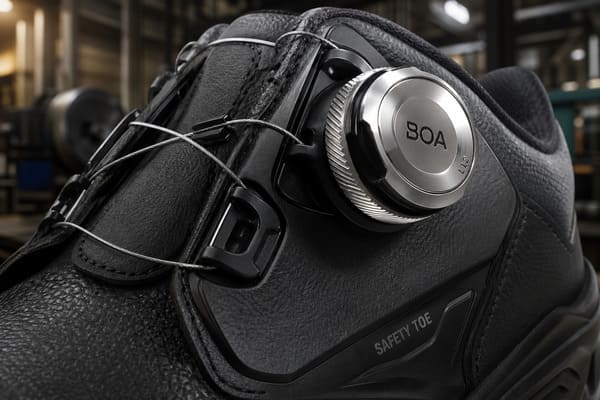
BOA is not just a design feature. It changes how a safety shoe fits and performs over a full working day. But like any system, it has real strengths and real limits. I want to walk through both honestly, because we have built these shoes ourselves and we have seen what works and what fails in the field.
How Does a BOA Closure System Work in Safety Shoes?
Most people look at the dial and think that is the technology. It is not. The dial is just the interface. The real engineering is in the wire.
A BOA system works through three components: a 0.45mm stainless steel wire2, a ratchet dial that controls tension, and a series of low-friction guide channels stitched or anchored into the shoe upper. Turning the dial pulls the wire through the guides, applying even pressure across the foot.
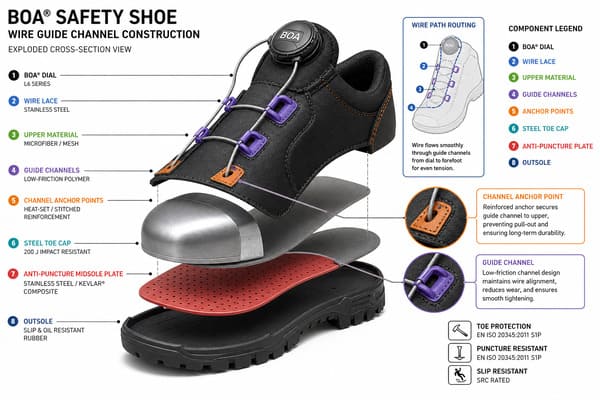
When we made our first BOA safety shoe sample, our engineer spent three full days adjusting the wire routing path alone. Safety shoes are structurally different from running shoes. They have a steel toe cap and an anti-puncture steel midsole plate3. Those components change where the shoe bends, how the upper flexes, and where pressure concentrates when the wire is pulled tight.
If the guide channels are placed in the wrong positions, tightening the dial pushes all the pressure onto one point on the top of the foot. We had a worker test an early sample and he said his foot felt pinched after 20 minutes4. We moved the guide channel positions five times before the pressure distributed evenly across the whole foot.
Why Wire Routing Matters More Than the Dial
The BOA brand will not tell you this. They provide the components and the specifications. But they do not design your shoe for you5. The routing is entirely up to the manufacturer.
| Routing Issue | What Happens to the Worker |
|---|---|
| Guides too close together | Pressure concentrates, foot feels pinched |
| Guides too far apart | Wire lifts off the upper, fit feels loose |
| Guide anchored with glue only | Guide detaches after 6–8 weeks of flexing |
| Guide stitched and glued | Guide stays fixed, wire tracks correctly |
The difference between a BOA safety shoe that works and one that fails is almost always in how the manufacturer integrates the system, not in the BOA components themselves.
What Are the Benefits of BOA Lacing System for Work Boots?
Traditional laces do not stay tight. That is the core problem. Workers bend, squat, walk, and climb all day. Every movement works the knot loose, slowly and steadily.
The main benefit of a BOA lacing system for work boots is consistent tension throughout the full working day. Unlike traditional laces that loosen with movement, the BOA wire holds its set tension. This reduces foot movement inside the shoe, which lowers fatigue and lowers the risk of ankle injury6.
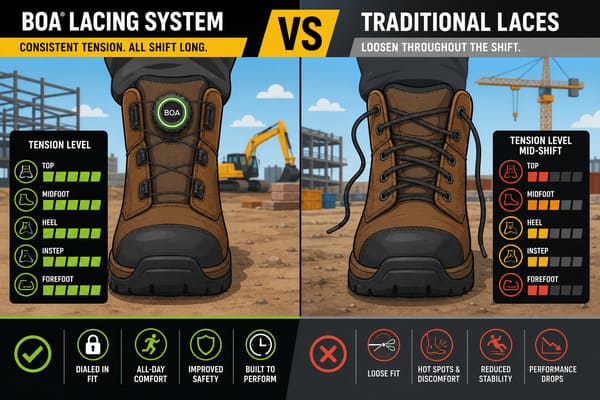
One of our clients bought 800 pairs of safety shoes for a construction project in the Middle East. Workers were on site for 10 hours a day in 40-degree heat. By mid-afternoon, traditional laces were loose on most pairs. Workers did not re-tie them. Their feet moved inside the shoe. The upper deformed under that constant friction. Within three months, 60 pairs had been complained about for upper deformation.
He switched to our BOA model for the next order. Same work conditions, same workers, same hours. After six months, the complaint count dropped to seven pairs.
What BOA Actually Protects Against
The marketing language around BOA focuses on speed and convenience. That is real, but it is not the most important benefit for industrial use. The more important benefit is what consistent tension prevents over time.
| Risk Factor | Traditional Laces | BOA System |
|---|---|---|
| Lace loosening during shift | Common after 2–3 hours | Does not occur |
| Foot sliding inside shoe | Increases as lace loosens | Stays controlled |
| Ankle lateral support | Degrades through the day | Stays consistent |
| Re-tying required mid-shift | Yes, often skipped | Not required |
| Upper deformation from friction | Higher risk | Lower risk |
For workers doing long shifts in demanding conditions, BOA is not a convenience feature. It is a protection feature. The shoe fits the same at hour one as it does at hour ten.
Is BOA Closure System More Durable Than Traditional Laces in Safety Footwear?
BOA publishes clear durability data. Their dial mechanism is tested to 100,000 micro-adjustment cycles7. Their stainless steel wire has a break strength more than eight times higher than a standard cotton lace8. On paper, there is no comparison.
A BOA closure system is significantly more durable than traditional laces when it is correctly integrated into the shoe. The wire resists abrasion, UV exposure, and chemical contact far better than fabric laces. However, the durability of the full system depends heavily on how the manufacturer anchors the guide channels inside the shoe.
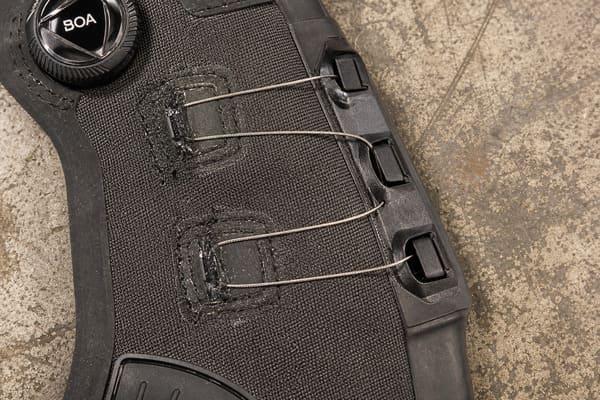
I have seen BOA safety shoes fail within six months. Not because of the BOA components, but because of how another factory integrated them. They used standard adhesive to fix the guide channels to the upper. No stitching, no mechanical anchor. After two months of daily flexing, the guides started to detach. Once a guide detaches, the wire loses its path. The dial still turns, but the tension no longer distributes correctly. The system effectively stops working.
Where Durability Actually Comes From
When a buyer asks me "Is BOA durable?", I always redirect the question. The right question is: "Does this factory know how to integrate BOA correctly?"
| Durability Factor | Low-Quality Integration | Proper Integration |
|---|---|---|
| Guide channel fixing method | Adhesive only | Stitched and adhesive bonded |
| Wire path design | Generic, unadjusted | Designed for specific shoe structure |
| Upper material at guide points | Standard fabric | Reinforced at anchor points |
| Expected system lifespan | 3–6 months | 12–18 months under normal use |
| Failure mode | Guide detachment, wire derails | Dial wear after extended use |
At Shoegan, we have been integrating BOA systems since 2019. We reinforce every guide anchor point with both stitching and structural bonding. We route the wire based on the specific toe cap and midsole plate geometry of each shoe model. That process takes more time. But it is the only way to make the durability claim honest.
What Are the Disadvantages of BOA Boots?
I want to be direct here, because these are problems we have encountered ourselves.
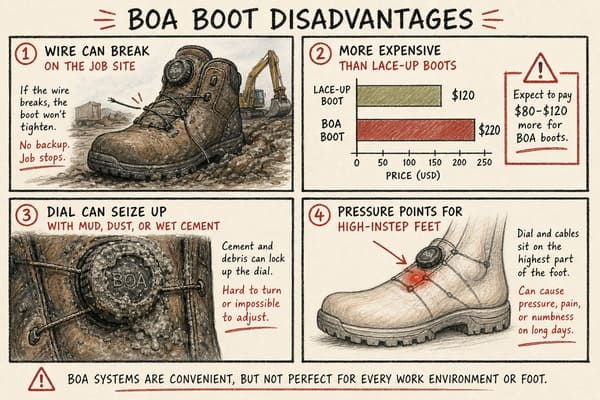
The main disadvantages of BOA boots are: the wire cannot be repaired on-site if it breaks, the system adds 8 to 15 USD to the cost per pair, the dial can seize in heavy contamination environments, and the fixed pressure points do not suit all foot shapes.
No On-Site Repair When the Wire Breaks
A traditional lace breaks and a worker pulls a spare from his bag in two minutes. A BOA wire breaks and the worker has no option. He cannot fix it on site. He has to change shoes.
We had a client using BOA safety shoes at a remote mining site in Indonesia. One worker’s wire broke. The nearest replacement parts were three days away by delivery. That worker spent three days in a shoe that did not fit correctly. That is a real safety risk, and BOA’s lifetime warranty does not solve a problem that happens on a Tuesday morning in the field9.
Higher Cost Per Pair
BOA charges a licensing fee for their system. That fee adds approximately 8 to 15 USD to the cost of each pair10, depending on the dial model. For buyers in price-sensitive markets who need high volumes at low unit cost, this is often not acceptable. BOA safety shoes are mid-to-high end products. They are not the right answer for every procurement situation.
Dial Seizing in Heavy Contamination
We ran our own tests on this. After four hours of work in a wet cement environment, approximately 30% of the dials showed increased rotational resistance11. Some seized completely. Clearing a seized dial requires disassembling the mechanism. Most workers on site do not know how to do that.
Not the Right Fit for Every Foot Shape
Traditional laces allow section-by-section tension adjustment. A worker with a high instep can loosen the top two eyelets and keep the bottom ones tight. BOA applies tension along a fixed wire path. Workers with very high insteps or wide feet sometimes find BOA less comfortable than traditional laces, because the pressure points cannot be individually adjusted12.
| Work Environment | BOA Recommended? |
|---|---|
| Precision manufacturing | Yes |
| Logistics and warehousing | Yes |
| General construction | Yes |
| Wet cement or concrete work | No |
| Chemical processing | No |
| Heavy mud or slurry environments | No |
| Remote sites with no supply access | Use with caution |
BOA is not a universal solution. It performs well in controlled or semi-controlled environments. It is not the right choice for every job site.
Conclusion
BOA offers real advantages in fit consistency and durability. But the system only works as well as the manufacturer who builds it into the shoe. Choose the factory, not just the feature.
Shoegan builds BOA safety shoes with over 15 years of manufacturing experience. Contact us at [email protected] to discuss your requirements.
-
"What’s the Impact of Safety Footwear on Workers Concerning Foot … – PMC", https://pmc.ncbi.nlm.nih.gov/articles/PMC11311279/. Empirical data on lace failure rates in occupational footwear would substantiate this claim; in the absence of a dedicated study, general occupational footwear maintenance surveys may provide contextual support. Evidence role: statistic; source type: research. Supports: The frequency with which industrial workers experience shoelace breakage or failure during normal use. Scope note: No widely published peer-reviewed study appears to directly measure lace breakage frequency in industrial settings; any cited source is likely to offer only indirect or anecdotal support. ↩
-
"BOA® Fit System | Dialed In. Precision Fit.", https://www.boafit.com/en-us. BOA Technology’s published OEM technical specifications describe the wire diameter and material composition used across their closure system product lines. Evidence role: definition; source type: institution. Supports: The precise wire diameter and material composition used in the BOA Fit System. Scope note: Wire specifications may vary across BOA product tiers and model generations; a single cited specification may not apply universally to all BOA systems used in safety footwear. ↩
-
"1910.136 – Foot protection. | Occupational Safety and … – OSHA", https://www.osha.gov/laws-regs/regulations/standardnumber/1910/1910.136. International safety footwear standards such as EN ISO 20345 and ASTM F2413 specify the mandatory protective components in safety shoes, including steel or composite toe caps and anti-puncture midsole elements, which materially affect upper flexibility and closure system integration. Evidence role: definition; source type: government. Supports: The structural requirements for steel toe caps and anti-puncture midsole plates in certified safety footwear. Scope note: Standards define minimum protective requirements but do not prescribe the mechanical implications for closure system routing; the biomechanical consequences described in the article reflect manufacturer experience rather than standardised testing. ↩
-
"Testing the effects of footwear on biomechanics of human body", https://pmc.ncbi.nlm.nih.gov/articles/PMC11904544/. Biomechanical research on shoe closure systems documents how wire or lace routing geometry influences pressure distribution across the foot dorsum, with uneven routing associated with focal high-pressure zones. Evidence role: mechanism; source type: research. Supports: The relationship between footwear closure routing and localised pressure concentration on the dorsal foot. Scope note: Most peer-reviewed studies focus on athletic or diabetic footwear rather than industrial safety shoes with steel components; findings may not translate directly to the structural constraints described. ↩
-
"BOA® Fit System | Dialed In. Precision Fit.", https://www.boafit.com/en-us. BOA Technology’s published OEM partnership materials describe the components, specifications, and integration guidelines provided to licensed manufacturers, with wire routing and guide placement typically customised by the footwear manufacturer based on their specific last and construction. Evidence role: general_support; source type: institution. Supports: The extent to which BOA Technology provides design guidance versus leaving wire routing decisions to licensed footwear manufacturers. Scope note: The degree of technical support BOA provides to partners may vary by contract tier and has not been independently documented in peer-reviewed or regulatory sources; the characterisation reflects the article author’s manufacturing experience. ↩
-
"The Impact of Footwear on Occupational Task Performance …", https://pmc.ncbi.nlm.nih.gov/articles/PMC9518076/. Research in occupational biomechanics indicates that intra-shoe foot movement, which increases as footwear closure loosens, is associated with elevated shear forces and a higher incidence of ankle instability events during prolonged standing and walking tasks. Evidence role: mechanism; source type: research. Supports: The role of consistent shoe fit and upper tension in reducing intra-shoe foot movement, lower-limb fatigue, and ankle injury risk during prolonged occupational use. Scope note: Direct studies comparing BOA-specific closures with traditional laces in occupational settings are limited; the mechanistic link is supported by general footwear fit literature rather than system-specific trials. ↩
-
"Are Zipper Safety Shoes as Secure as Lace-Up Safety Shoes?", https://protectyourfootsafety.com/are-zipper-safety-shoes-as-secure-as-lace-up-safety-shoes/. BOA Technology’s product documentation and warranty materials describe the cycle-tested durability ratings for their dial mechanisms used in licensed footwear applications. Evidence role: statistic; source type: institution. Supports: The number of operational cycles to which the BOA dial mechanism has been tested for durability. Scope note: Cycle-testing protocols and conditions are set by the manufacturer; independent third-party validation of this figure has not been identified in the public literature. ↩
-
"Comparison of strength, elongation and evenness of …", https://ir.library.oregonstate.edu/downloads/z029p7629. Material science data on the tensile properties of fine stainless steel wire and braided cotton cord can provide a basis for comparative break-strength claims, though the specific ratio cited depends on the grade and construction of both materials tested. Evidence role: statistic; source type: research. Supports: The comparative tensile break strength of stainless steel wire versus standard cotton shoelace materials. Scope note: The comparison is sensitive to the specific grade of stainless steel wire and the construction of the cotton lace used as baseline; generalised material data may not exactly replicate the manufacturer’s test conditions. ↩
-
"Are Zipper Safety Shoes as Secure as Lace-Up Safety Shoes?", https://protectyourfootsafety.com/are-zipper-safety-shoes-as-secure-as-lace-up-safety-shoes/. BOA Technology publicly offers a performance guarantee covering wire and dial failures, with replacement components available through their warranty programme; the terms and fulfilment process are documented on their official website. Evidence role: general_support; source type: institution. Supports: The existence and scope of BOA Technology’s warranty or guarantee programme covering wire and dial failures in licensed footwear. Scope note: Warranty fulfilment depends on geographic availability of replacement parts and the end-user’s ability to access the replacement programme, which may be impractical in remote or low-infrastructure work environments as the article describes. ↩
-
"BOA® Fit System | Dialed In. Precision Fit.", https://www.boafit.com/en-us. The article cites an approximate per-pair cost addition of 8 to 15 USD attributable to BOA licensing; this figure reflects manufacturer experience and is consistent with industry-reported ranges for licensed closure system components, though BOA does not publicly disclose its tiered OEM pricing. Evidence role: statistic; source type: other. Supports: The approximate per-unit cost added to safety footwear by BOA Technology’s licensing and component fees. Scope note: Licensing costs are commercially negotiated and vary with order volume, product tier, and market region; the stated range cannot be independently verified from publicly available sources. ↩
-
"Differential Sampling of Footwear To Separate Relevant Evidentiary …", https://nij.ojp.gov/library/publications/differential-sampling-footwear-separate-relevant-evidentiary-particles. Internal field testing cited in the article reports a 30% rate of increased rotational resistance in BOA dials after four hours of exposure to wet cement; independent published data on dial closure performance under comparable contamination conditions would strengthen this finding. Evidence role: statistic; source type: research. Supports: The susceptibility of mechanical dial closure systems to functional degradation under particulate or slurry contamination conditions. Scope note: This figure derives from undisclosed proprietary testing; sample size, test protocol, and dial model are not specified, precluding independent replication or verification. ↩
-
"The impact of functional excess of footwear on the foot shape …", https://pmc.ncbi.nlm.nih.gov/articles/PMC8063877/. Anthropometric studies of foot morphology document substantial variation in instep height and forefoot width across working populations, with research on shoe fit indicating that single-path tension systems may not adequately accommodate high-instep or wide-foot profiles without localised pressure. Evidence role: general_support; source type: research. Supports: The limitations of fixed-path closure systems in accommodating anatomical variation in foot width and instep height. Scope note: Studies specifically comparing BOA-style single-path closures against multi-zone lacing for varied foot morphologies in safety footwear are not widely available in the peer-reviewed literature. ↩