
Most buyers see "SRB" on a spec sheet and move on. But that label tells you exactly which hazard the shoe was built for — and getting it wrong is costly.
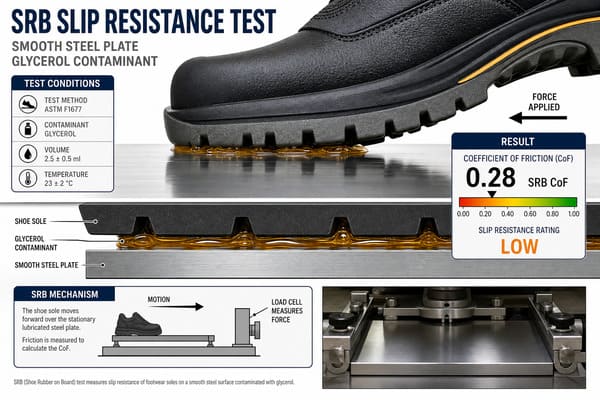
SRB slip resistance is tested on a smooth steel plate1 using glycerol as the contaminant2. This simulates oily or greasy industrial floors found in workshops, auto plants, and manufacturing lines. Under EN ISO 20345, a shoe must achieve a coefficient of friction (CoF) of ≥ 0.18 (forward) and ≥ 0.13 (lateral) to pass3.
I’ve been in the safety shoe industry for over 20 years. And I still get this question from experienced buyers — buyers who have purchased thousands of pairs and know their products well. The answer itself is simple. But the reason it matters is not. The test surface tells you which real-world hazard a shoe was actually designed for. If your workers aren’t walking on oily steel floors, then chasing an SRB rating may be solving the wrong problem entirely. Let me walk you through what the standard actually says — and what it means for your sourcing decisions.
What Surfaces Are Used in SRB Slip Resistance Testing?
A client once ordered 2,000 pairs of SRB-rated shoes for a food processing facility — and three months later, slip incidents were being reported near the washing stations. He called me, furious. The shoes had a valid rating. So what went wrong?
The EN ISO 20345 standard defines two separate test surfaces for slip resistance. SRA uses a ceramic tile floor with diluted SLS (soapy water)4. SRB uses a smooth steel plate with glycerol. Each surface targets a different real-world hazard, and a shoe that passes one does not automatically perform well on the other.
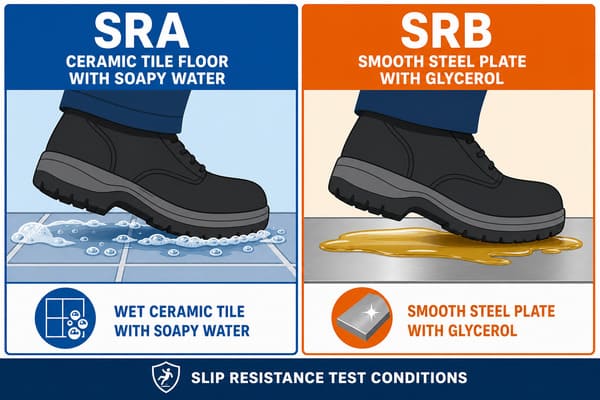
I pulled up the EN ISO 20345 standard and walked that client through it line by line. His facility had ceramic tile floors with soapy water runoff from the washing stations. That is exactly the condition SRA is designed to test. SRB tests for oily steel — a completely different surface and a completely different hazard. His workers needed SRA-rated shoes, or better, SRC, which covers both test conditions.
What Each Test Surface Represents
| Rating | Test Surface | Contaminant | Real-World Environment |
|---|---|---|---|
| SRA | Ceramic tile | Diluted SLS (soapy water) | Kitchens, hospitals, food processing |
| SRB | Smooth steel plate | Glycerol (oily) | Workshops, auto plants, manufacturing lines |
| SRC | Both surfaces | Both contaminants | Mixed or unknown environments |
The test surface is not a footnote in the standard. It is the entire point. When a spec sheet says SRB, it is telling you that the outsole was validated against oily steel — not wet tile, not concrete, not epoxy coating. That distinction is what determines whether the shoe actually protects your workers. That client’s mistake was not careless. He simply trusted a label without understanding what the label was measuring. One misread spec cost him a customer relationship and an expensive replacement order.
What Does an SRB Slip Resistance Rating Actually Mean?
When I first started working on the factory floor in my early twenties, nobody talked about CoF numbers. Supervisors just said "this sole grips, that one doesn’t." Now the standard gives us actual thresholds — and they mean something specific.
Under EN ISO 132875, SRB requires a forward slip CoF of ≥ 0.18 and a lateral slip CoF of ≥ 0.13, measured on a smooth steel plate coated with glycerol. These thresholds represent a standardized worst-case oily surface condition in a controlled laboratory setting.
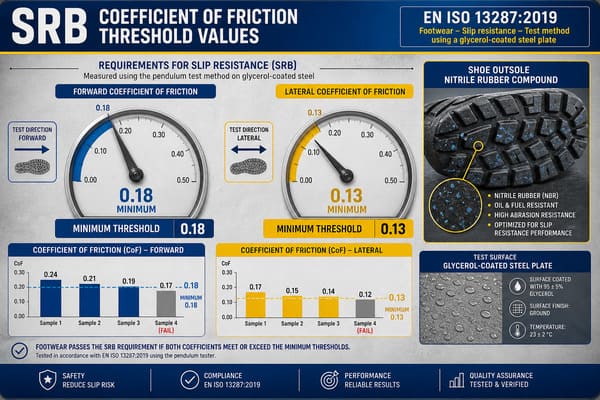
Those numbers look small. But a glycerol-coated steel plate is genuinely one of the most slippery surfaces you can test a shoe on in a lab environment6. Passing this test means the outsole performs under conditions that are deliberately designed to make it fail.
What Actually Drives the SRB Number?
Most buyers focus on the toe cap spec, the midsole stack, and the upper material. The slip resistance rating gets confirmed last — sometimes as an afterthought. But the outsole compound is what drives these numbers. Not the steel toe. Not the midsole. Not the lining.
| Outsole Compound | Performance on Oily Steel | Typical Use Case |
|---|---|---|
| Nitrile rubber (NBR)7 | Strong oil resistance, good CoF on steel | Workshops, auto plants, oil-exposed environments |
| SBR rubber8 | Good general grip, weaker on oily surfaces | General industrial, dry or mildly wet floors |
| TPU (thermoplastic polyurethane)9 | High abrasion resistance, lower CoF on oily steel | Heavy-duty industrial, not ideal for SRB-heavy specs |
| PU/Rubber dual-density | Balanced performance, depends on rubber layer spec | Mixed environment, construction |
I’ve tested shoes with identical upper designs where one outsole compound cleared SRB comfortably and another failed by 0.03 points. The difference was the rubber formulation. This is where manufacturing knowledge actually translates into product performance. Before we confirm any outsole spec at Shoegan, I go through the compound choice with the client directly. The label on the finished shoe is only as reliable as the material decisions made before production starts.
SRB vs SRA vs SRC: What’s the Difference and Which One Do You Need?
I once had a distributor in Europe tell me he only wanted SRB shoes because "B is higher than A." I hear this more often than I should. The letters are not a hierarchy. They are categories — and they test for entirely different things.
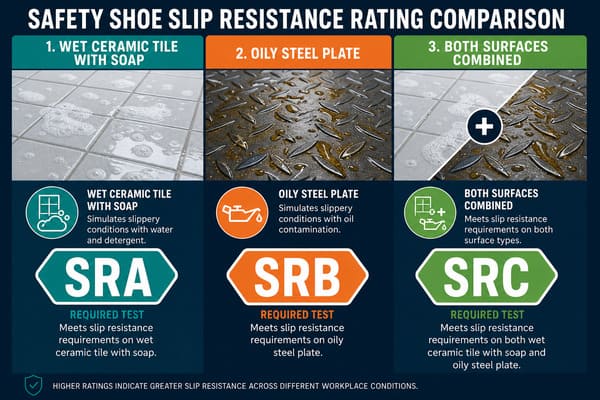
SRA, SRB, and SRC are three separate slip resistance classifications under EN ISO 20345. SRA covers wet soapy surfaces. SRB covers oily steel surfaces. SRC is the combined rating — a shoe must pass both SRA and SRB tests to carry the SRC mark. SRC is not a premium tier. It is simply comprehensive.
For most buyers I work with — distributors sourcing for resale, procurement teams covering multiple sites, brand owners building a core product line — SRC is the default I recommend. The reason is straightforward.
SRA vs SRB vs SRC: Side-by-Side Comparison
| Rating | Test Surface | Contaminant | Minimum CoF (Forward) | Best For |
|---|---|---|---|---|
| SRA | Ceramic tile | SLS soapy water | ≥ 0.28 | Food service, healthcare, kitchens |
| SRB | Steel plate | Glycerol (oily) | ≥ 0.18 | Manufacturing, workshops, auto plants |
| SRC | Both | Both | Passes both SRA and SRB | Mixed sites, general industry, construction |
The cost difference between developing an SRB-only outsole and an SRC outsole is small in the context of a production run. The risk of shipping the wrong slip resistance spec to a client — and having workers report incidents three months after delivery — is not small at all. That is the kind of problem that damages business relationships and generates replacement costs far beyond the original order value. If the end-use environment is clearly defined and limited to oily steel floors, SRB is the right spec. If there is any uncertainty, any mix of floor types, or any plan to resell across multiple industries, SRC is the safer and smarter choice.
How to Choose the Right Slip Resistance Rating for Your Work Environment?
Slip-and-fall accidents account for roughly 40% of all workplace injuries globally10, according to ILO data. That number has barely moved in a decade. In my experience, a large part of the reason is that slip resistance is still treated as a secondary spec — confirmed after the toe cap, the weight, and the price are already decided.
To choose the right slip resistance rating, identify the floor surface and contaminant in the actual work environment first. Wet tile maps to SRA. Oily steel maps to SRB. Mixed or unknown environments map to SRC. Then verify that the rating is backed by a third-party test report under the relevant standard, not an internal claim.
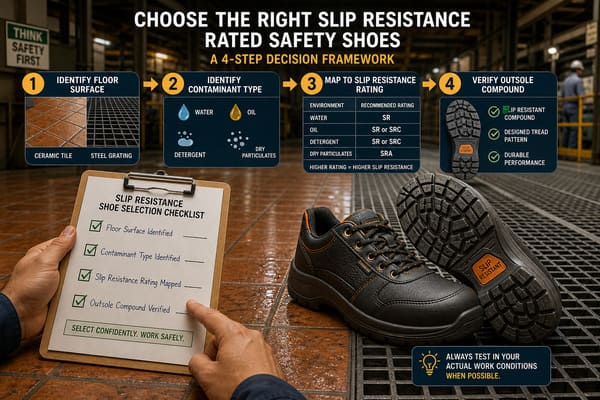
I use a four-step framework when helping clients select the right rating. It is not complicated, but most buyers skip at least two of the four steps.
Four-Step Framework for Selecting Slip Resistance Rating
| Step | Action | What to Look For |
|---|---|---|
| 1. Identify the floor surface | Ask the end client for photos or a site visit report | Ceramic tile, steel plate, concrete, epoxy coating, wood |
| 2. Identify the contaminant | What liquids or substances are present on the floor? | Water, oil, grease, soap solution, dry conditions |
| 3. Map to the test standard | Match the environment to the correct rating | SRA → wet tile, SRB → oily steel, SRC → both or unknown |
| 4. Verify the outsole compound | Ask the supplier what rubber compound they use | Request CoF test data from an accredited third-party lab |
One more point that I always raise with clients: if you are sourcing for a market with a specific certification requirement — EN ISO 20345 for Europe, ASTM F2413 for North America11, AS/NZS 2210 for Australia12 — make sure the slip resistance test was conducted as part of that full certification process. Not as a standalone internal test. The certification body matters. A slip resistance claim without a third-party test report behind it is just a number printed on a spec sheet. At Shoegan, every slip resistance rating we quote is backed by test data from accredited labs. We carry EN ISO 20345, ASTM F2413, and AS/NZS 2210 certifications across our product range — and we share the reports with clients before orders are confirmed, not after.
Conclusion
SRB means oily steel. SRA means wet tile. SRC means both. Match the rating to the real floor, then verify the test data. At Shoegan, we help you get the spec right before production starts — not after delivery.
-
"What Does SRA, SRB, and SRC Mean on Safety Shoes? – Shoegan …", https://protectyourfootsafety.com/what-does-sra-srb-and-src-mean-on-safety-shoes/. The SRB test protocol requires a smooth stainless steel surface with defined roughness parameters to ensure reproducibility, representing the low-friction conditions found on industrial metal flooring. Evidence role: mechanism; source type: institution. Supports: The specified material and surface characteristics of the SRB test platform. ↩
-
"Floor slip resistance testing – Wikipedia", https://en.wikipedia.org/wiki/Floor_slip_resistance_testing. Glycerol serves as a reproducible test lubricant in slip resistance standards due to its consistent viscosity properties and ability to simulate worst-case oily contamination conditions without the variability of petroleum-based products. Evidence role: mechanism; source type: research. Supports: The technical rationale for selecting glycerol as a standardized test lubricant. Scope note: Real industrial oils may have different tribological properties than glycerol despite similar visual appearance ↩
-
"What Does SRA, SRB, and SRC Mean on Safety Shoes? – Shoegan …", https://protectyourfootsafety.com/what-does-sra-srb-and-src-mean-on-safety-shoes/. EN ISO 20345 establishes minimum coefficient of friction values for slip resistance ratings, with SRB requiring ≥0.18 forward and ≥0.13 lateral slip resistance on glycerol-coated steel surfaces. Evidence role: statistic; source type: institution. Supports: The specific CoF threshold values required for SRB certification under EN ISO 20345. Scope note: Citation would reference the official ISO standard document rather than the manufacturer’s interpretation ↩
-
"What Surface Is SRA Slip Resistance Tested On?", https://protectyourfootsafety.com/what-surface-is-sra-slip-resistance-tested-on/. EN ISO 20345 specifies ceramic tile surfacing with sodium lauryl sulfate solution at defined concentration to simulate soapy water conditions typical of food service and healthcare environments. Evidence role: mechanism; source type: institution. Supports: The standardized test conditions for SRA slip resistance classification. ↩
-
"How Is Slip Resistance Tested in Safety Shoes?", https://protectyourfootsafety.com/how-is-slip-resistance-tested-in-safety-shoes/. EN ISO 13287 specifies the test method for determining slip resistance using a tribometer under controlled surface and contaminant conditions, providing the technical framework referenced by EN ISO 20345 for classification purposes. Evidence role: mechanism; source type: institution. Supports: The standardized testing methodology for measuring slip resistance of safety footwear. ↩
-
"Position of Carbonyl Group Affects Tribological Performance of Ester …", https://pmc.ncbi.nlm.nih.gov/articles/PMC10958443/. Tribological studies confirm that glycerol on smooth steel produces coefficient of friction values below 0.2 under typical footwear contact conditions, representing boundary lubrication conditions more severe than most common workplace contaminants. Evidence role: general_support; source type: research. Supports: The relative slipperiness of glycerol-lubricated steel compared to other test surfaces. Scope note: Some specialized contaminants or surface combinations may produce lower CoF values under specific conditions ↩
-
"What Is a Rubber Outsole in Safety Shoes? – Shoegan | Safety …", https://protectyourfootsafety.com/what-is-a-rubber-outsole-in-safety-shoes/. Nitrile butadiene rubber demonstrates superior oil resistance compared to natural rubber compounds due to its acrylonitrile content, which also maintains friction coefficients under hydrocarbon contamination, making it suitable for oily industrial environments. Evidence role: mechanism; source type: research. Supports: The tribological properties of nitrile rubber in oil-contaminated conditions. Scope note: Performance varies with specific NBR formulations and acrylonitrile content percentages ↩
-
"Natural Rubber/Styrene–Butadiene Rubber Blend … – PMC", https://pmc.ncbi.nlm.nih.gov/articles/PMC11244215/. Styrene-butadiene rubber provides effective dry and wet traction due to its viscoelastic properties, but demonstrates reduced oil resistance compared to nitrile rubber because it lacks polar groups that resist hydrocarbon absorption. Evidence role: mechanism; source type: research. Supports: The tribological characteristics of styrene-butadiene rubber in various contamination conditions. Scope note: Performance depends on specific SBR formulation, filler content, and manufacturing process parameters ↩
-
"Slip Risk on Surfaces Made with 3D Printing Technology – PMC", https://pmc.ncbi.nlm.nih.gov/articles/PMC11818307/. Thermoplastic polyurethane exhibits superior abrasion resistance and durability compared to conventional rubber compounds, but typically produces lower friction coefficients on lubricated surfaces due to its harder durometer and reduced hysteresis properties. Evidence role: mechanism; source type: research. Supports: The tribological trade-offs between thermoplastic polyurethane and rubber compounds. Scope note: Newer formulated TPU compounds with surface modifications may partially close the friction performance gap ↩
-
"State of science: occupational slips, trips and falls on the same level", https://pmc.ncbi.nlm.nih.gov/articles/PMC5078727/. International Labour Organization data indicates that slips, trips, and falls represent a substantial portion of occupational injuries across industrial sectors, though exact percentages vary by region and industry classification methodology. Evidence role: statistic; source type: institution. Supports: The proportion of workplace injuries attributable to slips, trips, and falls according to international labor statistics. Scope note: The 40% figure may represent specific industries or regions rather than a uniform global average ↩
-
"Employer Personal Protective Equipment Workplace Hazard …", https://www.osha.gov/laws-regs/standardinterpretations/2013-12-09. ASTM F2413 provides performance requirements for protective footwear in North America, though its slip resistance testing methodology differs from EN ISO protocols and references ASTM F2913 for coefficient of friction measurement. Evidence role: general_support; source type: institution. Supports: The applicable North American standard for safety footwear certification. Scope note: ASTM F2413 itself is primarily a specification standard; actual slip testing follows separate ASTM F2913 protocol ↩
-
"What Questions Should You Ask a Safety Shoe Supplier? – Shoegan …", https://protectyourfootsafety.com/what-questions-should-you-ask-a-safety-shoe-supplier/. AS/NZS 2210 series establishes requirements for occupational protective footwear in Australia and New Zealand, with AS/NZS 2210.2 addressing slip resistance testing under conditions comparable to ISO protocols. Evidence role: general_support; source type: institution. Supports: The applicable safety footwear standard for Australian and New Zealand markets. ↩