
I have worked in safety shoe manufacturing for over 20 years. In my early days, I was responsible for quality inspection on the production floor, checking hundreds of pairs every day. The Goodyear welt stitching process was always the slowest step — a full welt seam around one shoe requires at least three manual corrections1. But that slowness is exactly what makes it different from everything else.
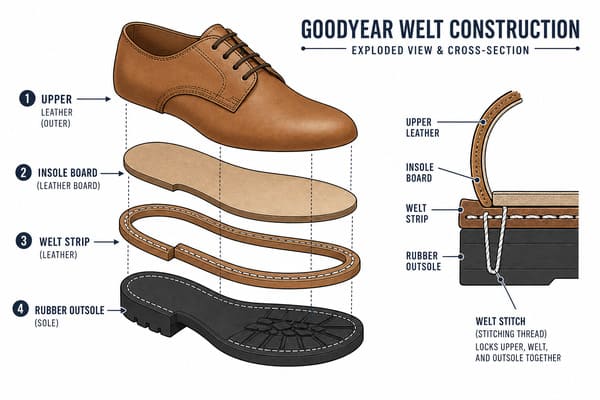
Goodyear welt construction joins the upper, insole, and welt strip together with a single stitch, then sews the outsole onto the welt. No adhesive holds the structure together. This means the sole can be replaced when it wears out, which directly reduces the total cost of ownership over the shoe’s full lifespan.
The question I hear most from buyers is simple: "Is it worth the extra cost?" That is a fair question, and the answer depends on where your workers actually stand. In this article, I will break down how Goodyear welt works, how it compares to other constructions, and where it makes sense — and where it does not.
What Makes Goodyear Welt Construction Different from Other Methods?
Most buyers know there are different ways to attach a sole to a shoe, but few understand what those differences mean in practice. Choosing the wrong construction for the wrong job is one of the most common sourcing mistakes I see.
Goodyear welt construction is different because it uses a welt strip as an intermediary layer, connecting the upper, insole, and outsole through stitching alone. This creates a structural gap between the insole and outsole that acts as a natural buffer for heat and impact2 — something cemented and injection-molded soles cannot replicate.
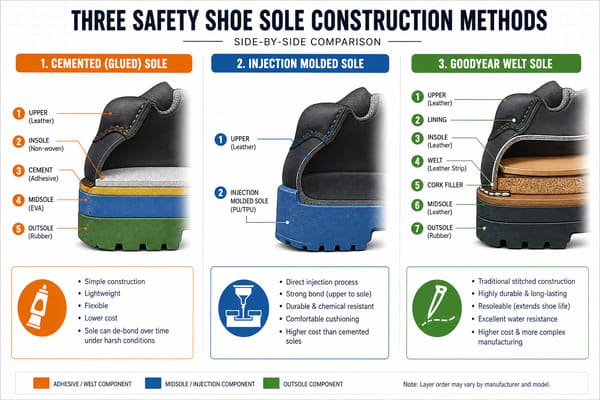
At our factory, we produce all three types: cemented (glued), injection-molded, and Goodyear welt. Each one has a very different production profile.
How the Three Methods Compare
| Construction Method | Assembly Time (per pair) | Skill Level Required | Sole Replaceable | Air Gap / Cushion Layer |
|---|---|---|---|---|
| Cemented (Glued) | 8–12 minutes | Low to medium | No | No |
| Injection-Molded | 3–6 minutes | Low (mold-driven) | No | No |
| Goodyear Welt | 20+ minutes (welt stitch alone) | High | Yes | Yes |
Once, a group of buyers visited our factory and watched the welt stitching station. One of them asked me: "Why does this step take so long?" I told him: because this step decides whether the shoe lasts three years or falls apart in six months. A skilled operator runs the welt seam around the full perimeter of the shoe and corrects the tension by hand at least three times per pair. There is no shortcut that keeps the structure honest. The welt strip is not just a connection — it creates a small cavity between the insole and outsole. That cavity provides real heat insulation and shock absorption. No glue layer and no injection mold can do that. This is a structural advantage built directly into the method itself, not added through materials or components.
Is Goodyear Welt Construction More Durable Than Cemented Soles?
Durability claims are easy to make. Real numbers from real field conditions are harder to find. I want to share one that I know firsthand.
Goodyear welt construction outlasts cemented soles in high-heat and high-stress environments because its structure does not rely on adhesive. Adhesive bonds weaken under sustained heat above 40°C and repeated flex stress3. Stitched welt construction holds its integrity under the same conditions without depending on glue.
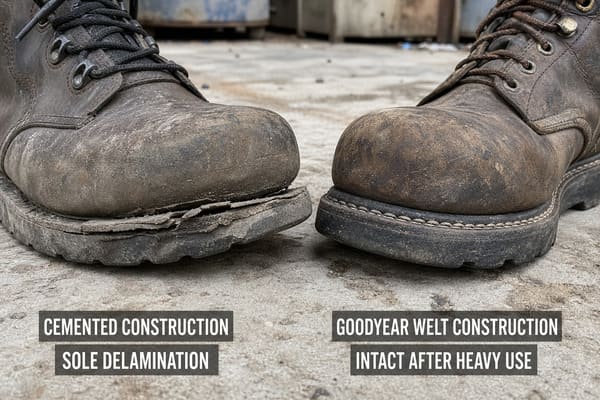
I have a client in the Netherlands who distributes industrial PPE. He started with our cemented-sole safety shoes — lower price, faster delivery. His first order was 500 pairs. Six months later, he sent me photos. Nearly 30% of the shoes showed sole separation at different stages. The workers were doing outdoor construction, and the ground surface temperature was regularly above 40°C. The adhesive had failed.
What the Numbers Actually Showed
| Metric | Cemented Sole | Goodyear Welt |
|---|---|---|
| Environment | Outdoor construction, ground temp 40°C+ | Same environment |
| Usage Period | 6 months | 18 months |
| Failure / Return Rate | ~30% (sole separation) | <5% |
| Root Cause | Adhesive bond degradation under heat | Structural stitching unaffected by heat |
He switched to our Goodyear welt version. Same workers, same job site, same conditions. After 18 months, the return rate was under 5%. That is not a marketing claim — it is a real comparison between two orders from the same buyer at the same worksite. But I also want to be clear about one thing: Goodyear welt is not a complete solution on its own. If the outsole rubber compound is poor quality, or if the upper leather is too thin, the welt structure cannot save the shoe. What Goodyear welt gives you is a strong skeleton. The materials around that skeleton still matter just as much.
Which Safety Shoe Applications Benefit Most from Goodyear Welt?
Not every application needs Goodyear welt. But for some industries, asking for anything less is a risk I would not take.
Safety shoe applications that benefit most from Goodyear welt construction include heavy construction, mining, oil and gas field operations, forestry, and military or law enforcement procurement4. These sectors share common conditions: long wear time per day, unpredictable ground surfaces, and situations where sole failure creates a direct safety incident, not just a product complaint.
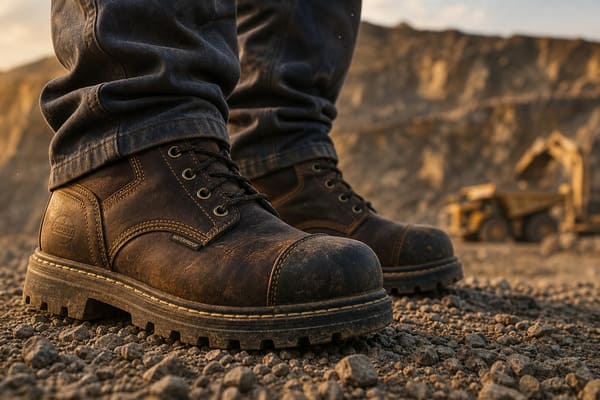
Looking at our order history over the past several years, buyers who specifically request Goodyear welt construction come from a consistent set of industries. Their workers wear shoes for more than 10 hours per day5. The ground conditions change constantly — gravel, mud, metal grating, hot surfaces, uneven terrain. A sole that separates mid-shift is not a quality complaint. It is a safety incident.
Market Demand Patterns by Region
| Buyer Region | First Question Asked | Priority Focus |
|---|---|---|
| Germany, Netherlands, UK | "Is it Goodyear welted?" | Construction method and certification |
| Middle East (UAE, Saudi) | Mix of construction and certification | EN ISO 20345 compliance6 + durability |
| Southeast Asia | Weight and price | Then construction method |
| Australia / New Zealand | AS/NZS compliance + construction | Durability in outdoor conditions |
I have noticed a clear pattern. Buyers from Germany, the UK, and the Netherlands almost never open with a price question7. They ask: "Is it Goodyear welted?" — because their end users recognize the construction method as a quality signal. They have been educated by the market. Buyers from Southeast Asia typically open with weight and price, and reach the construction method question later in the conversation. The awareness gap between these markets is significant. For distributors who are building or repositioning a product line, understanding where your end market sits on this awareness scale is useful information. If your clients already ask for Goodyear welt by name, your competition is already a step ahead of you if you are not carrying it.
What Are the Disadvantages of Goodyear Welt Construction?
I do not like to oversell any product. Clients find out the truth in the field, and when they do, what is lost is not just one order — it is the relationship.
Goodyear welt construction has real disadvantages: it adds weight (150–250g per pair compared to cemented alternatives)8, requires a break-in period of one to two weeks9, presents waterproofing challenges at the stitch holes without additional sealing, and carries a production cost 20–35% higher than cemented-sole shoes of the same material specification10.

Every construction method has trade-offs. Goodyear welt has four that buyers should understand before placing an order.
The Four Real Disadvantages
| Disadvantage | What It Means in Practice | When It Matters Most |
|---|---|---|
| Added weight | 150–250g heavier than equivalent cemented sole | Workers standing 8–12 hours daily; fatigue is cumulative |
| Break-in period | Welt and material layers are stiff for 1–2 weeks | Workers starting a new job or with low pain tolerance |
| Water resistance | Stitch holes are water entry points without extra sealing | Flooded work sites, drainage trenches, prolonged rain |
| Higher cost | 20–35% more than cemented at same material grade | Price-sensitive markets or short-term project procurement |
The weight issue is real. A worker standing on a concrete floor for 10 hours a day will feel an extra 200 grams11. That is not nothing. The break-in issue affects some workers more than others — a person who has worn cemented-sole shoes for years will notice the stiffness immediately in the first week. On waterproofing: we can apply additional sealant over the welt stitching, and I recommend this for clients whose workers operate in flooded environments or trenches. But without that extra step, the stitch holes are entry points. On cost: Goodyear welt is not the right answer for short-term project procurement or markets where the shoes are replaced every three to four months regardless. My honest advice to every buyer is this — do not choose Goodyear welt because it sounds premium. Choose it because your workers’ actual working conditions call for it.
Conclusion
Goodyear welt construction offers a durable, rebuildable structure for demanding work environments, but it is not the right choice for every application or every market. Match the construction method to the actual conditions your workers face. If you need a manufacturing partner who understands both the technical side and the real-world trade-offs, Shoegan builds safety shoes that are Built to Protect. Made to Last. — reach us at [email protected] or WhatsApp +8613008988018.
-
"Goodyear welt – Wikipedia", https://en.wikipedia.org/wiki/Goodyear_welt. Goodyear welt construction requires multiple manual interventions during stitching to maintain consistent tension and structural integrity, distinguishing it from automated sole attachment methods. Evidence role: mechanism; source type: research. Supports: the manual labor intensity and quality control steps required in Goodyear welt stitching. Scope note: The exact number of corrections may vary by manufacturer and operator skill level. ↩
-
"Shock absorption characteristics of running shoes", https://pubmed.ncbi.nlm.nih.gov/4025676/. Air spaces in footwear construction provide thermal insulation and impact attenuation by creating a buffer layer between the foot and ground surface. Evidence role: mechanism; source type: research. Supports: the thermal and mechanical buffering properties of air cavities in footwear construction. Scope note: The magnitude of thermal and impact benefits depends on cavity size and surrounding material properties. ↩
-
"Sustainable Reactive Polyurethane Hot Melt Adhesives Based … – PMC", https://pmc.ncbi.nlm.nih.gov/articles/PMC8779523/. Polymeric adhesives commonly used in footwear construction experience reduced bond strength when subjected to elevated temperatures and cyclic mechanical stress, with performance degradation accelerating above typical body and ground surface temperatures. Evidence role: mechanism; source type: research. Supports: the thermal degradation mechanisms of adhesives used in footwear assembly. Scope note: Specific failure thresholds vary by adhesive formulation and application method. ↩
-
"1910.136 – Foot protection. | Occupational Safety and …", http://www.osha.gov/laws-regs/regulations/standardnumber/1910/1910.136. Occupations involving prolonged standing, variable terrain, exposure to temperature extremes, and hazardous materials require durable footwear construction that maintains structural integrity under sustained stress. Evidence role: general_support; source type: government. Supports: the demanding footwear requirements in heavy industrial and outdoor occupational settings. ↩
-
"Employer Personal Protective Equipment Workplace …", http://www.osha.gov/laws-regs/standardinterpretations/2013-12-09. Workers in construction, mining, and heavy industrial sectors commonly work extended shifts ranging from 10 to 12 hours, particularly in resource extraction and large-scale construction projects. Evidence role: statistic; source type: government. Supports: typical work shift durations in construction, mining, and industrial occupations. Scope note: Shift lengths vary by country, project type, and labor regulations. ↩
-
"What Is the Puncture Resistance Rating in EN ISO 20345 …", https://protectyourfootsafety.com/what-is-the-puncture-resistance-rating-in-en-iso-20345/. EN ISO 20345 specifies basic and additional requirements for safety footwear including impact resistance, compression resistance, and other protective features, serving as the primary European standard for occupational protective footwear. Evidence role: definition; source type: government. Supports: the scope and requirements of EN ISO 20345 as a safety footwear standard. ↩
-
"Europe Protective Footwear Market Growth Report 2031", https://www.mordorintelligence.com/industry-reports/europe-protective-footwear-market. Procurement behavior for personal protective equipment varies significantly by region, with Western European markets typically prioritizing compliance, durability, and total cost of ownership, while price-sensitive markets emphasize initial purchase cost. Evidence role: general_support; source type: research. Supports: regional differences in procurement decision criteria for occupational safety equipment. Scope note: Procurement priorities vary by company size, industry sector, and specific buyer sophistication within each region. ↩
-
"The Impact of Footwear on Occupational Task Performance …", https://pmc.ncbi.nlm.nih.gov/articles/PMC9518076/. Goodyear welt construction typically adds 150-250 grams per pair compared to cemented construction due to the additional welt strip, stitching materials, and structural components required for the sewn assembly method. Evidence role: statistic; source type: research. Supports: the weight differences between Goodyear welt and cemented sole construction methods. Scope note: Actual weight difference varies based on specific materials, sole thickness, and shoe size. ↩
-
"Biomechanical Characteristics between Bionic Shoes and Normal …", https://pmc.ncbi.nlm.nih.gov/articles/PMC8003960/. Footwear with rigid construction methods and full-grain leather materials typically requires a break-in period during which the materials conform to the wearer’s foot shape and gait pattern, with comfort generally improving over the first 1-2 weeks of regular use. Evidence role: general_support; source type: research. Supports: the adaptation period required for stiff leather footwear construction. Scope note: Break-in duration varies by individual foot morphology, material stiffness, and wear patterns. ↩
-
"What Is Direct Injection Construction in Safety Shoes?", https://protectyourfootsafety.com/what-is-direct-injection-construction-in-safety-shoes/. Goodyear welt construction requires significantly higher labor input, specialized equipment, and skilled operators compared to cemented sole assembly, resulting in production costs typically 20-35% higher for equivalent material specifications. Evidence role: statistic; source type: research. Supports: the relative production cost differences between Goodyear welt and cemented construction methods. Scope note: Cost differential varies by production location, labor costs, and production volume. ↩
-
"The Impact of Footwear on Occupational Task Performance …", https://pmc.ncbi.nlm.nih.gov/articles/PMC9518076/. Additional footwear weight increases metabolic cost and cumulative lower limb fatigue during prolonged occupational standing and walking, with effects becoming more pronounced over extended work shifts. Evidence role: general_support; source type: research. Supports: the cumulative physiological effects of footwear weight during prolonged standing and walking. Scope note: Individual sensitivity to footwear weight varies based on fitness level, gait patterns, and task demands. ↩