
Early in my career, I spent 6 years on the factory floor before I ever took a sales call. I watched workers in auto repair shops and oil refineries wear out regular rubber soles in 3 to 4 months1.
A nitrile rubber outsole is made from NBR (Nitrile Butadiene Rubber), a synthetic compound combining acrylonitrile and butadiene2. It is built for environments with daily oil, fuel, or chemical contact. Unlike standard rubber, it resists swelling and grip loss — making it a direct tool for injury prevention on slick industrial floors.
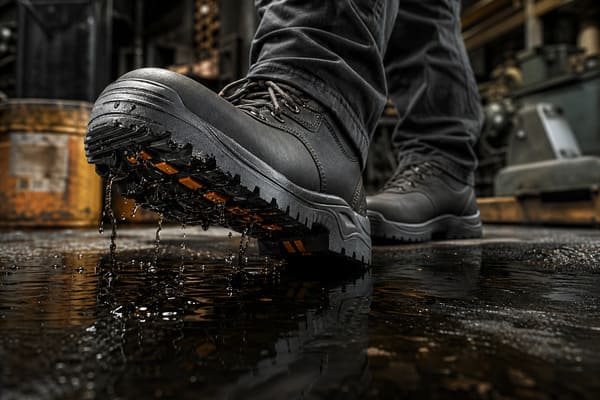
I saw the sole surface swell, crack, and lose grip — sometimes within weeks of first use. That experience taught me that the right outsole doesn’t just last longer. It keeps the worker upright. That’s not a comfort upgrade. That’s injury prevention. In this article, I’ll break down what nitrile rubber actually does, what it’s called, how it compares to other rubber types, and where it fails.
What Are the Key Properties of a Nitrile Rubber Outsole?
A client from the Middle East once sent me photos of his workers’ safety shoes after just 2 months on-site. The outsoles had swollen and separated from the upper. He had sourced them from a supplier using standard SBR rubber.
Nitrile rubber outsoles contain 28% to 45% acrylonitrile (ACN) content3. Higher ACN delivers better oil resistance but slightly reduces flexibility in cold conditions. Key properties include oil and fuel resistance, abrasion resistance (under 150mm³ loss per DIN 535164), heat resistance up to 120°C5, and no swelling in petroleum-based liquids.
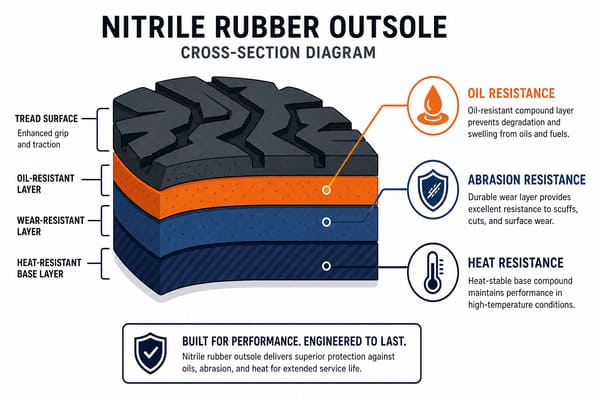
When I looked at his job site conditions — diesel fuel on concrete floors, ambient temperatures around 45°C — it was clear why SBR failed. SBR simply can’t handle that environment. In our production at Shoegan, we work with 33% to 38% ACN content for most orders. That range gives a balanced performance across the majority of industrial environments without sacrificing cold-weather flexibility entirely.
ACN Content and What It Actually Means in the Field
The acrylonitrile content in an NBR compound is not just a number on a spec sheet. It directly controls how the outsole behaves in real conditions. Here’s how the range breaks down in practice:
| ACN Content | Oil Resistance | Cold Flexibility | Best Use Case |
|---|---|---|---|
| 28% – 33% | Good | High | Cold environments with light oil exposure |
| 33% – 38% | Very Good | Moderate | General industrial, automotive, oil fields |
| 38% – 45% | Excellent | Low | High-exposure oil refineries, fuel handling |
Beyond ACN content, there are three other properties I check in every production batch. First, abrasion resistance: we test wear depth under DIN 53516 and target under 150mm³ loss per batch. Second, heat resistance: continuous floor contact up to 120°C is a baseline for most industrial environments. Third, swell resistance: we test outsole samples in hydraulic fluid and petroleum-based liquids for 72 hours, and the volume change must stay under 8%6. These aren’t marketing claims. They come from our lab testing and real client feedback built over 15 years of production. When a supplier can’t give you these numbers, that tells you something.
What Is Another Name for Nitrile Rubber?
I’ve received purchase orders that listed "NBR sole," "Buna-N outsole," and "nitrile rubber bottom" — all from different clients, all describing the exact same material. Once, a European distributor flagged our spec sheet asking why we wrote "NBR" instead of "nitrile rubber." He thought they were different compounds. They are not.
Nitrile rubber is also called NBR (Nitrile Butadiene Rubber) and Buna-N. NBR is the standard term used in manufacturing and material certifications. Buna-N is an older German trade name from WWII-era synthetic rubber development7. All three names refer to the same acrylonitrile-butadiene copolymer material.

In Chinese factory documentation and export spec sheets, NBR is the standard term. If you are a buyer reviewing a supplier’s spec sheet, you may see any of these names used. They all point to the same base material.
How to Read a Supplier’s Material Spec Without Getting Confused
Different markets and industries use different names. Knowing which term belongs to which context helps you verify what you’re actually buying.
| Term | Origin | Common Context |
|---|---|---|
| Nitrile Rubber | Generic chemical name | General commercial use, PPE product listings |
| NBR | Industry abbreviation | Factory spec sheets, material certifications, lab reports |
| Buna-N | German trade name (BASF origin) | Older industrial catalogs, some European suppliers |
| Perbunan | Another older trade name | Rarely used today, mostly historical references |
The name on the document matters less than what the supplier knows about the compound. If a supplier lists "NBR outsole" but cannot tell you the ACN content, the hardness rating (Shore A), or the abrasion test standard they use — that is a clear warning sign. A real manufacturer knows their material at that level. A catalog seller does not. At Shoegan, every outsole material we use comes with a full compound data sheet. If a client asks for it, we provide it. That is a basic expectation for a mid-to-high end manufacturer.
Is a Rubber Sole Better Than a Synthetic Sole?
A distributor in Australia once asked me to help him understand why two pairs of shoes — both listed as "rubber sole" — performed completely differently in the field. One lasted 14 months. The other failed at 5 months. The difference was the type of rubber, not the label.
Rubber soles and synthetic soles each suit different environments. Natural rubber offers excellent elasticity and wet grip for general outdoor use. Nitrile rubber (a synthetic) is the correct choice for oil, fuel, or chemical exposure. The better option always depends on the specific job site conditions — not on a general ranking.
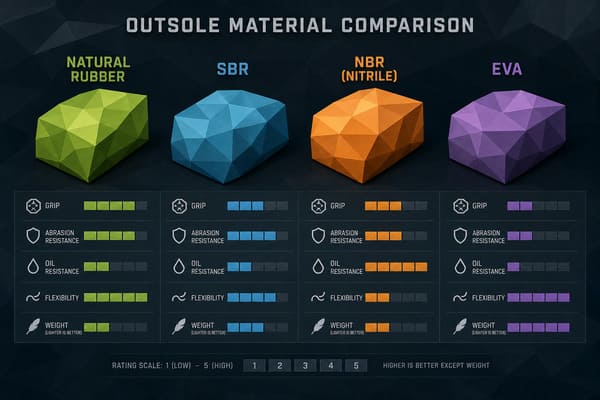
One pair used natural rubber. The other used SBR (Styrene-Butadiene Rubber)8. Neither was nitrile. The Australian distributor didn’t know there were multiple rubber types behind the same product label. That’s a common gap between buyers and manufacturers.
Rubber Type Comparison for Industrial Safety Shoes
Here is how the main outsole materials compare across key performance areas:
| Property | Natural Rubber | SBR | Nitrile (NBR) | EVA (Synthetic) |
|---|---|---|---|---|
| Oil Resistance | Poor | Poor | Excellent | Poor |
| Abrasion Resistance | Good | Moderate | Very Good | Low |
| Wet Grip | Excellent | Good | Good | Moderate |
| Cold Flexibility | Good | Moderate | Moderate | Good |
| Weight | Medium | Medium | Heavier | Lightest |
| Cost | Medium-High | Low | Medium-High | Low |
| Best Environment | Outdoor, general use | Light-duty, dry floors | Oil, fuel, chemical floors | Lightweight comfort use |
Natural rubber has excellent elasticity and wet grip. It works well for general outdoor use and construction. But soak it in diesel or engine oil for a few weeks, and it starts to swell and soften. SBR is cheaper and widely used, but it shares the same weakness under oil exposure. Nitrile rubber was specifically engineered to resist oil and fuel. That is its core design purpose, not a side benefit. For any job site with oil, fuel, or chemical splash on the floor, nitrile outsoles are the correct answer. The question was never "which rubber is better in general." The question is always "better for which environment."
What Are the Disadvantages of Nitrile Rubber?
A client running cold storage warehouses in northern Canada came to me asking for nitrile outsoles. Temperatures on his floors dropped to minus 25°C. He’d read that nitrile was "industrial grade" and assumed it was the right fit. I told him not to use them for his environment.
Nitrile rubber has clear disadvantages in specific conditions. Below minus 20°C, it stiffens significantly and grip drops9. It also has limited resistance to strong aromatic solvents like toluene and benzene10. It runs 15% to 25% heavier than rubber-EVA blends11 and can develop surface cracking after 18 to 24 months of strong UV exposure12.
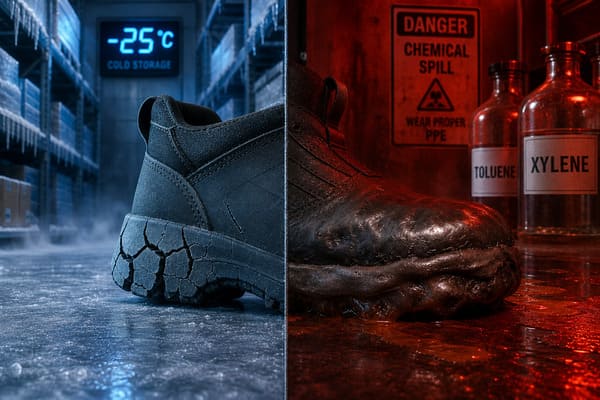
Below minus 20°C, nitrile rubber stiffens significantly, grip drops, and the material becomes more brittle. That is a fall risk. I recommended PU outsoles with a cold-resistant compound for his warehouses instead. Knowing when to say "this material is not right for you" is part of what we do at Shoegan.
Where Nitrile Outsoles Fall Short: A Practical Summary
Nitrile is a strong material in the right environment. But it has specific limits that matter in real procurement decisions.
| Limitation | Threshold or Detail | Alternative to Consider |
|---|---|---|
| Cold temperature | Stiffens and loses grip below -20°C | PU or cold-resistant rubber compound |
| Aromatic solvent resistance | Swells in toluene, benzene, MEK | Neoprene or Viton-based outsoles |
| Weight | 15–25% heavier than EVA-rubber blends | Composite outsole with EVA midsole |
| UV exposure | Surface cracking after 18–24 months outdoors | Carbon black-stabilized NBR compound |
| Flexibility in cold | Reduced at lower ACN content, near-absent above 38% ACN | Blended compound or alternative material |
Beyond cold temperatures, nitrile also reacts badly with strong aromatic solvents — toluene, benzene, MEK. If workers in a chemical plant handle these solvents, nitrile can swell and degrade faster than expected. Weight is another real factor. A standard nitrile outsole runs 15% to 25% heavier than a comparable rubber-EVA blend. That matters when workers are on their feet for 10-hour shifts. For outdoor environments with high UV exposure, nitrile surfaces can develop surface cracking after 18 to 24 months. My approach before every recommendation: I ask clients for a full list of their floor hazards, chemical exposure types, temperature range, and shift length. One material does not fit every job site. Knowing the limits of your own product is what separates a real manufacturer from a catalog seller.
Conclusion
Nitrile rubber outsoles are the right choice for oil, fuel, and chemical environments — but they are not universal. Match the material to the job site. At Shoegan, we help B2B clients select, customize, and certify the right safety shoe for their specific environment. Reach us at [email protected] or WhatsApp +8613008988018 — built to protect, made to last.
-
"Microbial Degradation of Rubber: Actinobacteria – PMC – NIH", https://pmc.ncbi.nlm.nih.gov/articles/PMC8235351/. Natural rubber and SBR exhibit poor resistance to petroleum-based oils and fuels, experiencing swelling, softening, and mechanical property degradation upon prolonged contact; oil-resistant compounds such as nitrile rubber are recommended for such environments. Evidence role: general_support; source type: research. Supports: the accelerated degradation of non-oil-resistant rubber compounds when exposed to petroleum products. Scope note: The specific 3-4 month degradation timeline reflects field observation rather than controlled laboratory testing ↩
-
"Nitrile rubber – Wikipedia", https://en.wikipedia.org/wiki/Nitrile_rubber. Nitrile butadiene rubber (NBR) is a synthetic copolymer of acrylonitrile and butadiene monomers, widely used in applications requiring oil and fuel resistance. Evidence role: definition; source type: encyclopedia. Supports: the chemical composition and synthesis of nitrile butadiene rubber. ↩
-
"Nitrile rubber", https://en.wikipedia.org/wiki/Nitrile_rubber. Commercial nitrile rubber grades typically contain acrylonitrile in proportions ranging from approximately 18% to 50%, with higher ACN content correlating to improved oil resistance. Evidence role: general_support; source type: research. Supports: the typical acrylonitrile content range in commercial NBR grades. Scope note: The cited range may be broader than the specific 28-45% range mentioned for outsole applications ↩
-
"What Is a PU Outsole in Safety Shoes? – Shoegan | Safety Shoes …", https://protectyourfootsafety.com/what-is-a-pu-outsole-in-safety-shoes/. DIN 53516 specifies a standardized method for determining the abrasion resistance of rubber using a rotating cylindrical drum, with results expressed in volume loss (mm³). Evidence role: general_support; source type: institution. Supports: the DIN 53516 standard for measuring rubber abrasion resistance. Scope note: The specific threshold of 150mm³ as a performance benchmark is application-specific rather than defined by the standard itself ↩
-
"Thermal degradation of naturally aged NBR with time and temperature", https://ui.adsabs.harvard.edu/abs/2022MRE…..9f5305A/abstract. Standard nitrile rubber compounds generally maintain functional properties at continuous temperatures up to approximately 100-120°C, though specific formulations and exposure duration affect performance limits. Evidence role: general_support; source type: research. Supports: the typical maximum service temperature for nitrile rubber compounds. Scope note: Maximum temperature tolerance varies with compound formulation, and continuous floor contact may present different thermal stress than ambient exposure ↩
-
"[PDF] The swelling of nitrile rubber by selected species in a synthetic jet", https://ecommons.udayton.edu/cgi/viewcontent.cgi?article=3971&context=graduate_theses. ASTM D471 describes standard methods for testing rubber deterioration in liquids, measuring volume change after immersion; acceptable volume change thresholds vary by application, with oil-resistant grades typically specified at 10-30% maximum depending on service requirements. Evidence role: general_support; source type: institution. Supports: standard test methods for rubber swelling in fluids and typical acceptance criteria. Scope note: The 8% threshold cited appears to be a manufacturer-specific quality criterion rather than a universal standard ↩
-
"Nitrile rubber – Wikipedia", https://en.wikipedia.org/wiki/Nitrile_rubber. The Buna family of synthetic rubbers was developed in Germany in the 1930s, with ‘Buna-N’ referring to the nitrile variant (where ‘N’ indicates nitrile), produced by companies including I.G. Farben. Evidence role: historical_context; source type: encyclopedia. Supports: the German origin of Buna-N as a trade name for synthetic rubber development. Scope note: Development began in the 1930s, predating but continuing through WWII ↩
-
"Polybutadiene", https://en.wikipedia.org/wiki/Polybutadiene. Styrene-butadiene rubber (SBR) is a synthetic rubber copolymer consisting of styrene and butadiene, widely used in tire manufacturing and general-purpose applications due to its abrasion resistance and cost-effectiveness. Evidence role: definition; source type: encyclopedia. Supports: the chemical composition of styrene-butadiene rubber. ↩
-
"Nitrile rubber", https://en.wikipedia.org/wiki/Nitrile_rubber. Nitrile rubber exhibits increased stiffness and reduced flexibility at low temperatures, with glass transition temperatures typically ranging from -20°C to -50°C depending on acrylonitrile content; higher ACN content results in higher glass transition temperatures and poorer cold performance. Evidence role: mechanism; source type: research. Supports: the low-temperature stiffening behavior of nitrile rubber. Scope note: The exact temperature at which performance degradation becomes critical varies with specific compound formulation ↩
-
"[PDF] The swelling of nitrile rubber by selected species in a synthetic jet", https://ecommons.udayton.edu/cgi/viewcontent.cgi?article=3971&context=graduate_theses. While nitrile rubber exhibits excellent resistance to aliphatic hydrocarbons and oils, it demonstrates poor resistance to aromatic hydrocarbons such as benzene and toluene, which can cause significant swelling and degradation. Evidence role: mechanism; source type: research. Supports: the limited resistance of nitrile rubber to aromatic hydrocarbons. ↩
-
"Ethylene-vinyl acetate – Wikipedia", https://en.wikipedia.org/wiki/Ethylene-vinyl_acetate. Nitrile rubber typically has a density of approximately 0.98-1.0 g/cm³, while EVA foam densities range from 0.15-0.35 g/cm³, resulting in NBR being substantially denser than EVA; however, the weight difference in composite outsoles depends on the proportion of each material used. Evidence role: statistic; source type: research. Supports: the relative density difference between nitrile rubber and EVA materials. Scope note: The 15-25% weight difference cited applies to specific composite outsole constructions rather than pure material comparison ↩
-
"Estimation of Synthetic Rubber Lifespan Based on Ozone … – PMC", https://pmc.ncbi.nlm.nih.gov/articles/PMC11944956/. Nitrile rubber exhibits moderate UV resistance and can undergo surface oxidation, cracking, and hardening with prolonged outdoor exposure unless protected with carbon black or UV stabilizers; degradation rate depends on UV intensity, temperature, and compound formulation. Evidence role: general_support; source type: research. Supports: the susceptibility of nitrile rubber to UV-induced degradation. Scope note: The specific 18-24 month timeline is context-dependent and may vary significantly with climate conditions and stabilizer content ↩