
Cold environments don’t just hurt workers — they destroy shoes. Most buyers don’t find out until soles crack, grips fail, and contracts are lost.
CI stands for Cold Insulation. In EN ISO 203451, it marks safety footwear tested at -17°C2 for thermal resistance, with a minimum insulation value of 0.25 m²·K/W. It means the shoe’s materials — especially the outsole — still perform under cold conditions, not just that the shoe feels warm.

Most buyers skip CI in their initial inquiry. They list toe cap type, slip resistance class, maybe ESD requirements. Cold insulation gets left off the spec sheet — until something goes wrong in the field. I’ve seen sole delamination at -25°C, outsoles that cracked under flex after one winter, and workers slipping on frozen ground because the rubber had gone stiff. Every one of those failures had one thing in common: no CI rating. This article breaks down what CI actually means, how it’s tested, how it compares across different certification systems, and why it matters more than most buyers think.
What Does CI Stand For in Safety Footwear Standards?
"Cold-resistant" sounds simple. But in footwear certification, it means something very specific — and most buyers don’t know the difference until a product fails.
CI stands for Cold Insulation. It is a defined marking under EN ISO 20345, the European safety footwear standard. A shoe carrying the CI marking has been tested to maintain a minimum thermal resistance of 0.25 m²·K/W3 when conditioned at -17°C. It is a performance rating, not a marketing claim.
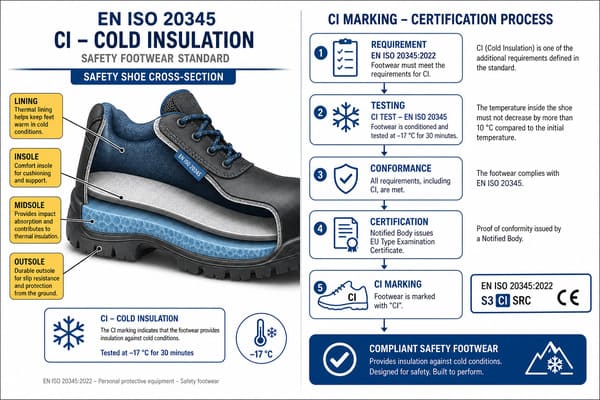
Two years ago, a buyer from a cold storage company in the Netherlands contacted me. He had been sourcing winter safety shoes from another supplier for three years. The shoes had thick fleece lining, felt warm, and workers liked them at first. After one winter, the complaints started — soles cracking, workers slipping on frozen ground because the outsole had hardened and lost grip. He had no idea what CI rating was. When I explained that CI testing is about whether the shoe’s materials keep their performance at -17°C — not just whether the shoe feels warm — he immediately understood the problem. His previous shoes had no CI certification at all. We re-sourced his full order with CI-rated outsoles. The complaints stopped the following winter.
CI vs. "Winter Use" — What’s the Real Difference?
Many products on the market are labeled "winter use," "cold protection," or "suitable for low temperatures." These are marketing descriptions. They carry no certification requirement and no testable standard behind them. CI is different. It is a pass/fail rating tied to lab-tested performance data.
| Label | Backed by Standard? | Tested at -17°C? | Thermal Resistance Requirement |
|---|---|---|---|
| "Winter use" | No | No | None |
| "Cold protection" | No | No | None |
| CI (EN ISO 20345) | Yes | Yes | Min. 0.25 m²·K/W |
A distributor based in Finland told me last year that less than 30% of the safety shoes in his local market carry a verified CI marking. Most products claim cold protection in marketing materials, but when he checked the actual EN certification documents, CI was missing. He made CI a mandatory spec for all his cold-weather SKUs. Within one season, he had won three new corporate contracts — including one with a logistics company operating freezer warehouses at -22°C. CI is verifiable, auditable, and something serious procurement teams increasingly ask for by name.
How Is the CI Rating Tested and Measured?
A lot of buyers assume cold-resistance testing just means leaving the shoe in a freezer for a while. The actual test is more specific than that — and the part of the shoe being evaluated might surprise you.
CI testing under EN ISO 20345 conditions the complete shoe at -17°C, then measures thermal resistance through the insole. The outsole is also subjected to flex testing at -17°C. The shoe must achieve a minimum thermal resistance of 0.25 m²·K/W and the outsole must not crack under repeated flexion at that temperature.
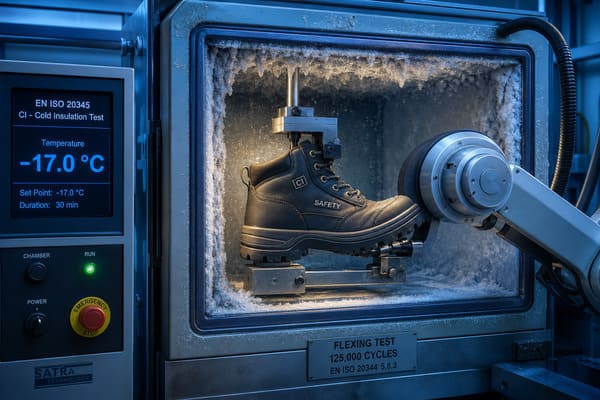
Most people, when they hear "cold-resistant shoe," immediately think about the lining — Thinsulate, wool, fleece. That thinking is understandable. But in actual CI certification, what determines pass or fail is usually the outsole. I’ve had clients come to me after failing EN certification audits with their previous supplier. In three out of four cases, the outsole compound was the problem.
Why the Outsole Is the Critical Variable
Standard TPU outsoles begin to stiffen noticeably below -15°C4. Some cheaper rubber compounds become brittle at -20°C and crack under flex5. We use a cold-grade rubber compound blended specifically to remain flexible at -30°C. The difference in material cost between a standard rubber outsole and a cold-grade compound is roughly 8–12% of total shoe cost. That’s not a large difference. But it’s the variable that determines whether the shoe passes CI testing.
| Outsole Material | Flexible Below -17°C? | CI Compliant? | Notes |
|---|---|---|---|
| Standard TPU | No | No | Stiffens at -15°C |
| Standard rubber | Sometimes | Sometimes | Depends on compound |
| Cold-grade rubber blend | Yes | Yes | Remains flexible to -30°C |
| Cheap PVC | No | No | Brittle below -10°C |
The thermal resistance measurement is taken through the insole using a standardized plate method6. The test simulates heat loss from the foot through the shoe to a cold surface. The shoe must maintain the minimum 0.25 m²·K/W value across the entire insole area, not just the heel or forefoot. This means both the midsole material and insole construction contribute to the result. A shoe with a CI-compliant outsole but a thin, low-density insole can still fail this part of the test. Both components have to be designed together with cold performance in mind.
Is ANSI Z41 Still Valid?
Buyers sourcing for the North American market still reference ANSI Z41 in specs and RFQs. If you’re doing that, here’s what you need to know.
ANSI Z41 was withdrawn in 20057. It has been replaced by ASTM F2413, which is the current active standard for safety footwear in the United States and Canada. Any product certified only to ANSI Z41 does not meet current North American safety footwear requirements.
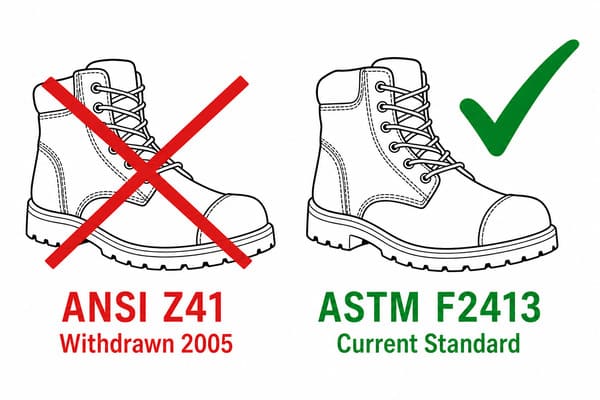
I still receive RFQs that list ANSI Z41 as the required certification — usually from buyers who have copied an old procurement template without updating it. When I see that, I flag it immediately. Supplying to an outdated standard is not a compliance solution. It creates liability for the distributor and risk for the end user.
ASTM F2413 vs. EN ISO 20345 — Cold Resistance Coverage
This is where North American buyers often run into confusion. ASTM F2413 covers impact resistance, compression resistance, metatarsal protection, electrical hazard, and puncture resistance. It does not include a standalone cold insulation rating equivalent to CI. There is no ASTM cold performance marking that directly matches what EN ISO 20345’s CI designation measures.
| Feature | ASTM F2413 | EN ISO 20345 |
|---|---|---|
| Impact/Compression | Yes (75 ft-lb / 2500 lb8) | Yes (200J toe cap) |
| Electrical Hazard | Yes (EH rating) | Yes (ESD, Electrical Insulation) |
| Slip Resistance | Limited (optional SRC) | Yes (SRA, SRB, SRC) |
| Cold Insulation | No equivalent | Yes (CI, tested at -17°C) |
| Puncture Resistance | Yes | Yes (P marking) |
I had one client supplying a multinational oil company with sites in both Norway and Texas. The Norway site required EN ISO 20345 with CI marking. The Texas site required only ASTM F2413. We produced two separate SKUs — one dual-tested to EN with CI, one ASTM-only without. It added cost and lead time. If that buyer had understood this gap at the start of the sourcing process, the planning would have been cleaner. I now raise this in the first conversation with any client who has multi-region supply needs, before the spec sheet is finalized.
What Does the S7L Rating on Safety Boots Mean?
S7L is one of the newer markings appearing on EN-certified safety footwear. Buyers seeing it for the first time often ask what it adds over S3 or S5.
S7L is a safety footwear classification under EN ISO 20345:20229. It indicates a full ankle boot with all S3 protections — steel or composite toe, puncture-resistant midsole, heel energy absorption, water resistance — plus additional requirements for lace retention and ankle support structure.
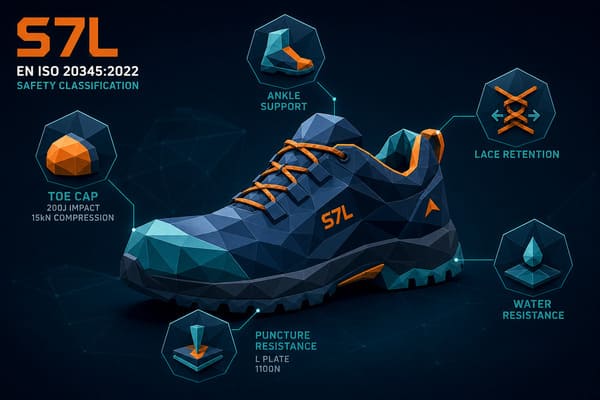
The 2022 revision of EN ISO 20345 introduced several updates to the classification system. S7 and S7L were added to recognize that ankle support and boot height have measurable impact on workplace injury outcomes10, particularly in construction, logistics, and outdoor industrial environments. Buyers who were previously specifying S3 HRO WR CI for cold, wet, outdoor environments should now consider whether S7L covers those needs more cleanly in a single classification.
Breaking Down the S7L Classification
S7L builds on the full S3 base protection and adds tested requirements for the boot structure itself, not just the protective components inside it.
| Marking | What It Means |
|---|---|
| S | Basic safety footwear with toe cap (200J impact11) |
| S3 | Adds water resistance + penetration resistance midsole + heel energy absorption |
| S7 | S3 base + tested ankle support structure |
| S7L | S7 + lace retention system tested under load |
| CI (add-on) | Cold insulation tested at -17°C, min. 0.25 m²·K/W |
| WR (add-on) | Whole upper water resistance |
| HRO (add-on) | Outsole resistant to hot contact surfaces |
For buyers supplying cold-climate markets — northern Canada, Scandinavia, the Baltics, Siberia — S7L with CI and WR is now the most complete single-boot specification available under EN ISO 20345:2022. In my experience, about 7 out of 10 new clients who come to me for cold-environment shoes don’t mention CI in their initial inquiry. They list toe cap standard and slip resistance, but cold insulation gets skipped. I had one client, a PPE distributor supplying construction sites in northern Canada, who had been selling non-CI shoes for two seasons. In his third winter, one of his end clients reported early sole delamination — the adhesive bond between midsole and outsole was failing at -25°C12. He lost that contract. When he came to me, the first thing I asked was whether his previous shoes carried CI. They didn’t. We rebuilt his product spec from scratch, added CI and HRO rating, and he won back the client the following year. CI should be on the first line of the spec sheet for any cold-environment application — not something you discover after a product failure.
Conclusion
CI rating is not a comfort feature. It is a performance standard that determines whether a safety shoe keeps working when the temperature drops below -17°C. Understand it before your product fails in the field. At Shoegan, we build cold-rated safety footwear that meets EN ISO 20345 CI requirements — built to protect, made to last.
-
"What Is the Puncture Resistance Rating in EN ISO 20345 …", https://protectyourfootsafety.com/what-is-the-puncture-resistance-rating-in-en-iso-20345/. EN ISO 20345 is the internationally recognized standard specifying basic and additional requirements for safety footwear for professional use, including the CI (Cold Insulation) marking for thermal resistance performance. Evidence role: definition; source type: institution. Supports: the authority and scope of EN ISO 20345 as the European standard for safety footwear specifications. ↩
-
"[DOC] https://www.k-state.edu/ier/testing/KSU%20Instruct…", https://www.k-state.edu/ier/testing/KSU%20Instructions%20for%20Footwear%20and%20Headwear.docx. EN ISO 20345 specifies that cold insulation testing must be performed with the footwear conditioned at -17°C to evaluate thermal resistance performance. Evidence role: mechanism; source type: institution. Supports: the standardized -17°C test temperature used for CI rating evaluation. ↩
-
"The use of footwear insulation values measured on a …", https://pubmed.ncbi.nlm.nih.gov/15028196/. According to EN ISO 20345, footwear marked with CI must demonstrate thermal resistance of at least 0.25 m²·K/W when tested at -17°C. Evidence role: statistic; source type: institution. Supports: the specific 0.25 m²·K/W threshold requirement for CI marking under EN ISO 20345. ↩
-
"What Is a Rubber Outsole in Safety Shoes? – Shoegan | Safety …", https://protectyourfootsafety.com/what-is-a-rubber-outsole-in-safety-shoes/. Thermoplastic polyurethanes exhibit reduced flexibility at low temperatures due to molecular chain stiffening, with glass transition effects becoming significant in sub-zero conditions. Evidence role: mechanism; source type: research. Supports: the temperature-dependent mechanical properties of thermoplastic polyurethane (TPU) materials. Scope note: Exact transition temperatures vary by TPU formulation and grade ↩
-
"Experimental Study on the Mechanical Properties of Crumb …", https://pmc.ncbi.nlm.nih.gov/articles/PMC10384641/. Rubber compounds can undergo cold-temperature embrittlement when cooled below their glass transition temperature, resulting in reduced elasticity and increased susceptibility to crack formation under mechanical stress. Evidence role: mechanism; source type: research. Supports: the cold-temperature embrittlement phenomenon in rubber materials. Scope note: The specific temperature threshold depends on rubber formulation, plasticizers, and compounding additives ↩
-
"Testing cold protection according to EN ISO 20344", https://pubmed.ncbi.nlm.nih.gov/19011127/. EN ISO 20345 thermal resistance testing employs a controlled plate method to measure heat transfer through the footwear assembly, simulating heat loss from the foot to cold surfaces. Evidence role: mechanism; source type: institution. Supports: the standardized testing methodology for measuring thermal resistance in safety footwear. ↩
-
"DRAFT SN", https://www.labor.nc.gov/osh/osh-enforcement-procedures/sn-70-revised-astm-standards-foot-protection/open. ANSI Z41, the former American National Standard for protective footwear, was withdrawn and replaced by ASTM F2413, which became the active standard for safety footwear in North America. Evidence role: historical_context; source type: institution. Supports: the withdrawal of ANSI Z41 and its replacement by ASTM F2413 as the current North American safety footwear standard. Scope note: The exact year of transition may vary by jurisdiction and enforcement authority ↩
-
"1910.136 – Foot protection. | Occupational Safety and … – OSHA", https://www.osha.gov/laws-regs/regulations/standardnumber/1910/1910.136. ASTM F2413 establishes minimum performance requirements for protective footwear, including impact resistance of 75 foot-pounds and compression resistance of 2,500 pounds for safety toe protection. Evidence role: statistic; source type: institution. Supports: the impact and compression resistance specifications required by ASTM F2413. ↩
-
"Guide to EN ISO 20345:2022 | Safety footwear", https://www.uvex-safety.co.uk/en/knowledge/safety-standards/safety-footwear/guide-to-en-iso-203452022/. The 2022 revision of EN ISO 20345 introduced updated classification schemes for safety footwear, including enhanced categories for ankle support and boot construction requirements. Evidence role: historical_context; source type: institution. Supports: the 2022 revision of EN ISO 20345 and its introduction of updated classification categories. ↩
-
"What’s the Impact of Safety Footwear on Workers Concerning …", https://pmc.ncbi.nlm.nih.gov/articles/PMC11311279/. Occupational safety research suggests that footwear design features including ankle support may contribute to injury prevention in industrial settings, though outcomes depend on work environment and specific hazard exposure. Evidence role: general_support; source type: research. Supports: the relationship between ankle support in safety footwear and occupational injury prevention. Scope note: Injury outcomes are multifactorial and cannot be attributed solely to footwear design ↩
-
"Employer Personal Protective Equipment Workplace …", http://www.osha.gov/laws-regs/standardinterpretations/2013-12-09. EN ISO 20345 specifies that safety footwear toe caps must withstand an impact energy of 200 joules to meet basic protective requirements. Evidence role: statistic; source type: institution. Supports: the 200-joule impact resistance requirement for safety footwear toe protection. ↩
-
"[PDF] note – effect of heating on the structure of an adhesive joint, as indicated …", http://www.acsu.buffalo.edu/~ddlchung/Effect%20of%20heating%20on%20the%20structure%20of%20an%20adhesive%20joint.pdf. Adhesive systems can experience reduced bond strength and increased brittleness at sub-zero temperatures due to thermal contraction mismatch and polymer chain immobilization, potentially leading to delamination under mechanical stress. Evidence role: mechanism; source type: research. Supports: the cold-temperature vulnerability of adhesive bonds in composite assemblies. Scope note: Adhesive cold-temperature performance varies significantly by chemistry, substrate materials, and application method ↩