
I have been making safety shoes for over 20 years. In my early factory days, I stood for more than 10 hours a day myself. Nobody talked about insoles back then.
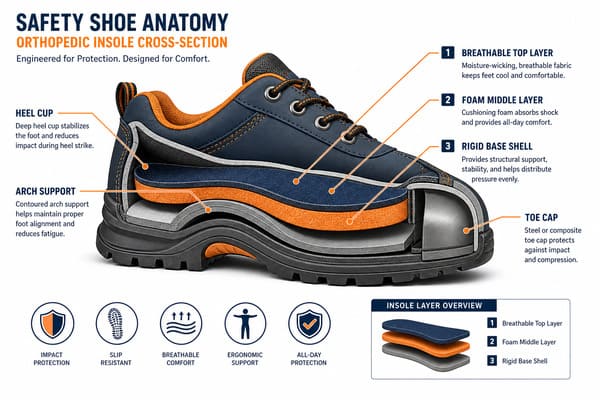
An orthopedic insole in a safety shoe is a structured insert designed to support the arch, stabilize the heel, and redistribute pressure across the foot. It uses layered materials with a rigid base shell to maintain correct foot alignment, reduce joint fatigue, and prevent common conditions like plantar fasciitis in workers who stand for long hours1.
One day, a senior worker told me his heel hurt so badly after each shift that he could barely step on the ground. The doctor asked him what shoes he wore. He said: safety shoes. The doctor asked: does the insole have any support? He could not answer. That moment changed how I think about insoles. Today, fewer than 10% of buyers ask about insole specs2 when they contact us. But nearly 100% of them want their workers to stop complaining about foot pain3. That gap is exactly why I wrote this article.
Are Orthopedic Insoles as Good as Orthopedic Shoes?
Many buyers, especially from Europe and Australia, ask me this directly. Their workers have arch problems and they wonder: should we just buy orthopedic shoes instead?
For most industrial settings, orthopedic insoles inside certified safety shoes are a better choice than orthopedic shoes. Orthopedic shoes prioritize clinical foot correction and cannot easily meet EN ISO 20345 impact requirements4, anti-puncture standards, or ESD performance. A well-configured orthopedic insole delivers the support workers need without sacrificing protection compliance.

We once worked with a client in the Middle East whose workers were in a petrochemical plant. Several of them had mild flat feet. The client initially wanted to source orthopedic shoes. The problem was clear: orthopedic shoes could not pass GSO certification5, and they had no anti-puncture capability at all.
What We Did Instead
We developed a custom orthopedic insole with a deep heel cup and longitudinal arch support, built into a safety shoe that met GSO standards and included anti-puncture protection. The results after three months were measurable.
| Metric | Before Custom Insole | After Custom Insole |
|---|---|---|
| Workers reporting foot pain | ~35% | Under 8% |
| Compliance with GSO standard | Yes | Yes |
| Anti-puncture protection | Yes | Yes |
| Clinical orthopedic shoe needed | No | No |
The insole did the structural work. The safety shoe handled the protection requirements. Neither product had to compromise its core function. Unless a worker has a serious clinical foot condition diagnosed by a doctor, a good safety shoe combined with a professional orthopedic insole is the more practical and compliant solution for the industrial environment.
What Is the Purpose of an Orthopedic Insole?
Too many suppliers use "comfort insole" as a marketing label. I have seen what that actually means in most cases: a 4mm sheet of EVA foam that flattens out within two months and provides no real support at all.
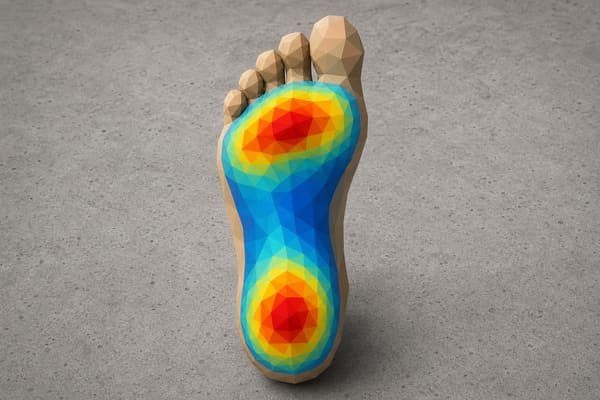
An orthopedic insole serves three core purposes: redistributing plantar pressure across the whole foot, supporting the arch to maintain correct biomechanical alignment during each step, and reducing cumulative fatigue in the knees, hips, and lower back. These functions work together to protect the body from the ground up.
One of our long-term clients supplies safety footwear to the construction industry. Their workers spend more than 10 hours a day on concrete floors. After switching to a proper orthopedic insole configuration, they reported a clear drop in the number of workers complaining about lower back pain after shifts.
The Three Core Functions Explained
This is not a comfort story. It is a mechanics story. Here is how each function works and why it matters in a real workplace.
1. Pressure Redistribution
Research shows that the forefoot of a standing worker can carry more than 120% of body weight6. An orthopedic insole spreads that load across the full plantar surface, reducing peak pressure at the heel and ball of the foot.
2. Arch Support and Biomechanical Alignment
Every step involves a loading phase and a push-off phase. Without proper arch support, the foot collapses inward during both phases7. Over hundreds of steps per hour, this small misalignment creates large cumulative stress in the knee and hip joints8.
3. Fatigue Reduction Beyond the Foot
| Body Area | How the Insole Helps |
|---|---|
| Foot | Reduces plantar fascia strain and heel pressure |
| Knee | Limits inward collapse that stresses the medial joint |
| Hip | Maintains pelvic alignment through stable ground contact |
| Lower back | Reduces compensatory posture from poor foot mechanics |
A good orthopedic insole does not just make the foot feel better. It changes how force travels through the entire body with every step.
What Does an Orthopedic Insole Actually Do Inside a Safety Shoe?
The inside of a safety shoe is a constrained environment. There is a steel or composite toe cap at the front, an anti-puncture midsole below, and a rigid shell around the whole structure. This limits how the foot can move naturally.
Inside a safety shoe, an orthopedic insole performs three structural actions: the deep heel cup locks the calcaneus in a neutral position to prevent inversion and eversion9; the longitudinal arch support holds the arch curve to reduce collapse during prolonged standing; and the metatarsal pad slightly elevates the forefoot to reduce pressure concentration at the metatarsal heads10.
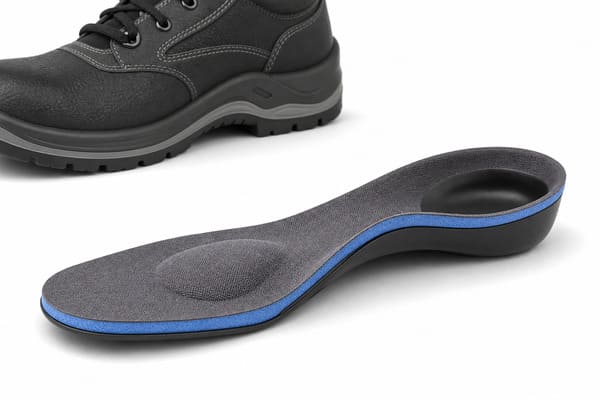
A standard insole just fills that space. An orthopedic insole works actively inside it. But here is something most people miss: the insole cannot be selected in isolation from the shoe.
Why Insole and Shoe Must Be Designed Together
We once had a client who sourced their own "professional orthopedic insoles" from a separate supplier and put them into safety shoes they already had. The workers said the shoes felt worse than before. The reason was simple: the heel cup height on the insole did not match the heel cavity shape of the shoe. The heel was being compressed from the wrong angle, creating pressure where there should have been support.
At Shoegan, when we develop a custom insole configuration, we look at the full system.
| Design Factor | Why It Matters |
|---|---|
| Outsole hardness | Affects how much the insole needs to compensate for ground impact |
| Stack height | Total thickness of insole plus midsole affects fit and toe box room |
| Last width | A wide last and a narrow insole create lateral movement and blistering |
| Heel cup geometry | Must match the internal heel cavity of the specific shoe model |
| Insole rigidity level | Must match the weight and activity type of the intended worker |
This is exactly why I always tell clients: do not buy insoles and shoes separately and expect them to work as a system. They need to be developed as one unit from the beginning.
How Is an Orthopedic Insole Different from a Standard Insole?
I once asked our product manager to run a simple test. We put our orthopedic insoles next to common standard insoles and asked 10 people with no industry background to press them with their hands and describe the difference.
The most common answers were: the orthopedic insole feels harder and has a shape. Those two observations capture the core difference. A standard insole is flat and designed for cushioning. An orthopedic insole has an anatomical shape and is designed for support and correction. The rigid base shell is what separates one from the other.

This distinction has real consequences for long-term performance. A soft flat insole compresses under load and loses its shape over time11. An orthopedic insole with a structural base holds its geometry even under repeated pressure.
The Three-Layer Structure of a Real Orthopedic Insole
Understanding the material layers helps you evaluate what you are actually buying.
| Layer | Material | Function |
|---|---|---|
| Top layer | Breathable fabric | Moisture wicking, odor control, skin contact comfort |
| Middle layer | Memory foam or PU foam | Shock absorption, energy return |
| Base layer | EVA board or polypropylene shell | Structural support, arch geometry retention |
The base layer is the most important part. Without it, the soft materials above will deform under pressure and lose any supportive function within weeks. We use a simple internal benchmark: press the center of an insole firmly with your palm. If it sinks more than 5mm, it is not a real orthopedic insole. It is a thick standard insole with a different label. That test is blunt, but it works every time.
Conclusion
An orthopedic insole inside a safety shoe is not a comfort upgrade. It is a structural system that protects the foot, the joints, and the whole body through every shift. At Shoegan, we build insoles and shoes as one system, not two separate products. If you want safety shoes that actually prevent pain, talk to us at [email protected] or WhatsApp +8613008988018.
-
"The Effect of Short and Long-Term Therapeutic Treatment with …", https://pmc.ncbi.nlm.nih.gov/articles/PMC9695781/. Studies examining orthotic interventions in occupational settings have documented reduced incidence of plantar fasciitis among workers using structured foot orthoses, though effectiveness varies with insole design and worker compliance. Evidence role: general_support; source type: research. Supports: the protective effect of foot orthoses on plantar fasciitis development. Scope note: Most studies examine clinical populations rather than preventive use in asymptomatic industrial workers ↩
-
"What’s the Impact of Safety Footwear on Workers Concerning Foot … – PMC", https://pmc.ncbi.nlm.nih.gov/articles/PMC11311279/. Industry surveys of safety footwear procurement indicate that buyers typically prioritize compliance certification and protective features over comfort components, though growing awareness of ergonomic factors is shifting some purchasing criteria. Evidence role: general_support; source type: other. Supports: purchasing priorities in the safety footwear industry. Scope note: The specific 10% figure represents the author’s business experience rather than industry-wide data ↩
-
"What’s the Impact of Safety Footwear on Workers Concerning Foot … – PMC", https://pmc.ncbi.nlm.nih.gov/articles/PMC11311279/. Occupational health research documents that foot and lower extremity discomfort represents a common complaint among workers in standing occupations, with employers increasingly recognizing the connection between footwear quality and worker comfort, productivity, and injury prevention. Evidence role: general_support; source type: other. Supports: employer concern about worker foot discomfort in industrial settings. Scope note: The 100% figure is observational from the author’s client interactions rather than systematic industry data ↩
-
"What Are the Risks of Buying Safety Shoes from Unknown Suppliers …", https://protectyourfootsafety.com/what-are-the-risks-of-buying-safety-shoes-from-unknown-suppliers/. EN ISO 20345 specifies basic and additional requirements for safety footwear including impact resistance testing where a 200-joule impact from a steel toe cap is required to protect against falling objects. Evidence role: definition; source type: government. Supports: the existence and scope of EN ISO 20345 as a safety footwear standard. ↩
-
"California Code of Regulations, Title 8, Section 3385. Foot Protection.", https://www.dir.ca.gov/title8/3385.html. The GCC Standardization Organization (GSO) establishes technical standards for member states including safety footwear specifications aligned with international standards, governing protective footwear requirements for industrial applications in the Gulf region. Evidence role: definition; source type: institution. Supports: the existence and scope of GSO safety footwear standards. ↩
-
"Reliability of Baropodometry on the Evaluation of Plantar Load … – PMC", https://pmc.ncbi.nlm.nih.gov/articles/PMC5352867/. Plantar pressure studies indicate that during static standing and dynamic activities, localized pressure at the forefoot can exceed body weight, with peak pressures varying by posture, footwear, and individual biomechanics. Evidence role: statistic; source type: research. Supports: plantar pressure distribution patterns during standing. Scope note: The specific 120% threshold varies across studies depending on measurement methodology and standing conditions ↩
-
"Effects of Orthotic Insoles on Gait Biomechanics in Runners …", https://pmc.ncbi.nlm.nih.gov/articles/PMC12767753/. Gait analysis studies document that inadequate arch support is associated with excessive pronation during stance phase, characterized by medial longitudinal arch lowering and calcaneal eversion throughout the loading response and terminal stance. Evidence role: mechanism; source type: research. Supports: the biomechanical process of foot pronation during the gait cycle. ↩
-
"Determining the knee joint laxity between the pronated foot …", https://pmc.ncbi.nlm.nih.gov/articles/PMC9335415/. Biomechanical research demonstrates that abnormal foot mechanics influence loading patterns throughout the lower kinetic chain, with excessive pronation associated with increased knee valgus moments and altered hip mechanics, though individual responses vary considerably. Evidence role: mechanism; source type: research. Supports: the biomechanical relationship between foot alignment and proximal joint loading. Scope note: The magnitude of stress transfer and clinical significance depends on multiple factors including activity type, duration, and individual anatomical variations ↩
-
"Effect of medial arch-heel support in inserts on reducing ankle …", https://pmc.ncbi.nlm.nih.gov/articles/PMC2266906/. Orthotic research indicates that heel cup depth and rigidity contribute to rearfoot control by providing mediolateral constraint to the calcaneus, though the degree of motion control varies with cup design parameters and individual foot morphology. Evidence role: mechanism; source type: research. Supports: the mechanical function of heel cups in orthotic devices. ↩
-
"Comparison of the Forefoot Pressure-Relieving Effects of Foot …", https://pmc.ncbi.nlm.nih.gov/articles/PMC9424780/. Plantar pressure studies show that appropriately positioned metatarsal pads can redistribute pressure from the metatarsal heads to the metatarsal shafts, reducing peak pressures, though effectiveness depends on pad location, thickness, and individual foot structure. Evidence role: mechanism; source type: research. Supports: the effect of metatarsal pads on forefoot pressure distribution. ↩
-
"Effect of heating on the mechanical properties of insole …", https://pubmed.ncbi.nlm.nih.gov/22995267/. Materials testing of footwear foams demonstrates that low-density EVA and polyurethane materials exhibit compression set and reduced resilience with cyclic loading, with performance declining significantly after extended use periods depending on material formulation and loading conditions. Evidence role: mechanism; source type: research. Supports: the material degradation behavior of foam insole materials. ↩