
I’ve been making safety shoes for over 15 years. One thing still surprises me: most buyers spend weeks comparing toe cap standards and outsole compounds, but nobody asks about width.
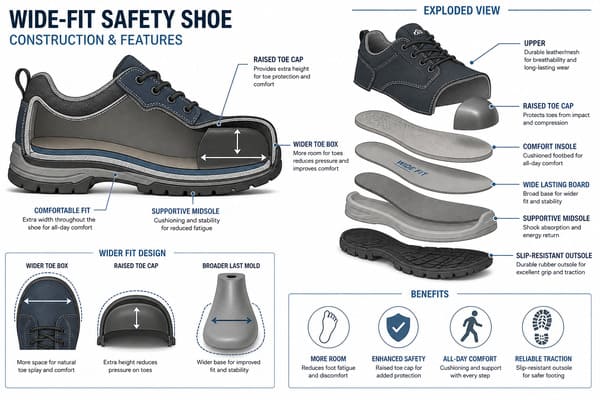
A wide-fit safety shoe is built on a wider last — the mold that shapes the shoe — typically 6–10mm broader across the ball of the foot than a standard shoe1. It also features a raised toe box and a resized protective toe cap. Workers with wide feet, foot swelling, or thick socks need this fit to stay safe and productive.
Last year, a client from a construction supply company in the Middle East came to us after their workers started complaining about foot pain. We measured 30 workers on-site. Over 60% of them had been wearing shoes that were at least one width size too narrow. The shoes fit in length — but they were crushing the foot from the sides. That’s when I realized: wrong width is just as dangerous as no toe protection. In this article, I want to break down what wide fit actually means, who needs it, and what to look for when you buy.
What Makes a Safety Shoe "Wide Fit"?
Wide fit is not just a bigger shoe. I need to say that clearly, because this is the most common mistake I see from buyers.
A true wide-fit safety shoe starts with a wider last — the mold used to shape the shoe. It is typically 6–10mm broader across the ball of the foot. The toe box is also raised to give vertical room, and the steel toe cap is resized to match the wider platform.
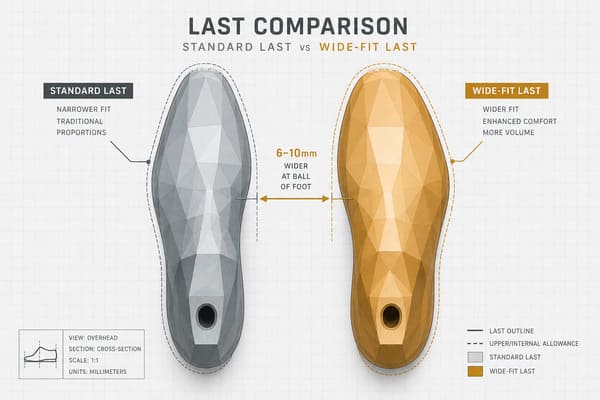
When we produce a wide-fit safety shoe at Shoegan, we change the last first. That’s the foundation of everything. If a manufacturer just cuts a wider upper and puts it on the same old last, the toe cap won’t sit right, the insole won’t align, and the shoe will fail both comfort and protection. That’s not wide fit. That’s a defect.
What exactly changes in a wide-fit last?
Here is a breakdown of the key structural differences between a standard last and a true wide-fit last:
| Component | Standard Last | Wide-Fit Last |
|---|---|---|
| Ball-of-foot width | Baseline measurement | +6–10mm wider |
| Toe box height | Standard clearance | Raised by 4–6mm |
| Steel toe cap size | Standard width | Resized to match wider platform |
| Insole width | Standard | Extended to match wider base |
| Upper pattern | Standard cut | Wider cut with adjusted seam placement |
Every one of these changes matters. If even one component is left at standard dimensions, the wide-fit shoe will not perform the way it should. Buyers often ask me why their "wide-fit" shoes from another supplier still caused foot pain. In most cases, it’s because only the upper was widened, and everything else stayed the same. A truly engineered wide-fit shoe requires changes at every layer — from the last to the lining to the protective cap. At Shoegan, we treat this as a complete redesign, not a simple adjustment. That’s why our wide-fit clients rarely come back with fit complaints, but they do come back with repeat orders.
Who Should Be Wearing Wide-Fit Safety Shoes?
Early in my career, I worked on the factory floor before I moved into production management. I remember a colleague — a big guy, worked in the welding section — who would unlace his shoes completely by 2pm every day just to relieve the pressure.
Workers who need wide-fit safety shoes include people with naturally wide feet, workers with diabetes, workers in hot environments where feet swell during a shift, and workers over 45 whose foot arch has flattened with age. This group is larger than most procurement managers expect.
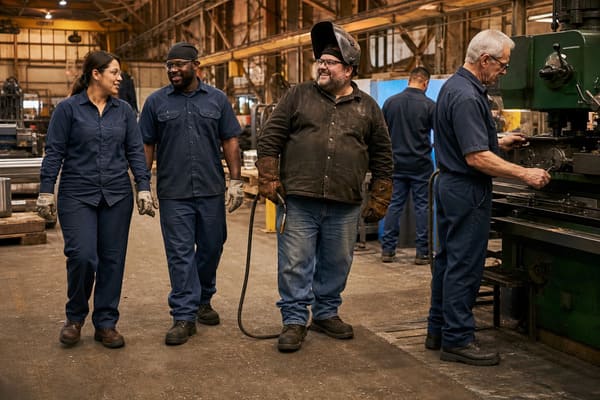
He wasn’t wearing the wrong size. He was wearing the wrong width. He had a D-width foot in a standard B-width shoe. Nobody told him wide-fit existed. He just thought foot pain was part of the job.
Breaking down the groups who need wide fit
Here is how I categorize the workers who need wide-fit shoes, based on what I’ve seen across 15 years of production and client conversations:
| Worker Group | Reason Wide Fit Is Needed | Risk If Ignored |
|---|---|---|
| Naturally wide feet | Standard last compresses the foot from the sides | Blisters, nerve pain, long-term joint damage |
| Workers with diabetes2 | Foot swelling is common; poor circulation means injuries don’t heal fast | Ulcers, serious infection risk |
| Workers in hot environments | Feet can swell by half a size or more during a single shift3 | Compression pain, reduced circulation |
| Workers over 45 | Foot arch flattens with age, which widens the natural foot shape | Plantar fasciitis, knee strain |
| Workers wearing orthotics | Custom insoles take up interior space and require a wider, deeper fit | Insole displacement, loss of arch support |
When I talk to procurement managers, they usually think of wide fit as a niche request for a small group of workers. In reality, when you combine all of the groups above, you’re often looking at 30–50% of any given workforce4. If your current supplier doesn’t offer wide-fit options, a significant portion of your workers are probably in the wrong shoe right now — and they may not even know it. They just think foot pain is normal. It’s not.
Which Industries Need Wide-Fit Safety Shoes the Most?
In my experience talking to clients across construction, oil and gas, logistics, and manufacturing, certain patterns keep coming up. And they are consistent enough that I now raise the width question myself before clients even ask.
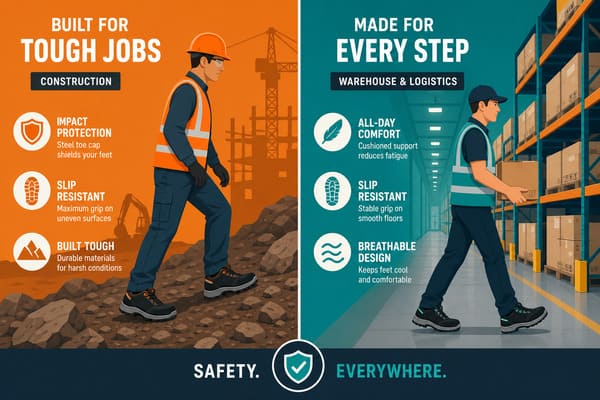
The industries that most commonly need wide-fit safety shoes are construction, warehousing and logistics, cold storage, and mining. Workers in these environments face foot swelling, uneven terrain, and thick sock requirements — all of which demand a wider interior fit.
I had a client running a cold storage facility in Scandinavia who switched their entire team to wide-fit after calculating that productivity dropped 12% in the second half of every shift due to foot fatigue5. That’s not a small number. That’s a measurable business loss caused by the wrong shoe width.
Industry-by-industry breakdown
Here is how wide-fit needs show up differently across key industries:
| Industry | Core Width Problem | Consequence |
|---|---|---|
| Construction | Feet spread naturally on uneven ground; standard shoes fight this movement | Fatigue, ankle instability, increased injury risk |
| Warehousing and logistics | Workers walk 15–20 km per shift6; feet swell significantly by hour six | Pressure pain, blisters, early shift productivity loss |
| Cold storage | Thick thermal socks consume 5–8mm of interior space7 | Standard shoe becomes a tight shoe mid-shift |
| Mining | Heavy socks plus underground heat cause consistent foot swelling | Circulation issues, reduced grip control |
| Oil and gas | Long shifts combined with chemical protective socks require extra room | Comfort failure leads to distraction and safety risk |
What strikes me most when I look at this list is that width is almost never mentioned in industry procurement specs. Buyers specify the toe cap standard, the slip resistance rating, the chemical resistance class — but width is treated as optional. These industries are asking their workers to operate in high-risk environments while potentially wearing shoes that are actively working against them. That’s a gap worth closing.
What Features Should You Look for in a Wide-Fit Safety Shoe?
After producing wide-fit safety shoes for clients in Europe, the Middle East, and Australia, I’ve learned that most buyers don’t know the right questions to ask. They look at the outside of the shoe and guess.
When buying wide-fit safety shoes, check the last width across the ball of the foot, toe box height, insole width and arch position, lining material for moisture control, and the outsole contact patch geometry. Each of these affects both comfort and protection.
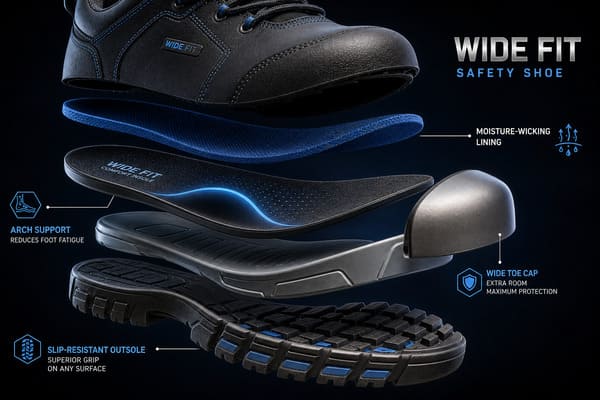
Most manufacturers won’t give you these numbers unless you push. I’ve seen buyers accept a shoe labeled "wide fit" without ever asking a single technical question. And then they come back six months later wondering why workers are still complaining.
The five features that matter most
Here is what I tell every buyer who comes to us asking about wide-fit options:
| Feature | What to Ask | Why It Matters |
|---|---|---|
| Last width | What is the ball-of-foot width in mm compared to your standard last? | This is the core measurement — everything else depends on it |
| Toe box height | How many mm of vertical clearance does the toe box provide? | Wide feet need room in both directions, not just side to side |
| Insole width and arch position | Is the insole resized to match the wider base? Where does the arch support sit? | A wide shoe with a standard insole puts arch support in the wrong position, causing knee and lower back strain |
| Lining material | What lining is used, and how does it manage moisture? | Wide-fit wearers generate more heat and moisture across a larger surface area — a poor lining causes odor and blisters faster |
| Outsole contact patch | Is the lug pattern designed for the wider base? | A wider base changes how the shoe contacts the ground; the grip geometry must match |
At Shoegan, every wide-fit model goes through a fit validation process before production. We check all five of these dimensions against the target last, and we document them in the product specification sheet so buyers can verify what they’re getting. If a supplier can’t give you this information, that’s a clear signal. They are not engineering a wide-fit shoe. They are just labeling one.
Conclusion
Wrong width causes real harm — blisters, pain, and lost productivity. Wide-fit safety shoes are not a niche product. They are a necessity for a large portion of your workforce. At Shoegan, we build wide-fit safety shoes the right way — engineered from the last up, certified, and ready for your workers.
-
"Shoe size", https://en.wikipedia.org/wiki/European_shoe_size. Industry last-grading guidelines typically specify the width increment between standard and wide-fit lasts, which is commonly expressed in millimeters across the ball-of-foot girth; the precise range varies by standard body and region. Evidence role: definition; source type: institution. Supports: Standard dimensional increments used in footwear last grading for wide-fit classifications. Scope note: Exact millimeter ranges may differ between European, American, and Asian sizing conventions, so a single figure may not apply universally. ↩
-
"Etiology, Epidemiology, and Disparities in the Burden … – PMC", https://pmc.ncbi.nlm.nih.gov/articles/PMC9797649/. Clinical literature documents that peripheral neuropathy reduces pain sensation in diabetic patients, allowing undetected pressure injury from ill-fitting footwear to progress to ulceration and infection (see, e.g., published guidelines from the International Working Group on the Diabetic Foot). Evidence role: mechanism; source type: research. Supports: That ill-fitting footwear in diabetic individuals with peripheral neuropathy and poor circulation increases risk of pressure ulcers and serious infections. Scope note: Evidence is drawn from clinical populations and may not directly quantify risk in occupational footwear contexts. ↩
-
"Evidence of Health Risks Associated with Prolonged Standing …", https://pmc.ncbi.nlm.nih.gov/articles/PMC4591921/. Studies on foot volume change during prolonged occupational standing report measurable increases in foot girth across a shift, with some findings suggesting changes sufficient to alter shoe fit; however, the magnitude varies with temperature, duration, and individual physiology. Evidence role: statistic; source type: research. Supports: That foot volume increases measurably — potentially equivalent to half a shoe size — during prolonged standing or walking in warm conditions. Scope note: Published studies typically report volume in milliliters or girth in millimeters rather than shoe-size equivalents, making direct comparison to ‘half a size’ an approximation. ↩
-
"Association between lifestyles, anthropometric measurements …", https://pmc.ncbi.nlm.nih.gov/articles/PMC8166583/. Anthropometric surveys of adult foot dimensions have found considerable variation in foot width relative to length, with a notable proportion of individuals falling outside the width range accommodated by standard-width lasts; combined with populations affected by diabetes, aging, and occupational swelling, the share requiring wider fit is potentially significant. Evidence role: statistic; source type: research. Supports: That a substantial proportion of the working adult population has foot dimensions that exceed standard-width shoe lasts. Scope note: The 30–50% estimate is the author’s industry observation; published anthropometric studies report varying figures depending on population, measurement method, and width-classification system used. ↩
-
"Evidence of Health Risks Associated with Prolonged Standing …", https://pmc.ncbi.nlm.nih.gov/articles/PMC4591921/. Ergonomics research has linked lower-limb and foot fatigue in standing or walking occupations to reduced work performance, increased error rates, and earlier onset of discomfort in the latter portion of shifts, supporting the plausibility of productivity losses attributed to poor footwear fit. Evidence role: general_support; source type: research. Supports: That foot fatigue during prolonged occupational standing or walking measurably reduces worker productivity or performance. Scope note: The specific 12% figure is drawn from a single client report and is not independently verified; published studies report varying magnitudes of effect depending on task type and measurement method. ↩
-
"Correlation between pedometer and the Global Physical …", https://pmc.ncbi.nlm.nih.gov/articles/PMC4023491/. Occupational health studies using pedometry in warehouse and order-picking environments have recorded daily walking distances of roughly 10–20 km depending on facility size, task type, and shift length, indicating high ambulatory demand in these roles. Evidence role: statistic; source type: research. Supports: That workers in warehouse and logistics roles walk distances in the range of 15–20 km per shift. Scope note: The specific 15–20 km range is an approximation; actual distances vary considerably by warehouse layout, automation level, and job function. ↩
-
"How Are Safety Shoe Sizes Different from Regular Shoe Sizes …", https://protectyourfootsafety.com/how-are-safety-shoe-sizes-different-from-regular-shoe-sizes/. Footwear fit research acknowledges that sock thickness materially affects the interior volume available within a shoe, with heavier occupational and thermal socks adding several millimeters of effective girth; the precise range depends on sock construction and compression characteristics. Evidence role: statistic; source type: research. Supports: That thick thermal or work socks add a measurable number of millimeters to the effective foot girth inside a shoe. Scope note: The 5–8mm figure is a practical industry estimate; standardized published measurements for occupational thermal socks are limited in the peer-reviewed literature. ↩