
Every year, buyers lose thousands of dollars — and workers get hurt — because a supplier looked legitimate until it wasn’t.1 The risk is real, and it starts before the first shipment arrives.
Buying safety shoes from unknown suppliers puts you at risk of material substitution without notice, fake or unverifiable certifications, non-compliant products that fail under pressure, and full legal liability if a worker is injured. These risks are not rare. They are common, and the consequences are serious.
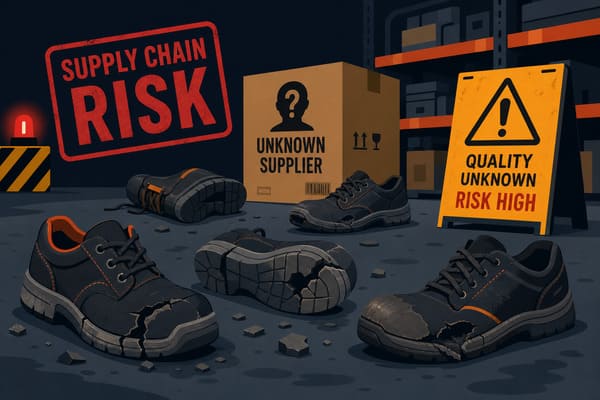
The safety shoe industry has a transparency problem.2 Most buyers only see samples and price sheets. What you don’t see is whether the factory actually exists, who controls the materials, and whether that test report was issued by a real lab. I’ve spent more than 20 years in this industry — starting on the production floor and eventually building Shoegan into a manufacturer that serves buyers across Europe, the Middle East, and North America. What I’ve seen in that time is worth understanding before you place your next order.
What Makes an Unknown Safety Shoe Supplier So Risky?
The problem rarely shows up on the first or second order. It shows up on the third — when the supplier knows you’re comfortable, and they need to protect their margin.
Unknown safety shoe suppliers carry risk because they typically don’t own a factory, don’t control raw material sourcing, and have no long-term accountability structure. When a quality problem occurs, there is no mechanism to hold them responsible — and no reputation at stake to motivate them to fix it.
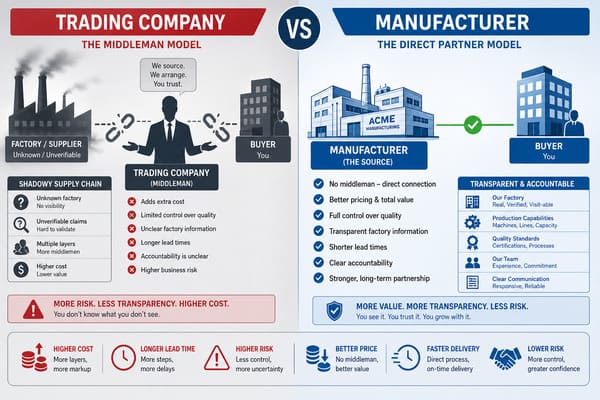
I had a client from Dubai — a PPE distributor who had been buying from a Guangzhou-based trading company for two years. The price was good. The samples looked fine. Communication was smooth. Then on the third order — 3,000 pairs — the upper leather thickness dropped from 1.8mm to 1.2mm without any notice. He only found out when his end customer reported that the shoes were cracking at the toe box after six weeks. By then, the trading company had stopped responding on WhatsApp.
Why Trading Companies Cannot Guarantee Consistency
| Factor | Established Manufacturer | Unknown Trading Company |
|---|---|---|
| Factory ownership | Yes — controls production | No — outsources to multiple factories |
| Material sourcing control | Direct supplier relationships | Depends on whoever quotes lowest |
| Quality accountability | Reputation and repeat business at stake | No long-term consequence for failure |
| Traceability | Full batch records available | Often none |
| Response when problem occurs | Contractual obligation to resolve | Disappears or denies involvement |
I’ve seen this pattern more than 30 times in my career. The supplier looks real until the moment it costs them something to be real. Manufacturers like Shoegan have built reputations over 15+ years. That reputation is the pressure that keeps quality consistent. Unknown suppliers feel none of that pressure. When a supplier owns nothing and controls nothing, they have nothing to lose — and you carry all the risk.
How Do Fake Certifications Put Your Workers in Danger?
A certification label on a shoe box means nothing if the test behind it was never done. That is not a hypothetical. It happens more often than the industry admits.
Fake safety shoe certifications mean the product was never tested to the standard it claims. A shoe labeled EN ISO 20345 S3 that failed to undergo the required 200-joule toe cap impact test looks identical to a compliant shoe — until the moment a worker’s foot is under a falling load.3
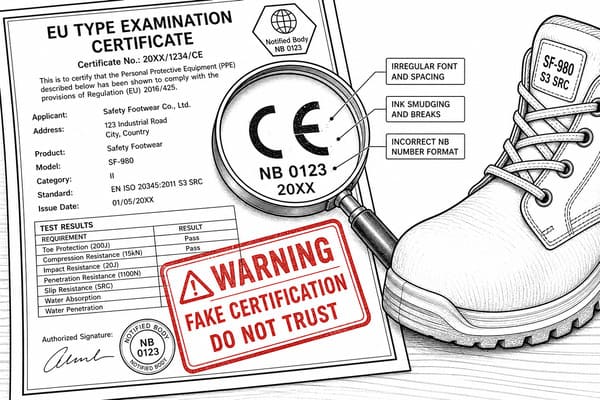
A construction company in Germany contacted me after an incident on their site. A worker dropped a steel beam — roughly 20kg — onto his foot. He was wearing shoes labeled EN ISO 20345 S3, sourced from an online marketplace. The toe cap failed. The worker lost two toes. When they traced the certification, the test report had been issued by a lab that didn’t exist at the listed address. The CE mark had been printed, not certified. The shoes had never been tested.
How to Identify Fraudulent Safety Shoe Certifications
| Verification Step | What to Check | Red Flag |
|---|---|---|
| Lab accreditation | Is the lab on the official notified body list? | Lab name not found in EU NANDO database |
| Test report date | Is it within the valid period? | Expired or no date listed |
| Certificate number | Does it match the product model exactly? | Generic certificate applied to multiple unrelated products |
| Importer declaration | Is the EU Declaration of Conformity available? | Supplier cannot provide it |
| Physical mark | CE marking with four-digit notified body number? | CE mark printed without a notified body number |
In my experience, roughly 1 in 5 "certified" safety shoes sold through unverified online channels in developing markets carry documentation that cannot be validated4. Under EU PPE Regulation 2016/425, if an importer or employer selects PPE with fraudulent certification and a worker is injured, liability does not stay with the overseas supplier.5 It transfers to the party who placed the product on the market or selected it for use. That party is usually you. Shoegan holds genuine EN ISO 20345, ASTM F2413, and AS/NZS 2210 certifications — all verifiable with documentation we provide before any order is confirmed.
Why Do Low-Price Safety Shoes Often Fail When It Matters Most?
A $8 FOB safety shoe is not a deal. It is a decision about which components get cut. And the components that get cut are exactly the ones that protect your workers.
Low-price safety shoes fail under real conditions because cost reduction always targets the internal components that are invisible during inspection: midsole density, outsole compound quality, and toe cap alloy grade. These cuts are undetectable until the shoe is under load — which is precisely when protection is needed most.
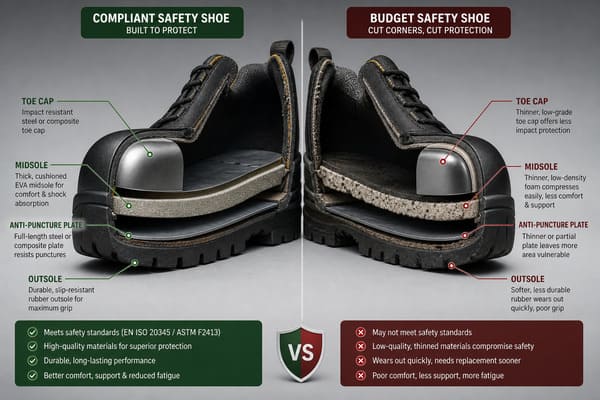
I spent my first five years working inside a production facility. I know exactly what gets cut when a factory needs to shave $2 off a shoe. The pattern is consistent.
Three Components Most Commonly Compromised in Low-Cost Safety Shoes
Midsole and Anti-Puncture Layer
Standard anti-puncture midsoles use a steel plate or composite fiber rated to withstand 1,100N of force.6 When cost is the pressure, the plate thickness drops or the composite grade is downgraded. The midsole still looks correct on inspection. It will not hold at 1,100N.
| Spec | Compliant Midsole | Budget Substitute |
|---|---|---|
| Puncture resistance rating | 1,100N (EN ISO 20345) | 600–800N estimated |
| Material | Rated composite fiber or full-spec steel plate | Thinner plate or lower-grade composite |
| Visual difference | None — identical appearance | Undetectable until failure |
Outsole Compound
Good slip-resistant outsoles use high-grade nitrile rubber or TPU with Shore A hardness tuned to the application.7 Cheap substitutes use recycled blended rubber. It hardens below 5°C and loses grip in wet conditions8 — exactly the conditions where workers slip and fall.
Toe Cap Alloy
Standard steel toe caps are tested to EN ISO 20345 at 200J impact and 15kN compression.9 Diluted alloy caps can look identical but deform under loads 30–40% lower than specification.
A shoe priced at $8 FOB when the honest cost of a compliant shoe is $14 FOB is not a bargain. That $6 gap came from somewhere. It always comes from the parts you cannot see until something fails. At Shoegan, our pricing reflects the actual cost of compliant materials — and we can walk you through the material spec sheet for any product we manufacture.
What Is the OSHA Rule on Safety Shoes?
North American buyers ask me this often, and the answer matters more than most people realize — especially when something goes wrong on a job site.
OSHA 29 CFR 1910.136 requires employers to provide foot protection where workers face hazards from falling objects, rolling objects, piercing, or electrical risks.10 Compliant footwear must meet ASTM F2413, which defines rated protection classes for impact, compression, puncture, electrical hazard, and static dissipation.11
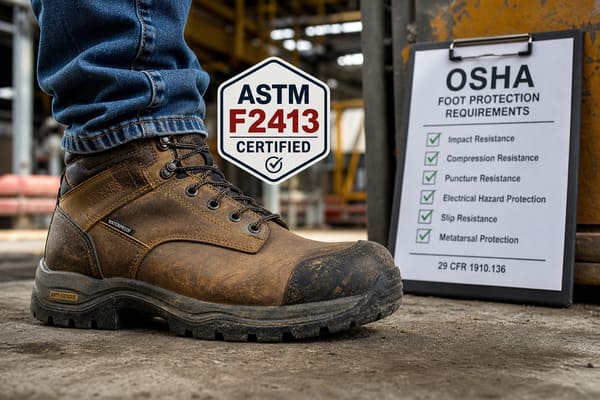
The rule is clear. But there is a part of it that most buyers miss — and it creates serious legal exposure when sourcing from unknown suppliers.
ASTM F2413 Protection Classes: What Each Code Means
| Code | Protection Type | Requirement |
|---|---|---|
| I/75 | Impact resistance | Withstands 75 ft-lbs impact at toe |
| I/50 | Impact resistance (lighter duty) | Withstands 50 ft-lbs impact at toe |
| C/75 | Compression resistance | Withstands 2,500 lbs compression |
| Mt | Metatarsal protection | Protects the top of the foot |
| PR | Puncture resistance | Resists puncture from below |
| EH | Electrical hazard | Insulates against open circuit up to 600V |
| SD | Static dissipative | Controls static discharge |
| Cd | Conductive | Grounds static electricity to earth |
Why OSHA Compliance Is the Employer’s Responsibility
OSHA does not certify products. OSHA does not inspect factories. OSHA inspects workplaces — and when they do, the burden falls on the employer to prove the PPE in use was properly certified. If you purchase shoes from an unknown supplier whose ASTM test reports are expired, unverifiable, or fraudulent, your workplace is non-compliant even if the shoe box says "ASTM F2413."
In a workers’ compensation case or an OSHA inspection, "I bought it from a cheap supplier online" is not a defense that holds.12 The employer selected the PPE. The employer carries the liability. Shoegan’s ASTM F2413 documentation is current, verifiable, and available for review before any purchase decision is made. That is not a sales point — it is the minimum standard any serious B2B buyer should require from their supplier.
Conclusion
Unknown suppliers bring hidden risks: material substitution, fake certifications, non-compliant shoes, and legal liability that falls on you when something goes wrong. The cost of getting this wrong is always higher than the savings on unit price. At Shoegan, we manufacture mid-to-high end safety footwear with 15+ years of production experience, full certification documentation, and complete OEM customization — Built to Protect. Made to Last. Contact us at [email protected] or WhatsApp +8613008988018.
-
"Commonly Used Statistics | Occupational Safety and …", http://www.osha.gov/data/commonstats. Government occupational safety agencies track injury rates associated with PPE failures, though specific attribution to supplier fraud versus other factors is often not separately reported. Evidence role: statistic; source type: government. Supports: annual injury rates and economic losses associated with defective or non-compliant personal protective equipment. Scope note: Most injury databases categorize by injury type rather than by supply chain failure mode ↩
-
"Supply chain visibility for personal protective equipment during COVID …", https://pmc.ncbi.nlm.nih.gov/articles/PMC8005248/. Supply chain researchers have documented transparency and traceability challenges across personal protective equipment sectors, particularly for products manufactured in regions with limited regulatory oversight. Evidence role: expert_consensus; source type: research. Supports: documented challenges in PPE supply chain transparency and traceability. ↩
-
"What Should You Check Before Ordering Custom Safety Shoes …", https://protectyourfootsafety.com/what-should-you-check-before-ordering-custom-safety-shoes/. EN ISO 20345 specifies testing requirements for safety footwear including impact resistance levels, with the standard published by the International Organization for Standardization and adopted as a European Norm. Evidence role: definition; source type: institution. Supports: the specific impact resistance testing requirements in EN ISO 20345 for S3 classification safety footwear. ↩
-
"Trends in safety footwear – Texas Department of Insurance", https://www.tdi.texas.gov/tips/safety/footwear.html. Studies on counterfeit and non-compliant PPE have documented significant rates of fraudulent certification, though exact percentages vary by region, product category, and distribution channel. Evidence role: statistic; source type: research. Supports: prevalence of fraudulent or non-compliant certification in safety equipment markets. Scope note: Published fraud rates typically reflect detected cases and may underestimate actual prevalence ↩
-
"Regulation (EU) 2016/425 on personal protective equipment", https://osha.europa.eu/en/legislation/directive/regulation-eu-2016425-personal-protective-equipment. EU PPE Regulation 2016/425 establishes that economic operators placing PPE on the market must ensure compliance, with importers bearing specific responsibilities for verifying manufacturer conformity assessment procedures. Evidence role: mechanism; source type: government. Supports: the liability framework established by EU PPE Regulation 2016/425 for importers and distributors. Scope note: Liability in injury cases also involves product liability law and national implementation, not regulation text alone ↩
-
"What Is the Puncture Resistance Rating in EN ISO 20345 …", https://protectyourfootsafety.com/what-is-the-puncture-resistance-rating-in-en-iso-20345/. Safety footwear standards such as EN ISO 20345 specify puncture resistance testing using a standardized test nail with defined force requirements to verify sole penetration resistance. Evidence role: definition; source type: institution. Supports: the puncture resistance force requirements specified in safety footwear standards. ↩
-
"Slip resistant properties of footwear on ice", https://pubmed.ncbi.nlm.nih.gov/15204296/. Footwear tribology research has examined how material composition and hardness affect slip resistance, though optimal specifications vary with intended surface conditions and environmental factors. Evidence role: mechanism; source type: research. Supports: the relationship between outsole material properties and slip resistance performance. Scope note: Optimal hardness ranges depend on specific application environments rather than a single universal value ↩
-
"Glass transition temperature as a unified parameter to design …", https://pmc.ncbi.nlm.nih.gov/articles/PMC11235161/. Polymer science literature documents that rubber compounds undergo changes in mechanical properties with temperature, approaching glass transition ranges where flexibility and surface traction decline, though specific temperatures vary by formulation. Evidence role: mechanism; source type: research. Supports: temperature-dependent changes in elastomer properties affecting grip performance. Scope note: The 5°C threshold is not universal; different rubber formulations exhibit different cold-temperature performance characteristics ↩
-
"How Much Impact Can a Steel Toe Cap Actually Withstand …", https://protectyourfootsafety.com/how-much-impact-can-a-steel-toe-cap-actually-withstand/. EN ISO 20345 specifies minimum performance levels for safety footwear toe caps, including impact energy and compression force thresholds, as defined in the standard published by ISO. Evidence role: definition; source type: institution. Supports: the impact and compression test specifications for protective toe caps in EN ISO 20345. ↩
-
"1910.136 – Foot protection. | Occupational Safety and …", http://www.osha.gov/laws-regs/regulations/standardnumber/1910/1910.136. OSHA regulation 29 CFR 1910.136 establishes employer requirements to ensure protective footwear is used where workplace hazards present injury risks to feet, as detailed in the Code of Federal Regulations. Evidence role: definition; source type: government. Supports: the specific requirements of OSHA regulation 29 CFR 1910.136 regarding employer obligations for foot protection. ↩
-
"ASTM F2413-11 Performance Requirements for Protective …", https://facilities.uw.edu/partner-resources/files/media/performance-requirements-for-protective-footwear.pdf. ASTM F2413 is the American standard specification for performance requirements of protective footwear, published by ASTM International and referenced in OSHA regulations. Evidence role: definition; source type: institution. Supports: the protection categories and testing requirements established in ASTM F2413. ↩
-
"1910.132 – General requirements. | Occupational Safety and Health …", https://www.osha.gov/laws-regs/regulations/standardnumber/1910/1910.132. OSHA’s general duty clause and specific PPE standards establish that employers are responsible for ensuring protective equipment meets applicable standards, regardless of supplier claims, as enforcement guidance and case precedent demonstrate. Evidence role: general_support; source type: government. Supports: employer responsibility for providing compliant PPE under OSHA regulations. Scope note: Specific liability outcomes depend on case facts, jurisdiction, and whether negligence or other factors are proven ↩
[…] than orthopedic shoes. Orthopedic shoes prioritize clinical foot correction and cannot easily meet EN ISO 20345 impact requirements4, anti-puncture standards, or ESD performance. A well-configured orthopedic insole delivers the […]