
Most buyers think FOB is just a price tag. It is not. It is where your cost responsibility begins — and most buyers find that out the hard way.
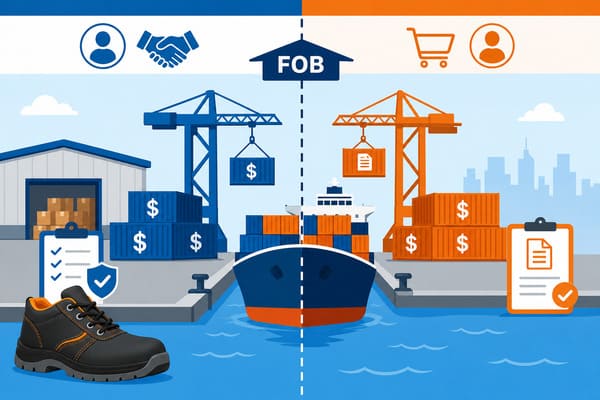
FOB stands for "Free On Board." It means the seller’s job ends when the goods are loaded onto the ship at the named port. From that point on, freight, insurance, and customs are the buyer’s responsibility. For safety shoe orders, this also means compliance documentation costs are often baked into the FOB price — sometimes visibly, sometimes not.
I have been shipping safety shoes FOB from Wenzhou, Ningbo, and Shanghai for over 15 years. The pattern I see is always the same. Buyers compare FOB prices from three to five suppliers, pick the lowest number, and then get surprised when the actual cost to receive the goods is 20 to 30 percent higher than expected1. FOB is just the starting line. What happens after that line is where most buyers lose money. This article walks through exactly how FOB works for safety shoe orders — and where the real risks are hiding.
What Does FOB Mean in International Shipping?
Most people have read the textbook definition. The real confusion starts when buyers realize that "FOB" without a named port is almost meaningless.
FOB means the seller’s responsibility ends the moment the goods are loaded onto the vessel at the named port. Everything after that — freight, marine insurance2, destination customs — is the buyer’s problem. The named port matters as much as the price itself.

I had a client from Germany last year who was comparing my FOB quote with another supplier’s. Same shoes, similar specs. Their price was $2.30 per pair lower. But their named port was Guangzhou. Mine was Ningbo. When the client checked with his freight forwarder, the inland trucking and port handling fees from Guangzhou to the vessel added $1.80 per pair back in. The real price difference was $0.50 — not $2.30. This happens more than most buyers expect.
Why the Named Port Changes Everything
The FOB price you see on a quotation is not just a factory price with a margin added. It already includes the cost of getting the goods from the factory to that specific port. Different ports mean different inland logistics costs, and those costs vary a lot depending on distance, route, and current trucking rates.
Here is a simple comparison to make this concrete:
| Supplier Location | FOB Port | Inland Distance | Est. Inland Cost/pair | Quoted FOB Price | Effective Starting Cost |
|---|---|---|---|---|---|
| Wenzhou | Ningbo | ~120 km | $0.30–$0.50 | $18.00 | $18.00 |
| Guangdong | Guangzhou | ~80 km | $0.20–$0.35 | $15.70 | $15.70 |
| Guangdong | Ningbo | ~1,200 km | $1.60–$2.00 | $15.70 | ~$17.30–$17.70 |
The table above shows why comparing FOB prices without checking the named port is one of the most common mistakes buyers make. A lower FOB price from a factory far from the port can easily cost more by the time the goods are actually loaded. Always ask the supplier: which port, and what is included in the inland cost?
How Is FOB Price Calculated for Safety Shoe Orders?
Safety shoe buyers often assume the FOB price is just the unit cost plus a margin. In practice, several cost layers sit between the factory floor and the ship.
The FOB price for safety shoes typically includes the ex-factory unit cost, inland trucking to the named port, export customs declaration fees, port terminal handling charges, and the cost of preparing compliance documentation such as EN ISO 20345 or ASTM F2413 test reports.
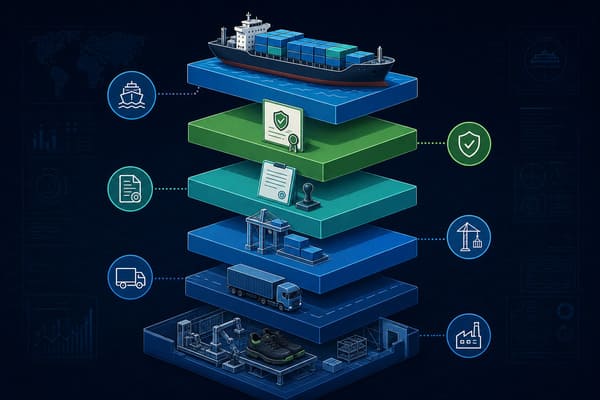
When I quote FOB Ningbo, the number already includes inland trucking from my factory in Wenzhou — roughly 120 kilometers — which typically adds $0.30 to $0.50 per pair depending on order volume. Export customs declaration fees and port terminal handling charges are also included. For safety shoes specifically, I also factor in the cost of preparing compliance documents. Test reports for EN ISO 20345 or ASTM F2413 can cost $800 to $1,500 per style to produce3. Some suppliers spread that cost across the order quantity quietly. I list it separately and explain it on the first call — because clients who understand what they are paying for come back for the next order.
What Gets Hidden in a "Low" FOB Price
Not every supplier builds their FOB price the same way. Some strip out compliance costs to make the number look smaller. Others skip inland insurance on the truck leg entirely. When you receive a quote that looks significantly lower than the market, it is worth asking point by point what is included.
Here is a breakdown of what should be in a clean FOB price for a safety shoe order:
| Cost Component | Included in a Transparent FOB Quote? | Notes |
|---|---|---|
| Ex-factory unit cost | Yes | Core product cost |
| Inland trucking to port | Yes | Varies by port and volume |
| Export customs declaration | Yes | Standard export paperwork |
| Port terminal handling (THC) | Yes | Charged by the port |
| EN ISO 20345 / ASTM test reports | Sometimes | Often hidden or spread without disclosure |
| Certificate of Conformity (CoC) | Sometimes | Required for some markets (e.g., Gulf/Middle East) |
| Inland cargo insurance | Rarely | Often excluded by lower-price suppliers |
If a supplier cannot walk you through this breakdown, that is a signal worth paying attention to. At Shoegan, every new client gets a line-by-line explanation of what the FOB price includes before they sign anything.
What Are the Risks of Buying Safety Shoes Under FOB Terms?
FOB sounds simple: the seller loads the goods, the buyer takes over. The risk is in what happens between the factory and the vessel — and what happens at the destination.
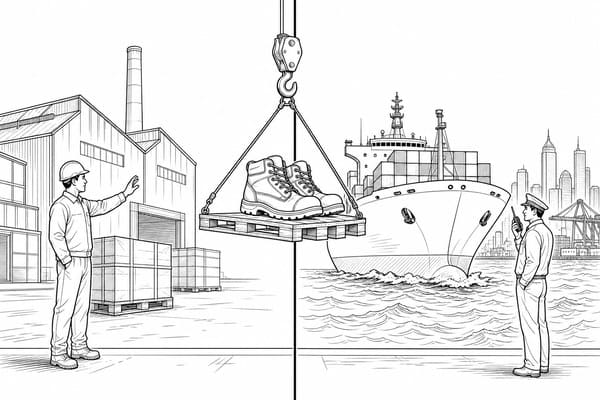
Under FOB terms, the buyer takes on full risk once goods are loaded onto the vessel4. This includes freight delays, marine damage, destination customs clearance, and import compliance. Missing a single document at the destination port can result in detention fees, shipment holds, or even rejection of the entire order.
I had a client in Saudi Arabia — a distributor — who ordered 2,000 pairs of steel toe boots under FOB terms. The goods arrived at Jeddah port in good condition. But his customs broker did not know that Saudi Arabia requires the GSO certification mark printed on the outer carton5. The shipment was held for 23 days. Demurrage fees alone cost him over $1,200. The shoes were fine. The documentation was not. Under FOB, I had already fulfilled my obligation when the goods were loaded in Ningbo. He had to absorb the entire cost. That experience is why I now proactively send every Middle East client a documentation checklist before production starts — even when they are buying FOB and it is technically not my responsibility.
Where FOB Buyers Lose Money Most Often
There are three common failure points for buyers under FOB terms. Understanding them before you place an order can save a significant amount of money.
1. Wrong or missing import documentation
Different countries require different certifications on the product label, carton, or accompanying paperwork. For safety shoes, this can include EN ISO 20345 for Europe, ASTM F2413 for North America, AS/NZS 2210 for Australia, and GSO for Gulf markets6. A missing stamp on a carton can hold an entire container7.
2. No marine insurance
Under FOB, the buyer is responsible for arranging marine insurance from the point of loading. Many first-time importers skip this step to save cost. If a container is damaged at sea, there is no recovery.
3. Underestimating destination handling costs
Port congestion surcharges, destination terminal handling fees, and customs broker fees at the destination are often not factored into the buyer’s cost estimate. These can add $0.50 to $1.50 per pair8 depending on the destination.
| Risk Category | Who Bears It Under FOB | How to Mitigate |
|---|---|---|
| Goods damaged during loading | Seller (until loaded) | Confirm packing standards before shipment |
| Marine transit damage | Buyer | Purchase marine cargo insurance |
| Destination customs delays | Buyer | Verify documentation requirements before production |
| Port demurrage / detention | Buyer | Work with experienced customs broker at destination |
| Import duty miscalculation | Buyer | Confirm HS code and tariff rate in advance |
How Does FOB Compare to CIF and DDP for Safety Shoe Buyers?
FOB looks cheaper on paper. CIF and DDP look more expensive. The real question is which one actually costs less by the time the goods reach your warehouse.
FOB, CIF, and DDP represent three different points at which the seller’s responsibility ends9. FOB ends at the origin port. CIF ends at the destination port10. DDP ends at the buyer’s named delivery address, with all duties and taxes paid. For buyers without strong logistics networks, DDP often delivers a lower total landed cost than FOB.
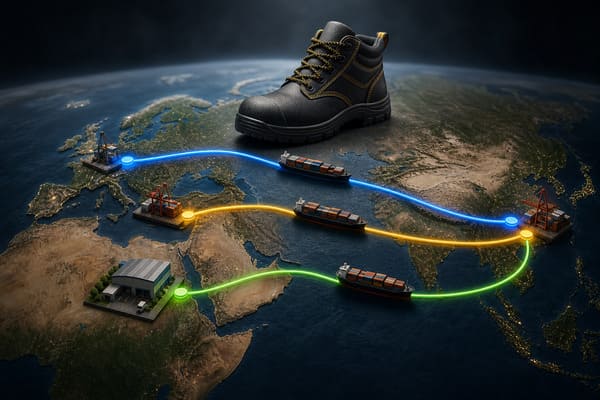
I ship under all three terms. Here is how I explain the difference to new clients using plain numbers. If the FOB price is $18.00 per pair, CIF to Hamburg might add $1.20 to $1.80 per pair for freight and insurance. DDP to a warehouse in Germany might add another $2.50 to $3.50 per pair for import duty — the EU tariff on safety shoes is around 4.3%11 — plus last-mile delivery. So the DDP price looks higher on paper: maybe $22.50 per pair versus $18.00 FOB. But a buyer without a reliable EU freight forwarder, going FOB and arranging everything themselves, could easily end up at $23.00 to $24.00 per pair once they add their freight rate, insurance, customs broker fee, and delivery. DDP costs more on paper. It is often cheaper in practice.
Choosing the Right Trade Term for Your Situation
The right trade term depends on your import volume, your logistics infrastructure, and how much control you want over the shipping process. Here is a practical guide:
| Trade Term | Seller’s Responsibility Ends At | Best For | Watch Out For |
|---|---|---|---|
| FOB | Named origin port (goods loaded) | High-volume buyers with own freight contracts | Hidden inland costs, no marine insurance by default |
| CIF | Destination port (freight + insurance included) | Mid-volume buyers wanting simpler logistics | Seller chooses freight carrier, buyer still handles customs |
| DDP | Buyer’s named delivery address (all duties paid) | Small-to-mid importers, first-time buyers | Higher unit price, but often lower total landed cost |
My honest recommendation: if you import fewer than three containers per year and do not have a dedicated customs broker at your destination, ask me for a DDP quote before you decide. The number often surprises buyers — in a good way. At Shoegan, we offer FOB from Wenzhou, Ningbo, and Shanghai, as well as CIF and DDP to most major markets. We will help you run the numbers before you commit to a trade term.
Conclusion
FOB is just the starting line. Your total landed cost — and your real risk — begins the moment the goods leave the factory. Understanding this before you place an order saves money, delays, and surprises.
Shoegan ships FOB, CIF, and DDP globally. Contact us at [email protected] or WhatsApp +8613008988018 to get a transparent, all-in quote for your next safety shoe order.
-
"Determine Total Export Price", https://www.trade.gov/determine-total-export-price. Research on import cost structures indicates that freight, insurance, duties, and destination handling charges can collectively add a significant percentage above the FOB price, though the exact range varies by commodity, origin, and destination market. Evidence role: general_support; source type: research. Supports: The gap between FOB price and total landed cost can be substantial once freight, insurance, customs duties, and destination handling are added.. Scope note: The 20–30% figure cited in the article is the author’s experiential estimate; no publicly available study directly validates this specific range for safety shoe imports. ↩
-
"Know Your Incoterms", https://www.trade.gov/know-your-incoterms. Incoterms 2020 FOB rules place no obligation on the seller to procure marine cargo insurance; once goods are on board the vessel, the buyer bears transit risk and must independently arrange cargo insurance if desired. Evidence role: mechanism; source type: institution. Supports: Under FOB Incoterms, the buyer bears the risk of maritime transit and is therefore responsible for procuring marine cargo insurance; the seller has no obligation to arrange such insurance.. ↩
-
"How Do You Start a Private Label Safety Shoe Brand? – Shoegan …", https://protectyourfootsafety.com/how-do-you-start-a-private-label-safety-shoe-brand/. Accredited third-party testing bodies charge fees for safety footwear certification under standards such as EN ISO 20345 and ASTM F2413; fee structures vary by laboratory, number of tests required, and number of shoe variants submitted. Evidence role: statistic; source type: institution. Supports: Third-party laboratory testing for safety footwear standards involves measurable costs that manufacturers typically factor into product pricing.. Scope note: The $800–$1,500 range is the author’s stated figure; publicly available laboratory fee schedules may differ and should be verified directly with accredited testing bodies such as SGS, Bureau Veritas, or TÜV. ↩
-
"Know Your Incoterms", https://www.trade.gov/know-your-incoterms. Incoterms 2020 A3/B3 (FOB) specifies that the seller bears risk of loss or damage until the goods are on board the vessel, at which point risk passes to the buyer; the buyer bears all costs and risks from that moment, including freight, marine insurance, and any subsequent handling. Evidence role: mechanism; source type: institution. Supports: Under Incoterms 2020 FOB rules, risk of loss or damage to goods passes from seller to buyer at the precise moment the goods are placed on board the vessel at the named port.. ↩
-
"Saudi Arabia – Labeling/Marking Requirements", https://www.trade.gov/country-commercial-guides/saudi-arabia-labelingmarking-requirements. The Gulf Standards Organization (GSO) establishes conformity requirements for safety footwear imported into GCC member states, including Saudi Arabia; compliance typically requires certification marks on product labeling and outer cartons as a condition of customs clearance. Evidence role: general_support; source type: institution. Supports: Gulf Cooperation Council markets, including Saudi Arabia, require imported safety footwear to comply with GSO standards and carry corresponding conformity marks on packaging.. Scope note: Specific carton-marking requirements may be updated by SASO or GSO; importers should verify current requirements directly with SASO or through an approved Saudi conformity assessment body. ↩
-
"Employer Personal Protective Equipment Workplace Hazard …", https://www.osha.gov/laws-regs/standardinterpretations/2013-12-09. EN ISO 20345 specifies requirements for safety footwear for general use in Europe; ASTM F2413 establishes performance requirements for protective footwear in the United States; AS/NZS 2210 covers occupational protective footwear in Australia and New Zealand; Gulf markets reference GSO standards administered by the Gulf Standards Organization. Evidence role: expert_consensus; source type: institution. Supports: Safety footwear standards are market-specific and enforced by regional regulatory or standards bodies, with EN ISO 20345 applicable in the EU, ASTM F2413 in North America, and AS/NZS 2210 in Australia and New Zealand.. Scope note: Mandatory versus voluntary application of these standards may differ by sector and jurisdiction; importers should verify current regulatory requirements with in-country authorities. ↩
-
"I ordered goods from abroad, but the seller said they are being held up …", https://www.help.cbp.gov/s/article/Article-1171. Customs regulations in most jurisdictions empower border authorities to detain shipments pending verification of required documentation and labeling compliance; detention may apply to an entire consignment even when only labeling or paperwork requirements are deficient. Evidence role: mechanism; source type: government. Supports: Customs authorities have the power to detain or hold shipments when required documentation, labeling, or marking requirements are not met.. Scope note: The scope of detention—whether applied to individual items or an entire container—varies by country and the nature of the non-compliance; the article’s claim is consistent with common customs practice but is not universally codified. ↩
-
"What are Terminal Handling Charges (THC): How to mitigate shipping …", https://www.container-xchange.com/blog/terminal-handling-charges. Freight industry analyses indicate that destination terminal handling charges (DTHC), port congestion surcharges, and customs brokerage fees are standard cost components in import transactions, with absolute amounts varying by port, carrier, and shipment size. Evidence role: statistic; source type: research. Supports: Destination terminal handling charges, port congestion surcharges, and customs broker fees represent measurable additional costs beyond the FOB price that importers must account for in landed cost calculations.. Scope note: The $0.50–$1.50 per pair figure is the author’s estimate derived from dividing container-level charges by order quantity; actual per-unit costs depend heavily on total order volume, destination port, and prevailing surcharge schedules. ↩
-
"Know Your Incoterms", https://www.trade.gov/know-your-incoterms. The International Chamber of Commerce’s Incoterms 2020 rules define FOB (Free On Board), CIF (Cost, Insurance and Freight), and DDP (Delivered Duty Paid) as distinct trade terms specifying the seller’s delivery obligations, the point of risk transfer, and the allocation of freight and insurance costs between contracting parties. Evidence role: definition; source type: institution. Supports: FOB, CIF, and DDP are three of the eleven Incoterms 2020 trade terms, each defining a different point at which costs, risks, and responsibilities transfer from seller to buyer.. ↩
-
"Know Your Incoterms", https://www.trade.gov/know-your-incoterms. Incoterms 2020 CIF (Cost, Insurance and Freight) requires the seller to arrange and pay for freight and minimum cargo insurance to the named destination port; however, risk of loss or damage transfers to the buyer when goods are placed on board the vessel at the port of origin, a distinction that the article’s simplified description does not fully reflect. Evidence role: definition; source type: institution. Supports: Under Incoterms 2020 CIF, the seller contracts for and pays freight and insurance to the named destination port, but risk passes to the buyer at the port of shipment upon loading, not at the destination port.. Scope note: The article’s statement that CIF ‘ends at the destination port’ conflates the seller’s cost obligation with the risk-transfer point; under CIF, risk actually passes at the origin port, not the destination. ↩
-
"Harmonized Tariff Schedule of the United States Revision 12 (2026)", https://hts.usitc.gov/reststop/file?release=currentRelease&filename=Chapter%2064. The European Commission’s TARIC database lists applicable import duty rates for safety footwear classified under Chapter 64 of the Combined Nomenclature; the applicable rate varies by specific HS subheading and country of origin, particularly where preferential trade agreements apply. Evidence role: statistic; source type: government. Supports: The European Union applies a specific ad valorem duty rate to imported safety footwear, searchable by HS code in the EU’s TARIC database.. Scope note: The 4.3% figure cited is the author’s stated approximation; the exact rate depends on the precise HS subheading and the exporting country’s trade agreement status with the EU, and should be confirmed via the official TARIC portal. ↩