
Most buyers pick insoles by price. That’s the wrong starting point — and it’s costing workers their comfort and buyers their reputation.
EVA insoles are lightweight and soft out of the box, while PU insoles are denser, more durable, and hold their shape far longer under daily wear. For light, short-shift use, EVA works. For heavy industrial environments with long hours, PU is the better choice.
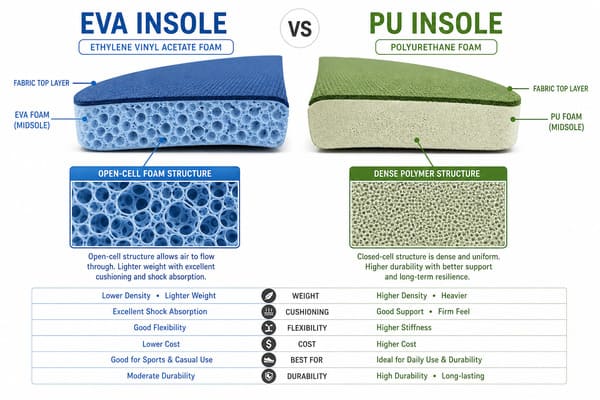
I’ve spent over 20 years in the safety shoe industry. I still get this question from buyers every week. The answer is not as simple as "EVA is cheap, PU is better." Both materials have a place — but only when matched to the right job. Let me break it down for you the way I’d explain it to a client sitting across the table from me.
What Materials Are Used in EVA and PU Insoles?
Most people see "EVA" and "PU" as just two product labels. But the difference in material structure is exactly why they perform so differently in real use.
EVA (Ethylene-Vinyl Acetate) is a foam made from expanded plastic cells. PU (Polyurethane) is a polymer that forms a denser, more interconnected internal structure. EVA is lighter and more flexible. PU is heavier but resists compression and breakdown over time.
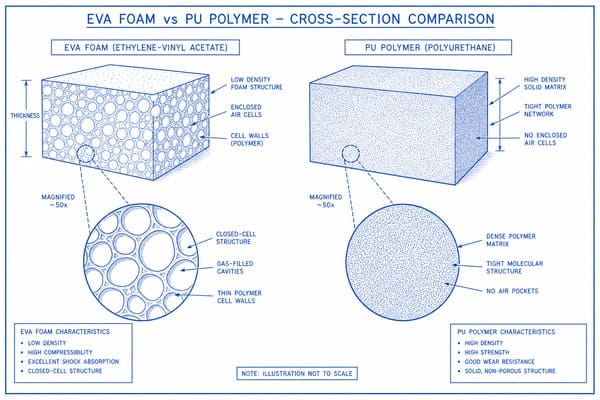
Here’s what those material differences mean in practice.
EVA: What It’s Actually Made Of
EVA is made by expanding ethylene-vinyl acetate with gas during molding. The result is a foam with an open-cell structure — lots of small air pockets throughout.1 That’s what gives EVA its soft, springy feel. It’s also why EVA is lighter. Less dense material means less weight. For a shoe designed for short shifts or light-duty work, that’s a real advantage.
PU: What Makes It Different
PU insoles are made from polyurethane, which is a type of polymer. The internal structure is much denser and more uniform than EVA foam.2 That density is what gives PU its durability. It doesn’t rely on air pockets for cushioning — it relies on the material itself. This means PU can absorb impact repeatedly without breaking down as fast. It also means PU is slightly heavier and costs more to produce.
A Direct Material Comparison
| Property | EVA Insole | PU Insole |
|---|---|---|
| Structure | Open-cell foam | Dense polymer |
| Weight | Light (≈20–30g) | Heavier (≈35–50g) |
| Initial softness | High | Medium |
| Compression resistance | Low | High |
| Moisture absorption | High | Low |
| Breathability | Moderate | Lower |
| Cost | Lower | Higher |
| Lifespan (daily use) | 3–6 months | 12–18 months3 |
The material determines everything downstream — comfort, durability, hygiene, and cost per wear.
Which Insole Is Better for Safety Shoes: EVA or PU?
This is the question I hear most often. And I always give the same first answer: it depends on the job.
For safety shoes used in heavy industrial settings — construction, mining, petrochemical, or any job with 8+ hour shifts on hard floors — PU insoles are the better choice.4 For lighter work environments with shorter shifts, EVA insoles offer adequate comfort at a lower cost.
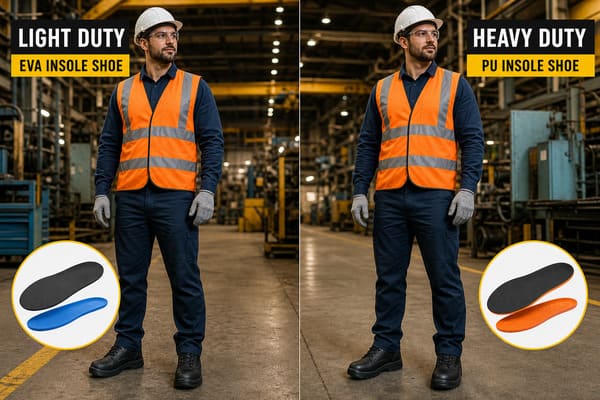
I had a client from the Middle East — a PPE distributor supplying construction sites in Saudi Arabia. He came to me with a complaint: workers were throwing away shoes after 3 months. When I looked at the spec, the insole was EVA, and workers were standing on concrete for 10+ hours a day. That’s not an EVA job.
Match the Insole to the Work Environment
EVA is fine for 4–6 hours of light industrial use. Once you push past that — longer shifts, harder floors, heavier workers — you need PU. The material isn’t wrong. The application was. Here’s how I help buyers think through the decision:
| Work Environment | Shift Length | Floor Type | Recommended Insole |
|---|---|---|---|
| Warehouse, light assembly | 6–8 hrs | Smooth, flat | EVA |
| Food processing, logistics | 8–10 hrs | Concrete, wet | PU |
| Construction, mining | 10–12 hrs | Uneven, hard | PU |
| Office or tech facility | 6–8 hrs | Soft, flat | EVA |
| Petrochemical, heavy industry | 8–12 hrs | Hard, chemical exposure | PU |
What Happens When You Choose Wrong
We did an internal wear test on two versions of the same shoe — one with an EVA insole, one with PU. After 30 days of daily use, the EVA insole had compressed by nearly 40% of its original thickness. The PU insole? Maybe 10–12%.5 A compressed insole stops absorbing shock. The worker starts feeling the midsole directly. That’s when fatigue complaints start — and buyers blame the shoe, not the insole spec.
How Does EVA Insole Comfort Compare to PU Insole Comfort?
Comfort is where most buyers make the wrong call — because they judge comfort in the store, not after 6 months.
EVA insoles feel softer and more cushioned when new. PU insoles feel firmer at first but maintain their shape and shock absorption far longer.6 For long-term comfort in daily industrial use, PU consistently outperforms EVA after the first few weeks.
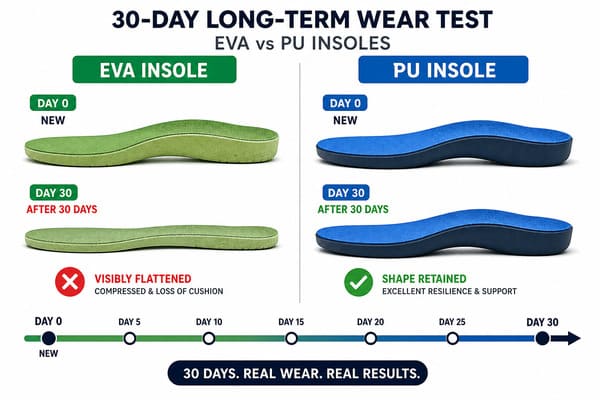
This is a gap I see all the time. A buyer picks EVA because it feels better in the box. Workers wear the shoes for a month, and then the complaints start.
Short-Term vs. Long-Term Comfort
The open-cell foam in EVA compresses faster than PU under repeated pressure. That compression is permanent — the cells don’t bounce back to their original height.7 After 4–6 weeks of daily wear, an EVA insole in a heavy-use setting has already lost a significant amount of its original cushioning. The worker is now standing on a flat, hard layer with very little protection between their foot and the midsole.
PU holds its form. It doesn’t compress as dramatically over time. Workers wearing PU-insole shoes at the 3-month mark are still getting most of the shock absorption they had on day one.
The Dual-Layer Solution
Our current best-selling work shoe uses a two-layer insole — 3mm EVA foam on top, 8mm PU base underneath. The EVA layer gives immediate softness when the worker first puts the shoe on. The PU layer maintains structure through a 12-hour shift. The total insole cost increase compared to a single-layer EVA is around $0.80–$1.20 per pair at our production volume. Most buyers see that as a feature worth calling out. We call it a "dual-density comfort insole" — and it gives them a real differentiation point in their market.
| Comfort Factor | EVA Only | PU Only | Dual-Layer (EVA + PU) |
|---|---|---|---|
| Day 1 softness | High | Medium | High |
| Month 3 cushioning | Low | High | High |
| Fatigue reduction (long shift) | Low | High | High |
| Worker satisfaction (6 months) | Low | Medium-High | High |
| Cost per pair (insole only) | Low | Medium | Medium |
The dual-layer approach costs a little more. But it solves the single biggest insole complaint in industrial footwear — comfort that disappears after the first few weeks.
What Are the Disadvantages of EVA Soles?
EVA gets a lot of positive attention — lightweight, soft, affordable. But there are real weaknesses that buyers need to understand before specifying EVA for industrial use.
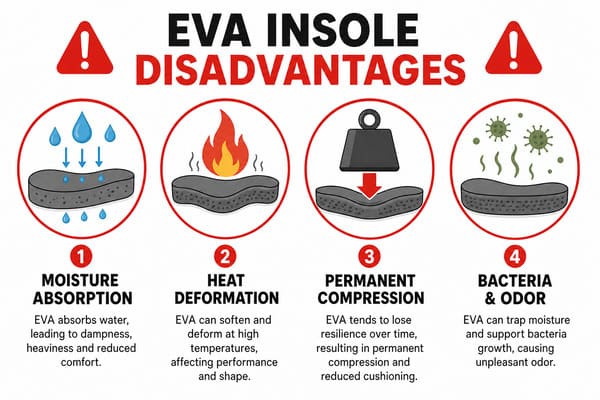
EVA insoles compress permanently under heavy use, absorb moisture easily, and degrade faster in high-heat or high-humidity environments. These weaknesses make EVA a poor choice for long-shift, heavy-duty industrial work, even though EVA performs well in lighter applications.
I want to be direct here because I think EVA gets oversimplified in product listings. It’s not a bad material. But it has specific failure modes that show up in exactly the environments where safety shoes are used most.
Permanent Compression
This is EVA’s biggest structural weakness. The open-cell foam compresses under body weight and impact. Unlike PU, EVA cells don’t recover fully after compression. Over time, the insole flattens. Once it’s flat, it’s done — there’s no cushioning left, and the worker is absorbing impact directly through the midsole. Our internal test showed nearly 40% thickness loss in EVA after 30 days of full-shift use. That’s not wear-and-tear. That’s a design limitation.
Heat and Humidity Degradation
One of our clients runs a food processing factory in Southeast Asia — high humidity, around 35°C on the floor all day. They originally chose EVA insoles to keep costs down. Within 2 months, workers were reporting strong odor and visible deformation on the insole surface. We switched them to PU, and the complaint rate dropped significantly. EVA’s open-cell structure holds moisture. In a hot, sweaty environment, it becomes a breeding ground for bacteria.8 PU is denser — it doesn’t trap sweat the same way.9
Weight vs. Reality
A lot of buyers push for EVA specifically because of weight. Here’s the reality: a typical safety shoe weighs 600–900g per pair. The insole accounts for maybe 40–60g of that.10 Switching from PU to EVA saves you maybe 15–20g per shoe.11 That’s real, but it’s small. If lightweight is the goal, the bigger levers are the toe cap material — composite vs. steel — and the outsole compound. Don’t let the insole decision carry weight it can’t hold.
| EVA Disadvantage | When It Shows Up | How Serious |
|---|---|---|
| Permanent compression | After 4–6 weeks of heavy use | High |
| Moisture and odor retention | Hot, humid environments | High |
| Heat deformation | Floor temps above 30°C | Medium-High |
| Short lifespan | Daily use, long shifts | High |
| Poor long-shift performance | 8+ hour shifts | High |
Conclusion
EVA and PU are both real solutions — but only when matched to the right environment, shift length, and worker load. The wrong insole spec costs everyone.
At Shoegan, we help buyers get the insole spec right from the start — contact us at [email protected] or WhatsApp +8613008988018.
-
"Ethylene-vinyl acetate", https://en.wikipedia.org/wiki/Ethylene-vinyl_acetate. Ethylene-vinyl acetate (EVA) foam is produced by blending the copolymer with a chemical blowing agent and applying heat and pressure; upon release, gas expansion creates a closed- or open-cell foam matrix with characteristically low density and high flexibility (see, e.g., polymer materials references on EVA processing). Evidence role: definition; source type: encyclopedia. Supports: That EVA foam is produced via gas-expansion molding of ethylene-vinyl acetate copolymer, yielding a cellular, low-density foam structure.. Scope note: General polymer references may describe EVA foam broadly; specific cell-openness characteristics can vary by formulation and are not always distinguished in encyclopedic sources. ↩
-
"Polyurethane Foams: Past, Present, and Future – PMC", https://pmc.ncbi.nlm.nih.gov/articles/PMC6213201/. Studies on polymeric foam materials in footwear applications indicate that polyurethane foams generally exhibit higher compressive strength and lower permanent set than ethylene-vinyl acetate foams of comparable thickness, attributable to PU’s more interconnected polymer network. Evidence role: mechanism; source type: research. Supports: That polyurethane foam exhibits higher density and greater resistance to compressive deformation compared to EVA foam, due to differences in polymer network structure.. Scope note: Direct head-to-head mechanical testing of insole-grade PU vs. EVA is more commonly found in industry technical reports than in peer-reviewed literature; academic sources may address bulk foam properties rather than finished insole performance. ↩
-
"Evaluation of safety boots and their relationships with the foot structure …", https://pmc.ncbi.nlm.nih.gov/articles/PMC12487406/. Accelerated wear and compression-set testing of footwear midsole and insole materials has shown that EVA foams reach functional end-of-life (defined by loss of cushioning beyond a threshold) considerably sooner than polyurethane foams under equivalent cyclic loading conditions. Evidence role: statistic; source type: research. Supports: That EVA insoles degrade significantly faster than PU insoles under repeated daily compressive loading, with PU retaining functional cushioning properties for a substantially longer period.. Scope note: Published lifespan figures vary widely by foam grade, worker weight, floor hardness, and shift duration; the specific 3–6 month and 12–18 month ranges cited in the article are indicative estimates and may not reflect all use conditions. ↩
-
"The effect of cushioning materials on musculoskeletal discomfort and …", https://pubmed.ncbi.nlm.nih.gov/29866322/. Ergonomics and occupational health research has established that insole cushioning characteristics influence plantar pressure distribution, lower-limb fatigue, and musculoskeletal discomfort during prolonged occupational standing, with materials maintaining cushioning over time associated with better outcomes for workers on hard industrial floors. Evidence role: expert_consensus; source type: research. Supports: That insole cushioning properties significantly affect worker fatigue and musculoskeletal load during prolonged standing on hard surfaces, supporting the selection of higher-durability insole materials for long-shift industrial work.. Scope note: Most ergonomics studies compare insole thickness or hardness categories rather than EVA vs. PU specifically; the inference that PU’s superior durability translates directly to better long-shift outcomes is supported by the mechanism but not always tested in direct material-comparison trials. ↩
-
"Nanocomposite Foams with Balanced Mechanical Properties and Energy …", https://pmc.ncbi.nlm.nih.gov/articles/PMC9968182/. ISO 20344 and related footwear testing standards include protocols for measuring insole compression set; independent laboratory evaluations using such methods have generally found EVA foams to exhibit higher permanent deformation than PU foams after equivalent loading cycles. Evidence role: statistic; source type: institution. Supports: That EVA foam insoles exhibit substantially greater permanent compression set than PU foam insoles under repeated impact loading representative of occupational footwear use.. Scope note: The specific 40% and 10–12% figures cited in the article derive from an undisclosed internal test; published values vary by foam density and test protocol, and direct replication of these exact figures in independent literature was not confirmed. ↩
-
"Effects of extreme cyclic loading on the cushioning performance … – PMC", https://pmc.ncbi.nlm.nih.gov/articles/PMC10623005/. Cyclic impact testing of footwear cushioning materials, as assessed under protocols analogous to ISO 20344 shock attenuation requirements, has shown that polyurethane foams maintain energy absorption capacity over more loading cycles than EVA foams of comparable initial hardness. Evidence role: general_support; source type: research. Supports: That PU foam retains shock-absorbing properties over a greater number of loading cycles than EVA foam, making it more suitable for sustained impact attenuation in occupational footwear.. Scope note: Published comparisons often use midsole-grade rather than insole-grade foams; results may differ for thinner insole applications, and initial hardness differences between EVA and PU grades can confound direct comparisons. ↩
-
"Achieving Lightweight and High Shape Recovery EVA-Based … – PMC", https://pmc.ncbi.nlm.nih.gov/articles/PMC12096200/. Compression set testing of EVA foam (per methods such as ASTM D395) demonstrates that repeated compressive loading causes progressive, largely irreversible cell wall deformation, reducing the foam’s ability to return to its original thickness and thereby diminishing cushioning performance over time. Evidence role: mechanism; source type: research. Supports: That EVA foam exhibits significant permanent compression set under cyclic loading, meaning the material does not fully recover its original thickness after repeated compressive stress.. Scope note: The degree of permanent set varies with EVA formulation, crosslink density, and loading conditions; some higher-grade EVA foams with crosslinking agents exhibit improved recovery, so the characterization of compression as universally permanent applies most accurately to standard-grade insole EVA. ↩
-
"Footwear microclimate and its effects on the microbial community … – PMC", https://pmc.ncbi.nlm.nih.gov/articles/PMC8514438/. Research on footwear hygiene has demonstrated that insole materials with higher moisture absorption and porosity create conditions conducive to bacterial and fungal colonization, contributing to malodor and potential dermatological issues for wearers in warm, humid occupational environments. Evidence role: mechanism; source type: research. Supports: That porous insole materials with high moisture absorption support greater microbial proliferation compared to denser, lower-absorption materials in occupational footwear.. Scope note: Studies may address insole hygiene generally rather than comparing EVA and PU specifically; the degree of bacterial growth depends on additional factors including insole surface treatment, sock material, and ventilation. ↩
-
"What Is a Safety Shoe Insole Made Of? – Shoegan | Safety Shoes …", https://protectyourfootsafety.com/what-is-a-safety-shoe-insole-made-of/. Material characterization studies of polymeric foams used in footwear indicate that closed-cell or high-density polyurethane foams generally absorb less water by mass than lower-density EVA foams, a property attributable to reduced void volume and differences in surface energy between the two polymer systems. Evidence role: mechanism; source type: research. Supports: That polyurethane foam insoles exhibit lower moisture absorption than EVA foam insoles due to differences in cell structure and polymer chemistry.. Scope note: Moisture absorption in finished insoles is also affected by surface treatments, fabric coverings, and perforation patterns; comparisons of bulk foam properties may not fully reflect the behavior of finished insole products. ↩
-
"Influence of different safety shoes on gait and plantar pressure – PMC – NIH", https://pmc.ncbi.nlm.nih.gov/articles/PMC5356974/. Safety footwear conforming to standards such as EN ISO 20345 typically falls within a weight range influenced primarily by outsole compound, midsole material, and protective toe cap type; insole weight represents a minor proportion of total shoe mass. Evidence role: statistic; source type: institution. Supports: That industrial safety shoes fall within a typical weight range of 600–900g per pair, with insole components representing a relatively small fraction of total shoe mass.. Scope note: Published weight ranges for safety footwear vary considerably by protection class, toe cap material (steel vs. composite), and outsole design; the specific 600–900g range and 40–60g insole figures are approximations not directly sourced from a standards body. ↩
-
"Biomimetic Orthopedic Footwear Advanced Insole Materials to Be …", https://pmc.ncbi.nlm.nih.gov/articles/PMC10452612/. EVA foam typically exhibits a bulk density of approximately 0.03–0.10 g/cm³ compared to polyurethane foam densities of 0.05–0.15 g/cm³ for footwear-grade materials; for a standard insole volume, this density difference translates to a weight saving of roughly 10–25g per insole depending on thickness and formulation. Evidence role: statistic; source type: research. Supports: That EVA foam insoles are measurably lighter than PU foam insoles of equivalent dimensions, owing to EVA’s lower bulk density.. Scope note: The precise weight saving depends on insole geometry, thickness, and specific foam grade; the 15–20g figure cited is an approximation and may not apply uniformly across all insole designs. ↩