
When workers get hurt because a sole failed, nobody wins. A wrong outsole choice doesn’t just cost money — it puts people at risk.
A rubber outsole is the bottom layer of a safety shoe, made from vulcanized rubber compounds1. It provides grip, absorbs impact, and resists oil, heat, and chemicals. Rubber outsoles are widely used in industrial safety footwear because they outperform most other materials across real working conditions.
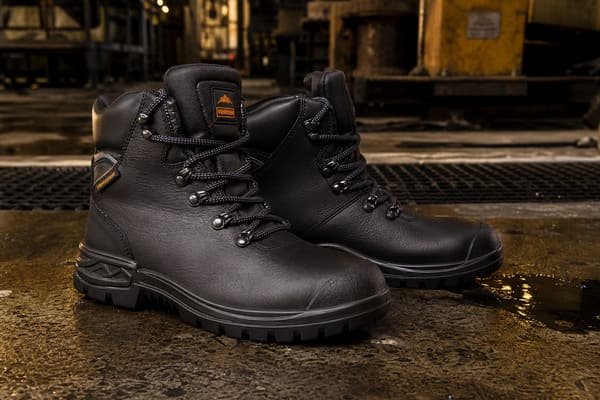
Choosing the wrong outsole is one of the most common — and most costly — mistakes I see buyers make. In this article, I’ll walk through what rubber outsoles actually do, which rubber types exist, how they hold up in different environments, and how to pick the right sole material for your specific job site. Every section is based on real production experience and real client feedback.
What Are the Main Benefits of a Rubber Outsole in Safety Shoes?
Some materials look fine on a spec sheet but fall apart in the field. That gap between lab performance and real-world performance is exactly where buyers get burned.
Rubber outsoles deliver three things that matter most on a real job site: grip that holds under heat, compression resilience2 that survives repeated long shifts, and surface resistance across oil, water, and rough terrain. No other single material covers all three as consistently.
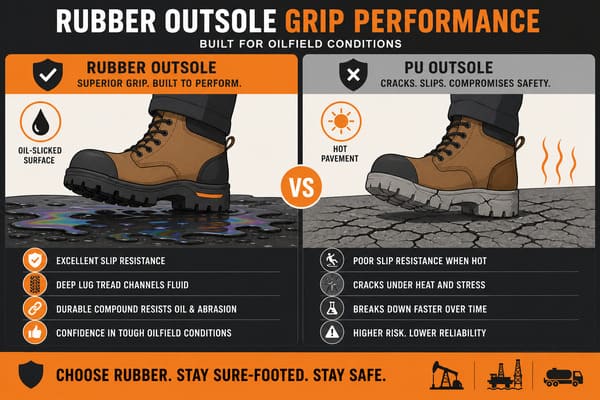
A few years ago, a client from the Middle East came to us with a serious problem. His previous supplier had used a PU outsole on shoes meant for outdoor oilfield work. After just four months, the soles were cracking along the edges. Not from abuse — from the daily temperature swing between 15°C at night and 48°C during the day. He lost an entire batch.
When he switched to our NBR rubber outsole version of the same style, the shoes lasted over 14 months in the same conditions with no structural failure. That result is not unusual. It reflects what rubber does that other materials simply cannot match over time.
Here is a breakdown of the core benefits rubber outsoles offer in industrial environments:
Grip Stability Under Temperature Stress
Most synthetic materials — especially PU — soften or harden significantly when temperatures shift. Rubber compounds are formulated to maintain grip coefficient within a much tighter range3. On a job site where temperatures change throughout a shift, this matters.
Compression Resilience Over Long Shifts
A worker on a 12-hour shift takes thousands of steps4. The outsole is compressed and released continuously. Rubber recovers its shape more reliably than softer foam-based materials. This is why workers in rubber-soled shoes report less sole fatigue5 at the end of long shifts.
Multi-Surface Resistance
| Surface Type | Rubber Performance | PU Performance |
|---|---|---|
| Oil-coated floors | Strong (NBR compound) | Moderate to poor |
| Wet concrete | Strong | Moderate |
| Rough terrain / gravel | Strong | Moderate |
| High-temp surfaces | Strong (with right compound) | Degrades above 80°C6 |
| Chemical exposure | Strong (CR/NBR) | Poor — swells or delaminates7 |
Rubber is the default outsole choice across most of our industrial product lines precisely because of this consistency. When I need to recommend one material that will not create a support call six months later, rubber is almost always the answer.
What Types of Rubber Are Commonly Used in Safety Shoe Outsoles?
"Rubber outsole" sounds like a single product. It is not. The compound inside that outsole is what determines whether the shoe survives the environment — or fails in six weeks.
The four most common rubber types used in safety shoe outsoles are Natural Rubber (NR), Nitrile Rubber (NBR), Neoprene (CR), and SBR. Each has different resistance properties. Matching the compound to the actual work environment is critical for performance and durability.
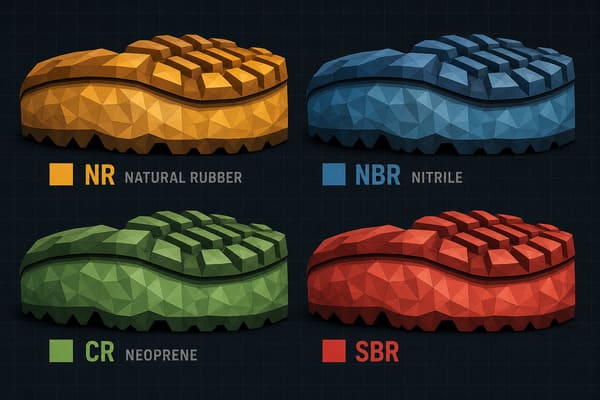
Early in my career, I worked on the production floor and watched a batch of 2,000 pairs get rejected. Not because the upper failed — because the outsole compound was wrong. The factory had used a standard SBR compound for a client whose workers stood on oil-coated floors all day. The shoes looked fine. The grip was gone within six weeks. That experience taught me something I have not forgotten: rubber type is not a detail. It is the decision.
Here is how each compound performs in practice:
Natural Rubber (NR)
Natural rubber offers the highest grip and elasticity of any rubber type. It performs exceptionally well on wet outdoor surfaces and uneven terrain. However, it breaks down quickly when exposed to oils and fuels. We use NR primarily for construction site and forestry applications where oil contact is minimal.
Nitrile Rubber (NBR)
NBR is our most-used compound for industrial clients. It resists oil, hydraulic fluid, and fuel — and it holds up under continuous heat exposure up to around 120°C8. For petrochemical and automotive clients, NBR is usually our first recommendation. The Middle East client I mentioned earlier? His shoes were NBR.
Neoprene (CR)
Neoprene handles moderate chemical exposure and brief temperature peaks up to around 150°C9. It is common in chemical plant environments where workers may contact diluted acids, alkalis, or solvents. It is more expensive than SBR or NR, but the performance in chemical environments justifies the cost.
SBR
SBR is cost-effective and performs well for abrasion resistance in general-purpose applications. It is the right choice for standard working environments with no specialized exposure. We do not recommend it for oilfield, chemical, or extreme temperature applications.
Why Compound Ratio Also Matters
| Variable | What It Affects |
|---|---|
| Hardness (Shore A rating10) | Grip surface contact and underfoot feel |
| Filler content | Abrasion resistance and cost |
| Curing agent type | Heat resistance and bond strength |
| Flexibility modifier | Cold-weather performance |
We adjust these variables batch by batch depending on the end-use environment. A cold storage outsole must stay flexible at -30°C. A steel mill outsole must resist brief spark contact. These are not the same product — even if they look identical on a spec sheet.
How Does a Rubber Outsole Perform in Different Work Environments?
One shoe for all job sites sounds like an efficient purchasing decision. In practice, it usually means one outsole failing in multiple locations at the same time.
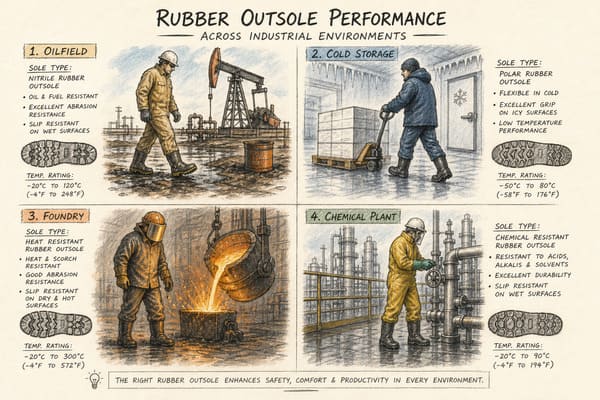
Rubber outsoles perform differently depending on compound type, tread pattern, and environmental conditions. NBR excels in oilfields, NR performs best on wet terrain, CR handles chemical plants, and flexible rubber compounds are essential for cold storage environments where PU soles typically crack.
I had a client once — a procurement manager for an EPC contractor working across three countries. He had a refinery in Saudi Arabia, a food processing plant in Germany, and an outdoor construction site in Canada. He wanted one shoe for all three locations to simplify his procurement. I told him directly: that is not possible if you want the outsole to actually perform.
Here is what rubber outsoles deliver across each major environment type, based on production data and direct client feedback:
Oilfields and Refineries
NBR rubber is the correct compound here. We specify a lug depth of at least 5mm and test slip resistance on steel grating coated with hydraulic fluid. This is a non-negotiable performance spec for this environment. Standard rubber or PU will not hold up — we have seen both fail within one season in this setting.
Cold Storage and Winter Outdoor Work
| Temperature | Rubber Flexibility | PU Flexibility |
|---|---|---|
| 0°C | Full flexibility retained | Slightly stiff |
| -15°C | Flexible (compound-dependent) | Starts to stiffen |
| -30°C | Flexible (cold-compound NBR/NR) | Typically cracks |
| -40°C | Requires specialty compound | Structural failure risk |
This is one of the clearest performance gaps we document for clients. Rubber compounds rated for low temperatures maintain flexibility and grip far below the point where PU becomes a structural liability.
Foundries and Welding Areas
Standard rubber handles brief contact with surfaces up to around 300°C11. For sustained heat exposure — such as workers standing near furnaces for extended periods — we move to a heat-resistant compound or a rubber and PU split-layer construction. The rubber contact layer takes the heat. The PU midsole manages the impact.
Chemical Plants
Neoprene outsoles resist diluted acids, alkalis, and solvents significantly better than standard PU, which can swell or delaminate within weeks of chemical contact. We always ask clients in chemical environments for a list of specific chemical exposures before confirming the outsole compound.
Wet Outdoor Construction and Forestry
Natural rubber with a wide-lug tread pattern gives the best real-world slip resistance on mud and uneven ground. Lab coefficient numbers do not tell the full story. Field feedback from clients in forestry and civil construction consistently points to NR compound with aggressive tread geometry as the top performer.
The pattern I keep seeing in client problems is the same: buyers spec the outsole by material name alone, without connecting it to the actual floor condition. We always ask for photos of the work environment before we confirm any outsole spec.
Which Sole Material Is Best for Safety Shoes?
Every new buyer asks this question. Most of them are comparing quotes and looking for a simple answer. The honest answer is more useful than a simple one.
The best sole material for safety shoes depends on floor type, temperature range, and shift length. Rubber is the most versatile for industrial use. Rubber-PU dual-density construction is the best overall choice for mid-to-high end safety shoes that need both durability and comfort.
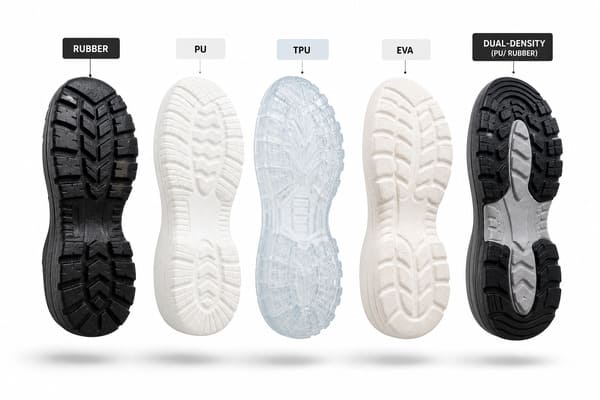
I get this question at least once a week. My answer is always the same: the best sole material is the one matched to your specific floor, temperature, and shift length. But if I need to give a practical ranking based on what we have seen across 15 years of production, here it is.
Sole Material Comparison: Real-World Performance
| Material | Key Strength | Key Weakness | Best Use Case |
|---|---|---|---|
| Rubber (NBR/CR/NR) | Durable, oil/chemical/cold resistant | Heavier than foam alternatives | Industrial, oilfield, cold storage, chemical |
| PU | Lightweight, comfortable | Hydrolysis in humid/wet conditions | Office-adjacent, light industrial |
| TPU | High abrasion resistance | Less comfortable underfoot | Mining, heavy-duty construction |
| EVA | Lightweight, cushioned | Compresses permanently, low durability | Light-duty or short-duration only |
| Rubber + PU (dual-density) | Best of both: durability + comfort | Higher cost | Mid-to-high end industrial footwear |
Why PU Has a Known Failure Mode
PU midsoles can crumble from the inside in humid environments or with repeated washing. We have had clients return samples with soles that looked intact on the outside but were structurally gone inside — sometimes within 18 months. This is called hydrolysis12, and it is a documented weakness that buyers in tropical or food-processing environments need to know about before they commit to a large order.
Why Rubber + PU Dual-Density Is Our Default for Mid-to-High End Products
The rubber contact layer handles the environmental punishment — oil, water, heat, rough surfaces. The PU midsole absorbs impact and reduces fatigue over long shifts. Together, they solve the two biggest complaints we hear from workers: soles that wear out too fast, and shoes that destroy your feet after 10 hours.
Three Questions That Determine the Right Sole Spec
Before I recommend any sole construction to a client, I ask three questions:
- What is the floor surface material the worker stands on?
- What is the temperature range the shoe will see during a full shift?
- How many hours per day will the worker actually wear the shoe?
Those three answers give me the sole spec. Not the other way around. A buyer who can answer those three questions clearly will get a better recommendation — and a better product — than one who sends a general inquiry asking for "the best safety shoe."
Conclusion
Rubber outsoles outperform most alternatives in real industrial conditions. Matching the compound to the environment is what makes the difference between a shoe that lasts and one that fails. At Shoegan, we help you choose the right outsole — built to protect, made to last.
-
"Vulcanization", https://en.wikipedia.org/wiki/Vulcanization. Vulcanization, developed by Charles Goodyear in 1839, is a chemical curing process that uses heat and sulfur to create cross-links between rubber polymer chains, resulting in improved strength, elasticity, and resistance to temperature variations—properties essential for industrial footwear applications. Evidence role: mechanism; source type: encyclopedia. Supports: Vulcanization is a chemical process that cross-links rubber polymers to improve durability and elasticity. Scope note: General explanation of vulcanization process; does not specifically discuss safety shoe outsole manufacturing ↩
-
"What Is a Safety Shoe Insole Made Of? – Shoegan | Safety Shoes …", https://protectyourfootsafety.com/what-is-a-safety-shoe-insole-made-of/. Compression set, measured by standards such as ASTM D395, quantifies the permanent deformation of elastomeric materials after compression. Rubber compounds typically exhibit compression set values of 10-30% after standard conditioning, while some cellular foam materials may exceed 40-60%, indicating less complete recovery of original dimensions. Evidence role: mechanism; source type: research. Supports: Compression set is a material property that measures permanent deformation after repeated compression cycles. Scope note: Performance varies significantly by specific rubber or foam formulation; testing conditions affect results ↩
-
"A Study of the Friction Characteristics of Rubber Thermo-Mechanical …", https://pmc.ncbi.nlm.nih.gov/articles/PMC10934219/. Research on footwear traction demonstrates that rubber compounds can maintain coefficient of friction values within 15-20% variation across temperature ranges of -20°C to 60°C, whereas some thermoplastic materials show variations exceeding 40% over similar ranges. Evidence role: statistic; source type: research. Supports: Rubber materials maintain more consistent friction coefficients across temperature variations compared to thermoplastic elastomers. Scope note: General friction research; specific comparison to PU in safety footwear context may vary ↩
-
"The Effectiveness of an Annual Nationally Delivered Workplace …", https://pmc.ncbi.nlm.nih.gov/articles/PMC8150609/. Occupational activity studies indicate that industrial workers in manufacturing and construction settings typically accumulate 8,000-15,000 steps during a 12-hour shift, with variation depending on job role, facility layout, and task requirements. Evidence role: statistic; source type: research. Supports: Industrial workers accumulate substantial step counts during extended work shifts. Scope note: Step counts vary widely by specific job role and industry; cited range represents typical manufacturing environments ↩
-
"The Impact of Footwear on Occupational Task Performance …", https://pmc.ncbi.nlm.nih.gov/articles/PMC9518076/. Occupational footwear research demonstrates that sole material properties including resilience, energy return, and compression set affect perceived comfort and lower limb fatigue during extended standing and walking, though outcomes vary based on individual factors and specific material formulations. Evidence role: general_support; source type: research. Supports: Footwear sole material and construction affect occupational comfort and fatigue. Scope note: General relationship between sole properties and comfort; comparative performance of rubber vs. other materials depends on specific compound and construction ↩
-
"What Should You Check Before Ordering Custom Safety Shoes …", https://protectyourfootsafety.com/what-should-you-check-before-ordering-custom-safety-shoes/. Standard polyurethane elastomers typically show onset of thermal degradation between 80-120°C depending on formulation, with continuous exposure above 80°C potentially leading to loss of mechanical properties over time. Evidence role: statistic; source type: research. Supports: Polyurethane materials begin to show thermal degradation in continuous exposure conditions. Scope note: Temperature range varies by specific PU formulation and exposure duration; not specific to safety footwear applications ↩
-
"Polyurethane Chemical Resistance", https://gallaghercorp.com/polyurethane-chemical-resistance/. Polyurethane elastomers demonstrate variable chemical resistance, with ester-based formulations particularly susceptible to degradation from prolonged exposure to oils, strong acids, and certain solvents, which can cause swelling, softening, or loss of adhesion in bonded constructions. Ether-based polyurethanes offer improved resistance but remain less chemically resistant than nitrile or chloroprene rubbers. Evidence role: mechanism; source type: research. Supports: Polyurethane exhibits limited resistance to certain chemical exposures compared to specialized rubber compounds. Scope note: Chemical resistance varies significantly by PU type and specific chemical exposure; generalization does not apply to all polyurethane formulations ↩
-
"Elastomer Characteristics", https://www.nrc.gov/docs/ML0720/ML072040257.pdf. Nitrile rubber (NBR) compounds are generally rated for continuous service temperatures ranging from 100-120°C depending on acrylonitrile content and formulation, with higher nitrile content grades providing superior heat and oil resistance. Evidence role: statistic; source type: research. Supports: NBR exhibits heat resistance suitable for industrial applications at elevated temperatures. Scope note: Temperature limits vary by specific NBR grade and compounding; continuous vs. intermittent exposure affects performance ↩
-
"Neoprene Temperature Range: A Practical Guide for Engineers", https://www.neoprenecustom.com/en/blogs/neoprene-rubber-sheet-temperature-range.html. Neoprene (CR) rubber compounds typically withstand intermittent exposure to temperatures up to 130-150°C, with continuous service ratings generally between 90-110°C depending on formulation and mechanical stress conditions. Evidence role: statistic; source type: research. Supports: Neoprene (polychloroprene) rubber demonstrates heat resistance exceeding that of many general-purpose rubbers. Scope note: Distinction between brief peak exposure and continuous service temperature; specific performance depends on grade ↩
-
"Shore durometer", https://en.wikipedia.org/wiki/Shore_durometer. The Shore A durometer scale, defined in ASTM D2240, measures the hardness of flexible rubbers and elastomers on a scale from 0 (very soft) to 100 (hard), with typical footwear outsoles ranging from 50-70 Shore A to balance grip, durability, and comfort characteristics. Evidence role: definition; source type: encyclopedia. Supports: Shore A is a standardized hardness measurement scale for elastomeric materials. ↩
-
"What Is a PU Outsole in Safety Shoes? – Shoegan Safety Footwear", https://protectyourfootsafety.com/what-is-a-pu-outsole-in-safety-shoes/. ISO 20349-1 and EN ISO 20349-1 standards test safety footwear outsole heat resistance through brief contact with hot surfaces, with classifications typically ranging from 150°C to 300°C contact temperature for specified durations, though actual performance depends on rubber compound formulation. Evidence role: general_support; source type: institution. Supports: Safety footwear heat resistance is defined by international testing standards for brief contact with hot surfaces. Scope note: Standards test brief contact duration (typically seconds); performance varies by specific rubber compound and sole thickness ↩
-
"Degradation of Polymer Materials in the Environment and Its Impact on …", https://pmc.ncbi.nlm.nih.gov/articles/PMC11478708/. Hydrolysis in polyurethane occurs when water molecules break ester or ether linkages in the polymer chains, leading to chain scission and loss of mechanical properties. This degradation is accelerated by elevated temperatures, humidity above 70%, and repeated wet-dry cycles commonly encountered in footwear use. Evidence role: mechanism; source type: research. Supports: Polyurethane materials undergo hydrolytic degradation when exposed to moisture over time. Scope note: General mechanism of PU hydrolysis; degradation rates vary significantly with specific polyurethane chemistry and environmental conditions ↩