
Comparing quotes from different manufacturers feels simple — until a shipment arrives and the shoes fall apart in three months. That gap between price and value1 is where most buyers get hurt.
Comparing safety shoe quotes means checking more than just the price per pair. You need to verify materials, certifications, port of shipment, and landed cost. A quote missing these details is not a quote — it is an estimate that puts your order at risk.
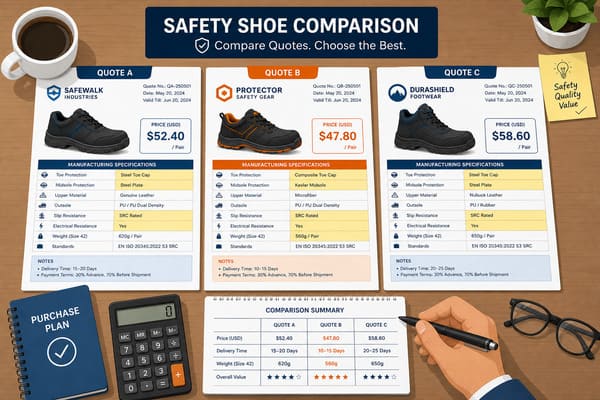
Getting this right takes more than reading a number on a page. Each section below breaks down one part of the quote comparison process, so you can make a decision based on facts — not assumptions.
What Information Should Be Included in a Safety Shoe Quote?
Most buyers accept a quote without knowing what is missing. One missing line in a quote can mean you receive a completely different product from what you expected.
A complete safety shoe quote should include: upper material and grade, toe cap protection level, outsole specification, certification test report number, FOB2 port, lead time, MOQ, and packaging details. Any quote missing more than two of these points is not usable for accurate comparison.
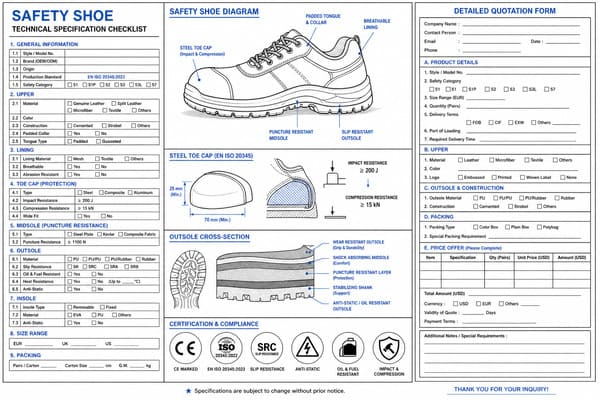
I once received an inquiry from a PPE distributor in the Middle East. He had a quote from another supplier — one page, one price, one photo. $18.50 per pair, "safety shoes, steel toe, EN ISO 203453." That was all it said. No upper material, no sole spec, no certification document attached, no FOB port, no packaging detail. He thought it was a good quote. I told him: this is not a quote, it is a guess.
When we sent him our quote, it was three pages. It listed the full grain leather upper, the 200J steel toe cap4 grade, the PU/rubber dual-density outsole, the EN ISO 20345 S3 SRC test report number, FOB Ningbo, and even the carton dimensions. He told me later it was the first time he actually understood what he was buying.
Why Each Data Point Matters
A quote is not a formality. Every line in a quote represents a production decision that was already made by the supplier. When a line is missing, that decision has not been made — or the supplier does not want you to know what they chose.
Here is what each key field in a quote tells you:
| Quote Field | What It Tells You |
|---|---|
| Upper material and grade | Durability, breathability, and cost honesty |
| Toe cap protection level | Whether it meets 100J or 200J impact standard |
| Outsole specification | Abrasion resistance, slip rating, chemical resistance |
| Certification test report number | Verifiable third-party testing vs. self-declaration |
| FOB port | Actual shipping cost baseline |
| Lead time | Production capacity and scheduling honesty |
| MOQ | Flexibility for smaller buyers |
| Packaging detail | Carton size, pairs per carton, labeling compliance |
When we build a quote at Shoegan, we treat it as a technical document. It reflects our EN ISO 20345, ASTM F24135, and AS/NZS 22106 certifications. It lists the actual test report reference numbers. A buyer can call the notified body7 and verify the report themselves. That level of transparency is what separates a quote you can trust from one you have to guess about. If a supplier cannot give you eight to ten specific data points in a quote, ask yourself what they are not telling you — and why.
How Do You Evaluate Price Differences Between Safety Shoe Suppliers?
A lower price on paper can become a much higher cost in reality. Most buyers only discover this after the shipment has already arrived and the damage is done.
A price gap of 15–25% between two suppliers at the same market level almost always means a material was changed. The most common swaps are: upper leather grade, outsole compound quality, and toe cap steel grade. Your job is to identify which material was changed and calculate its impact on product life.
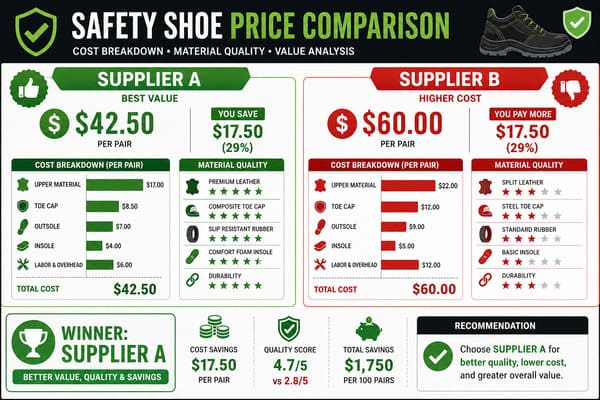
Last year, a client in Australia came to me after a bad experience. He had ordered 2,000 pairs from a cheaper supplier — saving about $4 per pair, which felt like a solid deal at $8,000 total savings. But when the shipment arrived, the outsole started delaminating within three months. The return and replacement cost him over $12,000, not counting the damage to his reputation with his end customers.
When we looked back at the original quote, the supplier had listed "rubber outsole" — technically true. But it was a recycled rubber blend with no abrasion resistance rating. Our quote says "rubber outsole, DIN 53516 abrasion ≤150mm³8." That one line is the difference between a shoe that lasts and one that does not.
How to Break Down a Price Difference
Do not treat a price difference as a single number. Break it into components and trace each one back to a material or process decision.
| Cost Component | Typical Share of FOB Price | Where Suppliers Cut Corners |
|---|---|---|
| Upper material | 30–40% | Split leather vs. full grain leather |
| Outsole | 20–30% | Recycled rubber blend vs. rated compound |
| Toe cap | 10–15% | Lower steel grade or thinner gauge |
| Lining and insole | 8–12% | Non-breathable synthetic vs. moisture-wicking fabric |
| Certification compliance | 5–10% | Self-declared vs. third-party tested |
| Labor and overhead | 15–20% | Rarely cut, but affects consistency |
When you see a 20% price gap between two mid-range suppliers, one or more of those rows has been changed. Ask the lower-priced supplier to confirm the spec for each line. If they cannot answer with a specific material name or rating, that is your answer. At Shoegan, we have held our mid-to-high end positioning for over 15 years because we compete on specification transparency, not the lowest number on a quote. A client who knows exactly what they are buying is a client who comes back.
What Hidden Costs Are Often Missing from Safety Shoe Quotes?
The price on a quote is not what you pay. There are costs that come after the quote — and most suppliers do not mention them unless you ask directly.
Hidden costs in safety shoe sourcing include: inland freight from factory to port, customs clearance fees, import duties, re-testing costs for non-compliant certifications, and last-mile delivery. These costs can add $1.00 to $4.00 per pair to the final landed price, depending on destination and supplier location.
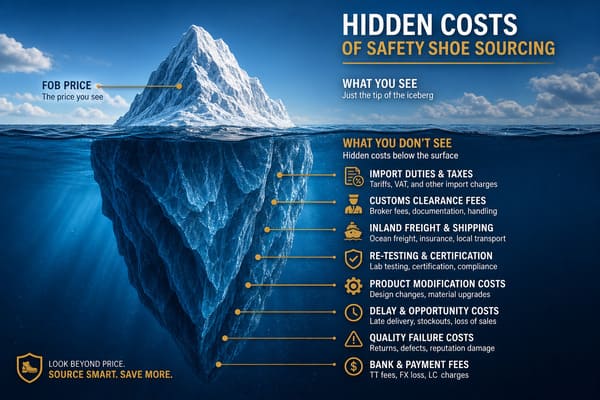
A client in Germany ordered 1,500 pairs from us last year. But before he came to us, he had almost placed the order with another supplier whose price was $2.30 lower per pair. On paper, that was a $3,450 saving. But when he started asking questions, the hidden costs came out one by one.
The other supplier’s quote was FOB Guangzhou, not Ningbo — adding roughly $0.80 per pair in inland freight. The CE test report was not from a notified body, so it would not clear German customs — he would have needed to pay for re-testing, around €2,000. And there was no DDP9 option, so he would have to handle import duties and last-mile delivery himself. By the time we added it all up, the "cheaper" option was actually $1.20 more expensive per pair, plus the customs risk. The $2.30 saving on the quote became a $1,800 loss before the shoes even left China.
A Framework for Calculating Landed Cost
Always compare suppliers on landed cost, not FOB price. Here is a simple framework to use for every quote you receive:
| Cost Category | Questions to Ask | Common Range |
|---|---|---|
| FOB port location | Is it Ningbo, Shanghai, or a smaller inland port? | $0.50–$1.20/pair difference |
| Inland freight to port | Is this included or charged separately? | $0.30–$0.80/pair |
| Certification compliance | Is the test report from a notified body? Verifiable? | €1,500–€3,000 re-test risk |
| Import duties | Has the supplier confirmed HS code10 and duty rate? | Varies by country |
| DDP availability | Can the supplier deliver to your door? | Saves 5–10 days and admin cost |
| Last-mile delivery | Who handles customs clearance and final delivery? | $0.40–$1.50/pair |
We offer FOB from Wenzhou, Ningbo, and Shanghai, and DDP to most European and Middle East destinations. For our clients in Germany, France, and the UAE, DDP has become their standard choice because it removes every variable after the factory gate. The landed cost is fixed before the order is confirmed. That is the kind of quote a real buyer can plan a business around.
How Do Certifications Affect the Price of Safety Shoes?
Certifications are one of the most misunderstood line items in any safety shoe quote. Buyers often treat them as a checkbox, not a cost — and that assumption is where the risk starts.
Proper third-party certification under EN ISO 20345 costs between €3,000 and €8,000 in testing fees11 alone, before annual audits. ASTM F2413 runs a similar range. This adds $1.50 to $3.00 per pair to honest production costs. Any quote that claims full certification below this threshold should be verified before the order is placed.
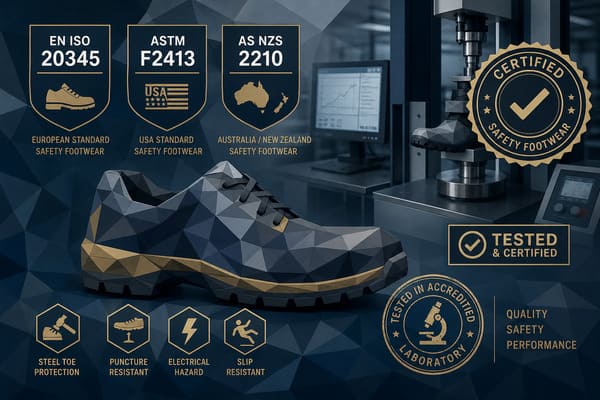
Here is something most buyers do not know: getting a pair of safety shoes properly certified under EN ISO 20345 by a European notified body costs between €3,000 and €8,000 in testing fees alone — and that is before annual surveillance audits. ASTM F2413 testing for the US market runs a similar range. When I see a supplier quoting "EN certified" shoes at $14 per pair with no test report reference number, I know one of two things is happening: either the cert is self-declared with no third-party verification, or the tested sample is not the same shoe that goes into production.
One of our clients found out the hard way. His "certified" order was detained at EU customs because the test report was issued for a different colorway with a different sole. It took six weeks and €4,500 in fees to resolve.
What Real Certification Costs — and What It Covers
This table shows the key certifications we carry at Shoegan, what market each one covers, and why each one adds to the cost of an honest quote:
| Certification | Market | Testing Body | Cost Impact per Pair |
|---|---|---|---|
| EN ISO 20345 | Europe | EU Notified Body (e.g., TÜV, SGS) | +$1.50–$2.50 |
| ASTM F2413 | USA / North America | SATRA or equivalent US lab | +$1.50–$2.50 |
| AS/NZS 2210 | Australia / New Zealand | Accredited Australian lab | +$1.00–$2.00 |
| GSO | Gulf / Middle East | GSO-approved body | +$0.80–$1.50 |
| ISO 900112 | Global (QMS) | Third-party audit body | Systemic cost, not per pair |
When you see a certification price that seems too low, the right question is not "can I get a discount?" The right question is: "which body issued this report, and can I verify the report number?" At Shoegan, every test report we provide includes the issuing body name, report number, and date. A buyer can verify it directly. That is what real certification accountability looks like — and yes, it adds $1.50 to $3.00 per pair to our price. That is not a markup. That is what protection actually costs.
Conclusion
Comparing safety shoe quotes is not about finding the lowest number. It is about understanding what each number includes — and what it does not. The right quote protects your business before the shoes even leave the factory. At Shoegan, every quote we send is a commitment: Built to Protect. Made to Last. Contact us at [email protected] or WhatsApp +8613008988018 to request a full specification quote today.
-
"The Influence of Price on Purchase Intentions: Comparative Study …", https://pmc.ncbi.nlm.nih.gov/articles/PMC7911682/. Supply chain management research documents that upfront price often poorly predicts total cost of ownership in industrial equipment purchases, particularly for safety-critical items where quality failures create cascading costs. Evidence role: general_support; source type: research. Supports: that price-value gaps are documented challenges in industrial procurement. Scope note: The cited research addresses general procurement patterns rather than safety footwear specifically. ↩
-
"Know Your Incoterms", https://www.trade.gov/know-your-incoterms. FOB (Free On Board) is an Incoterm published by the International Chamber of Commerce indicating that the seller delivers goods on board a vessel nominated by the buyer at a named port of shipment, with risk and cost responsibility transferring at that point, making it a critical factor in comparing international quotes. Evidence role: definition; source type: institution. Supports: the meaning and implications of FOB in international trade pricing. ↩
-
"What Is the Puncture Resistance Rating in EN ISO 20345 …", https://protectyourfootsafety.com/what-is-the-puncture-resistance-rating-in-en-iso-20345/. EN ISO 20345 specifies basic and additional requirements for safety footwear intended for general use, including impact resistance, compression resistance, and energy absorption in the heel region, as published by the International Organization for Standardization and adopted as a European standard. Evidence role: definition; source type: institution. Supports: the scope and authority of EN ISO 20345 as a European safety footwear standard. ↩
-
"Employer Personal Protective Equipment Workplace Hazard …", https://www.osha.gov/laws-regs/standardinterpretations/2013-12-09. Under EN ISO 20345, safety footwear toe caps are tested for impact resistance at 200 joules of energy, representing the kinetic energy of a 20kg mass dropped from approximately 1 meter, which establishes the minimum protection level for occupational safety footwear in industrial environments. Evidence role: definition; source type: institution. Supports: that 200J refers to a standardized impact energy level for toe cap testing. ↩
-
"Employer Personal Protective Equipment Workplace Hazard …", https://www.osha.gov/laws-regs/standardinterpretations/2013-12-09. ASTM F2413 is a specification published by ASTM International (formerly American Society for Testing and Materials) that establishes minimum performance requirements for protective footwear, including impact and compression resistance, widely referenced in United States occupational safety regulations. Evidence role: definition; source type: institution. Supports: the authority and scope of ASTM F2413 for safety footwear in North American markets. ↩
-
"What Should You Check Before Ordering Custom Safety Shoes …", https://protectyourfootsafety.com/what-should-you-check-before-ordering-custom-safety-shoes/. AS/NZS 2210 is a joint Australian/New Zealand standard specifying requirements for occupational protective footwear, including safety, protective, and occupational footwear classifications, published by Standards Australia and Standards New Zealand and referenced in workplace safety legislation across both countries. Evidence role: definition; source type: institution. Supports: the scope and regulatory status of AS/NZS 2210 for safety footwear. ↩
-
"Notified body", https://en.wikipedia.org/wiki/Notified_body. Notified bodies are organizations designated by EU member states to assess the conformity of products before they are placed on the EU market, operating under specific directives and regulations with authority to conduct testing and issue certificates required for CE marking compliance. Evidence role: definition; source type: government. Supports: what notified bodies are and their role in European product certification. ↩
-
"DIN 53516 Standard", https://powerrubber.com/en/blog/norm-din-53516?srsltid=AfmBOorlAzH_exJWhM16hF0HJJ5fSDDYSd_88sOsOluhlc-JsX6h-3Bi. DIN 53516 establishes a standardized method for determining abrasion resistance of rubber by measuring volume loss in cubic millimeters after exposure to an abrasive cylinder under controlled conditions; lower values indicate higher abrasion resistance, with ≤150mm³ representing relatively durable material performance. Evidence role: mechanism; source type: institution. Supports: how DIN 53516 measures abrasion resistance and what lower values indicate. ↩
-
"How Do You Choose a Safety Shoe Manufacturer in China …", https://protectyourfootsafety.com/how-do-you-choose-a-safety-shoe-manufacturer-in-china/. DDP (Delivered Duty Paid) is an Incoterm indicating maximum obligation for the seller, who delivers goods cleared for import at the named destination place, bearing all costs and risks including duties, taxes, and final delivery charges, representing the opposite end of the responsibility spectrum from FOB terms. Evidence role: definition; source type: institution. Supports: what DDP means in international trade and how it differs from FOB pricing. ↩
-
"Harmonized System (HS) Codes", https://www.trade.gov/harmonized-system-hs-codes. The Harmonized System (HS) code is a standardized numerical classification system developed by the World Customs Organization used by customs authorities worldwide to classify traded products and determine applicable duties, taxes, and regulatory requirements, making correct HS code identification critical for accurate landed cost calculation. Evidence role: definition; source type: institution. Supports: what HS codes are and how they determine import duties. ↩
-
"The European Union’s System of Conformity Assessment for …", https://www.cdc.gov/niosh/docket/review/docket237A/pdfs/237-A_EuropeanReport.pdf. Conformity assessment for safety footwear under EN ISO 20345 typically involves multiple test procedures conducted by accredited laboratories, with published fee schedules from European notified bodies and testing institutions indicating total certification costs in the thousands of euros per product line. Evidence role: statistic; source type: institution. Supports: typical cost ranges for third-party safety footwear certification testing. Scope note: Exact costs vary by testing scope, product complexity, and specific laboratory, so the stated range represents general market conditions rather than fixed prices. ↩
-
"Quality management system", https://en.wikipedia.org/wiki/Quality_management_system. ISO 9001 is an international standard published by the International Organization for Standardization specifying requirements for quality management systems, focusing on consistent product quality, customer satisfaction, and continuous improvement processes rather than product-specific technical requirements, with certification requiring third-party audit by accredited bodies. Evidence role: definition; source type: institution. Supports: what ISO 9001 certifies and its relevance to manufacturer quality. ↩