
Wrong sizing doesn’t just cause complaints. It causes warehouses full of unworn shoes and five-figure losses. I’ve seen it happen more than once.
EU, US, and UK safety shoe sizing systems use different base units and zero-points, which means the numbers don’t convert cleanly. EU sizing uses the Paris Point system (2/3 cm per unit)1. US sizing was developed independently. UK sizing runs one full size smaller than US2. These are not interchangeable systems.
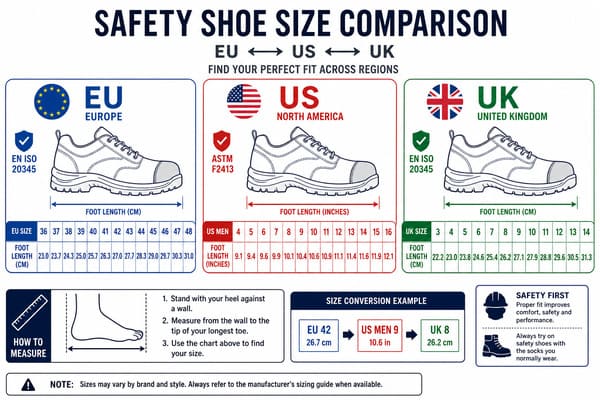
I’ve been on the production side of safety shoes for over 15 years. I’ve seen a 600-pair order come back because a buyer assumed EU 42 = US 9. It doesn’t — not always. Workers ended up with shoes half a size too small. Nobody wore them. The order sat in a warehouse. That wasn’t a sizing mistake. That was a $15,000 problem. This article is written from the factory side. I want buyers to understand what actually causes these errors, and how to stop them before the container ships.
Why Does Safety Shoe Sizing Vary Between Countries?
Most buyers think sizing is just a number. It isn’t. The number is only part of the problem — and often the smaller part.
The EU system is based on the Paris Point, where one size unit equals 2/3 of a centimeter. The US system was developed independently in the 19th century using a different base length and a different zero-point. UK sizing looks close to US sizing on the surface but runs exactly one full size smaller for men. These systems were never reconciled.
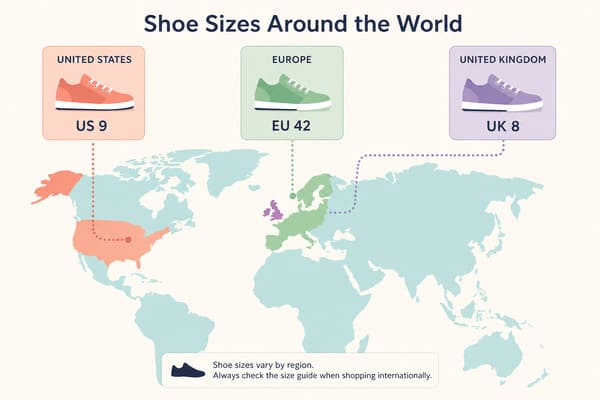
But here’s what most buyers don’t realize. For safety shoes specifically, the size number is only half the story. The other half is the last — the physical mold the shoe is built on. The last determines the actual shape of the shoe: the width, the toe box, the instep height. And lasts are regional.
How Do Regional Lasts Affect Fit?
European lasts tend to be narrower with a higher instep. American lasts are wider, especially in the toe box.3 This means that even when the size number converts correctly, the physical fit can still be wrong.
I had a client in Texas — a PPE distributor — who ordered 400 pairs based on a size chart he found online. The chart was technically correct. But the shoes were built on a European last. Half his workforce complained the toe box felt squeezed. He couldn’t return them because the sizes were right. The fit was wrong.
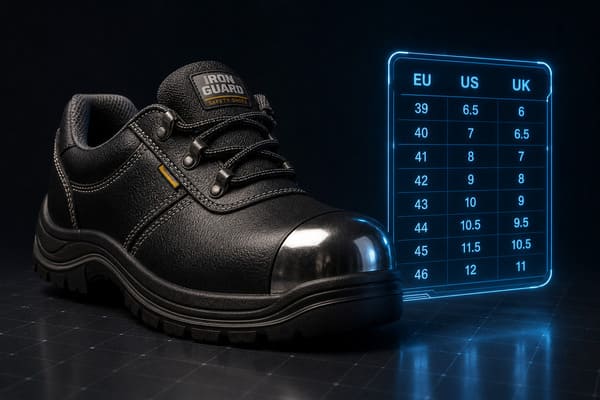
That’s the gap most articles never explain. The table below shows how the three systems compare at a structural level:
| Feature | EU (Paris Point) | US | UK |
|---|---|---|---|
| Unit size | 2/3 cm | ~8.47 mm | ~8.47 mm |
| Last shape | Narrower, higher instep | Wider toe box | Similar to US |
| Label on certified shoes | Standard (EN ISO 203454) | Secondary label | Secondary label |
| Common error | Assumed equal to US/UK | Mapped wrong to EU | Confused with US |
The size chart tells you the number. The last tells you whether the shoe will actually fit the foot wearing it. These are two different conversations, and both matter.
How Do You Convert EU Safety Shoe Sizes to US Sizes?
The conversion formula looks simple. That’s exactly why it causes so many problems.
The common formula is: EU size minus 33 equals US men’s size5. EU 43 minus 33 equals US 10. This works as a rough starting point but breaks down at the edges — EU 38 and below, EU 47 and above — and changes entirely for women’s sizing. Different brands also map the same EU size to different US sizes.
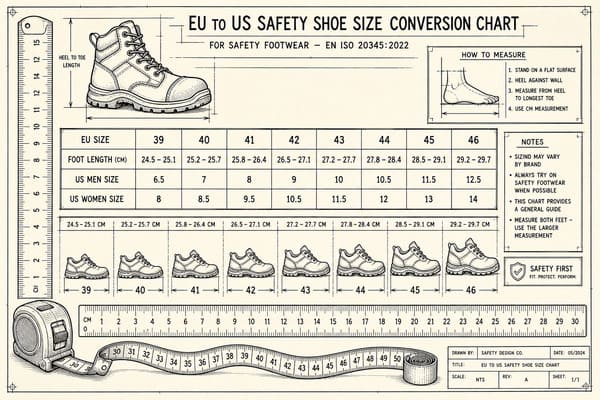
I’ve seen three different brands map EU 42 to US 8.5, US 9, and US 9.5 respectively6. All three were correct by their own internal sizing standard. That’s not a typo. That’s how inconsistent size conversion actually is across manufacturers.
Why Millimeter Foot Length Is More Reliable
The method I recommend to every OEM client we work with is simple: provide foot length in millimeters. Every last we use in production has a corresponding insole length in millimeters. 270mm maps to a specific last.7 There is no ambiguity. There is no conversion error.
I started recommending this after a 2022 order from a construction company in the Netherlands. They were ordering for a mixed workforce — some EU-based, some US-based. Instead of sending a size list, they sent us a spreadsheet with foot lengths in millimeters. We matched every worker to the right last. Zero returns. That one change saved weeks of back-and-forth.
| EU Size | Approx. Insole Length (mm) | US Men’s (approx.) | UK Men’s (approx.) |
|---|---|---|---|
| 39 | 255 mm | 6.5 | 6 |
| 41 | 268 mm | 8 | 7 |
| 42 | 273 mm | 8.5–9 | 7.5–8 |
| 43 | 279 mm | 9.5–10 | 8.5–9 |
| 44 | 284 mm | 10–10.5 | 9–9.5 |
| 46 | 295 mm | 12 | 11 |
For corporate buyers ordering 500 or more pairs, using millimeter foot lengths is the simplest way to get sizing right the first time. The size chart is a reference. The foot length is the source of truth.
What Is the UK Sizing System and How Does It Compare to EU?
UK sizing looks familiar. That familiarity is exactly what makes it dangerous for international orders.
UK men’s sizes run exactly one full size smaller than US men’s sizes. UK 8 equals US 9, which equals approximately EU 42 to 43. This single-size gap causes a high number of ordering errors — especially from buyers in Commonwealth markets like Australia, South Africa, and the UAE, who think in UK sizes but source from EU-labeled manufacturers8.
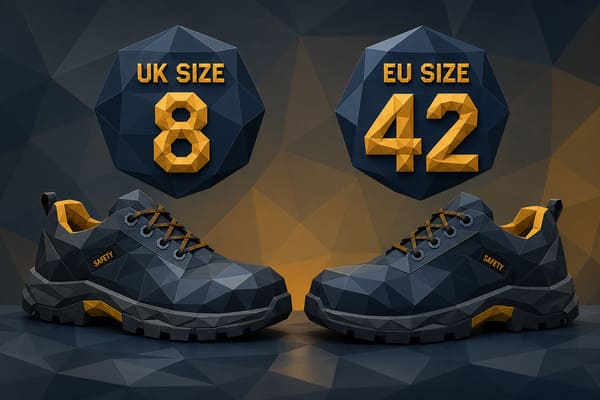
The certified safety shoes sold in most of these markets comply with EN ISO 20345, which is a European standard. So the size labels on the shoes are in EU numbers. But the buyers placing the orders are thinking in UK numbers. That gap — one full size — is where the errors happen.
A Real Order Error That Nearly Shipped
I remember a distributor in Dubai who had been working with us for three years. He placed a reorder and accidentally submitted UK sizes instead of EU sizes. It was a 300-pair order. Every single pair would have come out one size too large. We caught it during the pre-production confirmation call — which is exactly why we run that call on every order.
If we hadn’t caught it, 300 pairs of wrong-sized safety shoes would have shipped to a construction site. The fix cost him two weeks and a rush production fee. The cause was four words: UK versus EU sizing.
| Size System | Men’s Size 9 (US reference) | Equivalent EU | Notes |
|---|---|---|---|
| US | 9 | 42–43 | Wider last common |
| UK | 8 | 42–43 | One size below US |
| EU | 42 | — | Base manufacturing standard |
| AU | 9 | 42–43 | Follows UK system in most cases |
If you are based in a Commonwealth market and you are sourcing from a Chinese or European manufacturer, always confirm whether the size labels on the order form are in EU or UK. Do not assume. Ask directly. One size difference across 300 pairs is not a small problem.
Which Sizing Standard Should You Use When Ordering Safety Shoes Internationally?
After 15 years on the production side, my answer is clear. And it’s not "use whatever chart you find online."
Anchor everything on EU sizing and foot length in millimeters. EU sizing is the base system used in most safety shoe manufacturing globally. US and UK size labels can be printed on the tongue or box insert for the end user. But the order itself should always be placed in EU sizes, confirmed against millimeter foot lengths.
For any order above 300 pairs, I always push clients to request a pre-production size sample9 — one pair, in the most common size, before we cut the full run. The sample costs almost nothing. A wrong 500-pair run costs real money.
What Happens When You Skip the Sample
I had a client in Germany — a large industrial PPE distributor — who skipped the sample step on their first order with us to save two weeks. The toe cap position was slightly off due to a last adjustment we had made that season10. 200 pairs had to be reworked. After that, they never skipped the sample again.
Here is the process I recommend for any international safety shoe order:
| Step | Action | Why It Matters |
|---|---|---|
| 1 | Collect foot lengths in mm from end users | Removes conversion ambiguity |
| 2 | Confirm EU size mapping with manufacturer | Aligns order to production last |
| 3 | Request pre-production size sample | Catches last or fit issues early |
| 4 | Confirm size labels needed (US/UK/EU) | Avoids end-user confusion |
| 5 | Run pre-shipment size check | Final verification before container loads |
The right sizing system isn’t about the chart. It’s about the conversation you have with your manufacturer before the order is confirmed. If your manufacturer isn’t asking these questions, that’s a signal worth paying attention to.
Conclusion
Sizing errors in safety shoes are not number problems. They are communication problems. Get the system right before the order ships, not after. At Shoegan, we guide every client through sizing confirmation before production starts — because a protected worker starts with a shoe that actually fits.
-
"Shoe size", https://en.wikipedia.org/wiki/Shoe_size. The Paris Point (point de Paris) is a unit of measurement equal to two-thirds of a centimeter (approximately 6.67 mm), historically used as the incremental unit in the French and later pan-European shoe sizing convention. Evidence role: definition; source type: encyclopedia. Supports: That the Paris Point is a unit equal to two-thirds of a centimeter and forms the basis of the European shoe sizing scale.. Scope note: Encyclopedia sources describe the Paris Point in general footwear contexts; direct regulatory documentation specific to safety footwear sizing increments may differ. ↩
-
"Shoe size", https://en.wikipedia.org/wiki/Shoe_size. Standard shoe size conversion tables indicate that UK men’s sizes are one unit smaller than US men’s sizes throughout most of the common range, reflecting the shared barleycorn base unit but a different starting point. Evidence role: definition; source type: encyclopedia. Supports: That UK men’s shoe sizes are consistently one size smaller than equivalent US men’s sizes.. Scope note: Conversion equivalencies can vary by manufacturer and size extremes; the one-size rule is a general approximation rather than a guaranteed standard. ↩
-
"Comparison of female foot morphology and last design in …", https://pubmed.ncbi.nlm.nih.gov/20397116/. Anthropometric studies of foot morphology across populations have documented statistically significant differences in forefoot width and instep height between European and North American cohorts, which footwear manufacturers reflect in regional last designs. Evidence role: general_support; source type: research. Supports: That measurable anatomical and last-design differences exist between European and American shoe manufacturing conventions, affecting fit outcomes.. Scope note: Population-level foot morphology studies may not directly address safety footwear lasts specifically; manufacturer last specifications are proprietary and vary widely. ↩
-
"What Is the Puncture Resistance Rating in EN ISO 20345 …", https://protectyourfootsafety.com/what-is-the-puncture-resistance-rating-in-en-iso-20345/. EN ISO 20345 specifies basic and additional (optional) requirements for safety footwear used in conjunction with personal protective equipment, including requirements for toe cap protection, marking, and information supplied by the manufacturer. Evidence role: definition; source type: institution. Supports: That EN ISO 20345 is the applicable European and international standard specifying requirements for safety footwear, including marking and performance criteria.. Scope note: The standard itself is a paid ISO document; summaries available from standards bodies describe scope but may not detail size-labeling conventions specifically. ↩
-
"Shoe size", https://en.wikipedia.org/wiki/Shoe_size. Widely referenced shoe size conversion tables use the formula US men’s size = EU size − 33 as a working approximation, derived from the difference in zero-points between the Paris Point system and the American barleycorn-based system. Evidence role: mechanism; source type: encyclopedia. Supports: That the EU-minus-33 formula is a commonly cited approximation for converting European men’s shoe sizes to US men’s sizes.. Scope note: This formula is an approximation; manufacturer-specific deviations mean it cannot be relied upon as a precise conversion, particularly at size extremes or for safety footwear with specific last specifications. ↩
-
"Development of a footwear sizing system for diabetic feet – PMC", https://pmc.ncbi.nlm.nih.gov/articles/PMC11422582/. Research into footwear sizing consistency has found significant variation in the actual dimensions of shoes bearing identical size labels across different manufacturers, reflecting the absence of a binding global standard enforcing dimensional uniformity. Evidence role: general_support; source type: research. Supports: That shoe size labels of the same nominal value correspond to different physical dimensions across manufacturers, creating genuine inconsistency.. Scope note: Published studies on this topic tend to address general consumer footwear rather than safety footwear specifically; findings may not be directly transferable to certified industrial shoes. ↩
-
"Shoe size", https://en.wikipedia.org/wiki/Shoe_size. ISO 9407 defines the Mondopoint system, which expresses shoe size directly as the foot length in millimeters and optionally includes foot width, offering greater precision and cross-border consistency than national numeric sizing systems. Evidence role: expert_consensus; source type: institution. Supports: That foot length measured in millimeters (as used in the Mondopoint system) offers a more precise and internationally consistent basis for shoe sizing than regional numeric scales.. Scope note: While Mondopoint is endorsed by ISO, its adoption in commercial and safety footwear markets remains limited; manufacturer last dimensions expressed in millimeters are proprietary and may not align with Mondopoint values exactly. ↩
-
"United Arab Emirates", https://en.wikipedia.org/wiki/United_Arab_Emirates. Australia and a number of Commonwealth countries have historically followed the UK shoe sizing convention, though increasing international trade has led to broader adoption of EU and US size labels on imported footwear. Evidence role: general_support; source type: encyclopedia. Supports: That Australia and several Commonwealth-influenced markets historically use UK-derived shoe sizing conventions.. Scope note: Sizing conventions in retail and industrial procurement can differ within the same country; no single authoritative source uniformly categorizes all named markets as UK-size users. ↩
-
"Essential Steps in Shoe Quality Control: A Comprehensive Guide", https://www.tradeaiders.com/essential-steps-in-shoe-quality-control-a-comprehensive-guide.html. Quality management frameworks such as ISO 9001 incorporate the principle of pre-production verification, including first-article inspection and process validation, as mechanisms for identifying non-conformances before committing to full production volumes. Evidence role: general_support; source type: institution. Supports: That pre-production sampling is a recognized quality assurance mechanism in manufacturing procurement to detect defects or specification deviations before full production runs.. Scope note: General quality management standards do not prescribe a specific order-quantity threshold (such as 300 pairs) for triggering pre-production samples; the threshold cited reflects the author’s professional practice rather than a published industry standard. ↩
-
"1910.136 – Foot protection. | Occupational Safety and Health …", https://www.osha.gov/laws-regs/regulations/standardnumber/1910/1910.136. EN ISO 20345 specifies requirements for protective toe cap performance, including resistance to compression and impact; the physical positioning of the cap within the shoe relative to the last geometry is critical to meeting these performance criteria. Evidence role: mechanism; source type: institution. Supports: That toe cap positioning in safety footwear is governed by dimensional requirements within safety standards, and that last variations can affect compliance with those requirements.. Scope note: The standard defines performance requirements for toe caps rather than prescribing exact positional tolerances relative to last geometry; the link between last adjustment and cap displacement is a manufacturing inference not explicitly documented in the standard. ↩