
A client from Poland called me after 23 days at port. Not because his shoes failed. Because two pieces of paper were wrong. That mistake cost him thousands.
Importing safety shoes requires two types of documents: product certifications (such as EN ISO 203451, ASTM F24132, or AS/NZS 22103) that prove the shoe meets safety standards, and shipping documents (commercial invoice, packing list, bill of lading, Certificate of Origin) that prove the shipment is legitimate. Missing either side will stop your goods at customs.
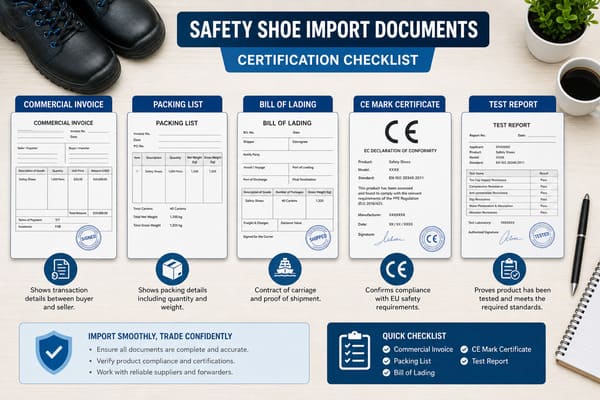
I wrote this article because that Polish client’s situation is not rare. It happens every month, in ports across Europe, the US, Australia, and the Middle East. Buyers focus on price, lead time, and product specs. Then the shipment arrives, and the paperwork isn’t right. By the time you realize it, the storage fees are already running. I want to walk you through exactly what documents you need, why customs rejects safety shoes, and what each major market requires. If you are placing an order or sourcing a new supplier, read this before you confirm anything.
What Certifications Are Required to Import Safety Shoes?
Every month I still see the same mix-up. Buyers treat certifications and import documents as the same thing. They are not, and confusing them is expensive.
A product certification like EN ISO 20345 or ASTM F2413 proves the shoe performs safely — it comes from a lab test and confirms the shoe meets a specific standard. An import document like a commercial invoice or Certificate of Origin proves the shipment is legal and correctly declared. One is about the product. One is about the transaction. You need both.
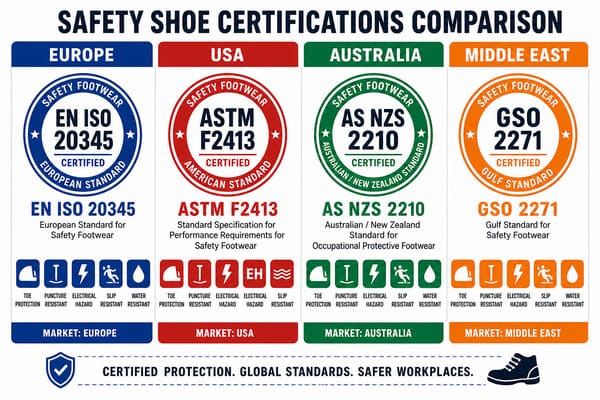
I had a client in Dubai in 2023 who had every shipping document in perfect order. Clean invoice, correct packing list, proper bill of lading. But he had no GSO certification for the Gulf market. His shipment cleared customs without a problem. Then, two weeks later, a local authority inspection pulled his products from the shelves. He had to recall 600 pairs. His shipping documents were fine. His product compliance was not. Both sides matter, and neither one covers for the missing other.
Here is a breakdown of the key certifications by market:
Certifications by Market
| Market | Required Standard | Issuing Body Type | Key Notes |
|---|---|---|---|
| Europe (EU) | EN ISO 20345 | Notified Body (third-party) | CE marking required under EU PPE Regulation 2016/4254 |
| United States | ASTM F2413 | Accredited lab | OSHA does not certify products directly5 |
| Australia / NZ | AS/NZS 2210 | Accredited lab | Distributors check this actively; do not assume |
| Middle East / Gulf | GSO 22716 | Approved lab | Required at point of sale, not just at customs |
| China (domestic) | GB 12011 | CMA-certified lab | Required for products sold within China |
The certification is what proves your product is safe. Without it, even a perfectly made shoe can be pulled from market or refused entry. At Shoegan, every product we ship comes with a current, version-matched test report. I check each one personally before it leaves with the shipment documents. That habit came from a very painful lesson I will explain in a later section.
One more thing worth knowing: certifications expire or become outdated when standards are revised7. A test report issued under an older version of EN ISO 20345 may not satisfy a customs officer enforcing the current version. Always verify that your supplier’s test report references the latest standard in force for your destination market.
What Import Documents Are Needed for Safety Shoes Customs Clearance?
Most buyers treat customs paperwork as routine. Fill in the form, attach the invoice, ship it out. That works for general cargo. Safety shoes are classified as PPE, and that changes the rules.
The standard customs documents for safety shoes include: commercial invoice, packing list, bill of lading or airway bill, Certificate of Origin, and a product test report or certification. For PPE like safety footwear, many markets also require a Declaration of Conformity. The HS code used on your invoice must match the product description exactly.
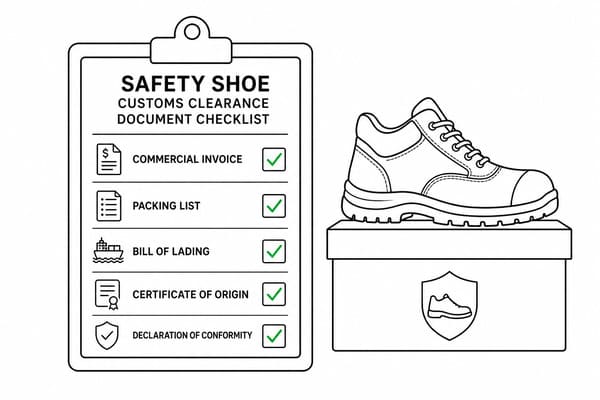
The HS code alone causes more delays than most buyers expect. The most common code for safety footwear is 6403.40, but sub-codes vary by material, construction, and toe protection type. I have seen buyers use the wrong sub-code and end up paying 4 to 7 percent more in import duties than they should have. That is not a small number on a container of 2,000 pairs. My freight forwarder in Ningbo told me that roughly one in five PPE shipments they handle gets flagged for document issues. Safety footwear is near the top of that list.
Core Documents Required for Safety Shoe Imports
| Document | Purpose | Who Prepares It |
|---|---|---|
| Commercial Invoice | Declares value, quantity, and product description | Supplier (us) |
| Packing List | Details carton count, weight, dimensions | Supplier (us) |
| Bill of Lading / AWB | Proves ownership and transport contract | Freight forwarder |
| Certificate of Origin | Declares manufacturing country for duty purposes | Chamber of Commerce or supplier |
| Test Report / Certification | Proves product meets safety standard | Third-party lab |
| Declaration of Conformity | Manufacturer’s written declaration of compliance | Manufacturer (us) |
| Material Safety Data Sheet | Required for chemical-resistant or treated materials | Supplier (us) |
The three things that resolve most customs delays are simple: the correct HS code, a product description on the invoice that clearly states "safety footwear with protective toecap," and a current test report attached to the shipment documents. Most delays trace back to one of these three being missing or wrong. None of them are difficult to prepare correctly. The problem is that most suppliers do not prioritize them, and most buyers do not think to ask until something goes wrong.
At Shoegan, we prepare the full documentation package as part of every order. If you tell us your destination market, we will match the documents to that market’s requirements. That is part of the service, not an add-on.
Why Do Safety Shoes Get Rejected at Customs?
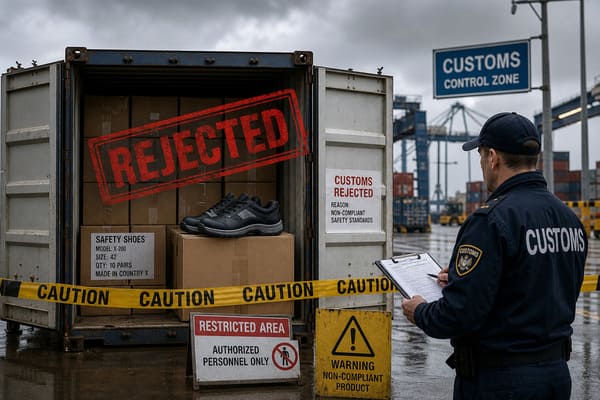
In 2018, a shipment of 900 pairs we produced for a UK client was held at Felixstowe port for 11 days. The shoes were fully EN ISO 20345 compliant. The test report was real. But the report referenced the 2011 version of the standard, and the UK border authority was already enforcing the updated version. Eleven days of port storage, a rushed re-documentation process, and one very unhappy client. That experience cost us the relationship, even though the shoes themselves were perfect.
Safety shoes most commonly get rejected at customs for four reasons: an outdated standard version on the test report, a Declaration of Conformity listing the wrong manufacturer name8, a country-of-origin mismatch when components come from multiple countries9, and an HS code that does not match the product description on the invoice.
From that 2018 experience, I made one change to our process. I personally review every test report before it ships with a consignment. I check the standard version, the manufacturer name, the product model, and the date of issue. That review takes me about ten minutes per order. It has saved multiple clients from port delays since then.
The Four Most Common Customs Rejection Reasons
| Rejection Reason | Why It Happens | How to Prevent It |
|---|---|---|
| Outdated standard version on test report | Standards are revised periodically; suppliers don’t update reports | Ask your supplier to confirm the report references the current active standard for your market |
| Wrong manufacturer name on Declaration of Conformity | OEM production where the brand name doesn’t match the factory | Ensure the DoC lists the correct legal entity and matches the invoice |
| Country-of-origin mismatch | Uppers made in one country, assembled in another; declared origin is ambiguous | Clarify substantial transformation rules with your forwarder before shipment |
| HS code mismatch with product description | Wrong sub-code used, or generic description doesn’t specify "protective toecap" | Confirm the HS code with your customs broker before the order is placed |
None of these are hard to fix before shipment. All of them are painful to fix after the goods have arrived at port. Storage fees accumulate daily. Your end customer’s delivery window does not wait. The Polish client I mentioned at the start of this article learned that at the port of Gdańsk. Twenty-three days. Missing Declaration of Conformity. Expired test report. He lost the storage fees, missed his delivery window, and had to re-negotiate his entire contract with his end customer. When he came to us, the first thing he said was: "I don’t want the cheapest price. I want someone who knows the paperwork." That sentence is the reason I wrote this article.
What Are the Safety Shoe Import Requirements for Europe, the US, and Australia?
I want to be direct: Europe, the US, and Australia are not interchangeable markets. The standards are different. The liability structures are different. The enforcement levels are different. What passes in one market may not pass in another, and assuming they are similar will cost you.
Europe requires EN ISO 20345 certification, a CE mark, and a Declaration of Conformity under EU PPE Regulation 2016/425. The US requires ASTM F2413 compliance, though OSHA does not certify products directly. Australia requires AS/NZS 2210 compliance, and local distributors verify this strictly. Each market has its own standard, and they are not mutually transferable.
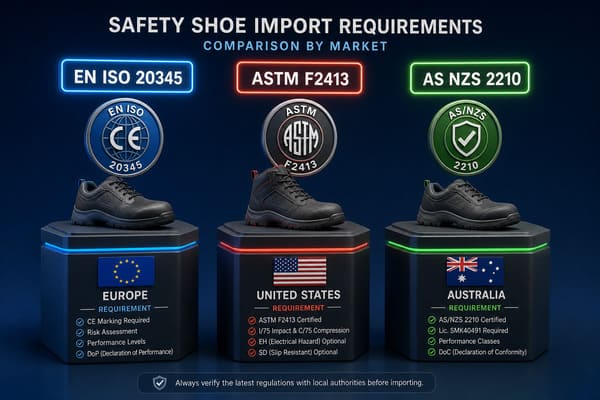
I had a new client in Melbourne in 2021. He came to us specifically because his previous supplier in Vietnam could not provide AS/NZS 2210 test reports. We could. That one document won us a three-year supply contract. He did not switch because of price. He switched because of paperwork. That is how much the right documentation matters in the right market.
Market-by-Market Import Requirements
| Market | Required Standard | Certification Body | Key Legal Framework | Importer Liability |
|---|---|---|---|---|
| European Union | EN ISO 20345 | Notified Body (EU-approved) | EU PPE Regulation 2016/425 | Importer is legally responsible party |
| United Kingdom (post-Brexit) | EN ISO 20345 (UKCA mark) | UK Approved Body | UK PPE Regulations 2002 (as amended) | Importer carries liability |
| United States | ASTM F2413 | Accredited test lab | OSHA 29 CFR 1910.136 | Employer and importer share responsibility |
| Australia / New Zealand | AS/NZS 2210 | Accredited lab | WHS Regulations (state-based) | Distributor and importer both liable |
| Middle East / Gulf | GSO 2271 | Gulf-approved lab | Gulf Standards Organization | Importer and distributor both liable |
The European market carries the highest paperwork burden and the clearest legal liability. Under EU PPE Regulation 2016/425, the importer, not the manufacturer, is the responsible party if something goes wrong on a job site10. If you are bringing 2,000 pairs into Germany and a worker is injured, you are the one who faces the legal process. You need a valid CE mark, a current Declaration of Conformity, and a Notified Body involved in the certification. This is not optional. It is the law.
The US is more straightforward in terms of legal structure, but ASTM F2413 is the standard that every serious industrial buyer will ask for. Without it, you will not get into most industrial supply chains or procurement programs. The UK has moved to its own UKCA marking system post-Brexit11, but in practice most buyers still accept CE-marked products during the transition period. Confirm with your importer what they require before placing your order.
Australia is the market I see people underestimate most often. The AS/NZS 2210 standard is genuinely strict, and Australian distributors check it. They do not assume compliance. They ask for the report. If your supplier cannot provide it, you will not get onto their approved vendor list, regardless of price or lead time.
Conclusion
Getting safety shoes through customs comes down to two things: the right product certifications and the right shipping documents. Missing either one is costly. At Shoegan, we supply both — because Built to Protect. Made to Last. means protecting your business, not just your workers’ feet. Reach out to us at [email protected] or WhatsApp +8613008988018.
-
"What Is the Puncture Resistance Rating in EN ISO 20345 …", https://protectyourfootsafety.com/what-is-the-puncture-resistance-rating-in-en-iso-20345/. ISO 20345:2021 specifies basic and additional requirements for safety footwear used for general purposes, including impact resistance and compression resistance of the toecap, and forms the basis for CE certification in the European Union. Evidence role: definition; source type: institution. Supports: EN ISO 20345 defines the requirements and test methods for general-purpose safety footwear in the European market. Scope note: The ISO standard document itself is paywalled; secondary descriptions from standards bodies such as ISO.org or CEN provide accessible summaries. ↩
-
"Employer Personal Protective Equipment Workplace Hazard …", https://www.osha.gov/laws-regs/standardinterpretations/2013-12-09. ASTM F2413 establishes minimum requirements for the design, performance, testing, and classification of protective footwear in the United States, covering impact resistance, compression resistance, and optional protections such as metatarsal and electrical hazard ratings. Evidence role: definition; source type: institution. Supports: ASTM F2413 sets the minimum performance requirements for protective footwear sold in the United States. Scope note: The full ASTM standard is behind a paywall; the ASTM International website provides an abstract and scope that confirm the standard’s application. ↩
-
"What Are the Steps to Sourcing Safety Shoes from China …", https://protectyourfootsafety.com/what-are-the-steps-to-sourcing-safety-shoes-from-china/. AS/NZS 2210 (series) sets out requirements for the design, manufacture, and testing of occupational protective footwear in Australia and New Zealand, covering impact resistance, slip resistance, and other protective properties, and is referenced in state-based Work Health and Safety regulations. Evidence role: definition; source type: institution. Supports: AS/NZS 2210 specifies the performance requirements for occupational protective footwear in the Australian and New Zealand markets. Scope note: The full standard is available only through Standards Australia at cost; secondary descriptions from Safe Work Australia provide accessible summaries of compliance obligations. ↩
-
"How Do You Start a Private Label Safety Shoe Brand? – Shoegan …", https://protectyourfootsafety.com/how-do-you-start-a-private-label-safety-shoe-brand/. Regulation (EU) 2016/425 of the European Parliament and of the Council lays down requirements for the design and manufacture of PPE, requires CE marking by a Notified Body for Category II and III equipment, and assigns legal responsibility to the importer when the manufacturer is outside the EU. Evidence role: historical_context; source type: government. Supports: EU PPE Regulation 2016/425 mandates CE marking and importer liability for personal protective equipment, including safety footwear, sold in the European Union. ↩
-
"1910.136 – Foot protection. | Occupational Safety and …", http://www.osha.gov/laws-regs/regulations/standardnumber/1910/1910.136. OSHA standard 29 CFR 1910.136 requires that protective footwear meet the requirements of ASTM F2413, but OSHA does not operate a product approval or certification program; compliance is verified through employer documentation and third-party test reports. Evidence role: expert_consensus; source type: government. Supports: OSHA requires employers to ensure workers use protective footwear meeting ASTM standards but does not itself certify or approve individual products. Scope note: OSHA guidance documents clarify this distinction, but the regulatory text itself does not explicitly state that OSHA does not certify products, making this an inference from the absence of a certification mechanism. ↩
-
"Report Name: Food and Agricultural Import Regulations and Standards …", https://apps.fas.usda.gov/newgainapi/api/Report/DownloadReportByFileName?fileName=Food%20and%20Agricultural%20Import%20Regulations%20and%20Standards%20Country%20Report_Riyadh_Saudi%20Arabia_SA2022-0011.pdf. GSO 2271, published by the GCC Standardization Organization (GSO), specifies the technical requirements and test methods for safety and protective footwear intended for occupational use in GCC member states, and compliance is required at both the customs clearance and point-of-sale stages. Evidence role: definition; source type: institution. Supports: GSO 2271 is the Gulf Cooperation Council standard specifying requirements for safety footwear sold in GCC member states. Scope note: The GSO standard documents are not freely available online; verification of current version and enforcement status should be confirmed with an approved Gulf-region testing laboratory or local trade authority. ↩
-
"Chapter 5: Personal Protective Equipment Program", https://response.epa.gov/_healthsafetymanual/Chapter_5_Personal_Protection_Equipment_Chapter_July_2024_final.docx. Under the EU harmonized standards framework, when a revised version of a standard such as EN ISO 20345 is published in the Official Journal of the EU, a coexistence period is typically established during which both versions are accepted; after the withdrawal date of the superseded version, test reports referencing only the old version are no longer sufficient to demonstrate conformity. Evidence role: mechanism; source type: institution. Supports: When a harmonized standard such as EN ISO 20345 is revised, products certified under the previous version may no longer satisfy regulatory requirements after the old version’s date of withdrawal. Scope note: The specific coexistence and withdrawal dates differ for each standard revision and must be checked against the current list of harmonized standards published in the EU Official Journal. ↩
-
"How Do You Start a Private Label Safety Shoe Brand? – Shoegan …", https://protectyourfootsafety.com/how-do-you-start-a-private-label-safety-shoe-brand/. Annex IX of Regulation (EU) 2016/425 prescribes the required elements of an EU Declaration of Conformity for PPE, including the name and address of the manufacturer; a Declaration of Conformity in which the named manufacturer does not correspond to the legal entity responsible for the product as declared on the commercial invoice creates a compliance discrepancy that customs and market surveillance authorities may use to reject or recall goods. Evidence role: mechanism; source type: government. Supports: EU PPE Regulation 2016/425 specifies the mandatory content of a Declaration of Conformity, including the identity of the manufacturer, making name discrepancies a basis for non-compliance. Scope note: This regulatory requirement applies specifically to the EU market; equivalent documentation requirements in the US and Australian markets are governed by different frameworks and should be verified separately. ↩
-
"Identify and Apply Rules of Origin", https://www.trade.gov/identify-and-apply-rules-origin. Under the WTO Agreement on Rules of Origin and most national customs frameworks, the country of origin of a manufactured product is determined by where the last ‘substantial transformation’ occurred, defined as a change in tariff classification or a significant manufacturing process that creates a new and different article of commerce. Evidence role: mechanism; source type: institution. Supports: The ‘substantial transformation’ test is the internationally recognized basis for determining the country of origin of goods made using components from multiple countries. Scope note: The specific definition of substantial transformation for footwear varies by importing country; EU, US, and Australian customs authorities each apply their own operational criteria, and importers should consult their customs broker for market-specific guidance. ↩
-
"REGULATION (EU) 2016/ 425 OF THE EUROPEAN …", https://eur-lex.europa.eu/legal-content/EN/TXT/PDF/?uri=CELEX:32016R0425. Article 13 of Regulation (EU) 2016/425 specifies the obligations of importers, including ensuring that PPE has undergone the applicable conformity assessment procedure, bears the CE marking, and is accompanied by a Declaration of Conformity; importers who place non-compliant PPE on the market bear legal responsibility under this framework. Evidence role: mechanism; source type: government. Supports: EU PPE Regulation 2016/425 assigns specific obligations to importers placing PPE from outside the EU on the European market, effectively making the importer the responsible economic operator. ↩
-
"UKCA for PPE product – Blog", https://www.ctcgroupe.com/en/blog/164/2021-07-26/ukca-for-ppe-product.html. The UK Government’s UKCA (UK Conformity Assessed) marking system was introduced for products including PPE placed on the Great Britain market following the end of the EU-UK Brexit transition period on 31 December 2020, with transitional arrangements permitting CE-marked goods to continue to be accepted under certain conditions. Evidence role: historical_context; source type: government. Supports: The UK introduced UKCA marking as its own conformity assessment marking to replace CE marking for products placed on the Great Britain market following the end of the Brexit transition period. Scope note: Transition period deadlines for UKCA acceptance have been revised multiple times by the UK government; importers should consult the latest GOV.UK guidance to confirm current acceptance of CE-marked PPE. ↩