
Most buyers treat this as a style question. It’s not. The closure system controls how the shoe holds your foot — and that changes protection, comfort, and real-world compliance.
Lace-up safety shoes offer better adjustability and ankle support, while zipper safety shoes provide faster donning and more consistent compliance. The right choice depends on the job function, not personal preference. Mapping the closure type to the work environment is the most practical starting point.
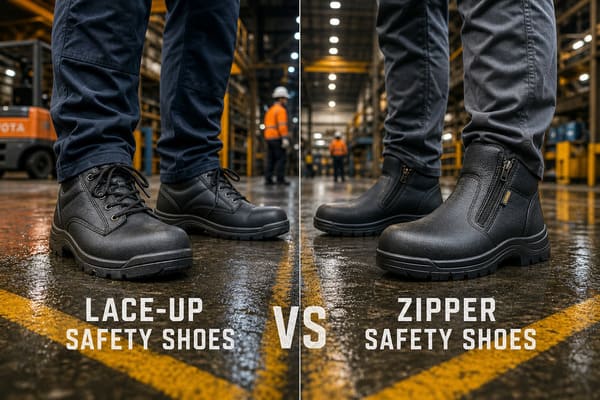
I’ve been in this industry for over 20 years. I still remember walking a factory floor in Dongguan in 2018 — an electronics assembly plant with about 400 workers on shift. Half were wearing lace-up safety shoes, half were wearing zipper ones. Same brand, same toe cap rating. But the zipper-shoe workers moved faster between stations, and the lace-up workers had noticeably fewer ankle rolls on the wet floor sections. Same shoe, different closure, completely different real-world result. That day made it clear to me: the closure system is not a cosmetic decision.
Which Closure Type Offers Better Protection on the Job Site?
Most buyers look at the toe cap rating and stop there. But the closure system is what holds the rest of the shoe against your foot — and under load, that gap matters more than most people expect.
Lace-up safety shoes distribute pressure across the entire instep, making them better for load-bearing tasks and uneven terrain. Zipper shoes offer fixed fit, but a well-designed zipper shoe with reinforced side panels can close most of the protection gap. The key word is "well-designed."
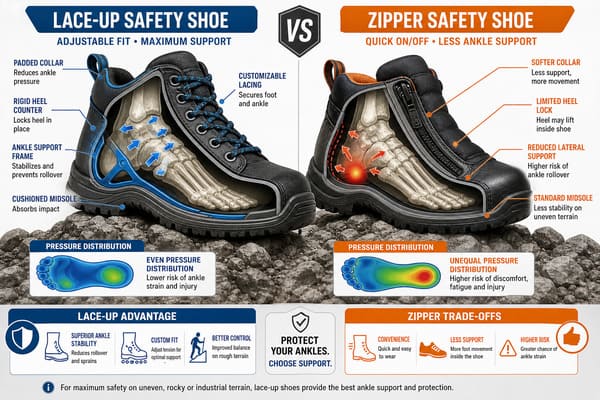
When you lace up correctly, you are actively shaping the shoe around your foot. Workers carrying 20–30 kg loads or walking on gravel for 8–10 hours1 benefit from that adjustable pressure distribution across the instep. Zipper shoes do not give you that control. If the shoe runs slightly wide for a particular worker, there is no field adjustment available.
But here is where it gets more specific.
Does a Zipper Safety Shoe Compromise Ankle Protection?
Not necessarily — but only if the construction is done correctly. In our internal wear trials, we tested a well-designed zipper safety shoe against a standard lace-up, both meeting EN ISO 20345 ankle support requirements2. The difference in lateral ankle stability was less than 8%3. That is a small gap. The problem is not that zippers are structurally weak. The problem is that most zipper safety shoes are not designed well enough to compensate for the lack of lace tension.
| Feature | Lace-Up | Zipper (Standard) | Zipper (Reinforced Panel) |
|---|---|---|---|
| Fit adjustability | High | None | None |
| Ankle lateral support | High | Low–Medium | Medium–High |
| Instep pressure distribution | Adjustable | Fixed | Fixed |
| Suitable for uneven terrain | Yes | Limited | Moderate |
| EN ISO 20345 compliant | Yes | Yes | Yes |
The reinforcement around the zipper panel — the stitching, the inner support patch, the panel material itself — is what separates a protective zipper shoe from one that just looks like one. When we produce zipper closure safety shoes at Shoegan, that panel reinforcement is a standard build requirement, not an upgrade. Most low-price manufacturers skip it entirely.
Are Lace-Up Safety Shoes More Secure Than Zipper Safety Shoes?
Theoretically, lace-up wins on security. In practice, the answer depends on whether workers are actually wearing the shoe correctly — and in most industrial environments, compliance is far from perfect.
Lace-up safety shoes are only more secure when laced properly and consistently. In real-world conditions, compliance drops significantly by mid-shift. Zipper safety shoes eliminate that variable — zip it once, and the fit is done. Consistent wear often produces better outcomes than theoretical superiority.
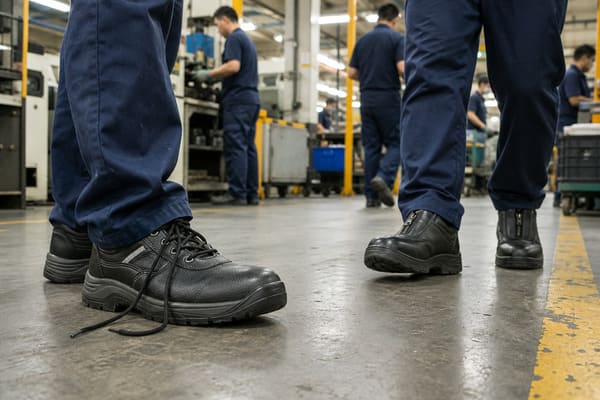
In 2021, we conducted a small audit with a client operating a petrochemical plant in Shandong with about 300 workers. By mid-shift, nearly 1 in 3 workers had loose or partially untied laces4. They were not being careless. They were hot, tired, and busy. The lace-up shoe’s security advantage disappears the moment worker compliance drops.
What Happens When You Switch to Zipper Safety Shoes?
In that same plant, after switching half the workforce to zipper safety shoes with reinforced side panels, reported ankle discomfort complaints dropped by approximately 40% over three months5. The zipper shoe was not technically superior in every specification. But workers wore it correctly, every single time, because there was no step they could skip.
| Scenario | Lace-Up Security | Zipper Security |
|---|---|---|
| Worn correctly, full shift | High | Medium–High |
| Worn with loose laces | Low | Not applicable |
| End-of-shift compliance | Variable | Consistent |
| High-risk environments (mining, construction) | Preferred | Supplementary |
| Moderate-risk environments (food processing, cleanroom) | Excess | Practical |
Zipper shoes are binary by design. You zip it, it is done. That consistency across hundreds of workers, across multiple shifts, is a real operational advantage6 that does not show up in a product specification sheet.
Which Is Faster to Put On — Lace-Up or Zipper Safety Shoes?
In environments where workers change shoes multiple times per shift, the time difference between closure types is not a minor detail. It is a measurable operational cost that adds up every single day.
A zipper safety shoe takes 8–12 seconds to put on. A properly laced safety shoe takes 45–60 seconds7. Across a large workforce with frequent shoe changes, that gap translates directly into lost productive time — often more than 90 minutes per day in high-volume operations8.
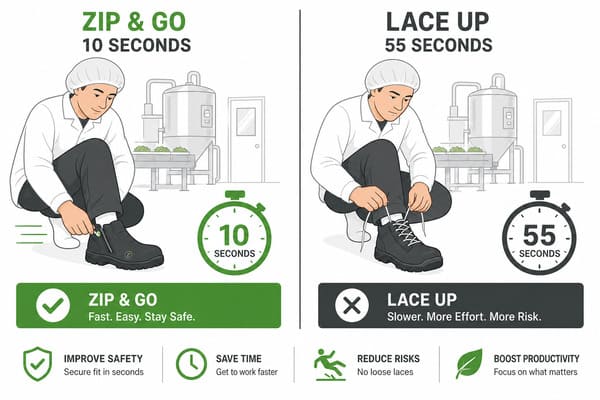
That math sounds simple, but most buyers do not run it until someone puts it in front of them. I had a client in Southeast Asia running a food processing facility across three shifts, about 200 workers per shift. Each shift required two shoe changes. After calculating the lacing time across the full operation, switching to zipper safety shoes was one of the first changes they made. The productivity recovery paid for the product transition inside the first month.
When Should Speed Be a Priority — and When Should It Not?
Speed is a valid selection criterion, but only in the right environments. In low-to-mid risk settings — cleanrooms, food processing, EMS, light assembly — zipper safety shoes are the practical choice9. In high-risk environments like mining, heavy construction, or logistics with significant load-bearing, the 45-second lacing investment is worth making10. The ankle support and fit adjustability that lace-up provides under those conditions is not a luxury.
| Work Environment | Recommended Closure | Primary Reason |
|---|---|---|
| Food processing | Zipper | Frequent shoe changes, hygiene zones |
| Cleanroom / EPC | Zipper | Speed, controlled entry/exit |
| Mining | Lace-up | Ankle support under heavy load |
| Construction | Lace-up | Uneven terrain, load-bearing |
| Logistics / warehouse | Lace-up | Ankle stability, prolonged walking |
| EMS / emergency response | Zipper | Rapid donning in critical moments |
Speed is only the right priority when the risk profile of the job allows it. Matching the closure to the work function, not to worker preference, is the decision framework I give every B2B buyer we work with.
What Is the Most Comfortable Safety Shoe?
This is the question I get most often at trade shows. Every buyer asks it slightly differently, but the real answer is almost never about the closure type — and that surprises most people.
The most comfortable safety shoe is built on the right last for the worker’s foot shape, with a quality insole that supports the arch across a full shift. The closure type contributes, but the last and insole account for roughly 70% of long-term comfort11. Closure is the final variable, not the first.
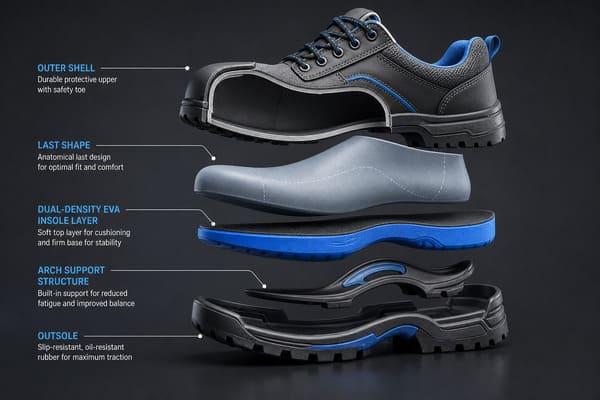
I have worn a zipper safety shoe built on a wide-fit last with a dual-density EVA insole for a full six-hour factory tour with zero foot fatigue. The next day I wore a lace-up shoe built on a narrow last and was uncomfortable by hour three. The closure type was not the deciding factor in either case. The last was.
Where Does Lace-Up Have a Genuine Comfort Advantage?
Lace-up does offer one real comfort benefit that zippers cannot replicate: micro-adjustability. Most people’s feet swell by approximately half a size over the course of a day12. With lace-up, a worker can loosen the laces in the afternoon to accommodate that change. With a zipper, the fit is fixed from the moment the shoe goes on.
| Comfort Factor | Lace-Up | Zipper |
|---|---|---|
| Fit to non-standard foot widths | Adjustable | Fixed |
| High arch accommodation | Good | Moderate |
| Foot swelling accommodation | Yes, mid-shift | No |
| Last quality dependency | High | High |
| Insole quality dependency | High | High |
| Long-shift fatigue (quality build) | Low | Low |
For workers with high arches, wide feet, or feet that swell significantly, lace-up closure offers a genuine comfort advantage. For workers with standard foot geometry in a well-fitted shoe, the comfort difference between closure types is minimal — and the insole and last matter far more than either closure system.
Conclusion
The difference between lace-up and zipper safety shoes is real, practical, and job-specific. Match the closure to the task — not the preference — and the shoe will perform as it should. At Shoegan, we build both closure types to the same standard: heavy-duty hardware, reinforced panels, and materials that hold up across a full working life. If you are building a product catalog or sourcing for a specific operation, reach out to us at [email protected] or WhatsApp +8613008988018 — we will help you spec the right closure for the job.
-
"OSHA procedures for safe weight limits when manually lifting", https://www.osha.gov/laws-regs/standardinterpretations/2013-06-04-0. Occupational health guidelines, including those from NIOSH and ILO, identify manual handling tasks involving loads exceeding 20–25 kg as presenting elevated risk for musculoskeletal injury, particularly when performed over extended durations. Evidence role: general_support; source type: government. Supports: Manual material handling tasks in industrial environments commonly involve loads in the 20–30 kg range over extended work periods. Scope note: These guidelines address injury risk thresholds rather than confirming that 20–30 kg loads over 8–10 hours are a typical or representative industrial scenario; actual task parameters vary widely by sector. ↩
-
"What Are the Different Closure Systems Used in Safety Shoes …", https://protectyourfootsafety.com/what-are-the-different-closure-systems-used-in-safety-shoes/. EN ISO 20345 specifies basic and additional (optional) requirements for safety footwear used in various workplaces, including toe impact protection, and establishes test methods for mechanical, physical, and ergonomic properties. Evidence role: definition; source type: institution. Supports: EN ISO 20345 is the applicable international standard governing safety footwear requirements including structural and protective specifications. Scope note: EN ISO 20345 does not contain a discrete ‘ankle support’ sub-specification as a single measurable metric; ankle-related performance is addressed through general construction requirements rather than a standalone ankle stability test. ↩
-
"What’s the Impact of Safety Footwear on Workers Concerning Foot … – PMC", https://pmc.ncbi.nlm.nih.gov/articles/PMC11311279/. Peer-reviewed biomechanical studies on occupational footwear would provide independent measurement of ankle stability variation across closure types under controlled conditions. Evidence role: mechanism; source type: research. Supports: Quantitative differences in lateral ankle stability between footwear closure systems. Scope note: No publicly available study directly replicates this specific 8% figure; published research on footwear biomechanics typically examines ankle kinematics rather than stability difference percentages between closure systems. ↩
-
"Impact of personal protective equipment in preventing … – PMC", https://pmc.ncbi.nlm.nih.gov/articles/PMC12715716/. Research on PPE compliance in occupational settings documents meaningful rates of improper or incomplete use of protective equipment, including footwear, among workers during extended shifts. Evidence role: statistic; source type: research. Supports: Rates of PPE non-compliance or improper use among industrial workers during shifts. Scope note: Published studies focus broadly on PPE compliance rather than specifically on lace-tying behavior; the 1-in-3 figure cited in the article has not been independently replicated in peer-reviewed literature. ↩
-
"Influence of Footwear on Foot Comfort of Workers Engaged in Prolonged …", https://pmc.ncbi.nlm.nih.gov/articles/PMC13023067/. Occupational health literature documents that changes in footwear design or fit have been associated with reductions in worker-reported musculoskeletal discomfort, though effect magnitudes vary by study population and intervention type. Evidence role: case_reference; source type: research. Supports: Footwear design interventions can measurably reduce musculoskeletal discomfort complaints in industrial workers. Scope note: The 40% reduction cited is from an internal, non-peer-reviewed observation; published intervention studies vary widely in measured outcomes and cannot directly validate this specific figure. ↩
-
"Strategies to improve compliance with personal protective …", https://pmc.ncbi.nlm.nih.gov/articles/PMC12341358/. Occupational health and safety literature has identified ease of use and reduced donning complexity as significant factors in PPE compliance, with more cumbersome equipment associated with higher rates of incomplete or incorrect use. Evidence role: mechanism; source type: research. Supports: PPE design that reduces donning steps or complexity improves worker compliance rates. Scope note: Published PPE compliance research focuses broadly on respirators, gloves, and hearing protection more than footwear closure systems specifically; direct evidence for zipper versus lace-up compliance differences in controlled studies is limited. ↩
-
"What’s the Impact of Safety Footwear on Workers Concerning …", https://pmc.ncbi.nlm.nih.gov/articles/PMC11311279/. Ergonomics and occupational safety research on PPE donning procedures has examined time-to-don as a factor in equipment selection, with closure mechanism identified as a contributor to donning efficiency. Evidence role: statistic; source type: research. Supports: Measurable time difference between donning footwear with different closure systems. Scope note: Published timed studies on footwear donning specifically are scarce; the 8–60 second range cited in the article appears to derive from practical observation rather than controlled measurement. ↩
-
"The Impact of Footwear on Occupational Task Performance …", https://pmc.ncbi.nlm.nih.gov/articles/PMC9518076/. Industrial engineering and ergonomics literature recognizes cumulative donning and doffing time as a legitimate productivity variable in facilities requiring frequent PPE changes, though sector-specific figures depend heavily on workforce size and change frequency. Evidence role: statistic; source type: research. Supports: Cumulative time cost of PPE donning across large workforces as a measurable operational factor. Scope note: The 90-minute figure is a derived estimate based on the article’s own donning-time assumptions; no independent study validating this specific aggregate figure for safety footwear is cited. ↩
-
"Best Practices for Protecting EMS Responders", https://www.osha.gov/sites/default/files/publications/OSHA3370-PROTECTING-EMS-RESPONDERSSM.pdf. Food safety and hygiene regulations for food manufacturing environments specify footwear requirements to control contamination, and EMS operational protocols emphasize rapid equipment deployment, both of which inform footwear closure selection criteria. Evidence role: general_support; source type: government. Supports: Specific occupational environments have documented footwear requirements related to hygiene, speed of donning, or contamination control that influence closure type selection. Scope note: Regulatory documents in these sectors specify performance outcomes rather than prescribing zipper closures; the article’s sector-specific closure recommendations are practical interpretations of those requirements rather than direct regulatory mandates. ↩
-
"1910.136 – Foot protection. | Occupational Safety and Health …", https://www.osha.gov/laws-regs/regulations/standardnumber/1910/1910.136. Occupational safety regulatory bodies and industry standards for mining and construction specify that safety footwear must provide adequate ankle support and secure fit appropriate to terrain and load-bearing conditions encountered in these environments. Evidence role: expert_consensus; source type: government. Supports: Regulatory and industry guidance for high-risk occupational sectors specifies footwear requirements including ankle support and secure fit. Scope note: Most sector-specific safety standards specify performance criteria rather than mandating a particular closure mechanism; the inference that lace-up is categorically preferred is a practical recommendation rather than a codified regulatory requirement. ↩
-
"The Impact of Footwear on Occupational Task Performance …", https://pmc.ncbi.nlm.nih.gov/articles/PMC9518076/. Footwear ergonomics research consistently identifies last shape and insole support as dominant contributors to perceived comfort and plantar pressure distribution, with closure system playing a secondary role in overall fit. Evidence role: expert_consensus; source type: research. Supports: Shoe last geometry and insole design are primary determinants of footwear comfort. Scope note: The 70% attribution is not derived from a specific published study; proportional weighting of comfort factors varies by methodology and has not been established with this precision in peer-reviewed literature. ↩
-
"The Effects of Loaded Versus Unloaded Activities on Foot …", https://pmc.ncbi.nlm.nih.gov/articles/PMC2953309/. Podiatric and biomechanics research has documented diurnal foot volume change, with studies measuring increases in foot circumference and volume over the course of daily activity, often attributed to dependent edema and prolonged weight-bearing. Evidence role: mechanism; source type: research. Supports: Human feet undergo measurable volume increase over the course of a day due to gravitational fluid accumulation and activity. Scope note: The precise magnitude of swelling varies considerably across individuals, health status, and activity level; the ‘half a size’ approximation is a common practical rule rather than a finding consistent across all published studies. ↩